Modular Heatless Desiccant Air Dryers for Flexible Compressed Air Systems
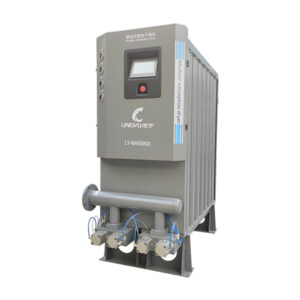
Lingyu M Series modular heatless desiccant air dryers combine Pressure Swing Adsorption (PSA) with a compact modular structure for applications requiring low pressure dew points, flexible installation, and scalable compressed air capacity.
Compared with conventional twin-tower heatless dryers, the modular architecture makes it easier to expand capacity, configure standby units, and service individual modules.
The M Series covers airflow capacities from 1.5 to 55 m³/min (approximately 53 to 1,942 CFM) with an average regeneration air consumption of 5–8%.
How Does a Modular Heatless Desiccant Air Dryer Work?
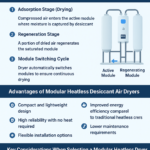
The M Series uses multiple adsorption chambers that alternate between drying and regeneration.
During adsorption, wet compressed air enters the active module and passes through the desiccant bed, where water vapor is adsorbed before dry compressed air flows downstream.
During regeneration, a portion of the dried compressed air is expanded and directed through the saturated module to remove adsorbed moisture.
The system automatically switches between adsorption and regeneration groups to maintain continuous dry air delivery without an external regeneration heater.
M Series Technical Range
| Parameter | Specification |
|---|
| Capacity | 1.5–55 m³/min |
| Approx. capacity | 53–1,942 CFM |
| Rated inlet pressure | 0.7 MPa |
| Operating pressure | 0.6–1.0 MPa |
| Rated inlet temperature | 10–30°C |
| Maximum inlet temperature | ≤40°C |
| Inlet pressure dew point | ≤15°C |
| Outlet pressure dew point | ≤-20°C |
| Optional pressure dew point | ≤-40°C |
| Regeneration air consumption | 5–8% |
| Desiccant | Activated alumina + high-performance molecular sieve |
| Rated ambient temperature | 35°C |
| Ambient operating range | 2–45°C |
For capacities above 55 m³/min or special operating conditions, model configuration should be confirmed according to project requirements.
Modular Capacity & Scalability
The M Series is available in multiple standard capacities:
1.5 · 2.5 · 3.8 · 6.5 · 10.5 · 13.5 · 17 · 21.5 · 25 · 28.5 · 37 · 41.5 · 50 · 55 m³/min
The modular architecture allows system capacity to be configured according to current compressed air demand while leaving room for future expansion.
This can be particularly useful when:
- Production capacity is expected to increase
- Compressed air demand is added in stages
- Installation space is limited
- A centralized dryer must support multiple production lines
- Standby capacity is required for critical processes
Expansion capability should be considered during the initial design of manifolds, controls, piping, and available installation space.
N+1 Redundancy & Standby Capacity
For critical compressed air systems, modular dryers can be configured with additional standby capacity.
A typical N+1 configuration uses the number of modules required for normal airflow plus one additional module as reserve capacity.
For example:
4 required modules + 1 standby module = N+1 configuration
This can allow the system to maintain dry-air capacity while one module is being serviced, provided the complete dryer, manifold, control system, and airflow capacity are designed for redundancy.
The M Series can therefore be considered for applications where maintenance flexibility and compressed air continuity are more important than the lowest initial equipment cost.
Maintenance Advantages of Modular Design
The modular structure provides easier access to individual adsorption sections compared with a large conventional pressure-vessel arrangement.
Depending on the system configuration, maintenance can include:
- Individual module inspection
- Desiccant replacement
- Valve servicing
- Standby-module rotation
- Capacity expansion
- Module replacement
The M Series also uses a compact integrated structure, helping reduce installation footprint and simplify equipment access in space-limited compressor rooms.
Modular vs Conventional Heatless Desiccant Dryer
| Factor | Modular Heatless | Conventional Heatless |
| Drying technology | PSA | PSA |
| Regeneration | Dry purge air | Dry purge air |
| Purge air | 5–8% | Typically higher depending on series |
| Standard capacity | 1.5–55 m³/min | Wider high-flow range available |
| Capacity expansion | Flexible | More limited |
| N+1 redundancy | Easier to configure | Usually requires separate standby dryer |
| Footprint | Compact / modular | Twin-tower arrangement |
| Maintenance flexibility | Higher | More dependent on complete dryer |
| Installation | Flexible | Conventional |
| Best suited for | Space-limited, expandable or redundant systems | Fixed-capacity systems |
A modular dryer is not necessarily the best option for every installation.
For high-flow systems with fixed capacity and no redundancy requirement, a conventional heatless or heated desiccant dryer may provide a simpler solution.
For systems where scalability, compact installation, maintenance access, or redundancy are priorities, modular architecture provides clear advantages.
Pressure Dew Point & Purge Air
The M Series provides a standard outlet pressure dew point of ≤-20°C, with ≤-40°C available as an option.
It uses approximately 5–8% regeneration air, lower than the 8–14% average specified for Lingyu conventional CH / HH heatless series.
For example, at 50 m³/min inlet airflow:
- 5% purge ≈ 2.5 m³/min
- 8% purge ≈ 4.0 m³/min
Purge air has already been compressed, so it should be included when evaluating total system airflow and operating cost.
How to Select a Modular Desiccant Air Dryer
Key parameters include:
- Airflow: CFM, SCFM, or m³/min
- Working pressure
- Inlet temperature
- Required PDP
- Regeneration air requirement
- Current airflow demand
- Future expansion capacity
- Number of operating modules
- Standby / N+1 requirement
- Available installation space
- Maintenance strategy
For applications requiring ≤-40°C PDP, confirm the optional low-dew-point configuration when selecting the model.
For systems approaching or exceeding 55 m³/min, conventional heatless, externally heated, blower-heated, or HOC configurations should also be evaluated according to airflow and operating-cost requirements.
Frequently Asked Questions
What is the capacity range of the M Series?
The standard M Series covers 1.5 to 55 m³/min, approximately 53 to 1,942 CFM.
What pressure dew point can it provide?
The standard outlet pressure dew point is ≤-20°C, with ≤-40°C available as an option.
How much regeneration air does it use?
The M Series specifies regeneration air consumption of approximately 5–8% under applicable operating conditions.
Can the modular dryer be expanded later?
Yes, where the system is designed for expansion. Manifold capacity, controls, piping, installation space, and the future number of modules should be considered during the initial design.
Can it be configured for N+1 redundancy?
Yes, a modular system can be designed with additional standby capacity. The exact N+1 configuration should be engineered according to the required system airflow and module capacity.
What desiccant does the M Series use?
The technical specification lists activated alumina combined with high-performance molecular sieve.
Regarding Modular Heatless Desiccant Air Dryers
The Ultimate Guide to Modular Heatless Desiccant Air Dryers
Clean and dry compressed air is essential for ensuring the reliability, efficiency, and longevity of […]
Read More