Externally Heated Desiccant Air Dryers for Industrial Compressed Air Systems
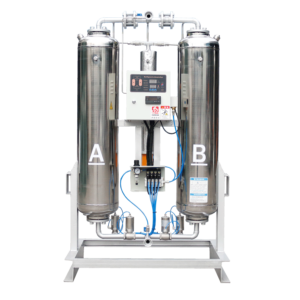
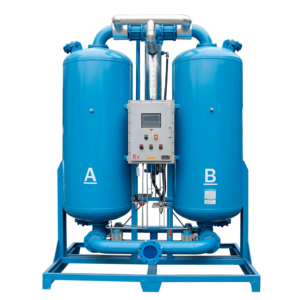
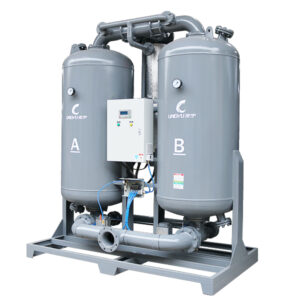
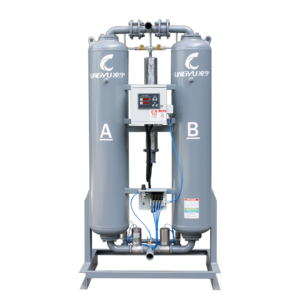
Externally heated desiccant air dryers remove water vapor from compressed air through adsorption and use an external electric heater to regenerate the desiccant.
Compared with heatless desiccant dryers, externally heated dryers require less compressed air for regeneration. Lingyu CH and HH Series have an average purge air consumption of 4–8%, making this technology suitable for industrial systems where low pressure dew point and reduced compressed air loss are both important.
Typical applications include instrument air, electronics, pharmaceuticals, chemical processing, precision manufacturing, and other moisture-sensitive processes.
How Does an Externally Heated Desiccant Air Dryer Work?
The dryer uses two adsorption towers for continuous operation.
During the adsorption cycle, wet compressed air passes through one tower, where activated alumina or molecular sieve adsorbs water vapor.
At the same time, the saturated desiccant in the second tower is regenerated using an external heater and a controlled amount of purge air. After heating, the desiccant is cooled and prepared for the next adsorption cycle.
The towers then automatically switch functions to provide a continuous supply of dry compressed air.
CH & HH Series Operating Parameters
| Parameter | CH Series | HH Series |
|---|
| Drying technology | Adsorption | Adsorption |
| Regeneration | Externally heated | Externally heated |
| Rated inlet pressure | 0.7 MPa | 0.7 MPa |
| Operating pressure | 0.6–1.0 MPa | 0.6–1.0 MPa |
| Rated inlet temperature | 10–30°C | 10–30°C |
| Maximum inlet temperature | ≤40°C | ≤40°C |
| Average purge air consumption | 4–8% | 4–8% |
| Pressure dew point | -50°C to -20°C | ≤-40°C |
| Desiccant | Activated alumina | Activated alumina + molecular sieve |
| Rated ambient temperature | 35°C | 35°C |
| Ambient operating range | 2–45°C | 2–45°C |
The CH Series provides adjustable pressure dew point performance from -50°C to -20°C, while the HH Series is designed for applications requiring a pressure dew point of ≤-40°C.
Energy Consumption & Purge Air Loss
The operating cost of a desiccant air dryer is affected not only by electrical power consumption, but also by the compressed air used during regeneration.
Externally heated dryers use an electric heater to release moisture from the desiccant, reducing average purge air consumption to 4–8% for the Lingyu CH and HH Series.
This creates a different energy balance compared with other regeneration technologies:
- Heatless dryers require no regeneration heater but consume more compressed air for regeneration.
- Externally heated dryers consume electrical heating power but reduce purge air loss.
- Blower purge dryers use a blower and heater to further reduce dependence on compressed air during regeneration.
For continuously operating or higher-flow compressed air systems, purge air loss should be included when comparing long-term operating costs.
How to Select an Externally Heated Desiccant Air Dryer
The correct dryer should be selected according to both air quality requirements and total operating conditions.
| Selection Parameter | What to Check |
| Airflow | CFM / SCFM / m³/min |
| Working pressure | Standard range 0.6–1.0 MPa |
| Inlet temperature | Rated 10–30°C, max. ≤40°C |
| Required PDP | Select according to process requirement |
| Purge air consumption | 4–8% average for CH / HH |
| Heater power | Check selected model |
| Desiccant | Activated alumina / molecular sieve |
| Operating hours | Important for energy and TCO comparison |
| Power supply | Voltage / phase / frequency |
| Installation environment | Temperature and site conditions |
If the application requires approximately -20°C to -50°C PDP, the CH Series can be considered according to the required dew point.
For applications requiring ≤-40°C PDP with enhanced adsorption performance, the HH Series uses activated alumina combined with high-performance molecular sieve.
Heatless vs Externally Heated vs Blower Purge
| Factor | Heatless | Externally Heated | Blower Purge |
| Regeneration method | Dry purge air | Heater + purge air | Blower + heater |
| Heater required | No | Yes | Yes |
| Purge air consumption | Higher | Lower | Lowest / minimized |
| Electrical regeneration energy | Low | Medium | Higher |
| System complexity | Lowest | Medium | Higher |
| Initial investment | Lower | Medium | Higher |
| Typical system size | Small–medium | Medium–large | Medium–large |
| TCO consideration | Purge air cost | Heater + reduced purge loss | Electricity + minimal purge loss |
There is no single regeneration technology that provides the lowest cost for every compressed air system.
For smaller systems or intermittent operation, a heatless dryer may provide the simplest solution. As airflow and annual operating hours increase, the cost of compressed air used for regeneration becomes more important, making externally heated or blower purge technologies worth evaluating.
Total Cost of Ownership (TCO)
When comparing desiccant air dryers, purchase price alone does not represent the total operating cost.
A practical TCO evaluation should consider:
Initial dryer cost + purge air loss + heater/blower electricity + desiccant replacement + valve maintenance + pressure loss + annual operating hours
For externally heated dryers, the key economic advantage is the reduction in compressed air consumed during regeneration compared with heatless technology.
The actual TCO depends on airflow, compressor specific power, electricity price, operating hours, required PDP, and regeneration cycle.
For large or continuously operating systems, Lingyu can compare heatless, externally heated, and blower purge configurations based on actual operating data.
Frequently Asked Questions
What is an externally heated desiccant air dryer?
It is an adsorption dryer that uses an external heater together with a controlled amount of purge air to regenerate the desiccant. This reduces compressed air consumption compared with heatless regeneration.
How much purge air does an externally heated dryer use?
The Lingyu CH and HH Series specify an average purge air consumption of 4–8% under applicable operating conditions.
What pressure dew point can it achieve?
The CH Series specifies an outlet pressure dew point of -50°C to -20°C, while the HH Series specifies ≤-40°C.
Is an externally heated dryer more efficient than a heatless dryer?
It generally reduces purge air consumption but requires electrical energy for the heater. The more economical option depends on airflow, operating hours, electricity cost, compressor efficiency, and required pressure dew point.
When should I consider a blower purge dryer instead?
A blower purge dryer should be evaluated when compressed air loss needs to be minimized further, particularly in larger systems where the cost of purge air has a significant impact on annual operating cost.
Regarding Heated Regeneration Adsorption Air Dryers
The Ultimate Guide to Heated Regeneration Adsorption Air Dryers
Compressed air systems are essential across industries—from manufacturing and automotive to electron […]
Read More