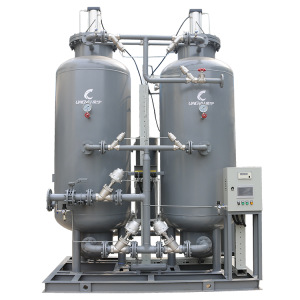
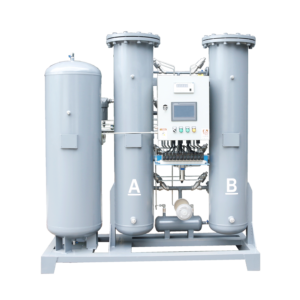
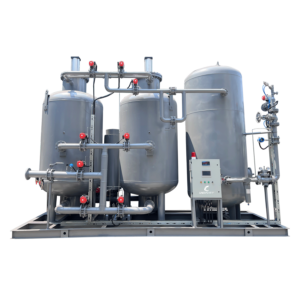
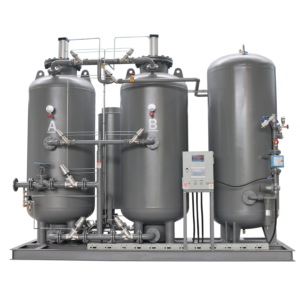
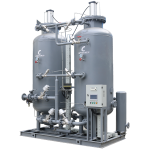
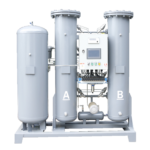
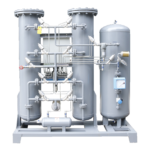
PSA Nitrogen Generators for Industrial On-Site Nitrogen Supply
Lingyu standard PSA nitrogen generators are available with nitrogen purity from 98% to 99.99%, with nitrogen production capacities up to 600 m³/h depending on purity. Customized configurations are available for 99.999% nitrogen and other project-specific requirements.
The system provides a continuous nitrogen supply without relying on nitrogen cylinders or routine liquid nitrogen deliveries. Nitrogen purity and flow capacity can be selected according to the requirements of the production process.
Lingyu PSA nitrogen generators are available with nitrogen purity from 98% to 99.999%, with standard production capacities up to 600 m³/h, depending on the selected purity.
They are suitable for food packaging, electronics, metal processing, chemical production, pharmaceuticals, laser cutting, heat treatment, and other industrial applications requiring a stable nitrogen supply.
How Does a PSA Nitrogen Generator Work?
A PSA nitrogen generator separates nitrogen from compressed air through the selective adsorption characteristics of Carbon Molecular Sieve.
1. Compressed Air Preparation
Compressed air first passes through filtration and drying equipment to remove moisture, oil, and particles before entering the nitrogen generator.
Proper compressed air treatment helps protect the CMS and maintain stable nitrogen purity and system performance.
2. PSA Adsorption
Clean compressed air enters one of two adsorption towers filled with Carbon Molecular Sieve.
Under pressure, oxygen is preferentially adsorbed by the CMS while nitrogen passes through the adsorption bed and is collected as product gas.
3. Regeneration
While one tower produces nitrogen, the second tower is depressurized. The adsorbed oxygen is released and discharged, regenerating the CMS for the next cycle.
4. Automatic Tower Switching
The two adsorption towers alternate between adsorption and regeneration, typically using an automatic switching cycle of approximately 45–60 seconds.
This allows the system to provide a continuous nitrogen supply.
PSA Nitrogen Generator Operating Conditions
| Parameter | Standard Condition |
|---|
| Technology | Pressure Swing Adsorption (PSA) |
| Adsorbent | Carbon Molecular Sieve (CMS) |
| Nitrogen Purity | 98%–99.999% |
| Nitrogen Production | Up to 600 m³/h depending on purity |
| Inlet Air Pressure | 0.5–0.8 MPa |
| Inlet Air Temperature | ≤40°C |
| Inlet Nitrogen Purity | 95%–99.999% |
| Nitrogen Dew Point | ≤−40°C |
| Ambient Temperature | ≤40°C |
| Switching Cycle | 45–60 s |
| Power Supply | 220 V / 50 Hz |
| Noise Level | ≤75 dB |
Actual nitrogen capacity and compressed air consumption depend strongly on the required nitrogen purity.
Nitrogen Purity, Flow & Air Consumption
Nitrogen purity is one of the most important parameters when selecting a PSA nitrogen generator.
Higher nitrogen purity requires more oxygen to be removed from the feed air and therefore generally increases compressed air consumption for the same nitrogen output.
Based on Lingyu standard PSA configurations:
| Nitrogen Purity | Standard N₂ Flow Range | Example at 100 m³/h N₂ | Effective Air Consumption* |
|---|
| 98% | 20–600 m³/h | 100 m³/h | ≈3.33 m³/min |
| 99% | 15–530 m³/h | 100 m³/h | ≈3.40 m³/min |
| 99.5% | 12–440 m³/h | 100 m³/h | ≈5.00 m³/min |
| 99.9% | 10–300 m³/h | 100 m³/h | ≈6.67 m³/min |
| 99.99% | 5–200 m³/h | 100 m³/h | ≈8.67 m³/min |
| 99.999% | Custom | Consult Lingyu | Application dependent |
*Reference values based on the standard operating conditions shown in the Lingyu technical data. Actual compressed air requirement depends on purity, pressure, temperature, humidity, and operating conditions.
How to Select a PSA Nitrogen Generator
A nitrogen generator should not be selected by nitrogen flow alone.
The required purity, flow, outlet pressure, compressed air conditions, and operating profile must be considered together.
The main selection parameters are:
- Required nitrogen purity (%)
- Required nitrogen flow (Nm³/h or SCFM)
- Required nitrogen outlet pressure
- Available compressed air pressure
- Compressed air temperature
- Compressed air quality
- Required nitrogen dew point
- Daily operating hours
- Peak and average nitrogen demand
- Available power supply
Purity Has a Major Impact on Generator Size
Do not automatically specify the highest available nitrogen purity.
For example, producing 99.99% nitrogen generally requires significantly more compressed air than producing 99% nitrogen at the same nitrogen flow.
Selecting the purity actually required by the process can therefore reduce:
Generator Size + Compressor Capacity + Energy Consumption + Operating Cost
For applications requiring purity above the standard PSA range, Lingyu can evaluate customized nitrogen purification configurations.
Nitrogen Purity Selection by Application
Different processes require different nitrogen purity levels.
| Application | Typical Nitrogen Requirement | Selection Consideration |
|---|
| Food packaging | Application dependent | Product, packaging process and residual O₂ target |
| Chemical blanketing | 98%–99.9%+ | Process safety and oxygen limit |
| Metal heat treatment | 99.5%–99.999% | Material and furnace process |
| Electronics | High purity | Process contamination requirement |
| Laser cutting | Application dependent | Material, thickness and cutting process |
| Pharmaceutical production | High purity | Process and quality requirements |
| Oil & gas inerting | Application dependent | Required oxygen concentration |
| General industrial inerting | 98%–99.9% | Process-specific oxygen tolerance |
These values should be treated as selection guidance rather than universal specifications. Final nitrogen purity should be determined according to the actual process requirement.
Complete PSA Nitrogen Generation System
A PSA nitrogen generator requires properly treated compressed air for reliable operation.
A typical system configuration is:
Air Compressor → Air Receiver → Pre-Filter → Refrigerated Air Dryer → Fine Filters → Air Buffer Tank → PSA Nitrogen Generator → Nitrogen Buffer Tank → Nitrogen Supply
The compressed air treatment section removes water, oil, and particles before air enters the CMS adsorption towers.
The nitrogen buffer tank stabilizes product gas flow and pressure before nitrogen is supplied to downstream equipment.
Lingyu can provide individual nitrogen generators or complete compressed air and nitrogen generation systems according to project requirements.
PSA Nitrogen Generator vs Nitrogen Cylinders / Liquid Nitrogen
For facilities with continuous nitrogen consumption, on-site PSA generation can reduce dependence on externally supplied nitrogen.
| Factor | PSA Nitrogen Generator | Cylinders / Liquid Supply |
|---|
| Nitrogen production | On-site | External supplier |
| Delivery dependence | Low | High |
| Nitrogen purity | Selected for process | Supplier specification |
| Supply continuity | Continuous with utilities | Depends on inventory/delivery |
| Storage requirement | Buffer storage | Cylinder / bulk storage |
| Main operating cost | Compressed air + electricity | Nitrogen purchase + logistics |
| Best suited for | Continuous demand | Low / intermittent demand |
The most economical solution depends on nitrogen consumption, required purity, local nitrogen price, electricity cost, compressor efficiency, and annual operating hours.
Nitrogen Generator TCO: What Determines Operating Cost?
The purchase price of the nitrogen generator is only one part of total cost of ownership.
For a PSA system, the largest long-term cost is typically associated with producing the compressed air required for nitrogen separation.
Important TCO factors include:
Nitrogen Flow × Required Purity × Effective Air Consumption × Compressor Energy × Annual Operating Hours
Higher nitrogen purity generally means higher compressed air consumption.
For this reason, correctly matching nitrogen purity to the actual process requirement can have a significant impact on lifecycle operating cost.
Other TCO considerations include:
- Filter element replacement
- Air dryer maintenance
- CMS service condition
- Valve maintenance
- Compressor maintenance
- Electricity cost
- System pressure optimization
Frequently Asked Questions
What purity can a PSA nitrogen generator produce?
Lingyu standard PSA nitrogen generators are available from 98% to 99.99% nitrogen purity, with 99.999% available for customized higher-purity requirements.
How much nitrogen can a PSA generator produce?
Standard Lingyu configurations cover nitrogen production up to approximately 600 m³/h, depending on required purity. Higher purity generally reduces the maximum standard flow range.
How much compressed air does a nitrogen generator consume?
Compressed air consumption depends strongly on nitrogen purity and flow. For example, based on Lingyu reference data, producing 100 m³/h at 98% purity requires approximately 3.33 m³/min effective air consumption, while 100 m³/h at 99.99% requires approximately 8.67 m³/min under the stated design conditions.
What inlet pressure does a PSA nitrogen generator require?
The standard inlet air pressure shown in the Lingyu technical data is 0.5–0.8 MPa.
Does a PSA nitrogen generator need an air dryer?
Yes. Compressed air should be properly filtered and dried before entering the PSA adsorption system. This helps protect the Carbon Molecular Sieve from water, oil, and contamination.
Should I choose 99%, 99.9%, or 99.99% nitrogen?
Choose the lowest nitrogen purity that safely satisfies the process requirement. Increasing purity can significantly increase compressed air consumption and operating cost.
Related Articles About PSA Nitrogen Generators
High-Purity Nitrogen Generator PSA System Explained
Nitrogen is an essential inert gas widely used in industries such as electronics, food packaging, ph […]
Read More
PSA Nitrogen Generator Selection Guide: How to Choose the Right PSA Nitrogen Generator for Your Industry
A PSA Nitrogen Generator (Pressure Swing Adsorption Nitrogen Generator) is a widely used industrial […]
Read More
Industrial Nitrogen Generator – Reliable, Efficient On-Site Nitrogen Solution
An industrial nitrogen generator is a high-efficiency system that produces nitrogen gas directly fro […]
Read More