Large centralized compressed-air systems require drying equipment that can handle high airflow while maintaining predictable pressure dew point, manageable pressure loss, and reliable operation over long production cycles.
Lingyu’s LY-D1200WH Water-Cooled High-Inlet-Temperature Refrigerated Air Dryer is rated at 120 m³/min, corresponding approximately to the 4238 CFM capacity class. Its defined technical configuration includes 19.2 kW total power, 35.5 t/h cooling-water flow, DN150 compressed-air connections, 1500 kg weight, and dimensions of 2600 × 1540 × 1895 mm.
This guide focuses on the LY-D1200WH’s 120 m³/min capacity, 35.5 t/h cooling-water requirement, high-inlet-temperature design, 2–10°C pressure dew point, dual-compressor operation, and installation requirements.
For users comparing other refrigeration-dryer capacities and configurations, Lingyu’s refrigerated air dryer range provides the broader product family.
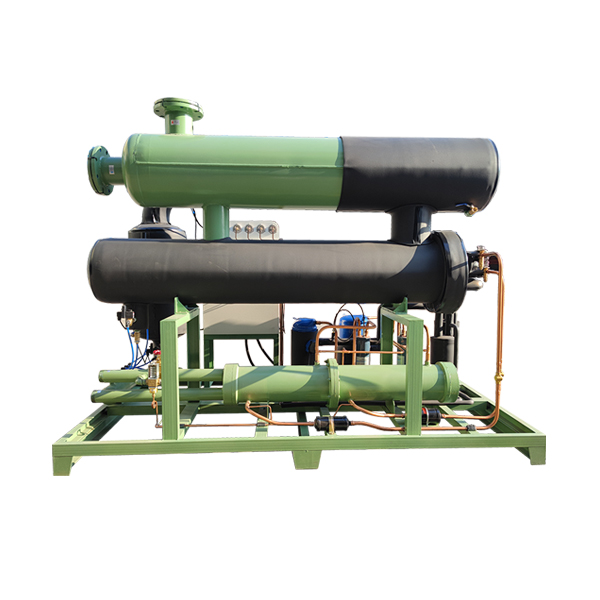
LY-D1200WH Technical Specifications
The LY-D1200WH has the following model-specific parameters:
| Parameter | LY-D1200WH |
|---|---|
| Airflow capacity | 120 m³/min |
| Power supply | 380V / 50Hz |
| Total power | 19.2 kW |
| Cooling-water flow rate | 35.5 t/h |
| Cooling-water connection | G2″ / G2½” |
| Compressed-air inlet/outlet | DN150 |
| Weight | 1500 kg |
| Dimensions | 2600 × 1540 × 1895 mm |
These model-specific values provide a more useful basis for equipment evaluation than applying generic large water-cooled dryer specifications to the LY-D1200WH.
How the Water-Cooled Refrigerated Dryer Works
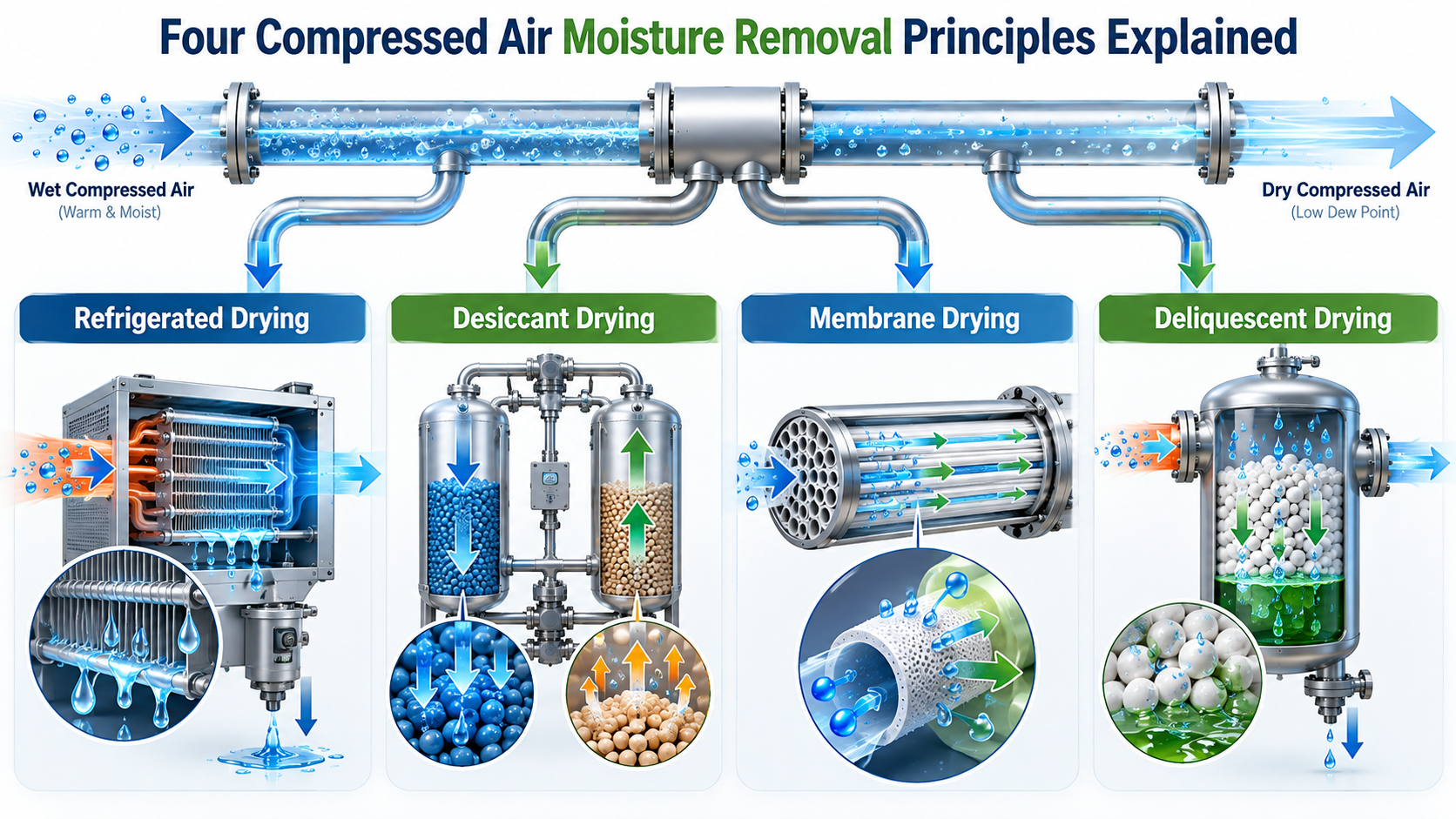
High-temperature compressed air containing moisture and oil first enters the water-cooled pre-cooler and air-to-air heat exchanger.
This initial heat-exchange stage lowers the compressed-air temperature before it reaches the refrigeration evaporator.
The air then enters the evaporator, where it is cooled to a 2–10°C pressure dew point. As the temperature falls, water vapor condenses together with some oil and impurities.
The resulting liquid is separated by the gas-liquid separation system and discharged through an automatic drain valve.
Finally, the dry compressed air returns through the air-to-air heat exchanger, where it is reheated toward ambient temperature before being supplied downstream.
The complete process combines pre-cooling, refrigeration, moisture separation, automatic condensate drainage, and reheating in one treatment sequence.
High-Inlet-Temperature Capability
The WH Series is designed as a Water-Cooled High-Inlet-Temperature Refrigerated Air Dryer.
Its inlet-temperature conditions are:
Rated inlet temperature: 50°C
Maximum inlet temperature: ≤80°C
This is particularly relevant for compressor stations where compressed air remains relatively hot before reaching the dryer.
The water-cooled pre-cooler removes part of the thermal load before the air reaches the evaporator, helping the refrigeration stage operate within its intended conditions.
Standard Pressure and Dew-Point Conditions
| Operating Parameter | Specification |
|---|---|
| Rated inlet pressure | 0.7 MPa |
| Operating pressure range | 0.6–1.0 MPa |
| Pressure dew point | 2–10°C |
| Pressure drop | ≤0.025 MPa |
| Rated ambient temperature | 32°C |
| Ambient operating range | 2–45°C |
Other working pressures are available upon request.
The standard operating range should therefore be stated as 0.6–1.0 MPa, rather than simplified to “up to 10 bar.”
Cooling-Water Flow: 35.5 t/h
For the LY-D1200WH, the cooling-water flow rate is:
35.5 t/h
The previously stated 300–350 L/min figure is not supported for this model and should not be used.
Because cooling-water demand is model-specific, the 35.5 t/h value should be used when discussing the LY-D1200WH rather than substituting a generic estimate.
Cooling-Water Pressure and Temperature
The WH Series cooling-water conditions are:
Cooling-water pressure: 0.2–0.4 MPa
Cooling-water temperature: ≤32°C
Cooling-water operating-temperature range: 2–38°C
These conditions are central to system integration.
The facility must provide the required 35.5 t/h water flow at the correct pressure and temperature. A water-cooled dryer cannot achieve its intended refrigeration performance if the cooling-water circuit is undersized or operates outside the specified range.
Cooling-water planning should therefore be completed alongside dryer sizing rather than after equipment selection.
Why Water Cooling Helps at 120 m³/min
At 120 m³/min, condenser heat rejection becomes a significant equipment-room consideration.
An air-cooled refrigeration system rejects condenser heat directly to ambient air. A water-cooled condenser instead transfers this heat into the facility’s cooling-water circuit, reducing dependence on large volumes of room air for condenser cooling.
The dryer is not completely independent of ambient conditions, however. Its specified ambient operating range remains 2–45°C.
Water cooling therefore reduces dependence on ambient ventilation for condenser heat rejection while the dryer continues to operate within its specified environmental conditions.
Pressure Drop and Large-System Efficiency
The WH Series specifies a pressure drop of:
≤0.025 MPa
In a 120 m³/min system, pressure drop should be considered carefully because the dryer is only one component in the complete compressed-air treatment path.
Additional pressure losses can arise from filters, piping, isolation valves, flow meters, receivers, and distribution headers.
The system design objective is to maintain acceptable pressure at downstream production equipment while avoiding unnecessary compressor discharge pressure.
Dual-Compressor Operation
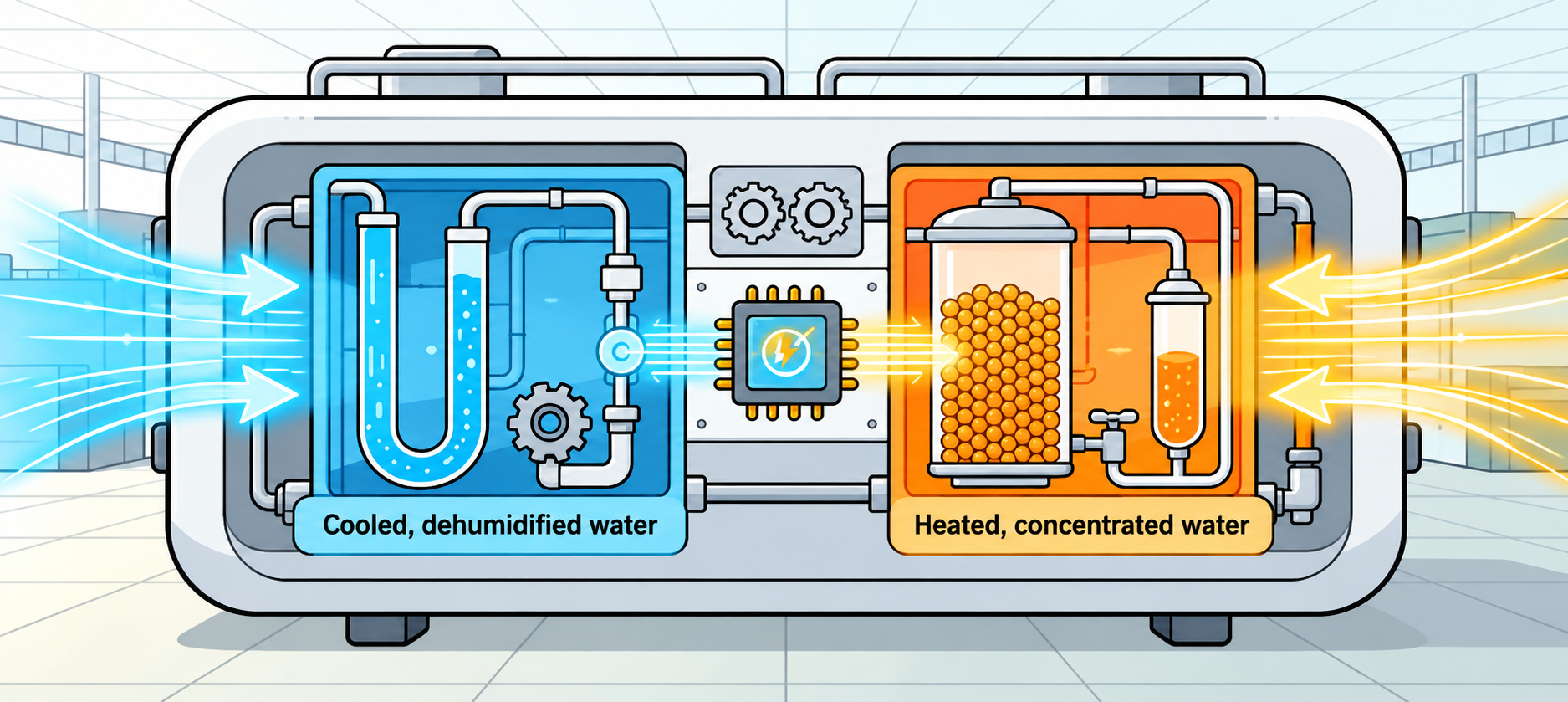
WH Series models from 5 to 180 m³/min use a 1+1 dual-compressor configuration.
The second refrigeration compressor automatically starts or stops according to system load, supporting load matching and adapting refrigeration capacity to variations in compressed-air demand.
Because the LY-D1200WH is rated at 120 m³/min, it falls within the specified 5–180 m³/min range. The 1+1 dual-compressor feature can therefore be applied directly to this model.
This load-responsive compressor arrangement provides a more specific description of the dryer’s energy-saving design than a general statement about water having high heat-transfer efficiency.
Moisture Separation and Automatic Drainage
The WH Series uses an independently designed moisture-separation system for condensate removal.
After the compressed air is cooled, condensate must be separated efficiently before the treated air leaves the dryer. The refrigeration process also incorporates automatic drainage.
Operators should inspect the drain system regularly because restricted or failed drainage can allow condensate to accumulate even when the refrigeration circuit itself remains operational.
Refrigerant Options
The standard refrigerant is:
R22
Environmentally friendlier R407C and R410A refrigerants are available upon request.
Refrigerant configuration should therefore remain within these stated options rather than being described as unrestricted customization.
Control and Communication Options
WH Series units can be configured with PLC control, dry contacts, Modbus communication, and IoT connectivity according to project requirements.
These options support integration into centralized compressor-station and plant-level control systems.
They should not be interpreted as meaning that every LY-D1200WH automatically includes a microprocessor control panel with real-time alarms and automatic diagnostics unless those functions are specified for the individual project.
Installation Requirements
The WH Series is designed for indoor installation on a level concrete floor without a foundation, with a minimum of 1.5 m clearance around the dryer.
For the LY-D1200WH, the listed dimensions are 2600 × 1540 × 1895 mm, and the unit weighs 1500 kg.
These physical characteristics should be considered when planning maintenance access, piping, cooling-water connections, electrical access, and equipment positioning.
Cooling-Water Quality and Heat-Exchanger Care
The specified cooling-water requirements define flow, pressure, and temperature but do not prescribe a universal water-treatment chemistry or fixed cleaning interval.
The maintenance objective is to preserve heat-transfer performance and prevent water passages from becoming restricted.
Inspection and cleaning frequency should therefore be determined according to the facility’s actual cooling-water quality and operating experience.
Filtration Should Match Required Air Quality
A refrigerated dryer removes moisture primarily through cooling and condensation. Other contaminants may require additional filtration according to the downstream process.
Where required, Lingyu’s precision compressed air filters can be integrated into the purification train.
The filter arrangement should be selected according to the required compressed-air quality rather than assuming that one fixed pre-filter and after-filter combination is mandatory for every installation.
Application Positioning
The LY-D1200WH is well suited to centralized industrial compressed-air systems where large continuous airflow, centralized cooling water, high inlet-air temperature, and a stable 2–10°C pressure dew point are important.
Rather than applying a broad generic industry list to every installation, the dryer should be evaluated according to the actual airflow, temperature, cooling-water, and air-quality requirements of the facility.
For a relevant large-scale application context, users can review Lingyu’s power and utilities compressed-air solutions.
Capacity Planning Should Be Based on Actual Conditions
Dryer capacity should not be selected simply by choosing a nominal rating “slightly above peak demand.”
Selection should consider actual airflow, peak airflow, inlet pressure, inlet temperature, ambient temperature, cooling-water conditions, and required pressure dew point.
The LY-D1200WH is rated at 120 m³/min, but project conditions should still be checked against the rated operating basis before final equipment selection.
Redundancy and Standby Strategy
For facilities where dry compressed air is critical to production, redundancy can be designed using multiple dryers or standby capacity.
A dual-dryer arrangement is not a mandatory LY-D1200WH product specification. Redundancy should instead be treated as a system-engineering decision.
Depending on maintenance requirements and acceptable production risk, configurations may include 1 × 100% + 1 standby, 2 × 50%, or another project-specific arrangement.
What to Confirm Before Selecting the 4238 CFM / LY-D1200WH
Before selecting this dryer, confirm the actual airflow, peak airflow, inlet pressure, maximum inlet temperature, required pressure dew point, allowable pressure drop, cooling-water temperature, cooling-water pressure, available 35.5 t/h flow capacity, electrical standard, installation clearance, filtration requirement, and control-interface requirement.
For detailed equipment information, users can review Lingyu’s 4238 CFM water-cooled high-temperature refrigerated air dryer page.
For non-standard operating requirements, users can also use Lingyu’s Contact Us page for technical confirmation.
Conclusion
The 4238 CFM water-cooled refrigerated air dryer can be positioned specifically around the LY-D1200WH 120 m³/min configuration rather than as a generic high-capacity refrigerated dryer.
Its model-specific parameters include 120 m³/min airflow, 380V / 50Hz power supply, 19.2 kW total power, 35.5 t/h cooling-water flow, G2″ / G2½” cooling-water connection, DN150 compressed-air connections, 1500 kg weight, and dimensions of 2600 × 1540 × 1895 mm.
The WH Series also specifies 0.7 MPa rated inlet pressure, 0.6–1.0 MPa operating pressure, 50°C rated inlet temperature, ≤80°C maximum inlet temperature, 2–10°C pressure dew point, ≤0.025 MPa pressure drop, cooling-water temperature ≤32°C at 0.2–0.4 MPa, a 2–38°C cooling-water operating-temperature range, and indoor installation with at least 1.5 m service clearance.
For this capacity class, cooling-water capacity, pressure drop, high-inlet-temperature conditions, 1+1 dual-compressor load matching, installation access, and plant-level control integration should all be considered during equipment selection.