A combined compressed air dryer is more than a refrigerated air dryer connected to a desiccant air dryer.
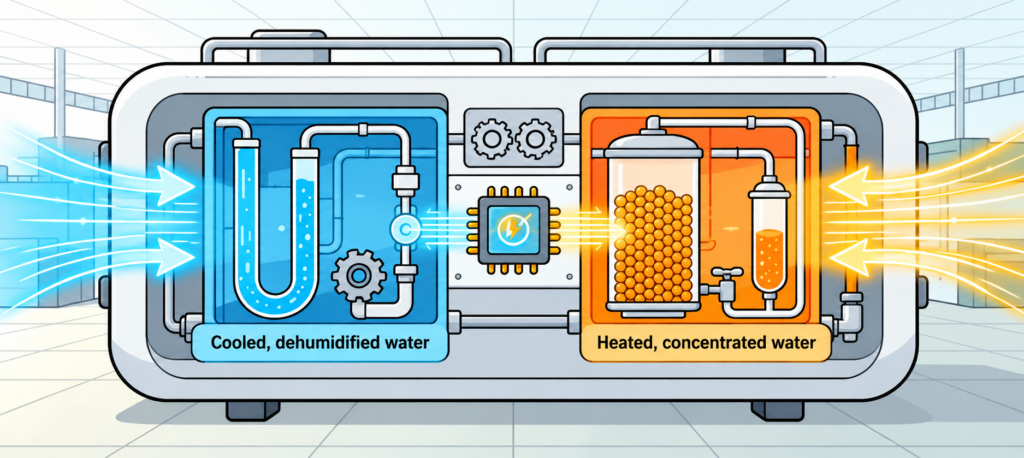
When properly engineered, it is a coordinated two-stage drying system in which each drying technology performs the task it handles most effectively. The refrigerated stage removes the bulk moisture load, while the downstream desiccant stage provides deeper drying to achieve the required pressure dew point.
This division of work can reduce the moisture load on the adsorption system, stabilize operating conditions, reduce unnecessary regeneration demand, and help protect critical components from excessive thermal and moisture stress.
For industrial facilities requiring consistently dry compressed air, this staged approach can offer an important advantage over relying on a single drying technology to handle the entire moisture load.
How Does a Combined Compressed Air Dryer Work?
A common configuration consists of:
Compressed air → Refrigerated drying stage → Condensate separation → Desiccant drying stage → Dry compressed air
The first stage cools the compressed air and removes a large portion of its moisture through condensation.
The second stage then removes the remaining water vapor through adsorption, allowing the system to reach a lower pressure dew point than a conventional refrigerated dryer could normally provide on its own.
This operating principle combines the strengths of refrigerated air drying and desiccant air drying within one coordinated treatment process.
The result is not simply “more drying equipment.” The real engineering value lies in load sharing between the two drying stages.
1. Refrigerated Pre-Drying Helps Protect the Desiccant
One of the most important functions of the refrigerated stage is to reduce the moisture load before the compressed air reaches the adsorption towers.
Bulk Moisture Removal Comes First
Compressed air leaving an air compressor can carry a substantial moisture load, particularly under warm and humid ambient conditions.
In the refrigerated stage, the air is cooled to a temperature at which a significant portion of the water vapor condenses into liquid water. A moisture separator then removes the condensate from the air stream.
The exact outlet pressure dew point depends on dryer design and operating conditions, but a conventional refrigerated dryer is generally intended for bulk moisture removal rather than extremely low dew point applications.
The partially dried air then enters the desiccant stage.
Why Is Pre-Drying Important for the Desiccant?
Adsorbents such as activated alumina and molecular sieve are designed primarily to adsorb water vapor.
They are not intended to receive uncontrolled quantities of liquid water.
If inadequately pretreated compressed air carries excessive liquid moisture into an adsorption dryer, the adsorbent can experience:
- reduced adsorption capacity;
- accelerated degradation;
- channeling or uneven air distribution;
- increased regeneration demand;
- unstable outlet dew point;
- shortened service life.
Contamination by compressor oil or other substances can further reduce adsorption performance.
This is why proper upstream moisture separation and filtration are critical for reliable adsorption drying.
For a deeper discussion of the factors that reduce adsorption performance, see what causes desiccant air dryer adsorption performance to decline.
Creating More Predictable Inlet Conditions
A refrigerated pre-dryer can also reduce variations in the temperature and moisture content reaching the adsorption stage.
Instead of requiring the desiccant dryer to handle the entire moisture load directly from the compressor system, the downstream adsorption stage receives air that has already undergone bulk moisture removal.
This helps keep the adsorption process closer to its intended design conditions and reduces the risk of moisture overload during periods of high ambient temperature or humidity.
2. Load Sharing Reduces Stress on the Adsorption Stage
The second major advantage of a combined dryer is moisture-load distribution.
When the refrigerated stage removes a significant portion of the incoming moisture, the desiccant stage only needs to remove the residual water vapor required to reach the specified pressure dew point.
This can provide several operational benefits.
Lower Moisture Loading on the Adsorbent
The amount of water an adsorption dryer must remove directly influences its adsorption and regeneration requirements.
Reducing the inlet moisture load can allow the adsorption system to operate under less demanding conditions.
Depending on dryer design and control strategy, this may support:
- longer adsorption cycles;
- reduced regeneration demand;
- fewer tower switching events;
- more stable pressure dew point;
- reduced thermal stress on the desiccant;
- potentially longer desiccant service life.
The actual improvement depends on factors such as inlet temperature, pressure, flow rate, target dew point, regeneration method, adsorbent selection, and control logic.
Therefore, cycle time and regeneration-air savings should always be evaluated according to the specifications of the specific combined dryer rather than treated as universal values.
Fewer Switching Events Can Reduce Mechanical Wear
Twin-tower desiccant dryers rely on alternating adsorption and regeneration cycles.
Every switching event requires valves and actuators to operate. Over long periods, frequent cycling can contribute to mechanical wear.
If a combined system is engineered so that the adsorption stage can operate with longer cycles, the number of switching events may be reduced.
This can help lower wear on:
- switching valves;
- actuators;
- seals;
- associated control components.
To understand how alternating adsorption towers maintain continuous dry-air production, see how twin-tower desiccant air dryers achieve continuous drying.
Regeneration Can Be Better Matched to Actual Demand
In a conventional desiccant dryer, regeneration energy or purge-air consumption can represent a significant operating cost, depending on the regeneration method.
Reducing the moisture load entering the adsorption stage creates an opportunity to optimize regeneration.
With suitable controls, regeneration frequency or duration may be adjusted according to actual operating demand rather than relying only on a fixed conservative cycle.
This is particularly valuable when inlet conditions and compressed-air demand vary throughout the day.
3. Each Drying Technology Handles the Job It Does Best
A major reason combined drying systems can provide stable performance is that neither drying technology is required to operate far outside its most practical role.
The Refrigerated Dryer Handles Bulk Moisture Removal
Refrigerated dryers are well suited to efficiently removing condensed moisture and maintaining a moderate pressure dew point for many industrial applications.
However, they are generally not designed to achieve the very low pressure dew points required by certain critical processes.
Attempting to use refrigeration alone for extremely low dew points would require a fundamentally different system design and can introduce icing and operational limitations.
The Desiccant Dryer Handles Deep Drying
Desiccant dryers can achieve much lower pressure dew points because they remove water vapor through adsorption.
But using adsorption alone to handle a very high inlet moisture load can increase regeneration requirements and place greater demand on the desiccant.
A combined dryer therefore assigns each stage a more appropriate task:
| Drying Stage | Primary Function |
|---|---|
| Refrigerated stage | Bulk moisture removal and condensate separation |
| Desiccant stage | Deep removal of residual water vapor |
| Integrated controls | Coordination of operating and regeneration cycles |
| Final air treatment | Stable dry-air delivery according to process requirements |
This is the fundamental engineering logic behind a well-designed combined compressed air dryer.
4. Integrated Design Can Improve System-Level Stability
There is an important difference between an engineered combined dryer and simply installing a separate refrigerated dryer and desiccant dryer in series.
An integrated system can be designed as one coordinated air-treatment package, with the piping, heat exchange, drainage, instrumentation, and control logic developed around the complete drying process.
Optimized Internal Piping
Factory-integrated piping can reduce the number of field-installed connections required between individual pieces of equipment.
Fewer external connections can help simplify installation and reduce potential sources of:
- compressed-air leakage;
- incorrect piping arrangements;
- unnecessary pressure drop;
- condensate drainage problems.
Pressure drop remains an important system-design consideration because excessive restriction increases the pressure the compressor must generate to maintain the required downstream pressure.
For more information, see our guide to compressed air pressure drop and system efficiency.
Heat Exchange Can Improve Operating Conditions
Depending on the combined dryer design, heat exchangers may be used to recover cooling capacity or manage air temperature between different stages.
Proper thermal integration can help:
- reduce unnecessary refrigeration load;
- stabilize the temperature entering the adsorption stage;
- improve overall thermal efficiency;
- reheat dry outlet air when required by the system design.
This thermal coordination is particularly useful when compressor discharge conditions or ambient temperatures vary significantly.
The specific heat-exchange arrangement, however, depends on the dryer configuration and should be evaluated from the manufacturer’s process flow diagram rather than assumed to be identical across all combined dryers.
5. Integrated Controls Reduce Coordination Problems
Another important advantage of an integrated combined dryer is coordinated control.
Instead of operating two completely independent dryers, an integrated PLC or controller can supervise the drying process as a complete system.
Depending on the model and control architecture, monitored parameters may include:
- inlet and outlet temperature;
- operating pressure;
- pressure dew point;
- refrigeration-system status;
- adsorption tower status;
- regeneration sequence;
- drain operation;
- alarm conditions.
Coordinated Operating Sequences
Integrated control allows the refrigerated and adsorption stages to operate according to a defined sequence.
This helps prevent situations in which the adsorption dryer operates without the required upstream conditions or regeneration occurs unnecessarily.
Advanced designs may also use dew-point-dependent or demand-based control strategies to adjust adsorption and regeneration cycles according to actual operating conditions.
The benefit is not simply automation for its own sake. The objective is to maintain the required air quality while reducing unnecessary switching, purge consumption, and energy use.
Centralized Monitoring Simplifies Operation
A unified controller also gives operators one location for monitoring system conditions and alarms.
This can make it easier to identify abnormal trends and reduce errors associated with managing multiple independent control systems.
For facilities that depend on continuous compressed-air quality, this system-level visibility can be an important reliability advantage.
6. Why Can a Combined Dryer Provide a More Stable Pressure Dew Point?
For critical applications, the most important question is not simply how much water the dryer removes.
The more useful performance indicator is whether the system can maintain the required pressure dew point (PDP) under actual operating conditions.
A combined dryer supports dew point stability by controlling moisture in stages:
Stage 1: Remove bulk moisture through cooling and condensation.
Stage 2: Remove the remaining water vapor through adsorption.
Because the desiccant stage receives a lower and more predictable moisture load, it can be easier to maintain the target outlet dew point within its designed operating envelope.
However, stable dew point still depends on correct dryer sizing and operating conditions, including:
- inlet air temperature;
- ambient temperature;
- operating pressure;
- compressed-air flow;
- target pressure dew point;
- upstream filtration;
- condensate drainage;
- adsorbent condition.
For a detailed explanation of dew point as a compressed-air performance parameter, see our guide to pressure dew point in compressed air dryers.
7. Combined Dryer vs. Standalone Refrigerated or Desiccant Dryer
A combined system is not automatically the best solution for every application.
The correct dryer depends primarily on the required air quality and operating conditions.
| System | Typical Strength | Key Consideration |
| Refrigerated air dryer | Efficient bulk moisture removal | Suitable where extremely low dew points are not required |
| Desiccant air dryer | Very low pressure dew point capability | Regeneration requirements can increase operating cost |
| Combined compressed air dryer | Bulk moisture removal plus deep drying | More complex system requiring coordinated design and controls |
If a process only requires the dew point normally provided by a refrigerated dryer, adding an adsorption stage may provide little practical benefit.
Likewise, certain applications may be better served by a standalone desiccant dryer, depending on inlet conditions, operating schedule, energy strategy, and required pressure dew point.
For a broader comparison, read refrigerated air dryer vs. desiccant air dryer.
8. Where Are Combined Compressed Air Dryers Used?
Combined dryers are particularly relevant where compressed-air quality must remain stable despite changing operating conditions or where lower pressure dew points are required.
Typical applications can include:
Precision Instrumentation
Instrumentation and pneumatic control systems can be sensitive to moisture, corrosion, and condensation. Stable dry air helps maintain reliable operation of valves, actuators, and control devices.
Laser Cutting and Metal Fabrication
Modern laser-cutting operations can require clean, dry compressed air to protect optical and pneumatic components and maintain consistent cutting conditions.
Pharmaceutical and Biopharmaceutical Manufacturing
Compressed-air quality can be critical in pharmaceutical processes, particularly where air can influence production equipment or product-contact environments.
Electronics and Precision Manufacturing
Moisture can affect sensitive pneumatic equipment, electronic manufacturing processes, and precision production environments.
Chemical and Process Industries
Dry compressed air can support instrumentation, pneumatic control, and processes where moisture must be carefully controlled.
The appropriate dryer configuration should always be selected according to the actual pressure dew point, flow, pressure, temperature, air-quality class, and operating profile required by the process.
FAQ: Combined Compressed Air Dryers
What is a combined compressed air dryer?
A combined compressed air dryer integrates two drying technologies—commonly refrigerated drying followed by desiccant adsorption—into a coordinated compressed-air treatment system. The refrigerated stage removes bulk moisture, while the adsorption stage removes residual water vapor to achieve a lower pressure dew point.
Why not use only a desiccant air dryer?
A standalone desiccant dryer can provide very dry compressed air and may be appropriate for many applications. However, when inlet moisture loads are high, upstream refrigerated drying can reduce the amount of water the desiccant must remove and may reduce regeneration demand.
Is a combined dryer always more energy efficient?
Not necessarily.
Energy performance depends on system design, regeneration method, pressure drop, inlet conditions, target dew point, operating hours, and control strategy. A combined dryer should therefore be evaluated against the actual requirements of the application rather than assumed to consume less energy in every installation.
Does a combined dryer extend desiccant life?
Reducing liquid-water exposure and moisture loading can help create better operating conditions for the adsorbent. Actual desiccant service life, however, also depends on oil contamination, dust, regeneration temperature, operating cycles, flow conditions, and maintenance.
What pressure dew point can a combined dryer achieve?
The achievable pressure dew point depends on the adsorption technology, system design, inlet conditions, and specified model. Always use the manufacturer’s rated performance under defined reference conditions rather than assuming one universal dew point value.
Is a combined dryer simply two separate dryers connected together?
Not necessarily.
A properly engineered combined dryer can integrate piping, condensate management, heat exchange, instrumentation, and control logic into a coordinated package. This system-level integration is one of the main differences between a purpose-built combined dryer and an improvised field installation of two independent units.
Conclusion: Stability Comes From Load Sharing, Not Simply More Equipment
The key advantage of a combined compressed air dryer is not that it contains two drying technologies.
Its real advantage is the way those technologies can work together.
The refrigerated stage handles bulk moisture removal and condensate separation. The desiccant stage then performs the deeper drying required to achieve a lower pressure dew point.
By dividing the moisture load between the two stages, a properly engineered combined dryer can:
- protect the adsorption system from excessive moisture loading;
- reduce regeneration demand;
- reduce unnecessary switching;
- create more stable inlet conditions for the desiccant;
- improve pressure dew point consistency;
- simplify system-level monitoring and control.
For applications that require both deep drying and long-term operating stability, this staged approach can provide a practical alternative to relying on a single drying technology for the entire moisture-removal process.
Lingyu’s DC Series combined compressed air dryer integrates refrigerated and adsorption drying within a purpose-designed compressed-air treatment system.
For applications with different flow rates, pressure dew point targets, inlet temperatures, or operating conditions, contact Lingyu to discuss the appropriate compressed-air drying configuration for your process.