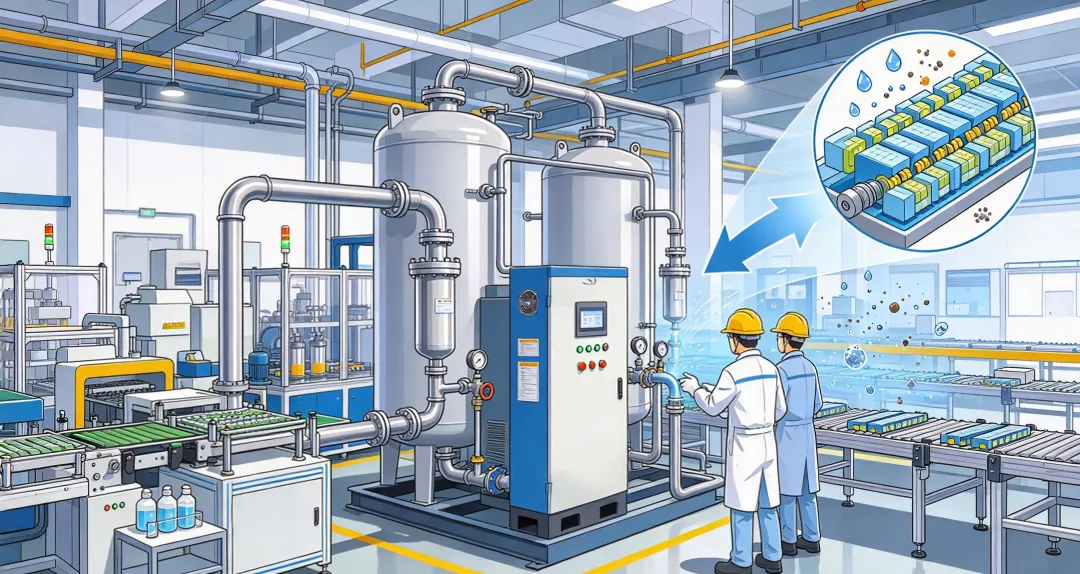
Moisture removal is a fundamental part of industrial compressed air treatment. Although refrigerated, desiccant, membrane, and deliquescent dryers all reduce the water content of compressed air, they rely on different physical or chemical mechanisms.
Understanding these mechanisms is useful for more than equipment selection. It also helps maintenance teams identify the causes of high pressure dew point, excessive regeneration losses, poor condensate drainage, and unexpected system downtime.
This technical guide explains four compressed air moisture removal principles: cooling and condensation, solid-desiccant adsorption, selective membrane permeation, and chemical deliquescence.
It also examines the operating sequence, regeneration requirements, performance limitations, and common failure points associated with each method.
For a broader comparison of equipment categories and purchasing considerations, see Lingyu’s guide to different types of compressed air dryers.
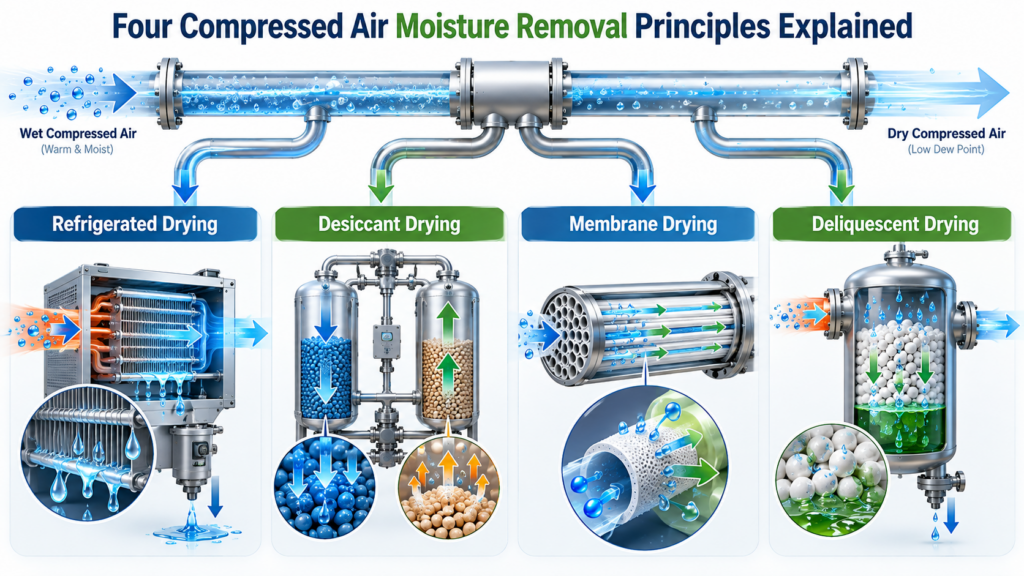
1. Refrigerated Drying: Moisture Removal by Cooling and Condensation
Refrigerated air dryers are widely used in industrial compressed air systems because they provide reliable moisture removal through a relatively straightforward thermodynamic process.
Their operating principle is based on the relationship between air temperature, water vapor saturation, and condensation.
1.1 The Physical Principle of Condensation
At a given pressure, the maximum amount of water vapor that air can contain decreases as temperature falls.
When warm, moisture-laden compressed air is cooled to its dew point, the air becomes saturated. Further cooling causes some of the water vapor to change into liquid water.
A refrigerated dryer uses this phase-change process to remove moisture.
The basic sequence is:
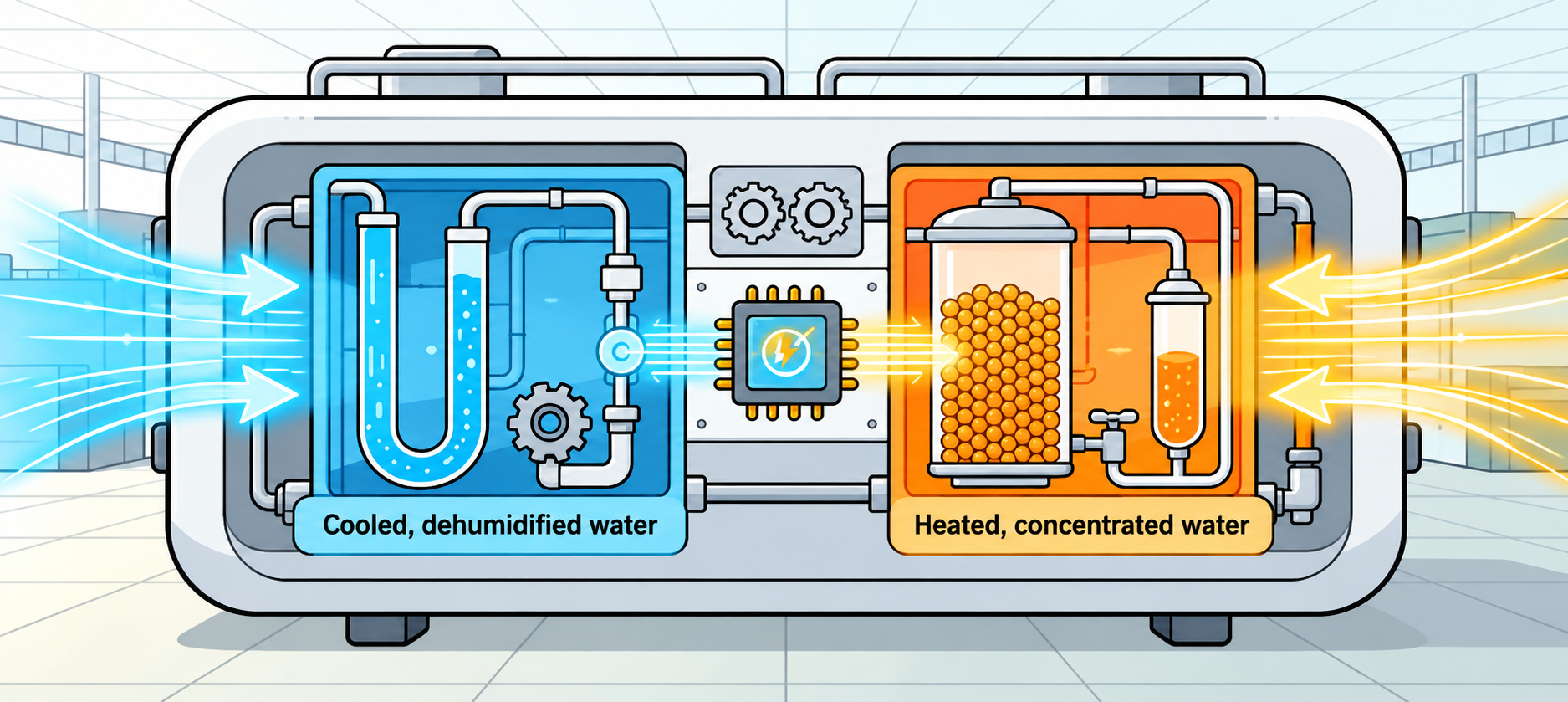
Warm, wet compressed air → cooling → condensation → water separation → condensate drainage → dry-air reheating
Unlike adsorption or membrane drying, the primary moisture-removal mechanism is not the capture of individual water molecules by a solid material. It is the conversion of water vapor into liquid condensate, which can then be physically separated.
Under specified rated conditions, conventional refrigerated air dryers commonly deliver positive pressure dew points. Lingyu’s conventional models include configurations rated for approximately +2°C to +10°C PDP.
1.2 Three Main Stages of the Refrigerated Dryer Air Path
A typical refrigerated air dryer includes three functional stages.
Stage 1: Air-to-Air Pre-Cooling
Warm compressed air enters a heat exchanger, where it transfers heat to the colder, already dried air leaving the refrigeration section.
This arrangement provides two benefits.
First, incoming wet air is partially cooled before reaching the refrigerant evaporator. As a result, the refrigeration system handles a lower thermal load.
Second, the outgoing dry air is reheated, helping reduce the likelihood of external condensation on downstream piping and equipment.
The actual heat recovery and temperature reduction depend on heat exchanger design, airflow, inlet temperature, and operating conditions.
The heat exchanger therefore acts as an energy-recovery component rather than a separate moisture-removal technology.
Stage 2: Refrigeration Cooling and Water Condensation
After pre-cooling, the compressed air passes through the evaporator.
Inside the refrigeration circuit, refrigerant absorbs heat from the compressed air. As the air temperature decreases, water vapor condenses into droplets.
The evaporator temperature must remain properly controlled.
If the refrigeration surface becomes too cold, ice may form and restrict airflow. If the temperature remains too high, insufficient water vapor condenses and the delivered pressure dew point rises.
Depending on the dryer design, temperature regulation may involve a hot-gas bypass valve, electronic controls, variable-speed refrigeration components, or other protective mechanisms.
The refrigerant type and operating temperatures must be checked against the actual equipment specification.
Stage 3: Water Separation, Drainage, and Air Reheating
The cooled air carries liquid water droplets into a moisture separator.
A centrifugal, coalescing, or other separator design removes the liquid condensate from the airflow.
An automatic condensate drain then discharges the collected water.
The dried compressed air returns through the air-to-air heat exchanger, absorbs heat from the incoming air, and exits the dryer at a higher temperature.
This reheating does not add back the moisture that was removed as liquid water.
1.3 Advantages and Operating Limitations
Advantages
Mature technology with relatively straightforward operation.
Suitable for many general industrial pneumatic systems.
No desiccant-regeneration purge-air consumption.
Generally lower maintenance complexity than regenerative adsorption systems.
Practical for installations where a positive pressure dew point is sufficient.
Limitations
Conventional refrigerated drying cannot provide the deep negative pressure dew points associated with adsorption technology.
High ambient temperatures can reduce condenser efficiency.
Excessive inlet temperature can overload the refrigeration system.
Poor drainage may allow liquid water to carry over into downstream piping.
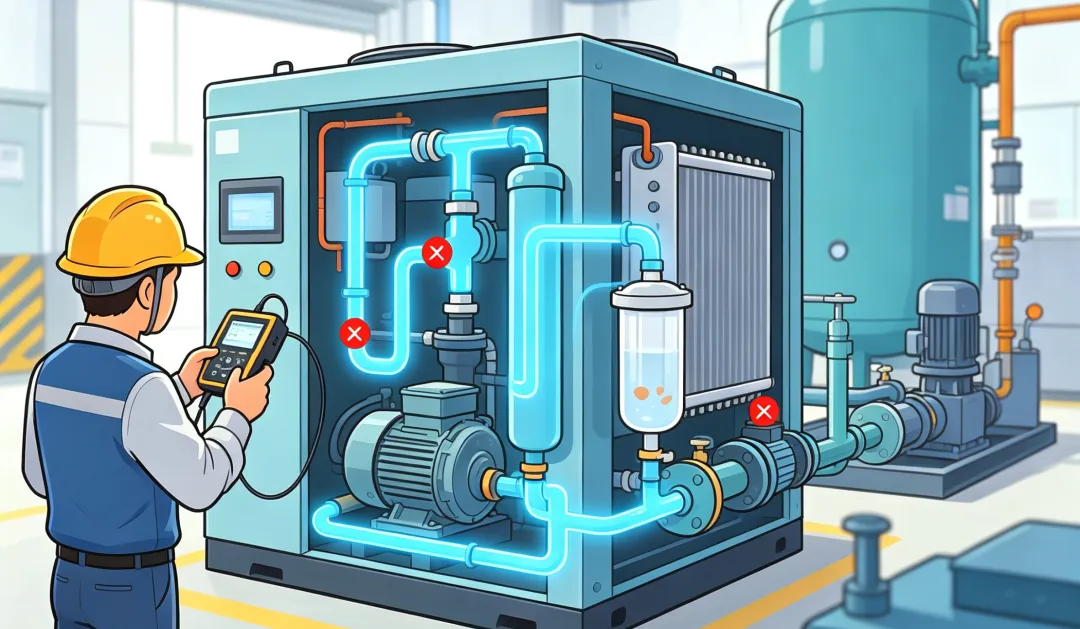
1.4 Refrigerated Dryer Troubleshooting by Process Stage
Dividing the air path into functional stages makes troubleshooting more systematic.
| Symptom | Area to inspect | Possible causes |
|---|---|---|
| Outlet dew point is too high | Pre-cooler and refrigeration circuit | High inlet temperature, insufficient cooling, dirty heat exchangers |
| Ice formation or reduced airflow | Evaporator and temperature controls | Excessive cooling, control malfunction, restricted airflow |
| Liquid water downstream | Separator and condensate drain | Blocked drain, separator malfunction, excessive condensate load |
| High operating temperature | Condenser and installation area | Poor ventilation, dirty condenser, inadequate cooling capacity |
When investigating high dew point, engineers should confirm actual operating pressure, airflow, inlet temperature, ambient temperature, and refrigeration conditions before replacing components.
For equipment options, explore Lingyu’s refrigerated compressed air dryers.
2. Desiccant Drying: Moisture Removal by Physical Adsorption
Desiccant dryers remove water vapor through adsorption, a process in which water molecules attach to the internal surfaces of a porous solid.
Unlike refrigerated dryers, adsorption systems do not need to condense all the moisture into liquid water to achieve deeper drying.
This makes them suitable for applications requiring significantly lower pressure dew points.
2.1 How Porous Desiccants Capture Water Vapor
Common industrial desiccants include activated alumina, molecular sieves, and silica gel.
These materials contain extensive internal pore structures and large effective surface areas.
As moist compressed air passes through the desiccant bed, water molecules are attracted to and retained on the adsorbent surfaces.
The process is influenced by water vapor partial pressure, temperature, pressure, adsorbent properties, and contact time.
As the desiccant takes up moisture, its remaining adsorption capacity decreases.
To maintain continuous operation, the saturated desiccant must be regenerated so it can remove moisture again.
2.2 Why Many Industrial Desiccant Dryers Use Two Towers
A common design uses two adsorption vessels.
During one phase of operation:
Tower A receives wet compressed air and produces dry air.
Tower B undergoes regeneration to release previously adsorbed water.
After a controlled interval, the towers switch roles.
Automatic valves and a controller manage the adsorption, depressurization, regeneration, repressurization, and switching sequence as required by the dryer design.
Proper tower switching helps maintain continuous dry-air delivery.
However, not all adsorption dryers use identical cycle times, and some modern systems use modular or alternative configurations.
2.3 Heatless Regeneration: Moisture Removal Through Depressurization and Purging
Heatless desiccant dryers regenerate the offline tower without an external heater.
After the tower has completed its adsorption phase, its pressure is reduced.
A portion of already dried compressed air is then expanded to a lower pressure and directed through the desiccant bed.
The low water vapor partial pressure of the purge air encourages moisture to leave the adsorbent surface.
The moisture-laden purge air is discharged, and the regenerated tower is prepared for the next adsorption cycle.
Regeneration mechanism:
Pressure reduction + low-humidity dry-air purge → moisture desorption
This is often described as a pressure-swing regeneration process.
The key advantage is mechanical simplicity. However, the use of treated compressed air for regeneration represents an operating cost.
Some heatless dryers use purge rates around 10–20% under particular conditions, but the actual percentage varies by model and operating specification.
Heatless systems can be attractive where simplicity, compactness, and operating flexibility are priorities.
They may be less economical for large systems operating continuously when compressed-air purge losses are significant.
Lingyu’s heatless regeneration adsorption dryers provide an equipment reference for this regeneration approach.
2.4 Heated Regeneration: Using Thermal Energy to Release Moisture
Heated desiccant dryers use thermal energy to improve the regeneration process.
During regeneration, the adsorbent is exposed to heated air, which facilitates water desorption.
The tower is then cooled and prepared for the next adsorption cycle.
Depending on the system design, a heated dryer may use less compressed-air purge than a comparable heatless system.
Its operating costs, however, include electrical or other heating energy.
The main engineering trade-off is therefore:
Lower compressed-air purge demand versus additional heating energy and system complexity.
Reliable operation also depends on temperature controls, heater condition, regeneration timing, and effective tower cooling.
A poorly controlled heating cycle can reduce drying performance or adversely affect the adsorbent.
2.5 Blower-Heated Regeneration: Using Ambient Air for Regeneration
Blower-heated adsorption dryers use an external blower to supply regeneration air.
In many configurations, ambient air is heated before passing through the saturated adsorption bed.
This reduces dependence on finished compressed air for regeneration.
The regeneration sequence may include heating, desorption, cooling, and pressure equalization.
Some specialized designs are marketed as zero-purge or zero-air-loss systems. These terms must be interpreted according to the actual regeneration and cooling arrangement.
A zero-purge designation does not automatically mean that the entire installation has no air losses or energy consumption.
The blower and heating components still require energy, and some configurations use compressed air during specific operating stages.
For large, continuously operating compressed air systems, blower-heated regeneration can offer energy advantages when properly matched to the duty cycle.
For more information, see Lingyu’s blower-heated regenerative desiccant dryer.
2.6 Heat-of-Compression Regeneration: Reusing Compressor Thermal Energy
Heat-of-compression (HOC) dryers use available heat from the compressor system to regenerate desiccant.
Instead of relying entirely on an independent heater, the system captures useful thermal energy already present in the compressed air production process.
This approach may reduce external regeneration energy requirements.
However, the actual performance depends strongly on the compressor type, discharge temperature, operating load, cooling arrangement, and dryer configuration.
HOC technology is therefore best evaluated as part of the complete compressor station rather than as an isolated dryer.
The Lingyu heat-of-compression regeneration dryer illustrates this equipment category.
2.7 Common Desiccant Dryer Failure Mechanisms
Although regeneration methods differ, adsorption dryers share several important operating risks.
Oil contamination: Oil aerosols and vapors can contaminate desiccant surfaces and reduce adsorption capacity.
Insufficient regeneration: Inadequate heat, purge flow, regeneration time, or cooling may cause outlet dew point to increase.
Switching-valve problems: Valve leakage or incomplete switching can compromise regeneration and product-air quality.
Desiccant deterioration: Mechanical damage, contamination, and repeated operating stress can cause dust generation and reduced performance.
Excessive moisture loading: High inlet temperatures, inadequate upstream separation, or unexpected condensate carryover can overload the adsorbent.
The service life of desiccant is not fixed for every installation. Replacement intervals should reflect actual inlet air quality, operating conditions, pressure dew point trends, and the manufacturer’s maintenance instructions.
3. Membrane Drying: Moisture Removal by Selective Permeation
Membrane air dryers use selective transport of water vapor through specialized membrane materials.
They operate differently from refrigerated and desiccant dryers because their primary drying mechanism does not depend on condensation or a cyclic adsorbent bed.
3.1 How Selective Water Vapor Permeation Works
Many membrane dryers use bundles of hollow fibers.
Moist compressed air flows through the membrane module, while water vapor permeates through the fiber walls more readily than the main air components.
The driving force is a difference in water vapor partial pressure across the membrane.
As water vapor moves through the membrane, the compressed air stream becomes drier.
The separation is selective rather than absolute. Actual performance depends on membrane material, surface area, operating pressure, temperature, airflow, and purge arrangement.
3.2 The Role of Sweep Air
Many membrane dryers use a fraction of treated compressed air as sweep or purge air.
This air is expanded to a lower pressure and routed along the opposite side of the membrane.
The sweep air helps maintain a low water vapor partial pressure outside the membrane, allowing moisture to continue permeating out of the compressed air stream.
The moisture-rich sweep air is then exhausted.
A simplified process is:
Wet compressed air → hollow-fiber membrane → selective water vapor permeation → dry outlet air
Dry-air branch → pressure reduction → membrane sweep → moisture discharge
The membrane module can provide continuous drying without the tower-switching cycle required by conventional twin-tower desiccant dryers.
3.3 Where Membrane Dryers Are Useful
Membrane dryers can be suitable for:
Compact point-of-use air treatment.
Small laboratory air systems.
Remote instrumentation.
Individual pneumatic equipment.
Applications with limited installation space.
Some configurations operate without a dedicated electrical supply at the drying module.
However, they are not necessarily energy-free because the compressed air consumed as sweep air has already required energy to produce.
Membrane dryers also need suitable upstream protection.
Liquid water, oil aerosols, and particulate contamination can reduce performance or damage the membrane.
3.4 Limitations of Membrane Drying
Membrane dryer performance should not be described using one universal flow or pressure dew point rating.
It varies significantly by membrane design, purge-air fraction, inlet humidity, operating pressure, and required outlet quality.
For this reason, membrane drying is particularly attractive when compact installation and continuous point-of-use treatment are more important than extremely high flow capacity.
4. Deliquescent Drying: Moisture Removal by Chemical Absorption
Deliquescent air dryers use consumable chemical materials that absorb moisture and gradually dissolve.
Their operating principle is fundamentally different from physical adsorption.
Rather than retaining moisture on a regenerable porous surface, a deliquescent material takes up water and forms a liquid brine solution.
4.1 How Deliquescent Drying Works
The dryer contains a bed of moisture-absorbing chemical media.
As moist compressed air passes through the vessel, the material absorbs water vapor.
The chemical medium gradually dissolves, forming a liquid solution that collects in the lower portion of the vessel.
This liquid must be drained, and the consumed drying medium must be replenished.
The simplified process is:
Wet compressed air → contact with deliquescent medium → moisture absorption → brine formation → drainage
Unlike regenerative desiccant dryers, conventional deliquescent systems do not restore the consumed chemical medium through a heating or pressure-swing cycle.
4.2 Advantages of Deliquescent Drying
The main advantages are the relatively simple equipment structure and the possibility of operating without a refrigeration compressor or regeneration heater.
For certain remote, temporary, or specialized pneumatic installations, this simplicity may be useful.
4.3 Limitations and Maintenance Considerations
Deliquescent drying has several important limitations.
The chemical medium must be replenished periodically. The collected liquid requires appropriate drainage and disposal.
Outlet dryness also depends on inlet conditions, chemical formulation, and contact time.
Unlike a regenerative adsorption dryer, a deliquescent dryer generally provides limited dew point suppression and is not normally selected for applications requiring a stable, deeply negative pressure dew point.
The system must also be designed to prevent chemical solution or particulate carryover into downstream equipment.
5. What Do ISO 8573-1 Water Classes Mean for Moisture Removal?
Pressure dew point is a useful way to specify compressed air dryness.
ISO 8573-1 defines compressed air purity classes for particles, water, and oil.
For water vapor, the commonly referenced pressure dew point classes are:
| Water purity class | Maximum pressure dew point |
|---|---|
| Class 1 | −70°C |
| Class 2 | −40°C |
| Class 3 | −20°C |
| Class 4 | +3°C |
| Class 5 | +7°C |
| Class 6 | +10°C |
These class limits should not be interpreted as proof that a specific dryer automatically meets a given class.
For example, a refrigerated dryer rated at +10°C does not meet the +3°C pressure dew point limit associated with Class 4.
Similarly, achieving a −70°C pressure dew point requires equipment and operating conditions capable of demonstrating that performance. It should not be assumed merely because an adsorption dryer is installed.
The water class must also be considered separately from the particle and oil purity classes.
Drying performance should be verified at the appropriate operating pressure and relevant measurement location.
6. How the Four Moisture Removal Mechanisms Differ
The essential differences can be summarized by the mechanism used to separate or retain water.
| Technology | Moisture-removal mechanism | Main operational requirement | Typical limitation |
|---|---|---|---|
| Refrigerated dryer | Cooling, condensation, and liquid-water separation | Stable refrigeration and drainage | Limited to positive PDP in conventional designs |
| Desiccant dryer | Water vapor adsorption onto porous solids | Regeneration of the adsorbent | Purge air, heating energy, or regeneration complexity |
| Membrane dryer | Selective water vapor permeation | Sufficient vapor partial-pressure difference | Purge loss and flow-dependent performance |
| Deliquescent dryer | Chemical absorption and dissolution | Replenishment of consumable media | Limited dew point suppression and chemical handling |
A combined refrigerated and adsorption system uses two of these mechanisms sequentially rather than introducing an entirely new moisture-removal principle.
The refrigerated stage removes bulk moisture through condensation. The adsorption stage then removes additional water vapor to produce a lower pressure dew point.
7. Three Practical Questions for Diagnosing Moisture Problems
Understanding the physical removal mechanism also helps determine where to investigate poor drying performance.
Question 1: Is the Dryer Removing Moisture as Liquid Water or Water Vapor?
A refrigerated dryer converts water vapor into condensate, so drainage and liquid separation are critical.
An adsorption dryer removes vapor on a solid surface, so regeneration quality and desiccant condition are critical.
A membrane dryer depends on permeation and sweep conditions, while a deliquescent dryer depends on the condition and quantity of its chemical medium.
Question 2: Is the Required Pressure Dew Point Physically Achievable?
A conventional refrigerated dryer cannot be expected to achieve −40°C PDP through normal refrigeration cooling.
A desiccant dryer may achieve substantially lower dew points, but only within the performance limits of its adsorbent, regeneration system, flow capacity, and operating conditions.
A membrane or deliquescent dryer must also be evaluated according to its own performance specifications rather than assumed to replace a regenerative adsorption system.
Question 3: What Happens When Operating Conditions Change?
Higher inlet temperature, excessive airflow, lower-than-rated pressure, inadequate cooling, contaminated filters, or excessive pressure drop can affect dryer performance.
These conditions should be investigated before assuming that the moisture-removal technology itself is defective.
For applications with strict air-quality requirements, outlet pressure dew point monitoring and appropriate filtration are essential parts of reliable system operation.
Lingyu’s precision compressed air filters can be considered when designing the upstream and downstream treatment arrangement.
Conclusion: Understand the Moisture Removal Mechanism Before Troubleshooting the Dryer
Compressed air dryers do not all remove water in the same way.
Refrigerated dryers rely on cooling and condensation. Desiccant dryers use physical adsorption followed by regeneration. Membrane dryers separate water vapor through selective permeation, while deliquescent dryers absorb moisture using consumable chemical media.
These differences determine not only achievable dryness but also the parts that require maintenance, the energy consumed during operation, and the likely causes of moisture-related problems.
For industrial systems requiring standard positive pressure dew points, refrigeration drying may be sufficient. For deeper drying, regenerative adsorption technologies and combined drying systems can be evaluated according to the actual process requirements.
The most effective compressed air treatment system is one that achieves the required pressure dew point consistently, protects downstream equipment, and minimizes total lifecycle cost.
Need Help Evaluating a Compressed Air Drying System?
Lingyu provides refrigerated, desiccant, and combined compressed air drying solutions for different industrial operating conditions.
Share your required pressure dew point, airflow, inlet temperature, working pressure, compressor configuration, and installation conditions with our engineering team.