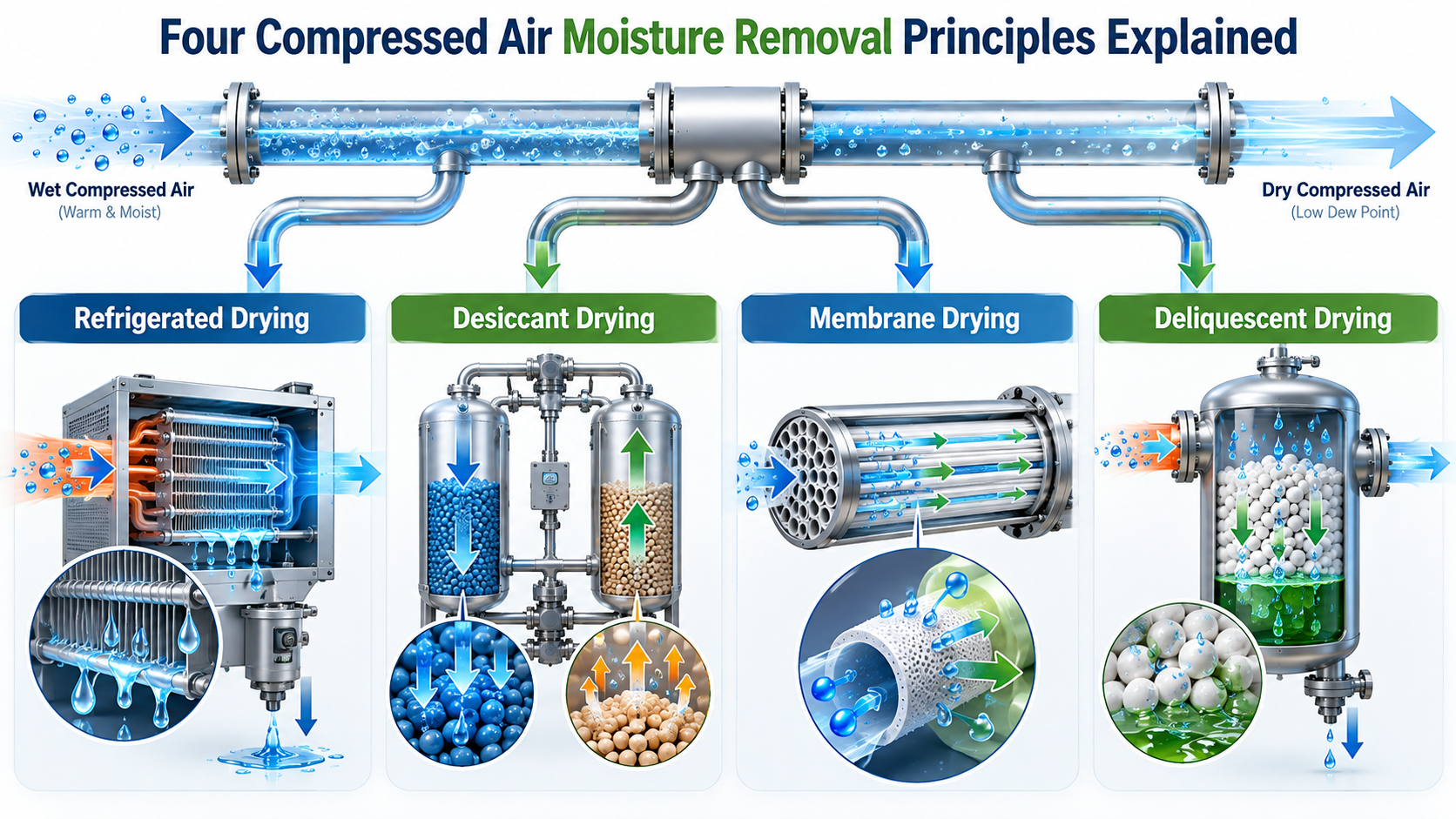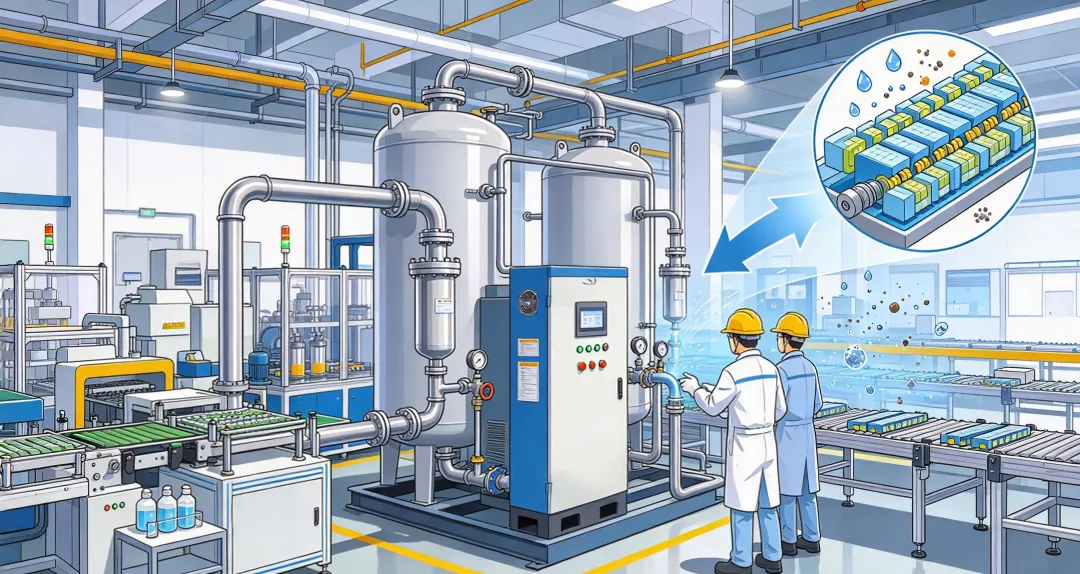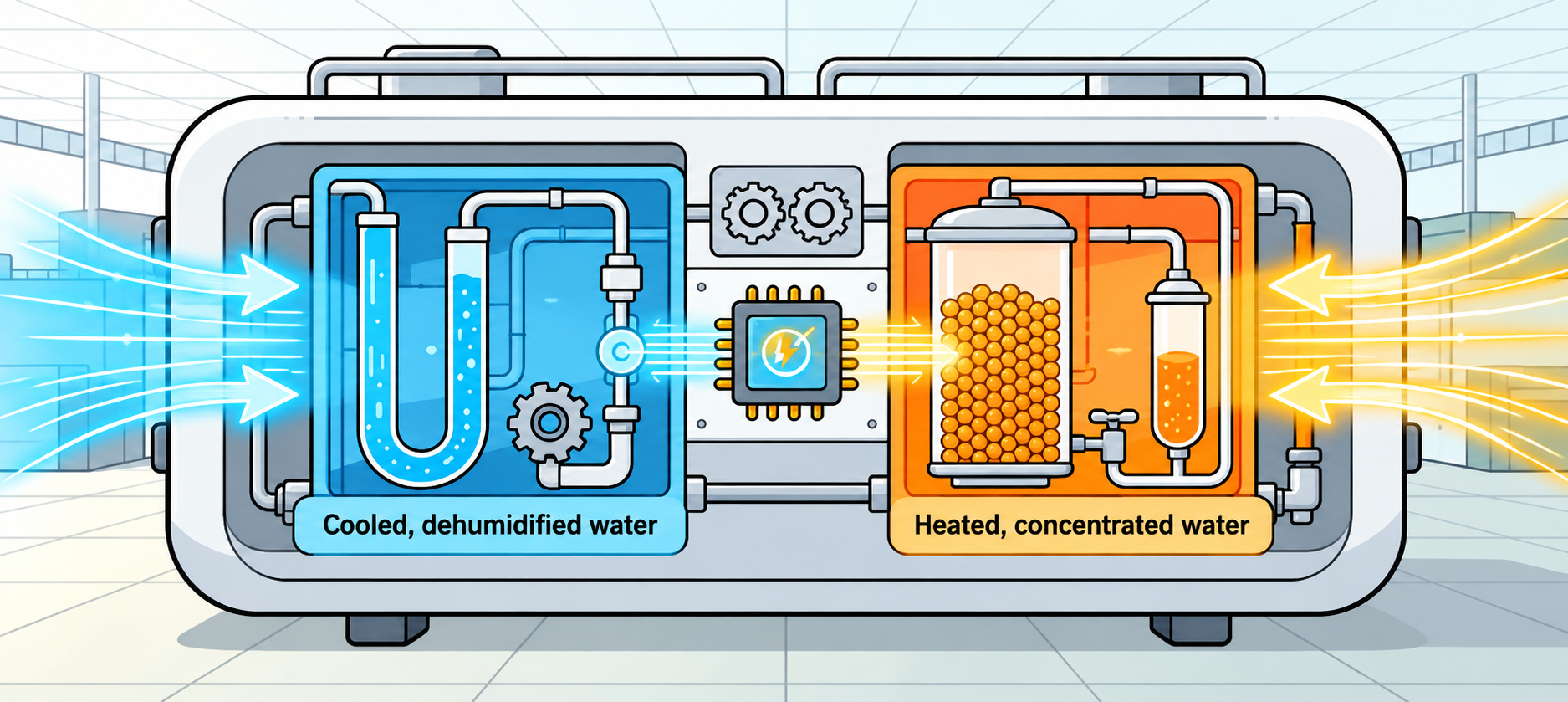
Air compressor filters and dryers perform different but complementary roles in compressed air treatment.
Filters remove contaminants such as solid particles, liquid droplets, and oil aerosols, while dryers reduce water vapor to the required pressure dew point. Used together, they help protect pneumatic equipment, reduce corrosion risk, improve process reliability, and support the required compressed air quality at the point of use.
The correct treatment system is not simply “filter + dryer.” It should be selected according to contaminant type, required pressure dew point, airflow, operating pressure, inlet temperature, pressure drop, and final process requirements.
Why Air Compressor Filters and Dryers Are Important
Atmospheric air naturally contains water vapor and airborne particles. Depending on compressor type and system condition, compressed air may also contain oil aerosols, oil vapor, rust, pipe scale, and wear debris.
As compressed air cools downstream of the compressor, part of the water vapor can condense into liquid water.
If these contaminants are not controlled, they can contribute to:
- Corrosion inside piping, valves, and receivers
- Premature wear of pneumatic tools and actuators
- Blocked or sticking control components
- Product or process contamination
- Coating and finishing defects
- Increased pressure drop
- Higher maintenance requirements
- Unplanned downtime
This is why filters and dryers should be treated as parts of one complete air-treatment system.
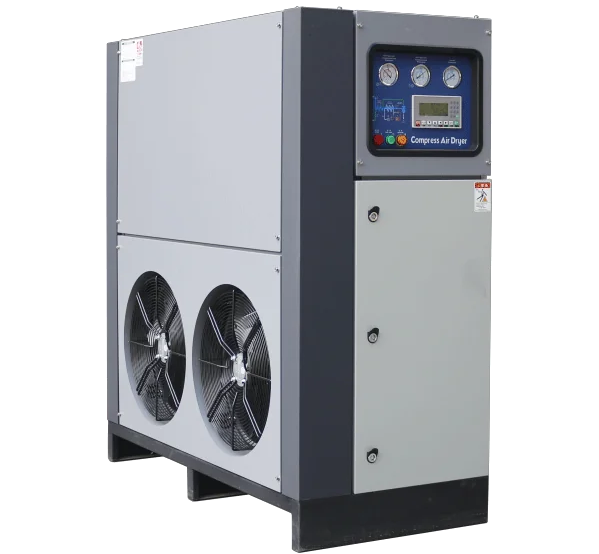
Filters and Dryers Do Different Jobs
A common mistake is assuming that one device can remove every contaminant.
It cannot.
A compressed air filter is primarily used to control particles, liquid droplets, and oil contamination according to its filtration grade.
A compressed air dryer is used to reduce water vapor and achieve a specified pressure dew point.
A typical treatment sequence may therefore look like:
compressor → moisture separator/receiver → pre-filter → dryer → after-filter → distribution
The exact arrangement depends on compressor type, dryer technology, and final air-quality requirements.
How Air Compressor Filters Work
Compressed air filters use specialized filter media and separation mechanisms to remove contaminants from the airflow.
Lingyu’s precision filter range includes AO, AA, AX, and ACS grades for different contamination-control requirements.
| Filter Grade | Particle Rating | Residual Oil |
|---|---|---|
| AO | ≤1.0 μm | ≤3 ppm |
| AA | ≤0.1 μm | ≤0.1 ppm |
| AX | ≤0.01 μm | ≤0.05 ppm |
| ACS | Not specified as a particle grade | ≤0.003 ppm |
The correct grade depends on what needs to be removed and where the filter is positioned in the treatment system.
Particulate and Pre-Filtration
Particulate filtration is used to control solid contaminants such as dust, rust, pipe scale, and other debris.
Upstream particulate control can help protect dryers and downstream equipment from contamination.
The required filtration level should be selected according to actual air quality rather than installing the finest possible filter everywhere.
Excessively restrictive filtration can increase pressure drop without providing a useful process benefit.
Coalescing Filtration
Coalescing filters are used to remove fine liquid aerosols, including oil and water droplets.
They work by causing small aerosol droplets to combine into larger droplets that can then drain from the filter housing.
Coalescing filtration is especially important when the compressor introduces oil aerosol or when adsorption dryers must be protected from contamination.
Oil and bulk liquid water can damage desiccant and reduce adsorption performance.
Activated-Carbon Filtration
Activated-carbon filtration is used mainly for oil vapor and odor reduction rather than as a conventional particle filter.
Lingyu’s ACS grade specifies residual oil down to ≤0.003 ppm.
Activated-carbon treatment should be used where the final air-quality requirement justifies it.
It should not be assumed that every compressed air system needs an activated-carbon stage.
Why Filter Placement Matters
Filter performance depends not only on filter grade but also on where the filter is installed.
Pre-Filter Before the Dryer
A pre-filter protects the dryer from contamination.
For refrigerated dryers, this helps reduce fouling of heat exchangers, separators, and condensate systems.
For adsorption dryers, upstream filtration is even more important because oil and liquid water can damage the desiccant.
After-Filter After the Dryer
An after-filter may be used to protect downstream equipment and control remaining particles.
With adsorption dryers, downstream filtration is commonly used to capture small quantities of desiccant dust that may leave the dryer.
The final filter arrangement should reflect the application rather than following one universal sequence.
How Air Compressor Dryers Work
Compressed air dryers remove water vapor rather than simply trapping liquid water.
The appropriate dryer type depends mainly on the required pressure dew point.
Refrigerated Air Dryers
A refrigerated air dryer removes moisture by cooling compressed air.
As the air cools, water vapor condenses into liquid. The condensate is separated and automatically drained before the air is reheated and sent downstream.
For Lingyu’s conventional AH air-cooled and WH water-cooled refrigerated dryer technology, typical operating specifications include:
| Parameter | Specification |
|---|---|
| Rated inlet pressure | 0.7 MPa |
| Operating pressure | 0.6–1.0 MPa |
| Rated inlet temperature | 50°C |
| Maximum inlet temperature | ≤80°C |
| Pressure dew point | 2–10°C |
| Rated ambient temperature | 32°C |
| Ambient range | 2–45°C |
| Pressure drop | ≤0.025 MPa |
This PDP range can suit many indoor industrial applications where very low dew points are unnecessary.
Desiccant Air Dryers
A desiccant air dryer removes water vapor by adsorption.
Desiccant materials capture moisture on their surface, and the dryer periodically regenerates the desiccant so it can continue drying.
Lingyu’s CH heatless adsorption technology specifies a PDP of −50°C to −20°C, with regeneration air consumption of 8–14%.
The CH heated regeneration design also specifies a PDP of −50°C to −20°C, but regeneration air consumption is reduced to 4–8% by using external heat.
Adsorption drying is more appropriate when the process requires substantially lower PDP or when downstream piping may experience freezing temperatures.
Modular Adsorption Dryers
A modular adsorption air dryer uses compact adsorption modules rather than one large conventional vessel arrangement.
It should not be confused with membrane drying.
Modular adsorption dryers still use desiccant to remove water vapor.
Their modular construction can be useful where compact installation, staged capacity, or installation flexibility is important.
Filters Do Not Replace Dryers
A filter can remove liquid water droplets, but it cannot normally reduce water vapor to a controlled pressure dew point.
This distinction is important.
Compressed air can look physically dry while still containing substantial water vapor.
If the air later cools below its pressure dew point, condensation can occur downstream.
Therefore:
separator/filter = liquid and contaminant control
dryer = water-vapor and PDP control
Both may be required.
Dryers Do Not Replace Filters
The reverse is also true.
A refrigerated dryer is not an oil-removal filter.
Although condensed liquid may carry some oil and contaminants out through the separator and drain, the dryer should not be relied on to achieve a specified oil concentration.
Appropriate coalescing or other filtration should be used when oil control is required.
Similarly, a desiccant dryer primarily removes water vapor and requires suitable filtration to protect the adsorbent and downstream equipment.
Choosing the Right Filter and Dryer Combination
The treatment system should be selected from the required final air quality backward.
1. Define the Required Pressure Dew Point
Start with the required PDP.
If a 2–10°C PDP satisfies the process, refrigerated drying may be sufficient.
If the system requires substantially drier air, adsorption drying should be evaluated.
Do not select desiccant drying simply because “drier is better.” Producing a much lower PDP than necessary can increase lifecycle cost.
2. Identify the Contaminants That Matter
Determine whether the compressed air needs control of:
- Solid particles
- Liquid water
- Oil aerosols
- Oil vapor
- Desiccant dust
- Other process-specific contaminants
This determines which filter grades and locations are appropriate.
3. Determine Peak Airflow
Filters and dryers should be sized for the maximum realistic flow through the treatment system.
If several compressors can operate simultaneously into a common header, their combined flow may need to be considered.
Sizing only from average demand can lead to moisture breakthrough and excessive pressure drop during peak production.
4. Check Inlet Temperature
Higher inlet temperature increases dryer load.
For conventional Lingyu AH and WH refrigerated dryers, the rated inlet temperature is 50°C, with a specified maximum of ≤80°C.
An effective aftercooler and moisture separator upstream can reduce the thermal and liquid-water load before the dryer.
5. Check Operating Pressure
Dryer and filter performance changes with operating pressure.
Lingyu’s conventional AH/WH refrigerated dryers and CH/HH adsorption dryers typically use 0.7 MPa rated inlet pressure with a 0.6–1.0 MPa operating range.
Actual site pressure should be considered during selection.
6. Evaluate Pressure Drop
Every filter and dryer creates some resistance to airflow.
If pressure drop becomes excessive, the compressor may need to operate at a higher discharge pressure just to maintain required pressure at the point of use.
This can increase total energy consumption.
For this reason, compressed-air treatment should be evaluated as a complete pressure-drop system rather than comparing individual components in isolation.
Filter Differential Pressure
Filter differential pressure is particularly important.
As a filter element becomes loaded with contamination, its resistance can increase.
Lingyu’s precision filter design includes a differential-pressure indicator to help identify when filter-element condition needs attention.
Filter elements should be replaced according to operating condition and manufacturer recommendations rather than an arbitrary universal interval.
Dryer Pressure Drop
Lingyu’s conventional AH and WH refrigerated dryers specify pressure drop of ≤0.025 MPa under rated conditions.
For applications where lower pressure loss is particularly important, the 3-in-1 plate heat exchange refrigerated air dryer specifies pressure drop below 0.015 MPa.
Pressure drop should be included in lifecycle energy analysis alongside electrical consumption and purge-air use.
A Practical Filter and Dryer Layout
A typical industrial treatment arrangement can be:
air compressor → aftercooler/separator → wet receiver → pre-filter → dryer → after-filter → dry receiver → distribution
This layout helps separate the treatment functions.
The wet receiver and separator remove bulk condensate.
The pre-filter protects the dryer.
The dryer controls pressure dew point.
The after-filter controls downstream particles or other contaminants.
The dry receiver stores treated air and supports downstream demand.
Not every plant requires every component in exactly this arrangement, but the system should always be designed around the final process requirement.
Filter and Dryer Selection for Automotive Manufacturing
In automotive and general manufacturing, compressed air may serve tools, cylinders, automation systems, assembly equipment, and coating processes.
General pneumatic uses and paint applications may have different air-quality requirements.
A dryer can control moisture, while suitable filtration controls oil aerosols and particles.
For coating applications, a low dew point alone does not guarantee acceptable air quality.
Filter and Dryer Selection for Food and Beverage
In food and beverage applications, the treatment requirement depends strongly on how compressed air interacts with the process.
Air used only for pneumatic actuators may have different requirements from compressed air that contacts product, packaging, or process surfaces.
A dryer controls moisture, but it does not automatically make compressed air hygienic or sterile.
Particle, oil, microbiological, and process-specific requirements must also be evaluated.
Filter and Dryer Selection for Pharmaceutical Applications
For pharmaceutical and biopharmaceutical manufacturing, compressed-air quality should be defined according to the actual process.
Moisture control is only one part of the treatment strategy.
Drying, filtration, distribution-system design, monitoring, and validation may all be relevant.
Installing a desiccant dryer or activated-carbon filter alone does not automatically make the air pharmaceutical-grade.
Filter and Dryer Selection for Electronics Manufacturing
In electronics and precision manufacturing, moisture requirements vary by process.
General pneumatic equipment may operate satisfactorily with refrigerated drying, while moisture-sensitive manufacturing steps may require lower PDP.
Filter selection should also reflect how directly the compressed air interacts with sensitive components or surfaces.
Maintenance of Air Compressor Filters and Dryers
Maintenance should be based on actual equipment condition and operating data rather than applying one fixed schedule to every compressed-air system.
Monitor Filter Differential Pressure
Rising differential pressure can indicate that a filter element is becoming loaded.
Excessive pressure drop increases system energy cost and can reduce available downstream pressure.
Replace filter elements according to measured condition and manufacturer recommendations.
Inspect Automatic Drains
Water separators, filters, receivers, and refrigerated dryers may all depend on condensate drains.
A failed-closed drain allows liquid to accumulate.
A failed-open drain can continuously waste compressed air.
Drain operation should therefore be checked regularly.
Monitor Pressure Dew Point
PDP provides direct information about dryer moisture-removal performance.
Critical processes may benefit from continuous downstream dew-point sensing.
A gradually rising PDP can indicate changing operating conditions or deteriorating dryer performance before visible water appears.
Keep Heat Exchangers and Condensers Clean
Contaminated refrigerated-dryer heat exchangers reduce heat-transfer efficiency.
Air-cooled condensers can also become restricted by dust and oil deposits.
Cleaning frequency should reflect actual site conditions.
Do Not Routinely Top Up Refrigerant
A sealed refrigeration system does not normally consume refrigerant.
If refrigerant charge is genuinely low, there is usually a leak or another system problem that should be diagnosed and repaired.
“Checking refrigerant” should therefore mean verifying refrigeration-system performance rather than automatically adding refrigerant during routine maintenance.
Check Adsorption Dryer Components
For adsorption dryers, inspect desiccant condition, switching valves, check valves, silencers, purge flow, heater systems where applicable, and PDP performance.
Desiccant replacement should be based on condition and manufacturer requirements rather than an arbitrary calendar interval.
Frequently Asked Questions
How often should compressed air filters be replaced?
There is no universal six- or twelve-month interval that applies to every installation.
Replacement depends on operating hours, contamination level, pressure drop, filter grade, environment, and manufacturer recommendations.
Differential pressure and actual element condition are better indicators than calendar time alone.
Which dryer is best for high-humidity environments?
High ambient humidity alone does not automatically mean a desiccant dryer is required.
The most important parameter is the required pressure dew point.
A correctly sized refrigerated dryer may still be appropriate if its PDP satisfies the process and operating conditions are within specification.
Use adsorption drying when the required PDP is substantially lower than refrigerated technology can provide.
Can a compressor run without filters or a dryer?
Technically, some systems can operate without a dedicated dryer or full filtration train, but whether this is acceptable depends on the process and environment.
If downstream equipment or products require controlled moisture, particles, or oil levels, appropriate treatment is necessary.
Treatment should therefore be based on required air quality rather than assuming every compressed-air system needs the same components.
Do refrigerated dryers remove oil?
A refrigerated dryer should not be treated as an oil-removal device.
Use appropriate coalescing or other filtration when oil aerosol or vapor must be controlled.
Do filters remove water vapor?
No.
Filters can remove liquid droplets, but water vapor requires drying technology when a controlled PDP is needed.
Are filters and dryers energy-efficient?
They can be selected for low pressure loss and efficient operation, but every treatment component creates some lifecycle cost.
Energy evaluation should include pressure drop, dryer electrical power, adsorption purge air, heaters or blowers where applicable, and actual annual operating load.
Does a lower dew point always mean cleaner air?
No.
Dew point describes moisture content only.
Compressed-air cleanliness also depends on particles and oil.
A system with an extremely low PDP can still contain unacceptable oil or particles if filtration is inadequate.
Build the Treatment System Around the Required Air Quality
Air compressor filters and dryers work best when they are selected as parts of one coordinated treatment system.
The basic roles are straightforward:
filters control particles and oil contamination; dryers control water vapor and pressure dew point.
A reliable selection process should consider:
required PDP → contaminant limits → peak airflow → inlet temperature → operating pressure → filter grade → dryer technology → pressure drop → maintenance requirements
For many general industrial systems, refrigerated drying combined with appropriately selected filtration provides practical moisture and contamination control. Where substantially lower PDP is required, adsorption drying can be combined with suitable upstream and downstream filtration.
The right system is not the one with the most filters or the lowest possible dew point. It is the one that delivers the required water, particle, and oil quality at the point of use with acceptable pressure loss and lifecycle cost.
For application-specific treatment selection, contact Lingyu with your airflow, operating pressure, inlet temperature, required PDP, compressor type, and final air-quality requirements.