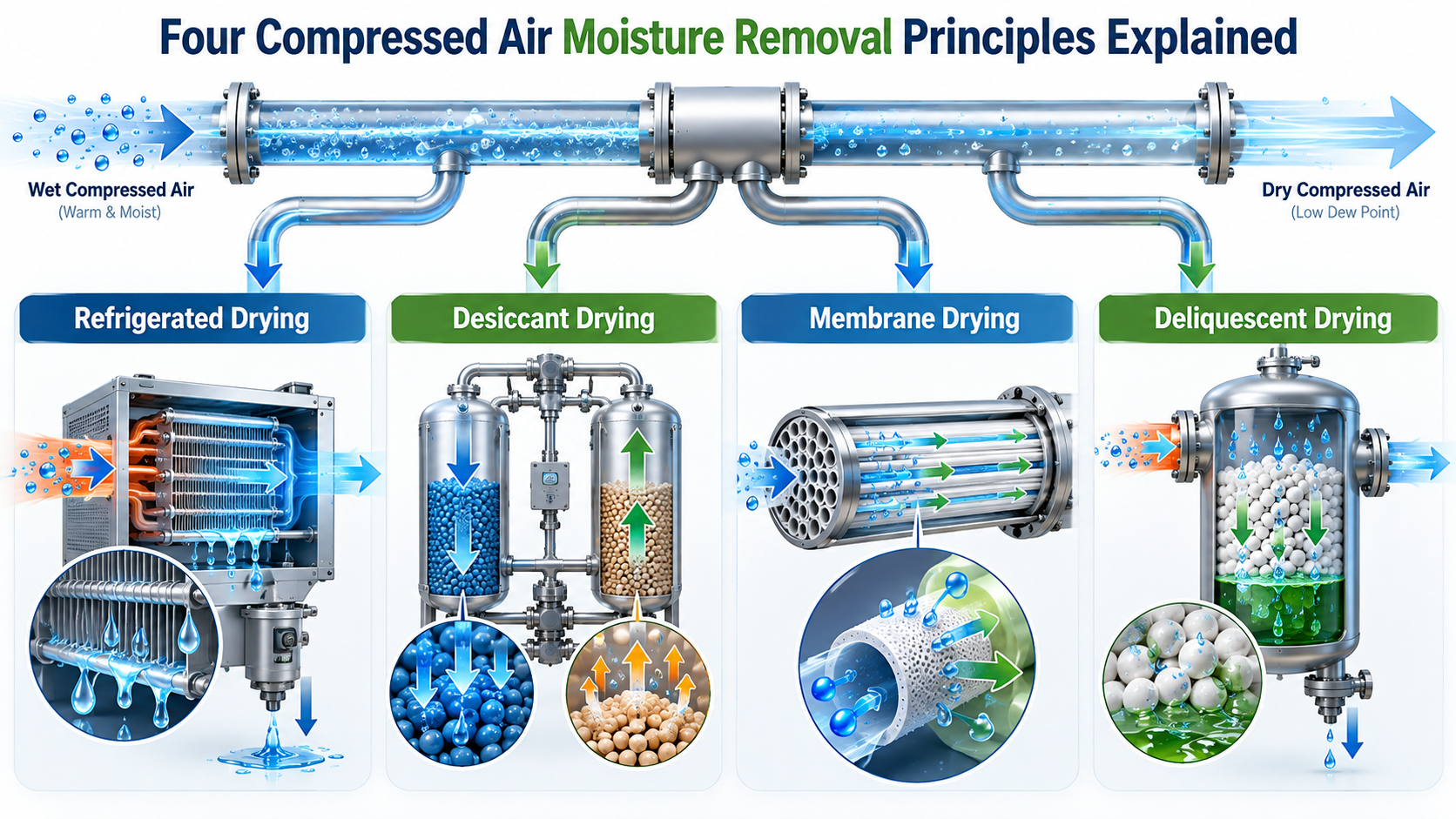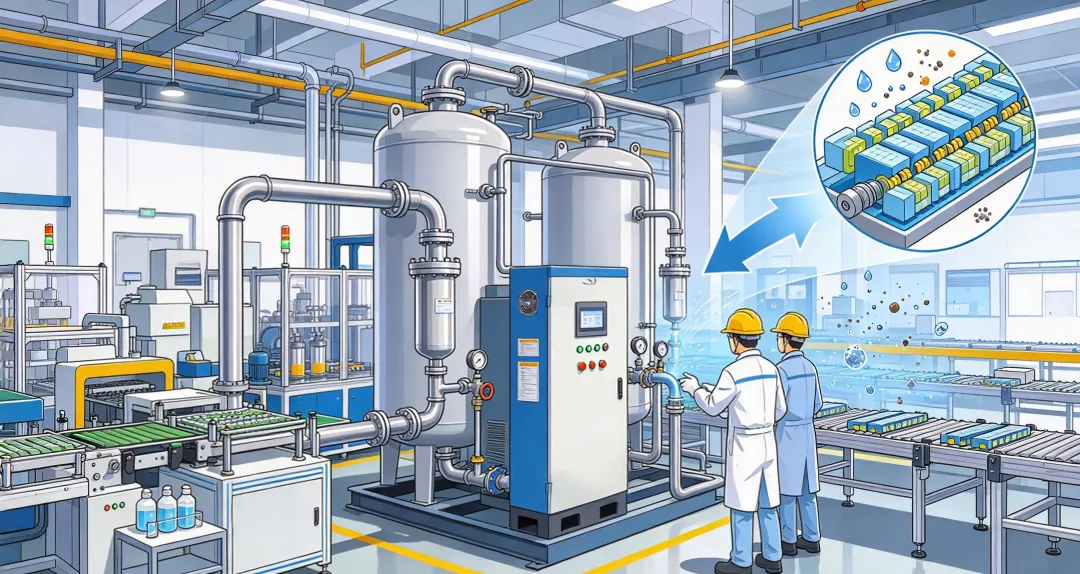
Compressed air can carry dust, rust, oil aerosols, condensed moisture, and other contaminants downstream from the compressor. Without effective filtration, these contaminants can increase equipment wear, affect product quality, shorten dryer life, and raise maintenance costs.
Lingyu’s precision compressed air filters are available in different filtration grades so that air treatment can be matched to the actual contamination level and downstream air-quality requirement.
Rather than simply choosing the finest available filter, an effective system normally uses the appropriate filtration stages in sequence while maintaining adequate airflow and low pressure drop.
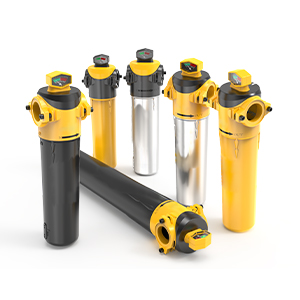
Understanding AO, AA, AX and ACS Filter Grades
Each filtration grade serves a different purpose.
| Grade | Application / Description | Particle Filtration Rating | Residual Oil Content |
|---|---|---|---|
| AO | Pre-filter | ≤1.0 μm | ≤3 ppm |
| AA | Oil and particulate removal filter | ≤0.1 μm | ≤0.1 ppm |
| AX | High-efficiency oil removal filter | ≤0.01 μm | ≤0.05 ppm |
| ACS | Activated carbon oil removal filter | Not specified as a particle grade | ≤0.003 ppm |
These values describe different filtration functions, so the grades should not automatically be treated as interchangeable.
AO Grade: Pre-Filtration
AO is primarily used as a pre-filter.
With particle filtration to ≤1.0 μm and residual oil content to ≤3 ppm, it is suitable for removing larger contaminants before air reaches finer filters, dryers, or general-purpose equipment.
Typical roles include:
- General compressed air pre-filtration
- Protection of downstream filters
- Pneumatic tools
- General manufacturing equipment
- Automation systems
AO filtration can also reduce the contaminant burden on subsequent AA or AX elements.
AA Grade: Fine Oil and Particle Removal
AA provides finer filtration than AO, with:
- Particle filtration: ≤0.1 μm
- Residual oil content: ≤0.1 ppm
It can be used where compressed air quality requirements are higher or where downstream equipment is more sensitive to oil aerosols and particles.
Applications may include precision manufacturing, instrumentation, laboratory systems, and selected production processes.
AX Grade: High-Efficiency Oil Removal
AX provides the finest stated particle filtration among the particulate grades:
- Particle filtration: ≤0.01 μm
- Residual oil content: ≤0.05 ppm
It is suitable as a high-efficiency filtration stage in compressed air systems where very fine particles and oil aerosols need to be tightly controlled.
Potential applications include electronics and precision manufacturing, instrumentation, sensitive pneumatic equipment, and other processes with stringent contamination requirements.
ACS Grade: Activated Carbon Oil Removal
ACS serves a different function.
It is an activated carbon oil removal filter designed to reduce residual oil content to ≤0.003 ppm under specified conditions.
Because its primary purpose is oil removal rather than particulate filtration, a particle filtration rating should not be assumed for ACS from the AO, AA, or AX specifications.
ACS is generally most useful as a downstream polishing stage after appropriate particulate and coalescing filtration.
Do You Need Every Filter Grade?
Not every compressed air system requires AO, AA, AX, and ACS together.
The correct combination depends on:
- Compressor type
- Inlet contamination
- Required final air quality
- Downstream equipment
- Dryer type
- Oil sensitivity of the process
- Particle sensitivity of the application
- Acceptable system pressure drop
A general industrial pneumatic line may require fewer filtration stages than a semiconductor, analytical, or other high-purity process.
The goal is to meet the required air quality without adding unnecessary filtration stages and pressure loss.
How to Select the Correct Filter Size
Filtration grade determines how clean the air needs to be. Filter size determines how much air the filter can process.
Both must be selected correctly.
Match Peak Airflow
Filter capacity should be based on peak compressed air demand rather than average consumption.
For example, the LYAF-D060AO/AA/AX model is rated at 6.5 m³/min and uses an RC1½” connection with one 060K filter element.
Other listed models include:
| Model | Rated Airflow | Connection | Element |
|---|---|---|---|
| LYAF-D015AO/AA/AX | 1.5 m³/min | RC3/4″ | 015K ×1 |
| LYAF-D024AO/AA/AX | 2.5 m³/min | RC1″ | 024K ×1 |
| LYAF-D035AO/AA/AX | 3.8 m³/min | RC1½” | 035K ×1 |
| LYAF-D060AO/AA/AX | 6.5 m³/min | RC1½” | 060K ×1 |
| LYAF-D090AO/AA/AX | 10.5 m³/min | RC2″ | 090K ×1 |
| LYAF-D120AO/AA/AX | 13.5 m³/min | RC2½” | 120K ×1 |
| LYAF-D150AO/AA/AX | 17 m³/min | RC2½” | 150K ×1 |
| LYAF-D220AO/AA/AX | 21.5 m³/min | RC3″ | 220K ×1 |
| LYAF-D240AO/AA/AX | 28.8 m³/min | RC3″ | 240K ×1 |
Larger flanged carbon-steel configurations are also available for higher flow requirements.
Check Connection Size
Pipeline size and filter connection size should be compatible.
An undersized connection can increase air velocity and pressure drop, while unnecessary reducers and adapters can complicate installation and servicing.
Consider Future Demand
A modest allowance for expected future airflow growth may be useful, but excessive oversizing is not automatically beneficial.
The filter should be selected around realistic maximum operating demand.
Why Pressure Drop Matters
Every filter creates some resistance to airflow.
As the element collects contaminants, this resistance can increase. Excessive pressure drop forces the compressor to maintain a higher discharge pressure to provide the same pressure at the point of use.
That means a dirty filter can create an energy penalty even if it still appears to be filtering effectively.
Lingyu precision filters use an enlarged and optimized internal flow path intended to reduce pressure loss.
The filter housing also includes a differential pressure indicator that provides a visual indication of element condition and helps operators determine when replacement may be necessary.
Filter Placement in a Compressed Air System
Correct placement is just as important as filter grade.
A compressed air treatment system may use filters at different points depending on the required air quality.
For example, AO filtration may be used before a dryer to reduce the contamination load. AA and AX filtration can then provide progressively finer treatment.
Filtration may also be used downstream of a desiccant air dryer to capture fine desiccant particles before the air reaches sensitive production equipment.
The exact sequence should be selected according to the compressor, dryer, final air requirement, and actual operating conditions.
Why Multi-Stage Filtration Is Often Better
Installing only the finest filter directly after a heavily contaminated air source can shorten element life and increase pressure drop rapidly.
Multi-stage filtration distributes the contaminant load.
For example, a system may use:
AO → AA → AX
Each stage removes progressively finer contamination.
Where extremely low residual oil is required, an ACS activated carbon stage may be added after suitable upstream filtration.
This staged approach can help:
- Protect finer filter elements
- Extend replacement intervals
- Maintain more stable air quality
- Reduce sudden increases in pressure drop
- Protect downstream dryers and equipment
The exact sequence should still be matched to the application’s air-quality requirement.
Applications for Precision Compressed Air Filters
Different industries require different combinations of particle and oil control.
Semiconductor and PCB Manufacturing
Fine particles and oil contamination can be problematic in sensitive manufacturing environments.
For semiconductor and PCB manufacturing, higher-grade filtration can support compressed air treatment for production equipment, pneumatic systems, and other contamination-sensitive processes.
Laboratory and Analytical Equipment
Analytical instruments can require carefully controlled compressed air.
In laboratory and analytical applications, filtration may be used to protect instruments and provide cleaner air for pneumatic or analytical processes.
Medical and Dental Systems
Oil aerosols, particles, and moisture need careful control in many medical compressed air applications.
For medical and dental equipment, the filter configuration should be selected as part of the complete treatment system according to the required final air quality.
Food and Beverage Processing
Compressed air may be used in packaging, pneumatic machinery, conveying, and other production operations.
For food and beverage applications, filtration should be selected according to whether the air is used indirectly for equipment operation or has a more sensitive process role.
Automation and General Manufacturing
Pneumatic valves, cylinders, actuators, and control systems can suffer from contamination.
AO or finer filtration can help reduce particles and oil aerosols reaching these components, supporting more consistent operation and potentially reducing maintenance requirements.
Maintenance Strategies for Reliable Filtration
Compressed air filters are not fit-and-forget components.
Their performance depends heavily on element condition, drainage, seals, and installation.
Monitor the Differential Pressure Indicator
A rising differential pressure is one of the clearest signs that a filter element is becoming restricted.
Waiting until pressure loss becomes severe increases compressor energy consumption and may disrupt production pressure.
Replace Elements When Required
Filter elements gradually accumulate contaminants and lose effective capacity.
Replacement timing depends on actual contamination, operating hours, pressure drop, and plant conditions.
Dusty, humid, or oil-contaminated environments may require more frequent inspection than cleaner systems.
Check the Automatic Condensate Drain
Lingyu filter housings are equipped with automatic condensate drainage.
The drain should be inspected regularly to make sure accumulated liquid is discharged properly.
A blocked drain can allow contaminants to collect inside the housing and potentially carry downstream.
Keep the Housing Clean During Service
When replacing an element, prevent dirt from entering the clean side of the housing.
Wipe accessible sealing surfaces and inspect the inside of the filter bowl before installing the new element.
Inspect Seals and Connections
Air leakage wastes compressed air and can interfere with system performance.
Seals, threaded connections, flanges, and the filter bowl should be checked for signs of leakage or damage.
The bayonet-style connection between the filter head and bowl is designed to simplify element servicing.
Protecting Air Dryers With Proper Filtration
Filters and dryers perform different functions.
A dryer primarily controls moisture, while precision filters remove particles, oil aerosols, and other contaminants according to their filtration grade.
Without adequate upstream filtration, oil and particles can contaminate a desiccant bed and reduce dryer performance.
Likewise, downstream filtration can prevent desiccant dust from reaching production equipment.
This is why filters and dryers should be designed as one air-treatment system rather than treated as unrelated components.
How Filtration Affects Energy Efficiency
A more efficient filtration system is not simply the one with the finest filtration grade.
It is the system that meets the required air quality with the lowest practical pressure loss.
Several practices help achieve this:
- Select adequate airflow capacity
- Avoid undersized filters
- Replace restricted elements promptly
- Maintain condensate drains
- Eliminate leaks
- Use staged filtration rather than overloading one fine element
- Avoid adding filtration stages that the process does not require
Low pressure drop throughout the air-treatment system reduces the amount of compressor pressure needed to maintain the required pressure at the point of use.
Choosing Between AO, AA, AX and ACS
The filter grade should follow the actual contamination-control objective.
Choose AO when the primary need is general pre-filtration and larger-particle removal.
Choose AA when finer particles and oil aerosols must be reduced.
Choose AX where high-efficiency particulate and oil-aerosol removal is required.
Choose ACS when the objective is to further reduce residual oil using activated carbon after appropriate upstream filtration.
For many applications, the correct solution is a staged combination rather than one filter grade used by itself.
Building a Reliable Compressed Air Purification System
Successful compressed air filtration depends on matching the filter grade, flow capacity, pipe connection, dryer, drainage, and downstream process requirements.
AO, AA, AX, and ACS filters each serve a different role. Selecting them according to their actual filtration function helps protect equipment while avoiding unnecessary pressure loss and operating cost.
For help selecting the correct filter grade, capacity, and treatment sequence, contact Lingyu with your airflow, operating pressure, compressor type, dryer configuration, and required final air quality.