A compressed air system often needs three different functions before air reaches the point of use: filtration, moisture control, and pressure regulation. These functions are sometimes described together as a “compressed air filter dryer regulator,” but in industrial systems they are not necessarily contained in one compact device.
A more accurate approach is to treat the filter, dryer, and regulator as separate but coordinated components. Each solves a different air-quality or operating problem, and the correct configuration depends on the compressor, required pressure dew point, contaminant limits, airflow, and end-use pressure.
What Is a Compressed Air Filter Dryer Regulator?
The term compressed air filter dryer regulator generally refers to an air-treatment arrangement that performs three functions:
Filter: removes specified particles, oil aerosols, and other contaminants according to the filtration grade.
Dryer: reduces water vapor to achieve the required pressure dew point.
Regulator: reduces and controls downstream air pressure for equipment or processes.
For small pneumatic systems, some of these functions may be packaged closely together. In larger industrial installations, however, the dryer is typically a separate piece of equipment, while filters and pressure regulators are positioned according to system requirements.
Understanding these distinctions is important because a filter cannot replace a dryer, and a pressure regulator cannot correct inadequate moisture treatment.
Why Compressed Air Needs Multiple Treatment Stages
Atmospheric air contains moisture and airborne contaminants. Depending on compressor type and system condition, compressed air may also contain oil aerosols, wear particles, rust, and other contamination.
As hot compressed air cools, water vapor can condense into liquid.
Without suitable treatment, these contaminants can contribute to corrosion, pneumatic valve and cylinder problems, blocked passages, process contamination, and shortened equipment life.
A complete treatment system therefore considers three separate questions:
How dry must the air be?
How clean must the air be?
What pressure does the end-use equipment require?
The answers determine the dryer technology, filter grades, and regulator arrangement.
How the Three Components Work
1. Compressed Air Filter
A compressed air filter removes specified contaminants from the airflow.
Different filter grades are designed for different purposes. A coarse or pre-filter is not equivalent to a high-efficiency oil-removal filter, and an activated-carbon filter serves a different purpose from a particulate filter.
Lingyu’s precision compressed air filter range includes several filtration grades:
| Filter Grade | Particle Rating | Residual Oil |
|---|---|---|
| AO | ≤1.0 μm | ≤3 ppm |
| AA | ≤0.1 μm | ≤0.1 ppm |
| AX | ≤0.01 μm | ≤0.05 ppm |
| ACS | Not specified as a particle grade | ≤0.003 ppm |
The correct filter combination depends on the compressor, dryer technology, downstream process, and required final air quality.
2. Compressed Air Dryer
A dryer addresses water vapor.
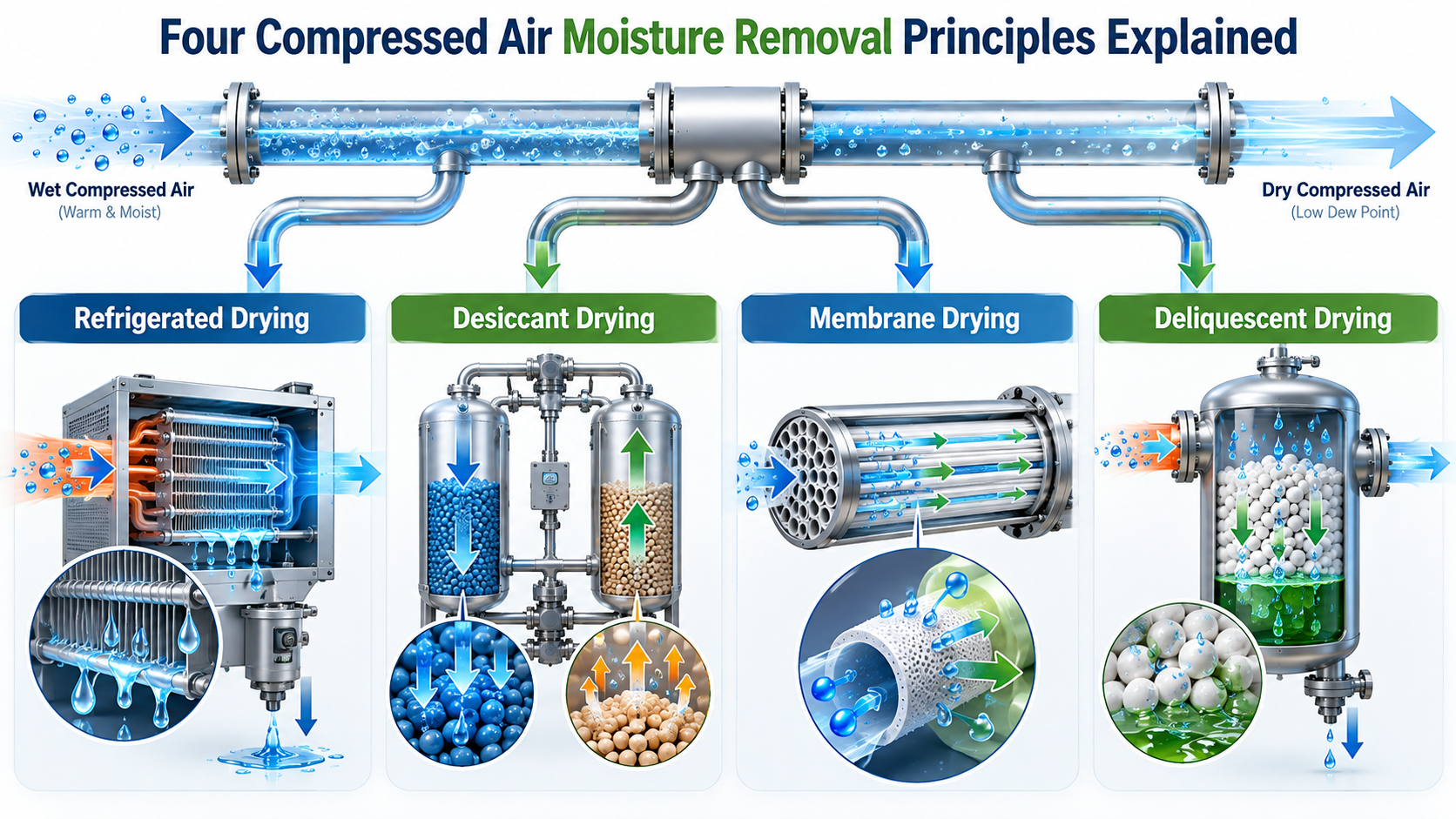
Two major industrial approaches are refrigerated drying and adsorption drying.
A refrigerated dryer cools compressed air so that water vapor condenses. The liquid is then separated and drained.
An adsorption dryer passes compressed air through a desiccant bed, where water vapor is adsorbed onto the desiccant surface. This technology is used when a substantially lower pressure dew point is required.
3. Pressure Regulator
A pressure regulator controls downstream pressure.
For example, the main compressed air distribution system may operate at a higher pressure than a particular pneumatic tool or process requires. A regulator reduces the pressure to an appropriate downstream setting.
Regulation should be performed as close as practical to the relevant pressure requirement while maintaining sufficient upstream pressure and flow.
A regulator does not dry or filter the air unless those functions are provided by separate components.
Typical Compressed Air Treatment Sequence
There is no single configuration suitable for every installation, but a simplified industrial arrangement may look like:
compressor → aftercooler → separator/receiver → pre-filtration → dryer → downstream filtration → distribution → pressure regulation → point of use
The exact sequence depends on dryer technology and required air quality.
For example, adsorption dryers can require specific upstream filtration to protect the desiccant from oil and other contamination.
Downstream filters may also be needed to control particles or other contaminants according to the final specification.
Why a Filter Cannot Replace an Air Dryer
A standard compressed air filter can remove liquid droplets, particles, or oil aerosols according to its design, but it does not remove water vapor in the same way as a dryer.
This distinction becomes important after the compressed air leaves the filter.
If water vapor remains in the air and the downstream temperature falls below its pressure dew point, additional liquid water can condense.
A dryer controls this risk by reducing the water-vapor content of the compressed air.
Refrigerated Drying for General Industrial Air
A refrigerated air dryer removes moisture through cooling and condensation.
For Lingyu’s conventional AH air-cooled and WH water-cooled refrigerated dryers, the specified pressure dew point is 2–10°C under rated conditions.
Typical AH/WH operating parameters include:
| Parameter | Specification |
|---|---|
| Rated inlet pressure | 0.7 MPa |
| Operating pressure | 0.6–1.0 MPa |
| Rated inlet temperature | 50°C |
| Maximum inlet temperature | ≤80°C |
| Pressure dew point | 2–10°C |
| Rated ambient temperature | 32°C |
| Ambient operating range | 2–45°C |
| Pressure drop | ≤0.025 MPa |
This level of drying is suitable for many general manufacturing and indoor pneumatic applications.
If the downstream system is exposed to temperatures below the delivered PDP, however, additional condensation can occur.
Desiccant Drying for Lower Pressure Dew Points
Where significantly drier compressed air is required, a desiccant air dryer may be more appropriate.
For example, Lingyu’s CH heatless adsorption technology specifies a −50°C to −20°C pressure dew point, with 8–14% regeneration air consumption under its specified operating conditions.
The CH heated regeneration technology provides the same specified PDP range while reducing regeneration air consumption to 4–8% by introducing external heat.
The correct technology should therefore be selected from the required PDP and lifecycle operating conditions rather than assuming that either refrigerated or adsorption drying is universally better.
Where Should the Pressure Regulator Be Installed?
Pressure regulation is usually most effective when matched to the actual downstream pressure requirement.
If several machines require different pressures, regulating the entire plant to one end-use pressure may not be practical.
Instead, the main distribution system can supply adequate pressure while individual branches or points of use regulate pressure for specific equipment.
The regulator must also be sized for the required flow. An undersized regulator can create excessive pressure loss during periods of high demand.
Pressure Drop Matters Across the Entire System
Every treatment component creates some resistance to airflow.
The total pressure drop can include losses through:
filters + dryer + regulator + valves + fittings + piping
If these losses become excessive, the compressor may need to operate at a higher discharge pressure to maintain adequate pressure at the point of use.
This can increase system energy consumption.
For that reason, treatment components should not simply be selected for the highest possible filtration efficiency or smallest physical size. Flow capacity and pressure drop must also be considered.
How to Select the Right Filter
Filter selection begins with the final air-quality requirement.
General Equipment Protection
For general pneumatic applications, the objective may primarily be removing larger particles, liquid contamination, and oil aerosols to protect downstream equipment.
Sensitive Production Processes
Electronics, coating, instrumentation, and other sensitive processes may require tighter contamination control.
Oil-Sensitive Applications
Where residual oil requirements are particularly strict, additional high-efficiency or activated-carbon treatment may be appropriate.
The final configuration should be based on the specified particle and oil limits rather than assuming that every application needs every filter grade.
How to Select the Right Dryer
Required Pressure Dew Point
This is one of the most important criteria.
If approximately 2–10°C PDP meets the requirement, conventional refrigerated drying may be suitable.
If a much lower PDP is required, adsorption drying should be evaluated.
Peak Airflow
The dryer must accommodate the maximum airflow passing through it, not merely average consumption.
Inlet Temperature
Higher inlet temperature increases the thermal and moisture load.
Operating Pressure
Dryer capacity changes with pressure, so actual operating conditions should be considered.
Environmental Conditions
For air-cooled refrigerated dryers, ambient temperature and ventilation affect condenser performance.
For water-cooled dryers, cooling-water temperature, pressure, flow, and quality must be considered.
How to Select the Right Regulator
A pressure regulator should be selected according to:
- Required inlet and outlet pressure
- Maximum airflow
- Acceptable pressure drop
- Connection size
- Required control stability
- Downstream equipment requirements
Selecting a regulator only by pipe diameter can result in poor pressure stability if its actual flow characteristics are insufficient.
Automotive Applications
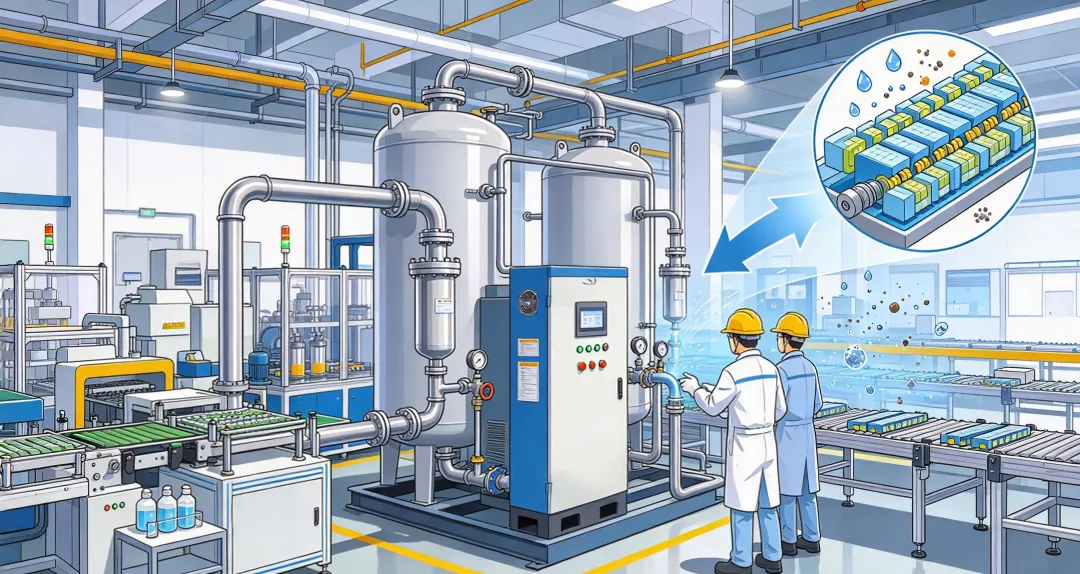
In automotive and general manufacturing, compressed air may operate pneumatic tools, cylinders, assembly equipment, and paint systems.
Different end uses can require different treatment levels.
A pneumatic wrench may tolerate air-quality conditions that would be inappropriate for a precision coating process.
For painting, moisture control should therefore be combined with suitable oil and particle filtration based on the finishing requirement.
Electronics and Precision Manufacturing
In electronics and precision manufacturing, compressed air can support pneumatic equipment, automation, and production processes.
Moisture, oil, and particles may have different effects depending on how the compressed air interacts with the process.
Where the application requires a pressure dew point substantially below refrigerated drying capability, adsorption technology should be considered rather than simply adding finer filtration.
Food and Beverage Applications
In food and beverage production, compressed air may support packaging, conveying, pneumatic equipment, and processing operations.
A filter-dryer-regulator arrangement should not automatically be assumed to produce food-contact-quality compressed air.
The required moisture, particle, oil, and microbiological limits depend on how the air is used and whether it contacts products or product-contact surfaces.
Treatment equipment should be selected according to the specific process requirement.
Maintenance of Filters, Dryers and Regulators
Maintenance should be based on the actual component, operating environment, contamination level, operating hours, and manufacturer requirements rather than one universal service interval.
For filters, monitor differential pressure and element condition and verify automatic drain operation.
For refrigerated dryers, inspect condenser cleanliness, drains, refrigeration performance, heat exchangers, and electrical components.
For adsorption dryers, monitor desiccant condition, valves, purge or regeneration systems, silencers, controls, and pressure dew-point performance.
For regulators, check pressure stability, leakage, adjustment behavior, and contamination.
Common Selection Mistakes
Choosing Everything by Compressor CFM
Nominal compressor airflow is only one parameter.
Temperature, pressure, required PDP, contamination limits, and pressure drop also affect equipment selection.
Assuming a Filter Removes Water Vapor
A filter can remove liquid water droplets according to its design, but water vapor requires drying.
Assuming a Dryer Removes Every Contaminant
Dryers primarily address moisture. Particle and oil requirements must be handled through appropriate filtration.
Using Excessively Fine Filtration Without a Requirement
More filtration stages can increase cost and pressure drop.
Filter grades should be selected according to the actual final air-quality specification.
Regulating Pressure Too Early
Reducing pressure unnecessarily before a long distribution run can leave insufficient pressure at downstream equipment during peak flow.
Pressure-control strategy should consider the complete distribution system.
Frequently Asked Questions
Do I need a filter, dryer and regulator?
Not every compressed air application requires exactly the same configuration.
The need for each component depends on required moisture level, contamination limits, and end-use pressure.
Many industrial systems use all three functions, but they may be distributed throughout the system rather than packaged into one unit.
Should the filter go before or after the dryer?
It depends on the dryer and filtration requirement.
Upstream filtration can protect the dryer from contaminants, while downstream filtration may control particles, oil, or other contaminants before the air reaches the process.
Follow the treatment sequence specified for the selected dryer and required final air quality.
Does a refrigerated dryer remove oil?
Its primary function is moisture removal through cooling and condensation.
Appropriate filtration should be used when residual oil limits must be controlled.
What pressure dew point should I choose?
Choose a PDP that prevents unwanted downstream condensation and satisfies the process requirement.
General indoor plant air may be adequately served by refrigerated drying, while freezing environments or moisture-sensitive processes may require adsorption drying.
Can a regulator reduce energy consumption?
Reducing unnecessarily high end-use pressure can help reduce compressed-air consumption in some applications.
However, a regulator should not simply be installed with the assumption that it will automatically reduce compressor load. The effect depends on demand, leakage, control strategy, and the overall compressor system.
Is an automatic drain important?
Yes. Filters, separators, and refrigerated dryers can collect condensate that must be discharged reliably.
A blocked drain can allow accumulated liquid to carry downstream, while a drain that remains open can waste compressed air.
Build the Treatment System Around the Required Air Quality
A compressed air filter dryer regulator is best understood as a combination of three treatment functions rather than a universal all-in-one device.
The filter controls specified particles and oil contamination. The dryer controls water vapor and pressure dew point. The regulator controls the pressure delivered to downstream equipment.
For industrial systems, the most reliable selection process is:
define required air quality → establish pressure dew point → determine peak airflow → select dryer technology → specify filtration → evaluate pressure drop → regulate pressure for the end use
Treating these components as a coordinated system helps avoid both inadequate treatment and unnecessary equipment.
For application-specific compressed air treatment design, contact Lingyu with your airflow, operating pressure, inlet temperature, required pressure dew point, contamination limits, and end-use pressure.