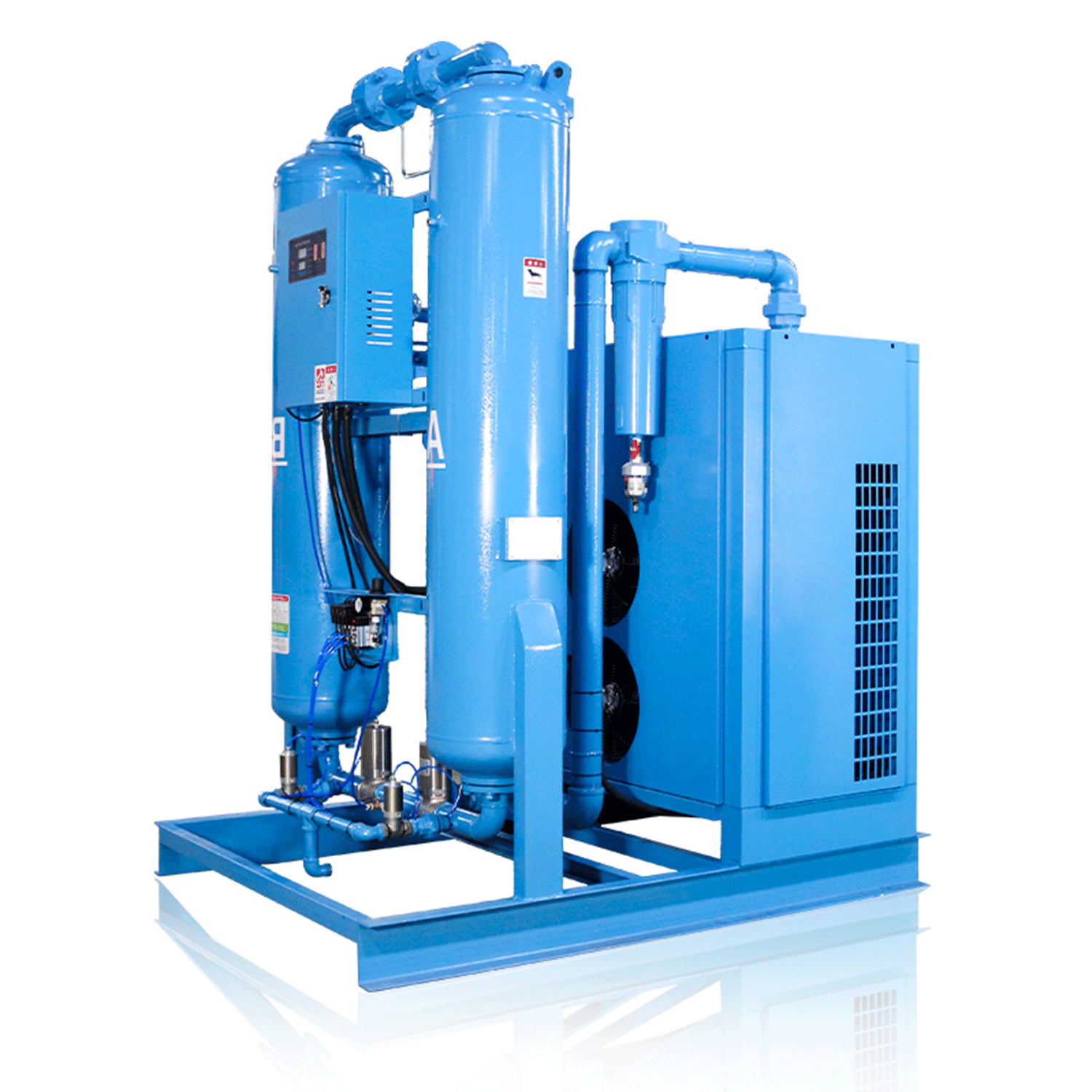
The DC Series Combined Compressed Air Dryer is designed for compressed air systems that require both effective cooling and deep moisture removal within an integrated treatment unit.
Rather than relying on a single drying method, the DC Series combines an AH Series refrigerated air dryer with a CH Series regenerative adsorption dryer. This integrated configuration allows the system to first remove a large portion of moisture through refrigeration and condensation, then use adsorption drying to achieve an outlet pressure dew point of ≤−40°C.
For users seeking a compact solution for low-dew-point compressed air, the DC Series Combined Compressed Air Dryer is available in standard capacities up to 45 m³/min, with customized configurations available for larger systems or special requirements.
How Does the DC Series Combined Dryer Work?
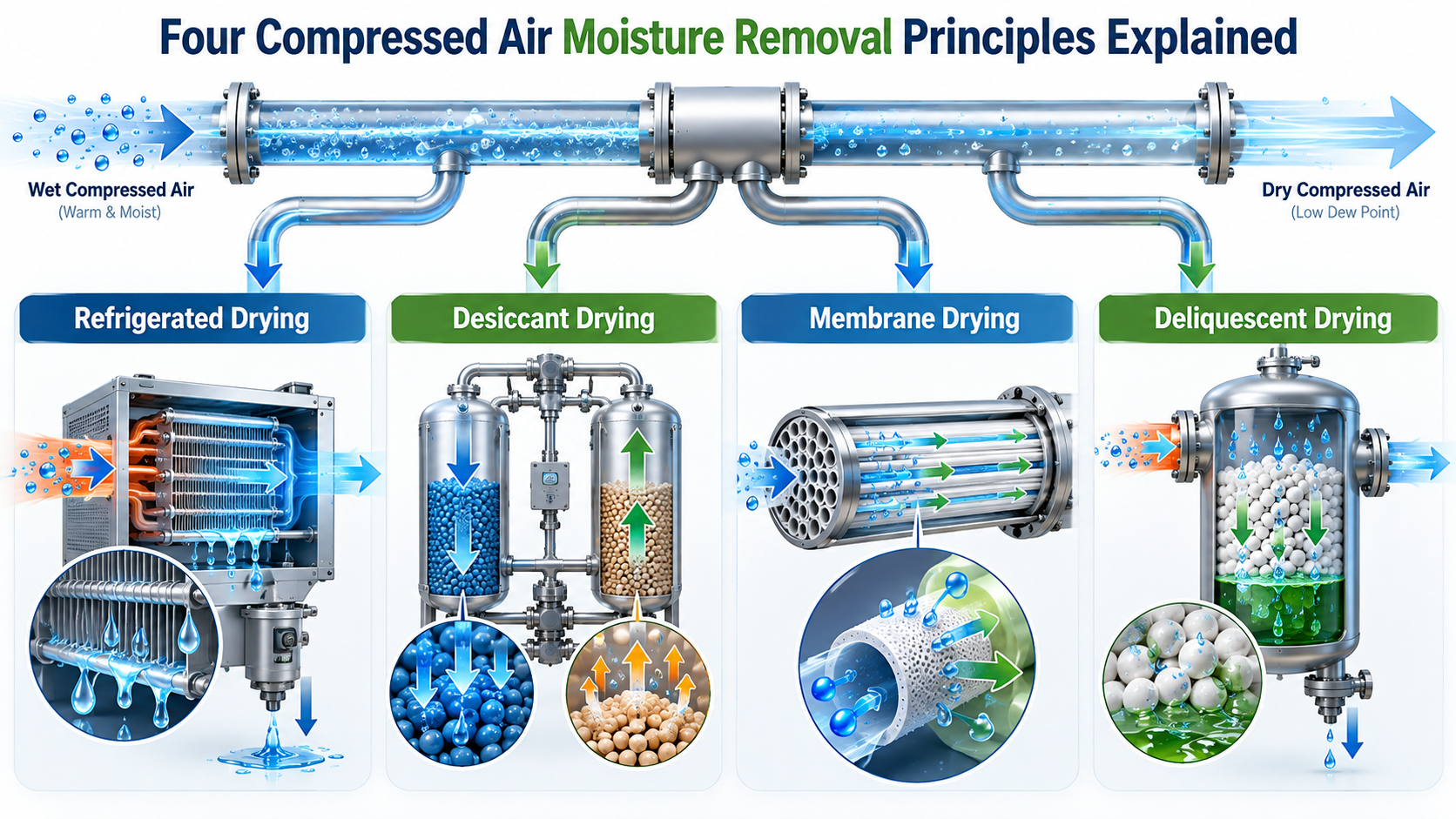
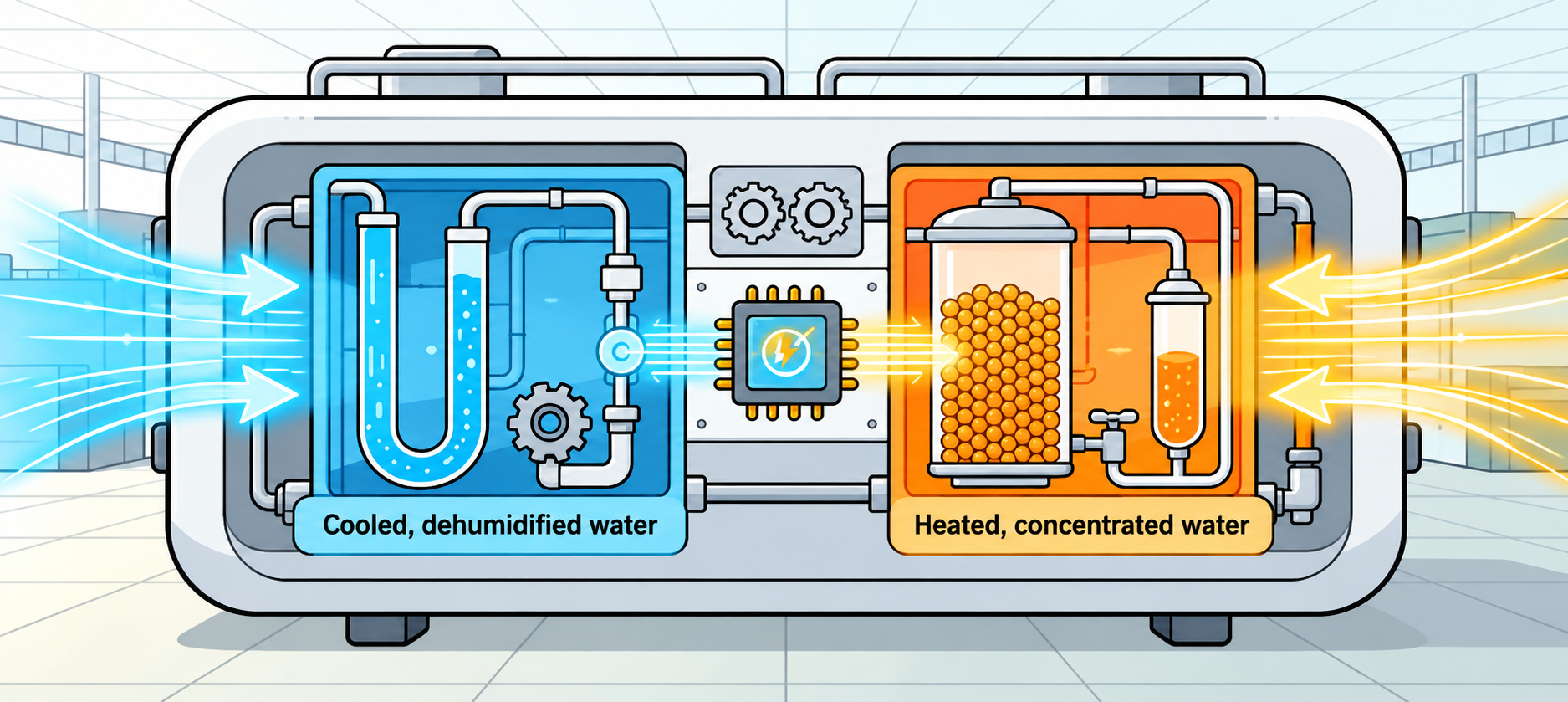
The DC Series combines refrigerated drying and adsorption drying into one coordinated system.
Compressed air first passes through the refrigerated drying stage, where its temperature is reduced. As the air cools, water vapor condenses into liquid moisture, which can then be separated and discharged.
The pre-dried compressed air subsequently enters the adsorption stage. Activated alumina removes the remaining water vapor, allowing the system to achieve a significantly lower pressure dew point than a conventional refrigerated dryer alone.
Depending on the selected configuration, the adsorption section can use either:
- Heatless regeneration
- Heated purge regeneration
The cooling section can also be configured as either:
- Air-cooled
- Water-cooled
This flexibility allows the DC Series to be matched to different installation environments, operating patterns, and energy requirements.
DC Series Operating Conditions
Standard operating conditions include:
- Applicable Medium: Compressed air / non-corrosive air
- Rated Inlet Pressure: 0.7 MPa
- Operating Pressure Range: 0.6–1.0 MPa
- Rated Inlet Temperature: 50°C
- Maximum Inlet Temperature: ≤80°C
- Regeneration Method: Heatless / heated purge regeneration
- Cooling Method: Air-cooled / water-cooled
- Outlet Pressure Dew Point: ≤−40°C
- Desiccant: Activated alumina
- Rated Ambient Temperature: 35°C
- Ambient Operating Range: 2–45°C
- Standard Maximum Airflow: 45 m³/min
For airflow above 45 m³/min or projects involving special materials, temperatures, pressures, or other technical requirements, a custom-engineered solution should be considered.
Why Combine Refrigerated and Adsorption Drying?
A combined dryer is useful because the two drying stages perform different functions.
The refrigerated section handles the initial moisture load by cooling the compressed air and removing condensed water. This reduces the amount of water vapor that must be handled by the adsorption stage.
The adsorption stage then removes the remaining vapor-phase moisture to reach a much lower pressure dew point.
This arrangement can offer several practical advantages:
- Reduced moisture load on the desiccant
- Stable low-dew-point performance
- More compact system integration
- Simplified installation compared with separately assembled equipment
- Better coordination between cooling and adsorption stages
- Improved protection of downstream equipment
For users evaluating different compressed air treatment technologies, the broader compressed air dryer product range includes refrigerated, adsorption, combined, and other specialized configurations.
How to Select the Right DC Series Dryer
Choosing the correct DC Series model requires more than matching compressor capacity.
Determine the Actual Airflow
The dryer should be selected according to the maximum compressed air flow expected during normal operation.
Standard DC Series configurations are available up to 45 m³/min.
A reasonable design margin may help accommodate short-term demand fluctuations, but excessive oversizing is unnecessary and can increase equipment cost.
The most appropriate model should therefore be based on actual peak demand, expected load variation, pressure, and temperature.
Check Inlet Pressure
The rated inlet pressure is 0.7 MPa, with a standard operating range of 0.6–1.0 MPa.
Because dryer capacity changes with operating pressure, systems running outside rated conditions should be evaluated before final equipment selection.
Pay Attention to Inlet Temperature
The DC Series is rated for an inlet temperature of 50°C, with a maximum allowable temperature of 80°C.
Higher inlet temperatures increase both thermal load and moisture load.
The refrigerated stage therefore plays an important role in cooling the incoming compressed air before adsorption drying takes place.
Confirm the Required Dew Point
The DC Series is designed to provide an outlet pressure dew point of ≤−40°C.
Such a low dew point is useful where moisture can interfere with production processes, pneumatic equipment, instrumentation, or product quality.
If the downstream process only requires a moderate dew point, a standalone refrigerated air dryer may be sufficient and could provide a simpler solution.
Heatless vs. Heated Purge Regeneration
One of the main DC Series selection decisions is the regeneration method used in the adsorption section.
Heatless Regeneration
Heatless regeneration uses part of the dry compressed air to regenerate the desiccant.
Its main advantages are structural simplicity and straightforward maintenance because there is no regeneration heater.
It can be a suitable choice where:
- Simplicity is important
- Maintenance resources are limited
- Compressed air demand is moderate
- Purge-air consumption is acceptable
Heated Purge Regeneration
Heated purge regeneration uses external heat during regeneration, reducing the amount of dry compressed air required compared with a conventional heatless cycle.
It may be more appropriate where:
- The dryer operates continuously
- Compressed air is relatively expensive
- System capacity is larger
- Lower purge-air consumption is an important operating objective
The correct choice should be based on total operating cost rather than only initial equipment price.
Air-Cooled vs. Water-Cooled Configuration
The refrigeration stage can also be selected according to site conditions.
Air-Cooled Configuration
Air-cooled systems reject heat directly to the surrounding air.
They are generally easier to install because no cooling-water circuit is required.
Air-cooled configurations are often suitable where:
- Cooling water is unavailable
- Installation simplicity is important
- Ambient temperature can be adequately controlled
- Sufficient ventilation is available
Water-Cooled Configuration
Water-cooled systems transfer refrigeration heat through a cooling-water circuit.
They can be useful where ambient conditions make air cooling less practical or where the facility already has suitable cooling-water infrastructure.
Before selecting water cooling, users should consider water temperature, water quality, pressure, flow availability, and maintenance requirements.
Compact Integrated Design
One of the practical advantages of the DC Series is its integrated structure.
Instead of installing a refrigerated dryer, adsorption dryer, and associated components as completely separate units, the combined design integrates the major drying functions into a more compact arrangement.
This can help reduce:
- Installation footprint
- Interconnecting pipework
- Installation complexity
- On-site assembly time
- Coordination between individual dryer stages
The standard combined dryer is also equipped with an intermediate filter, with additional intermediate filtration available when required by the application.
Typical Industrial Applications
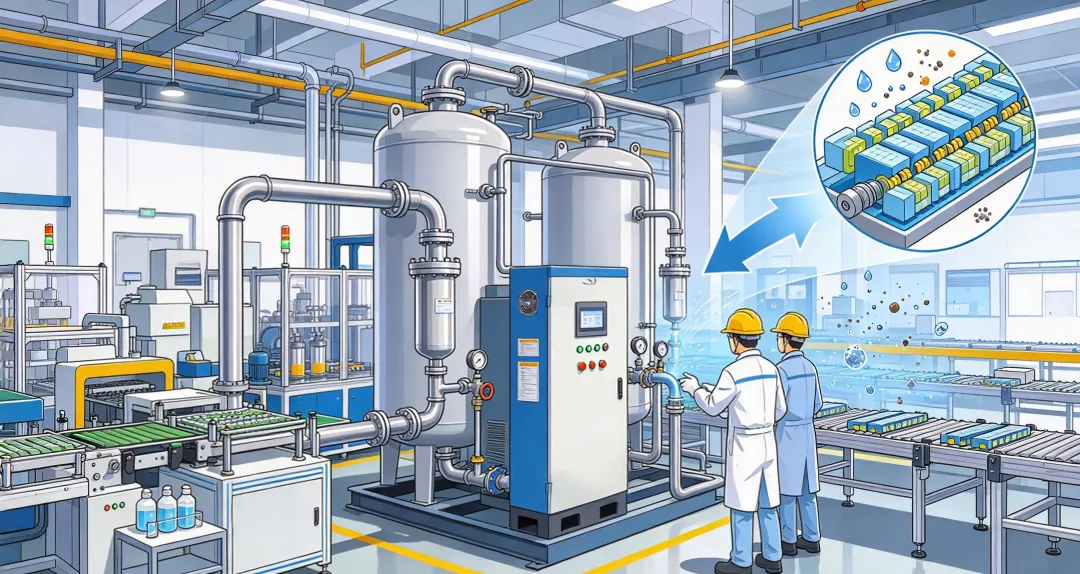
The DC Series is suitable for industries where a refrigerated dryer alone cannot provide sufficiently dry compressed air.
Electronics and Precision Manufacturing
Sensitive production processes can be affected by moisture in compressed air.
In electronics and precision manufacturing, low-dew-point air can support pneumatic tools, automation systems, test equipment, and moisture-sensitive production processes.
Semiconductor and PCB Manufacturing
Compressed air used in semiconductor and circuit-board manufacturing may require strict control of moisture and contamination.
For semiconductor and PCB manufacturing, combined drying can provide an additional level of moisture control for sensitive production environments.
Laboratory and Analytical Systems
Laboratory instruments and analytical equipment may require stable dry air for accurate operation.
In laboratory and analytical equipment applications, a low pressure dew point can support pneumatic instrumentation and moisture-sensitive analytical processes.
Medical and Dental Applications
Medical and dental compressed air systems may require carefully controlled air quality.
For medical and dental applications, the dryer can form part of a complete air treatment system designed according to the required final air quality.
Automotive and General Manufacturing
Dry compressed air can help improve the reliability of pneumatic controls, automation equipment, instruments, and production machinery.
The DC Series can therefore also support automotive and general manufacturing where low-dew-point air is required.
Why Filtration Still Matters
Even though the DC Series combines two drying technologies, filtration remains essential.
Compressed air can contain:
- Oil aerosols
- Solid particles
- Rust
- Compressor wear debris
- Condensed moisture
- Other contaminants
If these contaminants reach the adsorption bed, they can reduce desiccant performance and shorten its useful life.
Proper filtration therefore helps protect both the refrigeration and adsorption sections.
Where additional air-quality control is required, an appropriate precision compressed air filter can be incorporated into the treatment system.
Maintenance Tips for Long-Term Reliability
An integrated dryer simplifies installation, but both drying stages still require regular inspection.
Monitor Outlet Dew Point
A rising dew point can indicate problems with the refrigeration section, adsorption stage, regeneration process, airflow, inlet temperature, or desiccant condition.
Trend monitoring can help identify deterioration before production is affected.
Check Refrigeration Performance
The refrigeration stage should be monitored for proper cooling, condensate separation, drainage, and stable operation.
If the refrigerated section fails to remove enough moisture, the adsorption bed receives a much higher water load.
This can shorten adsorption cycles and reduce desiccant life.
Inspect Drainage
Condensed water must be removed effectively.
Blocked or malfunctioning drains can allow liquid moisture to carry downstream and place unnecessary stress on the adsorption stage.
Check Intermediate and External Filters
Filter elements should be inspected according to actual operating conditions.
A clogged filter increases pressure drop, while a damaged or saturated filter may allow contaminants to reach the desiccant.
Verify Regeneration Cycles
For heatless configurations, check that purge and vessel switching operate correctly.
For heated purge configurations, heating, regeneration, switching, and related control functions should be inspected as part of routine maintenance.
Inspect Desiccant Condition
Activated alumina can gradually lose performance because of contamination, mechanical wear, or long-term exposure to unfavorable operating conditions.
Desiccant should be evaluated for dusting, contamination, and declining drying performance rather than replaced solely according to a generic calendar interval.
How to Improve Operating Efficiency
System efficiency depends on the entire compressed air treatment process rather than one component.
Several measures can help improve performance.
Maintain the refrigerated stage properly. Removing as much bulk moisture as possible before adsorption reduces the regeneration burden.
Keep filters clean. Excessive pressure drop forces the compressor to operate at a higher pressure.
Select the appropriate regeneration method. Heatless regeneration emphasizes simplicity, while heated purge regeneration can reduce compressed air consumption in suitable applications.
Avoid oversized equipment. A properly sized dryer generally provides a better balance of investment and operating performance.
Repair compressed air leaks. Dryer efficiency cannot compensate for energy wasted through leaks elsewhere in the plant.
Monitor outlet dew point. Stable dew-point data provides an early indication of whether the system is operating as intended.
When Is a Combined Dryer Better Than Separate Equipment?
The DC Series can be particularly attractive where users want low-dew-point compressed air but prefer a more integrated installation.
A combined system may be appropriate when:
- Space is limited
- A ≤−40°C pressure dew point is required
- High inlet temperature must be managed
- Simplified installation is preferred
- Refrigerated pre-drying and adsorption drying are both required
- The facility wants coordinated treatment stages in one equipment package
For applications where process requirements, installation layout, or redundancy strategies call for fully independent equipment, separately installed dryers may still be preferable.
The decision should therefore consider both treatment performance and overall plant design.
DC Series vs. DH Series
The DC and DH Series are both combined compressed air dryers, but they use different adsorption stages.
The DC Series combines an AH refrigerated dryer with a CH Series adsorption dryer and uses activated alumina.
The DH Series Combined Compressed Air Dryer combines the refrigerated drying stage with an HH Series adsorption dryer, using activated alumina together with high-performance molecular sieve.
This distinction can be important when comparing desiccant configuration and project requirements.
A Practical Integrated Solution for Low-Dew-Point Air
The DC Series Combined Compressed Air Dryer integrates refrigerated drying and regenerative adsorption into a compact system designed to achieve an outlet pressure dew point of ≤−40°C.
With heatless or heated purge regeneration options, air-cooled or water-cooled configurations, activated alumina adsorption, and capacities up to 45 m³/min as standard, the series can be adapted to a wide range of industrial compressed air systems.
Correct selection should consider airflow, inlet pressure, inlet temperature, target dew point, cooling conditions, regeneration method, filtration, and actual production demand together.
For larger capacities or special operating requirements, contact Lingyu with your airflow, pressure, inlet temperature, required dew point, cooling conditions, and preferred regeneration method.