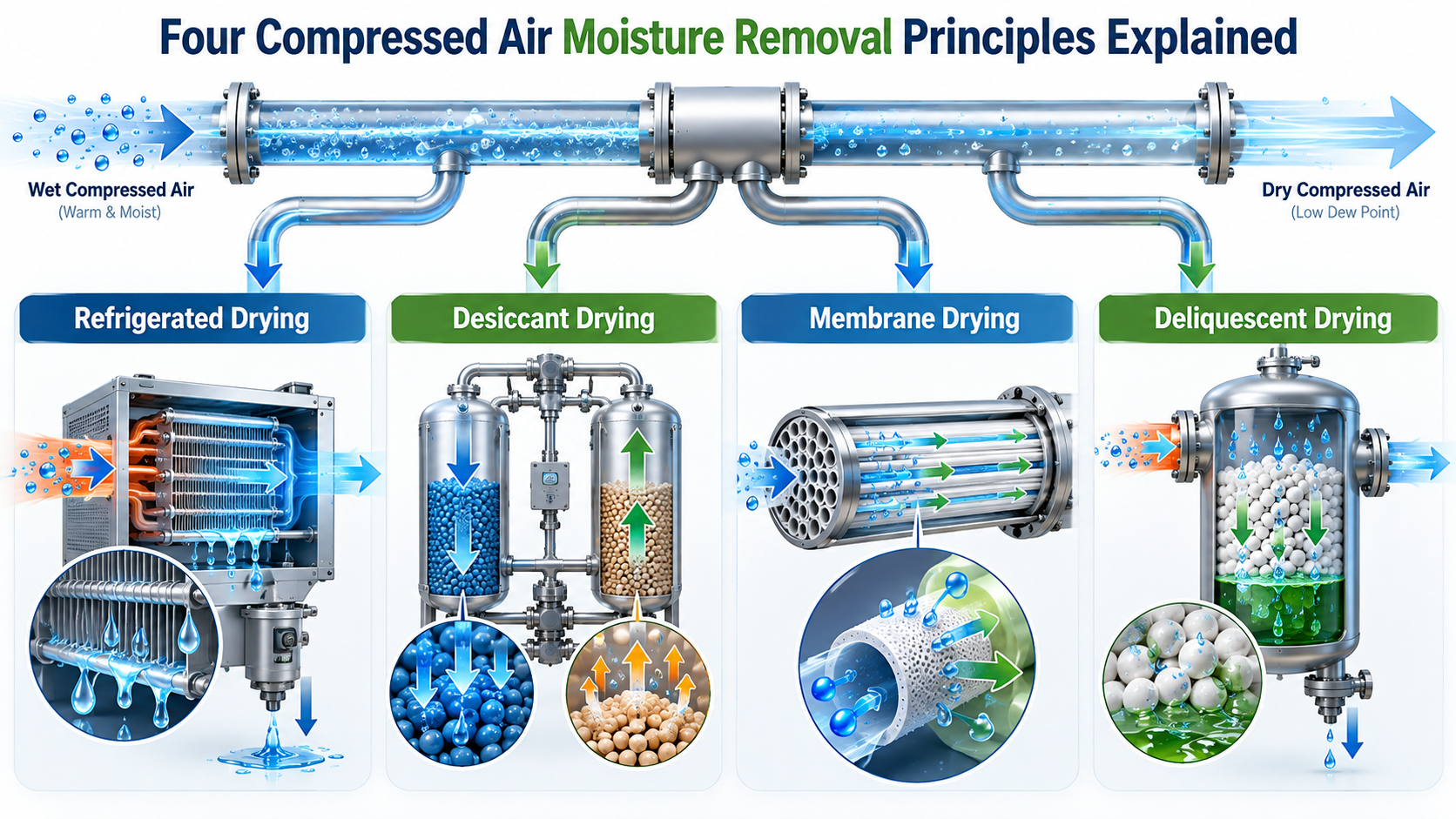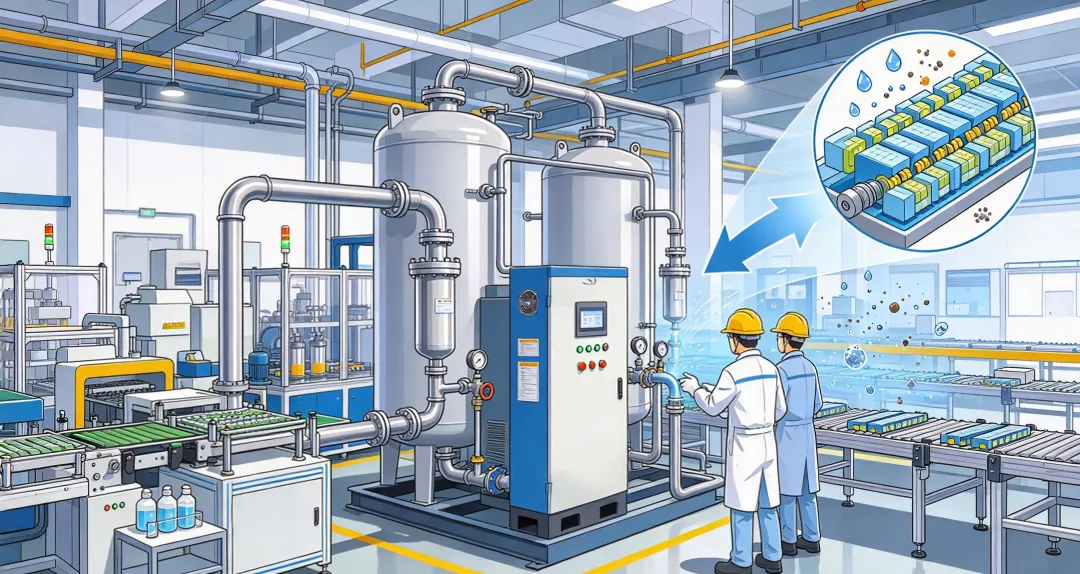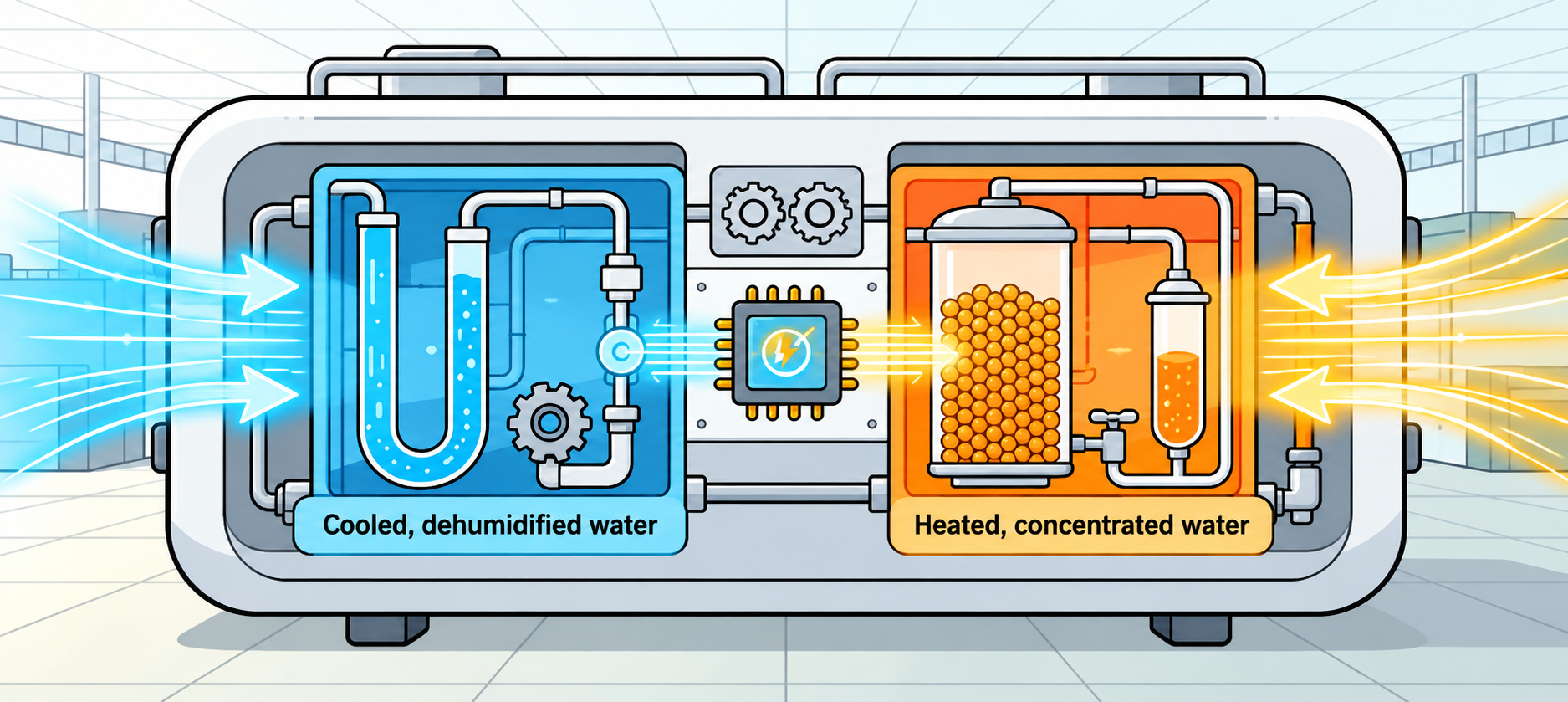
A homemade refrigerated air dryer is a DIY system intended to cool compressed air so that water vapor condenses into liquid and can be separated and drained. DIY designs are sometimes built around repurposed refrigeration or cooling equipment, but their performance, pressure integrity, electrical safety, and moisture control can vary substantially.
For hobbyists, understanding the concept can be useful for learning how compressed-air moisture control works. For a working compressed-air installation, however, any component exposed to compressed air should be properly pressure-rated, and refrigeration circuits should only be serviced by appropriately qualified personnel.
For applications requiring predictable performance, a purpose-built refrigerated air dryer provides defined operating limits, pressure dew-point performance, condensate separation, and safety provisions.
How Does Refrigerated Compressed Air Drying Work?
The basic principle behind both commercial and experimental refrigerated drying is cooling and condensation.
Compressed air contains water vapor. When that air is cooled sufficiently, some of the vapor condenses into liquid water.
The treatment sequence can be summarized as:
hot wet compressed air → cooling → condensation → gas-liquid separation → drainage → drier compressed air
Commercial refrigerated dryers optimize this process through purpose-designed heat exchangers, refrigeration controls, separators, drains, and pressure-rated components.
Why Cooling Alone Is Not Enough
A common misconception is that simply passing compressed air through a cold coil creates a complete refrigerated air dryer.
Cooling is only the first part of the process.
Once moisture condenses, the system must efficiently separate the liquid from the moving compressed-air stream and discharge it without excessive compressed-air loss.
If separation is ineffective, condensed water can simply travel downstream.
The system therefore needs to address three distinct functions:
cool the air → separate condensed liquid → remove the liquid
Commercial dryers additionally reheat the dried air through heat exchange before it enters the downstream distribution system.
Understanding Pressure Dew Point
Pressure dew point (PDP) describes the temperature at which water vapor in compressed air would begin to condense at operating pressure.
A lower PDP means drier compressed air.
A homemade system should not automatically be assumed to provide a 2–10°C PDP simply because its cooling surface reaches a similar temperature. Actual outlet PDP depends on heat transfer, airflow, inlet temperature, operating pressure, separation effectiveness, refrigeration stability, and other conditions.
By comparison, Lingyu’s conventional AH and WH refrigerated dryer technologies specify a 2–10°C pressure dew point under defined operating conditions.
This distinction between measured cooling temperature and verified pressure dew point is important when evaluating DIY performance.
Conceptual Layout of a Refrigerated Air-Drying System
At a conceptual level, moisture treatment may involve:
compressor → aftercooling → condensate separation → receiver → filtration → refrigerated drying → downstream treatment → point of use
The exact arrangement depends on compressor design and the required final air quality.
A DIY experiment should not be treated as a substitute for engineered pressure equipment simply because the refrigeration concept appears straightforward.
Why DIY Pressure-Side Construction Requires Caution
Compressed air stores substantial energy.
Components used on the compressed-air side must be suitable for the system’s actual pressure and temperature. Improvised vessels, tubing, fittings, heat exchangers, or containers without appropriate pressure ratings can create serious failure hazards.
This is particularly important when repurposing refrigeration equipment.
A component designed to contain refrigerant in its original configuration should not automatically be assumed suitable for use as a compressed-air pressure vessel or air-side heat exchanger.
For this reason, a homemade refrigerated dryer should remain an educational concept unless the pressure-side system is properly engineered using components rated and installed for the intended compressed-air service.
Refrigeration Safety Matters Too
The refrigeration side introduces another set of risks.
Refrigeration equipment can involve:
- Pressurized refrigerant
- Electrical power
- Hot compressor surfaces
- Very cold evaporator surfaces
- Refrigerant-specific environmental requirements
Opening, modifying, charging, or recovering a refrigeration circuit requires appropriate equipment and expertise and may be regulated depending on the location and refrigerant.
Repurposing a refrigerator or air conditioner therefore involves more than reconnecting its evaporator to a compressed-air line.
Why an Old Refrigerator Is Not Automatically an Air Dryer
An old refrigerator can demonstrate refrigeration principles, but it was not designed as a compressed-air dryer.
A purpose-built industrial refrigerated dryer has to manage:
- Continuous compressed-air flow
- High inlet temperature
- Operating pressure
- Moisture load
- Heat-transfer capacity
- Gas-liquid separation
- Condensate drainage
- Pressure drop
- Refrigeration control
- Freeze protection
- Variable operating load
A domestic refrigerator is designed for a very different thermal duty.
Its cooling capacity, controls, heat exchangers, and internal components should therefore not be assumed suitable for industrial compressed-air drying.
A Safer Way to Experiment With the Principle
For educational work, the refrigeration principle can be studied without fabricating an improvised high-pressure refrigeration dryer.
For example, the focus can be placed on observing how cooling affects condensation and understanding the relationship among air temperature, moisture content, separation, and drainage.
Where compressed air is involved, use commercially manufactured, appropriately pressure-rated components and remain within their specified operating limits.
This retains the educational value without assuming that salvaged refrigeration hardware is suitable for compressed-air pressure service.
Homemade vs. Commercial Refrigerated Air Dryer
| Factor | DIY/Experimental System | Purpose-Built Industrial Dryer |
|---|---|---|
| Cooling performance | Depends on design | Defined for rated conditions |
| Pressure dew point | Must be measured; not assumed | Specified by manufacturer |
| Airflow capacity | Depends on heat exchanger and conditions | Rated under defined conditions |
| Pressure integrity | Depends on selected components | Designed for stated working pressure |
| Condensate separation | Often separately engineered | Integrated into dryer design |
| Drainage | Depends on configuration | Purpose-designed drainage |
| Refrigeration controls | May be limited | Designed around dryer operation |
| Pressure drop | Must be evaluated | Specified for rated conditions |
| Industrial suitability | Not automatically established | Designed for industrial service |
The difference is therefore not simply convenience. A commercial dryer integrates refrigeration, pressure containment, moisture separation, drainage, controls, and defined operating performance.
How a Commercial Refrigerated Air Dryer Works
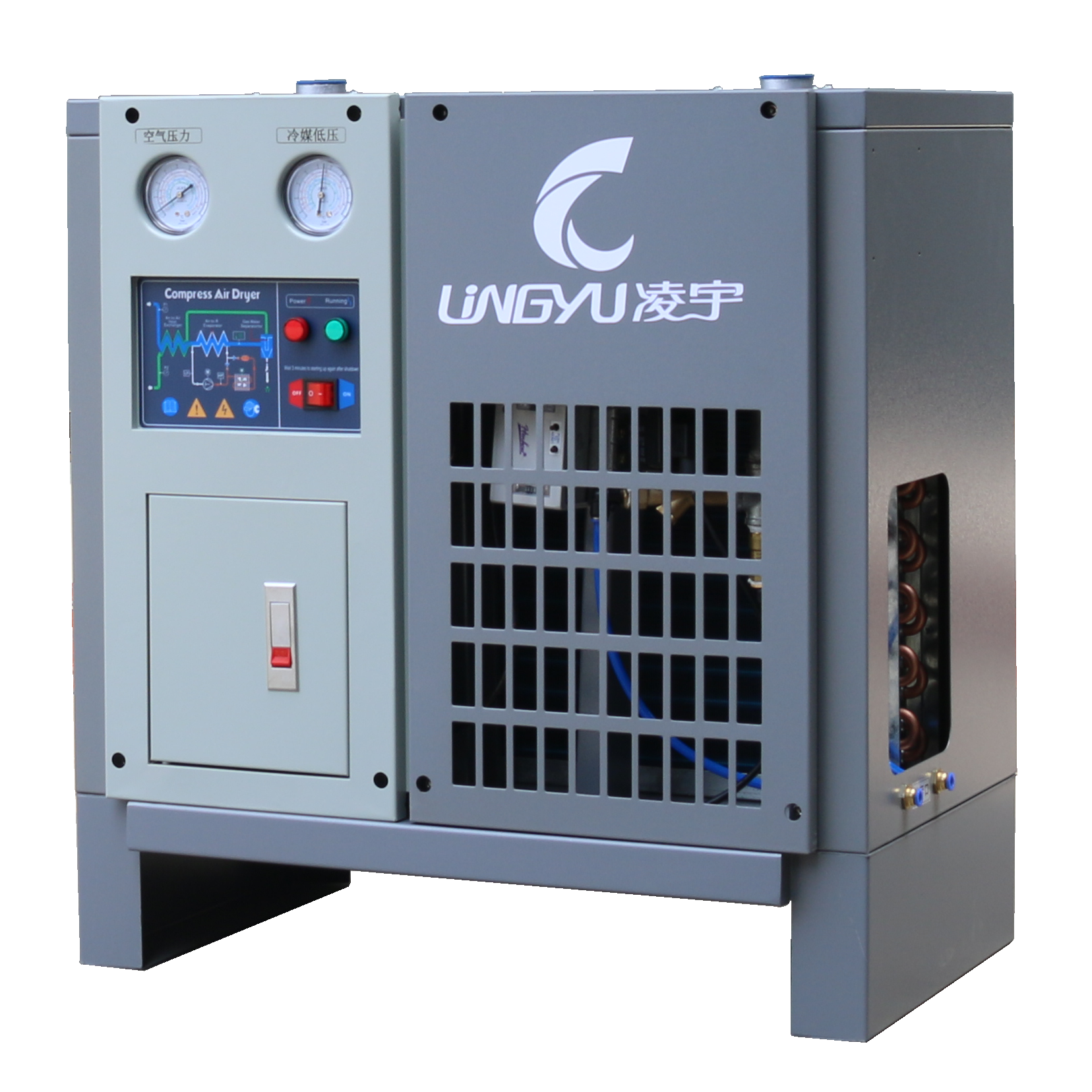
Lingyu’s conventional air-cooled AH Series provides a useful example of a purpose-designed industrial system.
High-temperature compressed air first passes through pre-cooling and heat exchange before entering the evaporator.
The evaporator cools the air sufficiently for moisture, oil, and some impurities to condense.
A gas-liquid separator then removes the condensate, which is discharged through an automatic drain.
Finally, the dried compressed air is reheated toward ambient temperature before leaving the dryer.
For the AH Series, standard operating conditions include:
| Parameter | Specification |
|---|---|
| Rated inlet pressure | 0.7 MPa |
| Operating pressure | 0.6–1.0 MPa |
| Rated inlet temperature | 50°C |
| Maximum inlet temperature | ≤80°C |
| Pressure dew point | 2–10°C |
| Rated ambient temperature | 32°C |
| Ambient operating range | 2–45°C |
| Pressure drop | ≤0.025 MPa |
| Cooling method | Air-cooled |
These defined conditions illustrate why the performance of an industrial dryer cannot be reproduced simply by making compressed air “cold.”
When Does a Small Commercial Dryer Make More Sense?
For a workshop that regularly depends on dry compressed air, a small commercial dryer becomes more practical when:
- Moisture is affecting tools or production
- Compressed air is used frequently
- Consistent pressure dew point matters
- Painting or finishing quality is important
- Automatic condensate management is desirable
- Reliability matters more than experimentation
Lingyu’s 25/35/50 CFM refrigerated air dryer provides purpose-built capacities for smaller compressed-air systems.
Model selection should still be based on actual airflow, pressure, inlet temperature, ambient temperature, and required PDP rather than CFM alone.
Don’t Forget Upstream Condensate Removal
A refrigerated dryer should not be expected to handle every drop of liquid water produced by the compressor system.
Effective aftercooling and upstream condensate separation can remove substantial liquid water before it reaches the dryer.
An air receiver can also contribute to system stability and provide additional opportunity for condensate separation when correctly installed and drained.
Reducing the liquid load upstream helps the dryer perform its intended function: controlling the remaining water vapor to the required pressure dew point.
Filtration and Drying Are Different
A dryer controls moisture, while filtration addresses other contaminants.
Depending on compressor type and final air-quality requirements, appropriate precision compressed air filters may be required to control:
- Solid particles
- Oil aerosols
- Other contamination
Filter selection and placement should be based on the complete treatment system.
A homemade cooling device should not be assumed to produce “clean air” simply because liquid water has been removed.
What About Painting and Workshop Air?
Painting is one reason DIY users often investigate compressed-air drying.
Moisture and oil contamination can interfere with finishing processes, but a dryer is only one part of the solution.
For paint-quality compressed air, consider:
moisture + oil aerosol + particles + piping condition + point-of-use requirements
The required treatment depends on the coating process and equipment.
A refrigerated dryer can provide bulk moisture control, while appropriate filtration and point-of-use treatment may still be required.
When a Refrigerated Dryer Is Not Dry Enough
Even a correctly operating industrial refrigerated dryer has limitations.
If compressed air piping will be exposed to temperatures below the delivered pressure dew point, water can condense again downstream.
Similarly, moisture-sensitive processes may require substantially drier air than conventional refrigerated drying provides.
In these situations, a desiccant air dryer may be more appropriate.
The objective is not to make compressed air as dry as technically possible, but to select a PDP that reliably meets the actual application requirement.
Energy Efficiency: DIY vs. Purpose-Built Systems
Repurposed refrigeration equipment should not automatically be assumed to save energy.
Energy performance depends on:
- Refrigeration efficiency
- Heat-exchanger effectiveness
- Airflow
- Inlet temperature
- Ambient temperature
- Compressor loading
- Pressure drop
- Control strategy
A poorly designed air-side heat exchanger can also introduce excessive pressure loss, indirectly increasing compressor energy consumption.
For industrial operation, lifecycle energy cost should therefore be considered alongside the initial equipment cost.
Frequently Asked Questions
Can I build a refrigerated air dryer from an old refrigerator?
The refrigeration principle can be demonstrated using repurposed equipment, but an old refrigerator is not designed as an industrial compressed-air dryer.
In particular, its components should not automatically be used as compressed-air pressure vessels or heat exchangers.
Can a homemade dryer achieve a 2–10°C pressure dew point?
Possibly under some engineered conditions, but it should not be assumed.
Outlet PDP must be measured. Cooling-surface temperature alone does not establish the pressure dew point of the delivered compressed air.
Can copper tubing be used for the compressed-air cooling coil?
Material choice alone is insufficient to establish safety.
The complete tubing, fittings, joints, temperature range, wall thickness, pressure rating, and applicable installation requirements must be suitable for the intended compressed-air service.
Can I modify the refrigerant circuit myself?
Refrigerant circuits involve pressure, electrical hazards, and refrigerant-handling requirements. Refrigeration servicing should be performed by appropriately qualified personnel using suitable equipment and procedures.
Can a DIY dryer be used for an industrial production line?
An experimental homemade system should not be assumed suitable for industrial service.
Industrial systems require predictable capacity, pressure integrity, pressure dew-point performance, drainage, controls, maintainability, and compliance with applicable requirements.
Is a refrigerated dryer enough for paint air?
It can provide moisture control, but painting may also require particle and oil control.
The complete compressed-air quality requirement should be considered.
Should I use a refrigerated or desiccant dryer?
Use refrigerated drying when its delivered pressure dew point is sufficient for the process.
If the application requires substantially lower PDP or downstream piping will experience temperatures below the refrigerated dryer’s dew point, adsorption drying may be more appropriate.
DIY Experiment or Industrial Air Dryer?
A homemade refrigerated air dryer can be useful for understanding the principles of cooling, condensation, moisture separation, and compressed-air treatment. But there is an important difference between demonstrating the principle and building equipment that safely handles compressed air in continuous service.
The refrigeration circuit is only one part of a complete dryer. Pressure-rated heat exchangers, effective gas-liquid separation, automatic drainage, pressure-drop control, refrigeration protection, and stable dew-point performance are equally important.
For a hobby experiment, keep the project focused on learning and use properly rated components wherever compressed air is involved. For workshops and industrial systems where reliable dry air matters, a purpose-built dryer is generally the more appropriate solution.
For help matching a commercial dryer to actual airflow, pressure, inlet temperature, ambient conditions, and required pressure dew point, contact Lingyu.