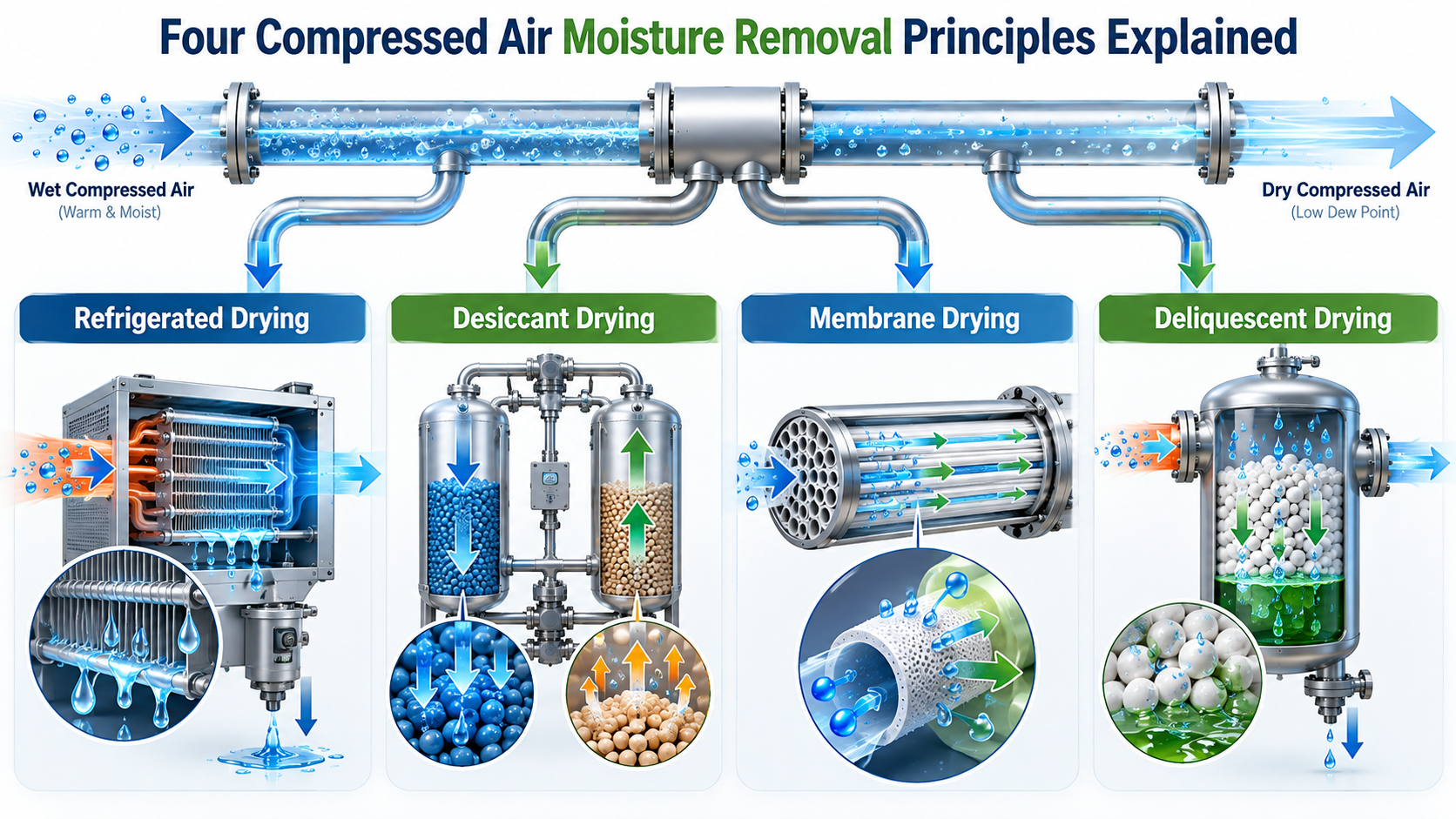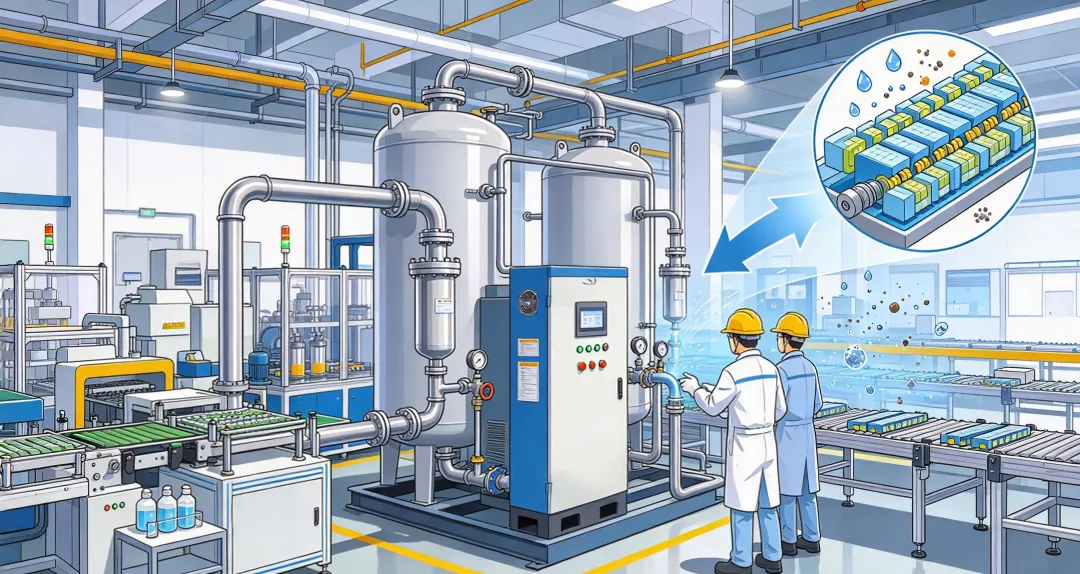
Large compressed-air systems that require low pressure dew points must consider not only drying performance but also the amount of compressed air consumed during desiccant regeneration.
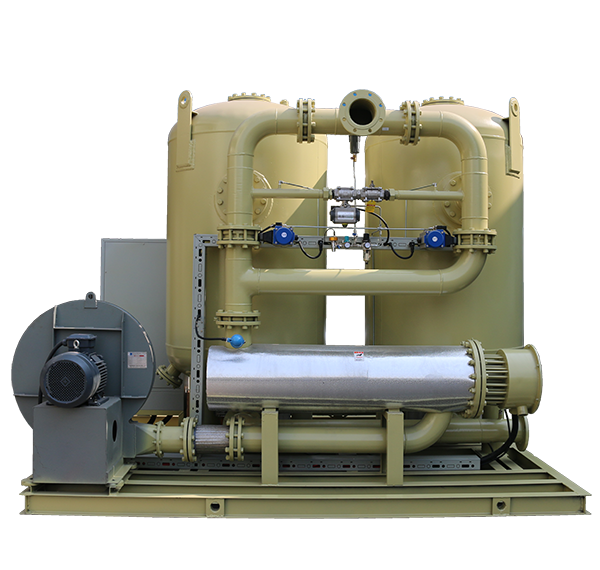
The HRB-E Series Low-Purge Blower-Heated Regenerative Desiccant Air Dryer is designed to reduce regeneration-air losses by using an independent blower and externally heated ambient air during the heating stage. Only a relatively small amount of dry product air is required during cooling.
The HRB-E combines this regeneration method with 2–3% regeneration-air consumption, intelligent energy control, and pressure dew point configurations of −20°C or −40°C.
For users comparing other adsorption technologies, Lingyu’s desiccant air dryer range includes heatless, heated-purge, blower-assisted, and heat-of-compression configurations.
How the HRB-E Low-Purge Blower-Heated Dryer Works
The HRB-E Series is developed from the heated-purge regenerative adsorption dryer by adding an independent blower.
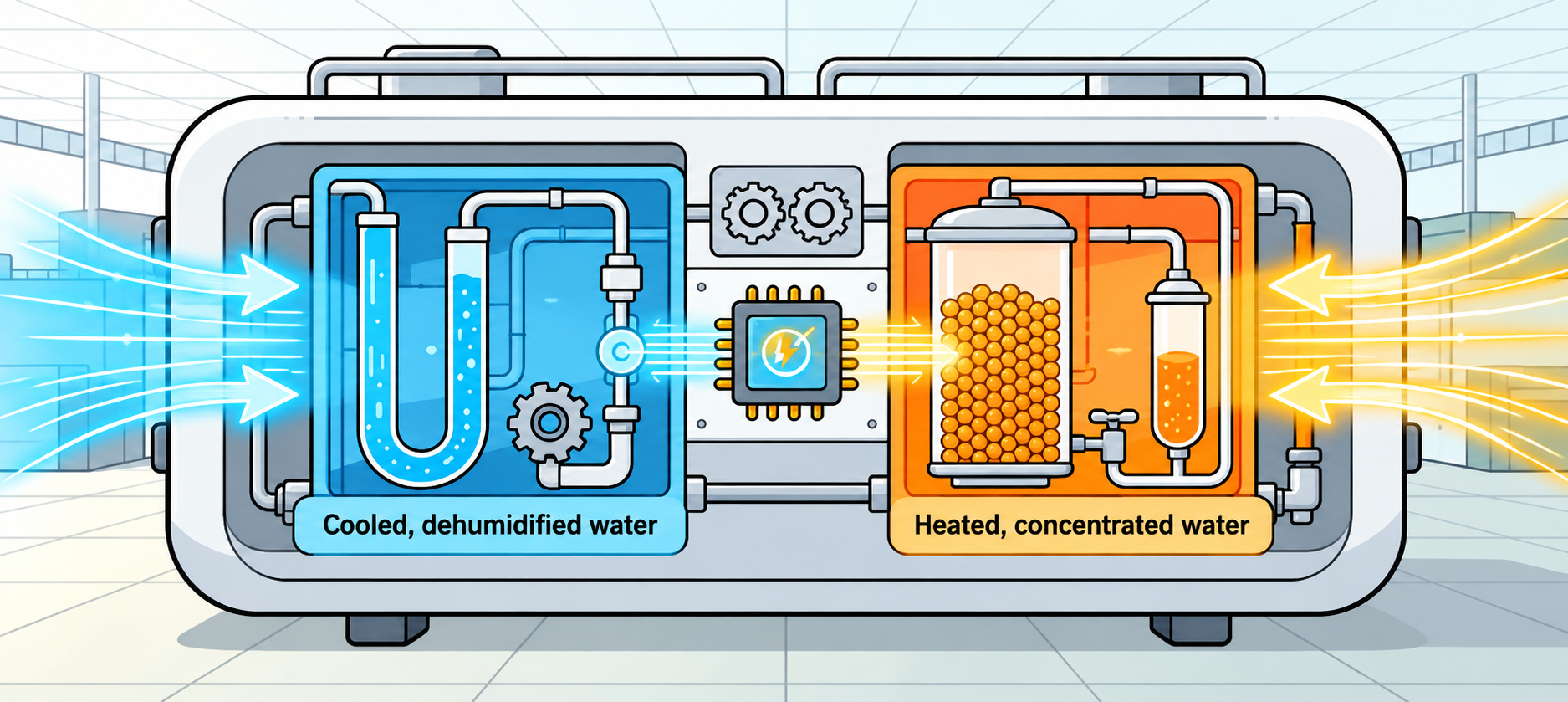
During the heating stage, ambient air is drawn into the system by the blower. The air passes through an external heater and is raised to the required regeneration temperature.
The heated air then enters the regeneration tower, where it transfers heat to the desiccant. As the desiccant temperature increases, previously adsorbed moisture is released and carried out of the adsorption vessel.
The key difference appears during the cooling stage. Instead of continuing to use large quantities of compressed product air throughout regeneration, the HRB-E uses only a small amount of dry product air—approximately 2% of system airflow—to cool the regenerated desiccant bed.
This reduces compressed-air loss compared with regeneration methods that depend more heavily on dry purge air.
HRB-E Is Low-Purge, Not Zero-Purge
The HRB-E is a low-purge blower-heated dryer, not a zero-purge model.
Its regeneration-air consumption is 2–3%. Therefore, descriptions such as “zero compressed-air consumption,” “0% purge,” or “no product air is used throughout regeneration” do not apply to the HRB-E.
Those characteristics belong to the HRB-Z Zero-Purge Blower-Heated Regenerative Desiccant Air Dryer, which uses an intercooler and closed-loop cooling arrangement and has regeneration-air consumption of approximately 0%.
Keeping the two configurations technically distinct is important:
HRB-E = low purge. HRB-Z = zero purge.
Why the Independent Blower Reduces Compressed-Air Consumption
In a conventional heated-purge configuration, dry compressed air may be used as the carrier gas during regeneration.
The HRB-E takes a different approach during the heating stage. Ambient air is moved by the blower, heated externally, and passed through the regeneration tower. Because atmospheric air rather than compressed product air provides the primary regeneration airflow during heating, considerably less compressed air is sacrificed.
Dry compressed air is mainly required during the cooling portion of regeneration.
This is why the HRB-E can reduce regeneration-air consumption to 2–3% while maintaining low-dew-point drying performance.
For large compressed-air installations, this difference becomes increasingly important because purge air represents compressor capacity and electrical energy that cannot be delivered to production.
Standard Operating Conditions
The HRB-E Series operates under the following standard conditions:
| Parameter | Specification |
|---|---|
| Applicable medium | Compressed air / non-corrosive air |
| Rated inlet pressure | 0.7 MPa |
| Operating pressure range | 0.6–1.0 MPa |
| Rated inlet temperature | 10–30°C |
| Maximum inlet temperature | ≤40°C |
| Inlet-air dew point | ≤25°C |
| Regeneration-air consumption | 2–3% |
| Outlet pressure dew point | −20°C / −40°C configurations |
| Rated ambient temperature | 35°C |
| Ambient operating range | 2–40°C |
The distinction between the ambient-temperature figures is important: 35°C is the rated ambient temperature, while 2–40°C is the ambient operating range.
Why Inlet-Air Dew Point Matters
The HRB-E specifies an inlet-air dew point of ≤25°C.
This parameter affects the moisture load entering the adsorption system. If the inlet air contains excessive moisture or liquid water, the desiccant must handle a greater water load during each adsorption cycle, which can affect regeneration demand and long-term dew-point stability.
Upstream cooling, moisture separation, and filtration should therefore be evaluated together with the adsorption dryer rather than sizing the HRB-E from airflow alone.
Outlet Pressure Dew Point: −20°C or −40°C
The HRB-E is available with −20°C / −40°C pressure dew point configurations.
The required target should be determined from the downstream process. A lower dew point is not automatically more economical. If a process operates reliably at −20°C, specifying −40°C without a process requirement may increase system cost or regeneration demand unnecessarily.
Selection should therefore begin by defining the actual required pressure dew point rather than simply requesting the driest possible compressed air.
Intelligent Energy-Saving Control
The HRB-E includes Lingyu’s EBZ200-2 multi-core control system.
Its intelligent control strategy can reduce overall energy consumption by more than 10% compared with conventional fixed-cycle operation.
Instead of treating every operating condition as identical, the controller manages the drying and regeneration process according to system operating requirements.
For larger compressed-air systems, this is particularly relevant because both heater operation and regeneration timing affect lifecycle energy consumption.
Optional Dew-Point-Based Energy-Saving Control
For applications with fluctuating compressed-air demand, the HRB-E can also use an optional dew-point-based control strategy.
When air demand decreases or the desiccant has not yet reached the end of its effective adsorption capacity, the system can extend the adsorption cycle instead of switching towers only according to a fixed timer.
Under suitable variable-load conditions, this control strategy can reduce overall energy consumption by more than 30%.
This figure applies specifically to the optional control strategy under appropriate fluctuating-load conditions and should not be interpreted as a guaranteed energy saving for every installation.
Airflow Distribution and Desiccant Utilization
Dryer performance depends not only on regeneration temperature but also on how evenly compressed air passes through the desiccant bed.
The HRB-E uses a specially designed flow distributor intended to improve desiccant utilization while reducing compressed-air pressure drop. The design also uses 304 stainless-steel control-air piping.
More uniform airflow helps prevent localized overloading of the adsorption bed and supports stable long-term moisture removal.
High-Performance Desiccant and Core Components
The HRB-E uses customized high-performance desiccant with an additional filling allowance intended to support reliable adsorption performance and long-term stability.
Principal components also include a high-pressure blower, high-performance pneumatic valves, and a high-efficiency cooler designed using HTFS thermal design software.
These components influence regeneration airflow, heating efficiency, vessel switching, cooling effectiveness, and pressure stability. Maintenance should therefore consider the regeneration system as an integrated process rather than inspecting only the desiccant.
Intelligent Touchscreen Monitoring
The HRB-E configuration includes a 7-inch MCGS touchscreen programmable controller.
The controller can dynamically monitor parameters including outlet-air temperature, heating temperature, regeneration exhaust temperature, Tower A/B pressure, blower pressure, and optional pressure dew point.
RS-485 communication is supported as standard, with optional IoT or other communication solutions available according to project requirements.
These functions are particularly relevant for centralized compressed-air stations where dryer operation needs to be monitored alongside compressors and other treatment equipment.
HRB-E Capacity Range
The standard HRB-E Series extends from 13.5 to 260 m³/min.
| Model | Airflow | Connection | Installed Power | Dimensions |
|---|---|---|---|---|
| HRB-E100 | 13.5 m³/min | DN65 | 12.1 kW | 1416×950×2357 mm |
| HRB-E150 | 21.5 m³/min | DN65 | 19.5 kW | 1720×1000×2567 mm |
| HRB-E200 | 28.5 m³/min | DN80 | 22.8 kW | 1900×970×2533 mm |
| HRB-E300 | 37.0 m³/min | DN100 | 36.5 kW | 2000×1150×2823 mm |
| HRB-E500 | 55.0 m³/min | DN125 | 57.5 kW | 2850×1800×2959 mm |
| HRB-E800 | 85.0 m³/min | DN125 | 63.5 kW | 2930×1930×3075 mm |
| HRB-E1000 | 110 m³/min | DN150 | 77.5 kW | 3076×2347×3029 mm |
| HRB-E1400 | 140 m³/min | DN200 | 105.5 kW | 3700×2789×3307 mm |
| HRB-E1800 | 180 m³/min | DN200 | 146.5 kW | 4000×2898×3411 mm |
| HRB-E2100 | 210 m³/min | DN200 | 250.5 kW | 4100×2850×3450 mm |
| HRB-E2600 | 260 m³/min | DN250 | 257.5 kW | 4150×3000×3480 mm |
For capacities above 260 m³/min, or projects involving special materials, specifications, or operating temperatures, a custom technical evaluation is recommended.
For detailed equipment information, users can review Lingyu’s blower-heated regeneration adsorption air dryer product page.
Low-Purge Blower-Heated Project Reference
A documented low-purge blower-heated project used eight customized 220 m³/min regenerative adsorption dryers.
The required performance included a pressure dew point of ≤−40°C, oil content ≤0.01 ppm, particle size ≤1 μm, and regeneration-air consumption ≤3%.
The solution incorporated high-performance pneumatic butterfly valves, optimized airflow distribution, advanced control, and high-quality adsorbent. For that project configuration, the reported energy saving was approximately 8% compared with conventional heated-purge dryers.
The approximately 8% figure is a project-specific result and should not be interpreted as a guaranteed saving for every HRB-E installation.
Filtration Is Still Required
The adsorption dryer should not be expected to perform every compressed-air purification function by itself.
Liquid water, oil aerosols, and solid particles entering the adsorption system can affect desiccant performance, valve reliability, and long-term operation.
Suitable precision compressed air filters can therefore be integrated according to the required compressed-air quality and upstream contamination level.
The filtration arrangement should be selected as part of the complete compressed-air treatment system rather than added as a generic accessory.
When the HRB-E Is More Relevant Than a Heatless Dryer
The HRB-E becomes particularly relevant as system airflow increases.
A conventional heatless adsorption dryer is mechanically simple, but regeneration can consume a larger proportion of dry compressed air. In a large continuous system, the compressor energy represented by that purge air can become economically significant.
The HRB-E shifts most regeneration airflow to an independent atmospheric-air blower and limits compressed-air use primarily to the cooling stage.
Its main selection advantage is therefore specifically low compressed-air regeneration loss at medium-to-large airflow capacities, rather than a generic claim of greater efficiency under every operating condition.
When HRB-Z May Be More Appropriate
If the primary project requirement is to reduce regeneration compressed-air consumption from the HRB-E’s 2–3% toward approximately 0%, the HRB-Z architecture should be evaluated separately.
The HRB-Z adds an intercooler and uses closed-loop circulation during desiccant cooling, avoiding dry product-air consumption throughout the regeneration process.
The technical distinction is:
HRB-E = low purge. HRB-Z = zero purge.
Their working principles should therefore remain separate when evaluating the appropriate dryer configuration.
Application Positioning
The HRB-E is particularly relevant to medium- and large-scale industrial compressed-air systems where low regeneration-air loss and stable low dew point are important.
Industry-specific process-air requirements should then be evaluated according to the actual application rather than applying one generic application list to every HRB-E installation.
For example, users with demanding process-air requirements can review Lingyu’s petrochemical and chemical processing solutions.
Installation and Maintenance Priorities
Installation planning should provide sufficient space for the blower, heater, adsorption vessels, exhaust system, piping, and routine service access.
Unlike the HRB-Z configuration, the HRB-E does not specify an external cooling-water requirement in its stated operating conditions. A cooling-water supply should therefore not be presented as a standard HRB-E installation requirement.
During operation, attention should be given to blower condition, heater performance, pneumatic valves, regeneration exhaust temperature, tower pressures, control-system status, filters, and dew-point trend where monitoring is installed.
Abnormal regeneration temperature or pressure behavior can indicate a problem before outlet dew point deteriorates significantly.
What to Provide Before Selecting an HRB-E Dryer
Before selecting an HRB-E model, define the required airflow, inlet pressure, inlet temperature, inlet dew point, required outlet pressure dew point, minimum/normal/peak load, operating hours, upstream filtration, and whether purge-air cost is a major system concern.
For variable-load installations, also determine whether optional dew-point-based control is appropriate.
For capacities above the standard 260 m³/min range or special operating conditions, users can use Lingyu’s contact page for technical configuration support.
Conclusion
The HRB-E Series Low-Purge Blower-Heated Regenerative Desiccant Air Dryer reduces compressed-air regeneration losses by using an independent blower and heated ambient air during desiccant heating, while using only a small quantity of dry product air during cooling.
Its key operating characteristics include 2–3% regeneration-air consumption, 0.7 MPa rated inlet pressure, 0.6–1.0 MPa operating pressure, 10–30°C rated inlet temperature, ≤40°C maximum inlet temperature, ≤25°C inlet-air dew point, −20°C / −40°C outlet pressure dew point configurations, 35°C rated ambient temperature, and a 2–40°C ambient operating range.
For large compressed-air systems, the key selection question is not simply whether the dryer can achieve a low dew point. The amount of compressed-air capacity consumed during regeneration, together with blower/heater energy consumption and actual load profile, should be considered when determining whether low-purge blower-heated regeneration is appropriate.