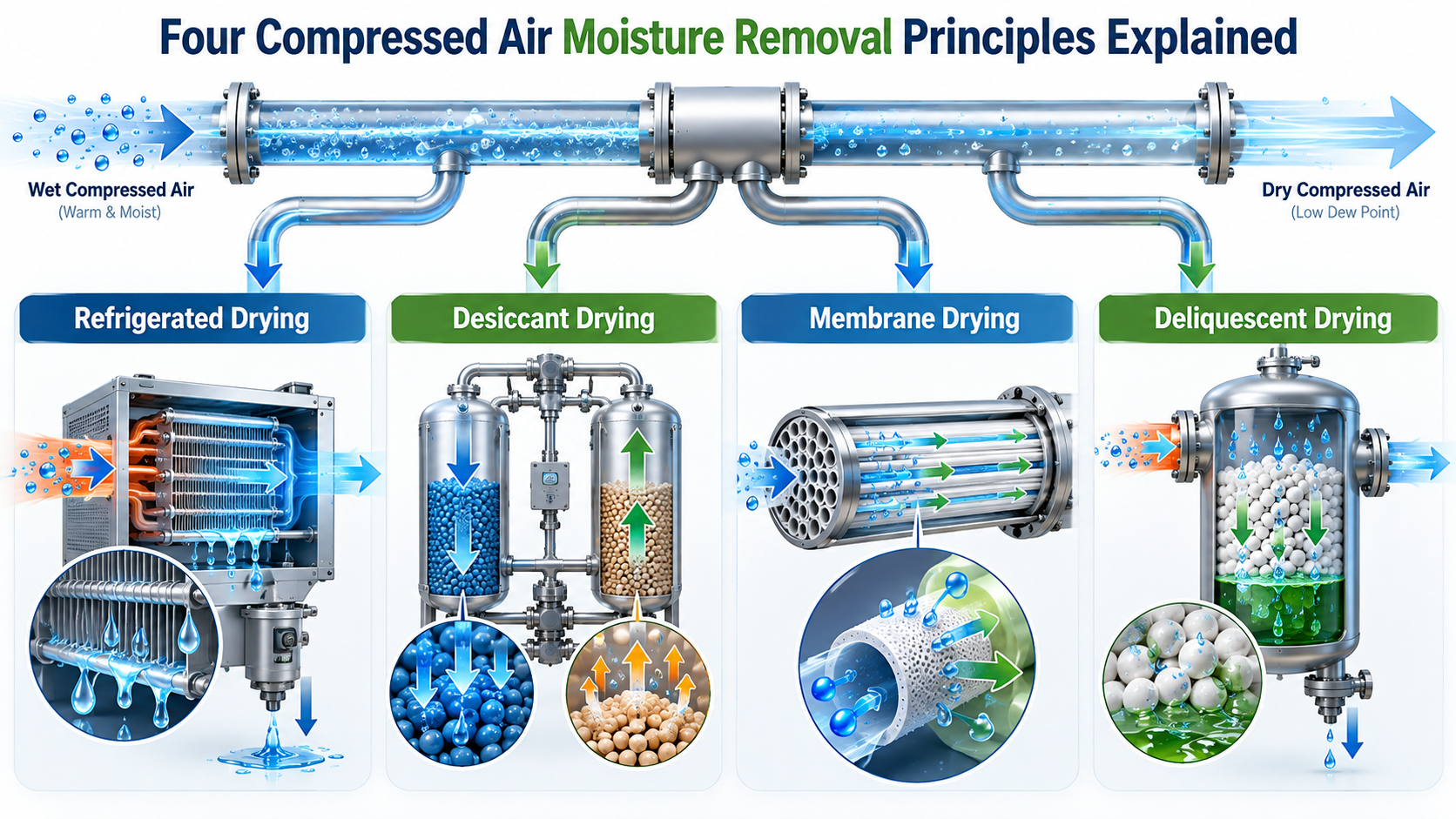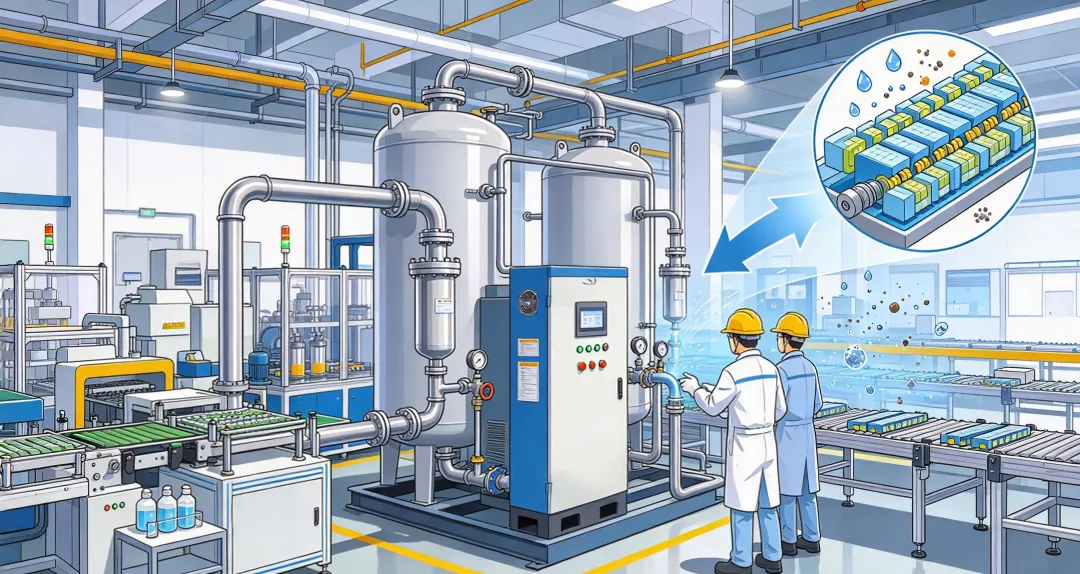
Compressed air used in food and pharmaceutical production often requires tighter moisture and contamination control than ordinary plant air. However, installing a dryer alone does not make compressed air hygienic, sterile, or suitable for direct product contact. The complete treatment system must be designed around the required pressure dew point, particle level, oil content, filtration, distribution system, and process requirements.
For applications that require pressure dew points below the range normally achieved by refrigerated drying, a modular adsorption air dryer can provide a compact alternative to conventional twin-tower desiccant dryers.
Lingyu’s M Series combines heatless regeneration with modular adsorption chambers, optimized airflow distribution, corrosion-resistant construction, and a pressure dew point of ≤−20°C, with −40°C available as an option.
Why Moisture Control Matters in Food and Pharmaceutical Production
Atmospheric air contains water vapor. When air is compressed, moisture becomes concentrated, and as the compressed air subsequently cools, part of that moisture can condense.
Uncontrolled moisture may contribute to corrosion, pneumatic equipment problems, microbial risk under certain conditions, process instability, and product-quality problems.
The required air quality depends heavily on how compressed air is used.
Air operating a pneumatic cylinder may have different requirements from air that contacts packaging, equipment surfaces, ingredients, or pharmaceutical products.
For this reason, dryer selection should begin with the required pressure dew point (PDP) rather than simply choosing the lowest possible dew point.
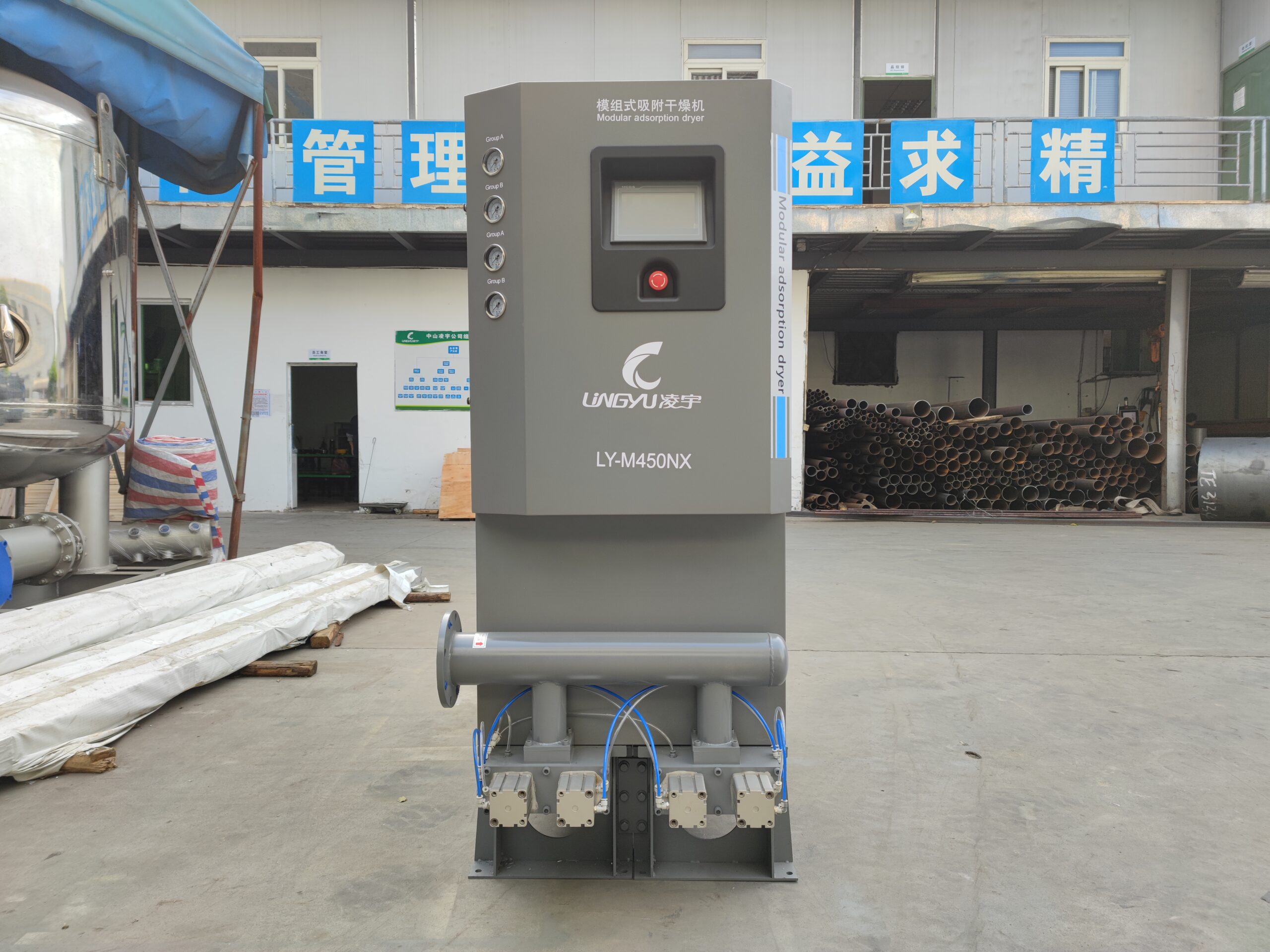
How a Modular Adsorption Air Dryer Works
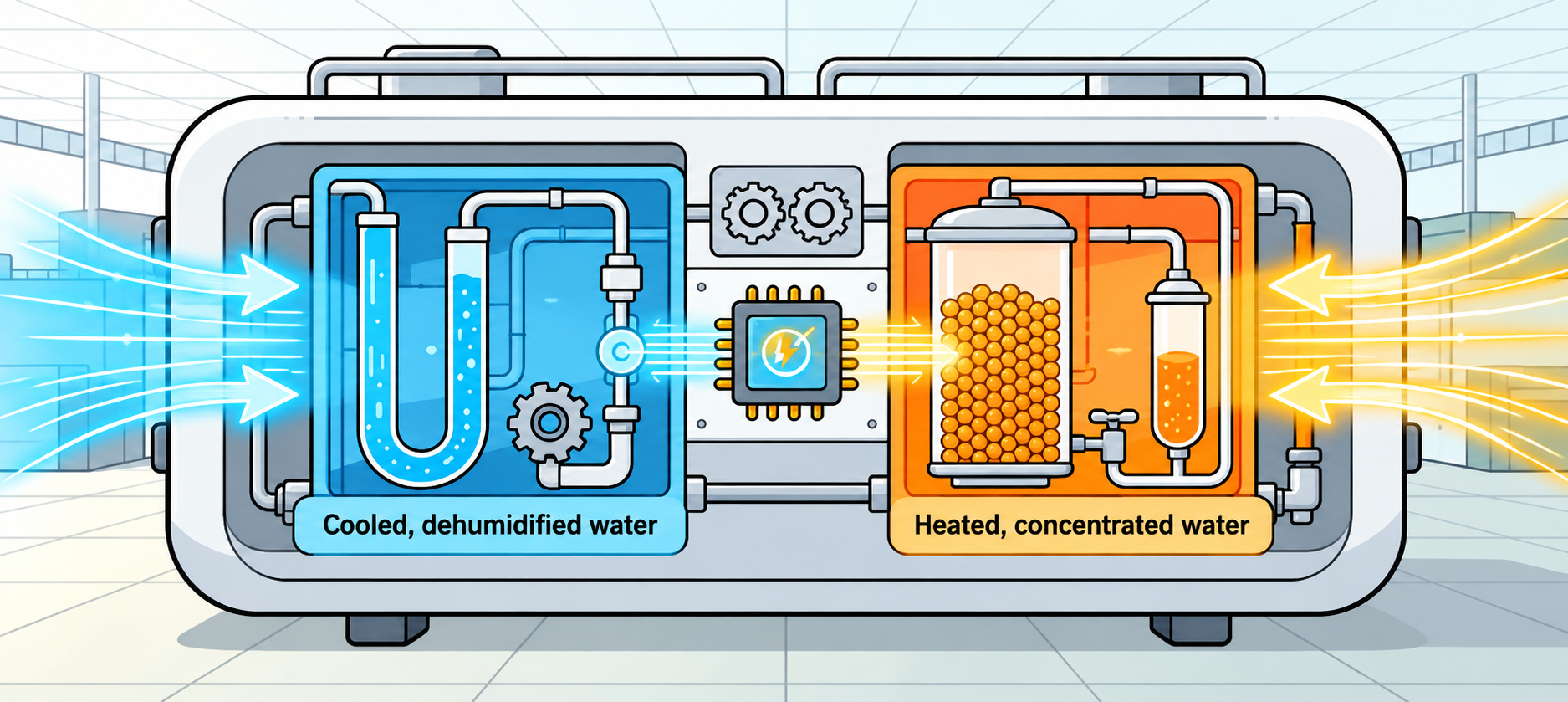
The M Series is based on the same fundamental Pressure Swing Adsorption principle used by conventional heatless desiccant dryers.
During operation, one group of adsorption chambers dries the compressed air while the other group regenerates.
Wet compressed air enters through the lower manifold and passes through desiccant-filled adsorption chambers. Water vapor is adsorbed by the desiccant, and the dried air passes into the upper manifold before flowing downstream.
A portion of the dry product air is then used to regenerate the opposite group.
After regeneration, the groups switch functions and the cycle repeats.
This allows continuous drying while maintaining a compact modular structure.
1. Straight-Through Modular Adsorption Chambers
One of the important differences between the M Series and a conventional large twin-tower configuration is its modular chamber arrangement.
The dryer uses a straight-through adsorption chamber design intended to improve airflow distribution and desiccant utilization.
The specially designed base incorporates an inlet-air buffer chamber, helping address airflow problems that can occur inside conventional adsorption vessels, such as:
uneven distribution → channeling → adsorption dead zones → incomplete desiccant utilization
More uniform flow helps the compressed air contact the desiccant more effectively.
This is particularly useful where stable pressure dew point performance is required over long operating periods.
2. Reduced Desiccant Channeling and Dusting
Desiccant performance depends on more than simply filling a vessel with adsorbent.
Poor airflow distribution can cause compressed air to repeatedly follow preferential paths through the desiccant bed. This reduces effective adsorption area and can accelerate local desiccant deterioration.
The M Series uses a specially designed filling and airflow arrangement intended to reduce channeling, tunneling, and impact-related desiccant attrition.
Reducing desiccant movement and dust generation can help improve long-term dryer stability and reduce the downstream particulate burden.
An appropriate downstream precision compressed air filter should still be considered because adsorption systems can produce small quantities of desiccant dust during service.
3. Low Regeneration-Air Consumption
Heatless adsorption dryers regenerate their desiccant using a portion of already dried compressed air.
Because this air has already been compressed, purge consumption represents an indirect energy cost.
The M Series specifies regeneration air consumption of approximately:
5–8%
This is an important parameter when comparing adsorption dryers because the purchase price of the dryer represents only part of its lifecycle cost.
A useful comparison should include:
purge-air consumption + pressure drop + maintenance + desiccant life + required PDP
rather than evaluating the dryer only by nominal flow capacity.
4. Stable Pressure Dew Point
For the M Series, the specified outlet pressure dew point is:
≤−20°C
with:
−40°C available as an option
This makes modular adsorption drying relevant to applications where conventional refrigerated drying cannot provide the required moisture level.
The M Series operating conditions include:
| Parameter | M Series Specification |
|---|---|
| Rated inlet pressure | 0.7 MPa |
| Operating pressure | 0.6–1.0 MPa |
| Rated inlet temperature | 10–30°C |
| Maximum inlet temperature | ≤40°C |
| Inlet air dew point | ≤15°C |
| Outlet PDP | ≤−20°C |
| Optional PDP | −40°C |
| Desiccant | Activated alumina + high-performance molecular sieve |
| Rated ambient temperature | 35°C |
| Ambient operating range | 2–45°C |
| Regeneration-air consumption | 5–8% |
These conditions are important because a dryer cannot be selected from airflow alone.
Actual inlet temperature, pressure, upstream air quality, and required PDP must also be checked.
5. Corrosion-Resistant Air-Contact Surfaces
Compressed-air quality can be affected not only by contaminants entering the dryer but also by the condition of internal equipment surfaces.
The M Series uses air-contact surfaces treated with an anti-corrosion oxidation process.
This treatment is intended to reduce corrosion and the potential for secondary contamination from deteriorating internal surfaces.
For sensitive applications, this can be an important design consideration.
However, corrosion-resistant dryer construction should not be interpreted as proof that the complete compressed-air system is suitable for direct food or pharmaceutical contact.
Downstream piping, filters, receivers, valves, and point-of-use components must also be evaluated.
6. Magnesium-Aluminum Alloy Modular Construction
The M Series integrated structure is manufactured from aerospace-grade magnesium-aluminum extruded alloy.
This construction provides a compact arrangement compared with many traditional large-vessel adsorption systems.
The modular geometry is also designed so the equipment can pass through standard doorways, which can simplify installation in facilities where access space is limited.
This can be useful in existing food or pharmaceutical plants where equipment rooms cannot easily accommodate large conventional vessels.
7. Compact Installation for Existing Facilities
Space can become a significant constraint when upgrading an existing compressed-air station.
Modular construction can reduce installation footprint and make equipment positioning more flexible.
The M Series covers multiple capacities, from smaller modular units to configurations with inlet airflow up to 55 m³/min in the listed standard range.
For special requirements beyond the listed range, the system should be evaluated according to project conditions rather than assuming a standard model will fit.
8. Maintenance and Standby Flexibility
Modular construction can make servicing more manageable because the drying system is divided into multiple adsorption chambers instead of depending entirely on two large conventional vessels.
The design also allows a full-capacity standby unit to be configured where production continuity justifies redundancy.
This can be particularly relevant to food and pharmaceutical production lines where interruption of compressed-air treatment may affect production availability.
Maintenance intervals should nevertheless be determined from operating hours, pressure dew point, desiccant condition, valve operation, purge performance, filtration condition, and manufacturer recommendations.
A universal rule such as annual seal replacement should not be applied unless it is specified for the selected model and operating conditions.
9. Pressure Drop and Overall Energy Efficiency
The straight-through flow arrangement is designed to minimize unnecessary airflow resistance while improving contact between the compressed air and desiccant.
Low pressure loss matters because every pressure drop in the treatment system has to be compensated somewhere upstream.
The total pressure drop can include:
pre-filter → dryer → after-filter → piping → valves → point of use
If excessive treatment pressure loss forces the compressor to operate at a higher discharge pressure, total system energy consumption can rise.
Energy performance should therefore be evaluated at the compressed-air-system level rather than looking only at electrical consumption of the dryer.
Why Modular Adsorption Drying Can Fit Food Production
In food and beverage compressed air applications, moisture requirements vary according to where and how the air is used.
Possible uses include pneumatic actuators, packaging machinery, conveying equipment, process instrumentation, and applications where air may interact more directly with production.
A modular adsorption dryer can be appropriate when the application requires a PDP significantly below the capability of refrigerated drying.
Its potential advantages include compact installation, low-PDP capability, corrosion-resistant construction, controlled regeneration, and relatively low purge consumption for a heatless modular design.
However, the dryer addresses primarily moisture.
Food-related air quality may also require control of particles, oil aerosols, oil vapor, and other process-specific contaminants.
Why Modular Adsorption Drying Can Fit Pharmaceutical Production
In pharmaceutical and biopharmaceutical compressed air applications, the required PDP should be determined from the process specification.
Low moisture content can be important for moisture-sensitive operations, instrumentation, production environments, and certain process-air applications.
The modular structure can also be useful where installation space or equipment access is restricted.
Again, a low PDP does not automatically make compressed air pharmaceutical-grade or sterile.
A complete treatment and quality strategy may require suitable upstream filtration, downstream particulate filtration, oil control, distribution-system design, point-of-use treatment, monitoring, and validation according to the actual application.
Filtration Is Essential for Adsorption Dryer Performance
Adsorption dryers are sensitive to contamination.
Bulk liquid water and oil can reduce desiccant performance and shorten useful life.
A practical arrangement may therefore be:
compressor → aftercooler/separator → wet receiver → pre-filtration → modular adsorption dryer → after-filter → dry receiver → point of use
Upstream filtration protects the desiccant from liquid and oil contamination.
Downstream filtration helps control desiccant dust and protects sensitive equipment.
The exact filtration grades should be selected according to compressor type and final air-quality requirements.
Modular Adsorption vs. Conventional Twin-Tower Dryers
Both technologies rely on adsorption and regeneration, but their physical construction differs.
| Factor | Modular Adsorption Dryer | Conventional Twin-Tower Dryer |
|---|---|---|
| Drying principle | Adsorption | Adsorption |
| Vessel arrangement | Multiple compact chambers | Two larger vessels |
| Airflow path | Straight-through modular design | Conventional vessel flow |
| Installation footprint | Compact | Typically larger |
| Desiccant distribution | Designed to reduce channeling | Depends on vessel/distributor design |
| Standard M Series purge | 5–8% | Technology dependent |
| Maintenance approach | Modular | Vessel-based |
| PDP capability | ≤−20°C; −40°C optional | Depends on dryer series |
Neither configuration is automatically better for every plant.
The choice should depend on airflow, required PDP, available installation space, redundancy requirements, energy cost, maintenance strategy, and plant standards.
Modular Adsorption vs. Refrigerated Drying
Not every food or pharmaceutical facility requires adsorption drying.
If a pressure dew point of approximately 2–10°C is sufficient, a refrigerated dryer may provide a more economical solution.
Where substantially lower PDP is required, desiccant dryer technology becomes more appropriate.
Selecting a −40°C dryer when the process only requires several degrees above freezing can add purge-air consumption and maintenance without improving the process.
The target should always be the required dew point, not the lowest dew point available.
Does the M Series Require Annual Pressure-Vessel Inspection?
The product design documentation states that the M Series is not classified as pressure equipment requiring the same mandatory annual pressure-vessel reinspection applied to conventional pressure vessels.
This can simplify servicing and inspection requirements in applicable installations.
However, pressure-equipment regulations vary by country and jurisdiction.
The local classification and inspection requirements should always be confirmed before installation rather than assuming one regulatory treatment applies worldwide.
Does a Modular Adsorption Dryer Prevent Secondary Contamination?
Its corrosion-resistant internal surface treatment is specifically intended to reduce the risk of secondary contamination caused by corrosion products.
That is beneficial, but it should not be interpreted as eliminating every contamination source.
Compressed-air quality also depends on compressor condition, inlet air, filters, drains, piping, receivers, downstream equipment, and point-of-use treatment.
The dryer should therefore be considered one controlled component within the complete air-treatment system.
Frequently Asked Questions
What makes a modular adsorption air dryer different from a conventional twin-tower dryer?
Both use adsorption to remove water vapor.
The modular design replaces two large conventional adsorption vessels with multiple compact straight-through adsorption chambers. The design is intended to improve airflow distribution, desiccant utilization, installation flexibility, and servicing.
What pressure dew point can the M Series achieve?
The standard M Series specification is ≤−20°C PDP, with −40°C available as an option.
The required version should be selected according to the process and minimum downstream temperature.
How much regeneration air does the modular dryer use?
The M Series specifies regeneration-air consumption of approximately 5–8%.
Actual operating performance should be evaluated under the selected model’s specified conditions.
What desiccant does the M Series use?
The specified adsorption media are activated alumina and high-performance molecular sieve.
Does the dryer completely remove moisture?
No dryer makes compressed air literally moisture-free.
The M Series reduces water vapor to a specified pressure dew point. The important requirement is whether that PDP is sufficiently low for the process.
Is it suitable for 24/7 operation?
It is designed for industrial compressed-air service and alternating adsorption/regeneration operation.
Whether a particular system can meet continuous production requirements depends on correct sizing, operating conditions, filtration, maintenance, and any required standby redundancy.
How often should seals or desiccant be replaced?
There is no universal annual replacement interval that should be applied to every installation.
Maintenance should follow the selected model’s recommendations and actual operating condition. Desiccant performance, valve operation, PDP, purge flow, filter condition, and operating hours should be monitored.
Does a modular adsorption dryer make compressed air safe for direct food or pharmaceutical contact?
Not by itself.
The dryer controls moisture. Final suitability depends on the complete compressed-air treatment and distribution system and the specific process air-quality requirement.
Selecting a Modular Adsorption Dryer for Sensitive Applications
The main reason to select a Modular Adsorption Air Dryer is not simply that food or pharmaceutical production requires “high-quality air.”
The stronger engineering case is when the process requires:
low pressure dew point + compact installation + controlled regeneration + corrosion-resistant construction + stable adsorption performance
Lingyu’s M Series combines a straight-through modular adsorption structure, 5–8% regeneration-air consumption, a standard ≤−20°C PDP with −40°C available as an option, magnesium-aluminum alloy construction, and anti-corrosion treatment of surfaces exposed to compressed air.
These characteristics can make modular adsorption drying a practical option for moisture-sensitive food and pharmaceutical compressed-air applications.
The final system should still be designed around the required particle, water, and oil limits rather than relying on the dryer alone.
For project-specific sizing or air-treatment configuration, contact Lingyu with your maximum airflow, operating pressure, inlet temperature, required pressure dew point, compressor type, available installation space, and final air-quality requirements.