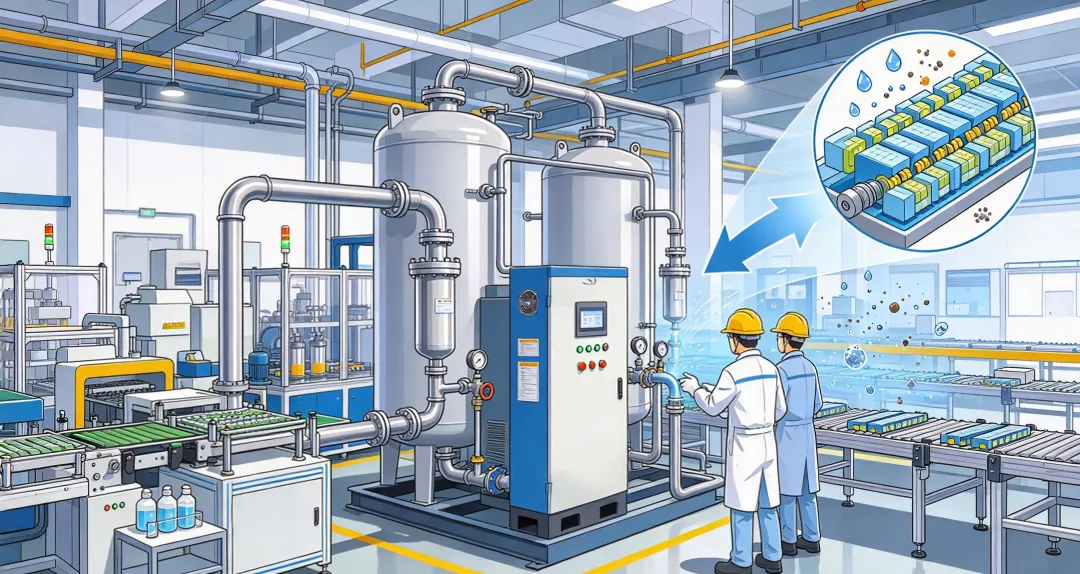
On-site nitrogen generation allows industrial facilities to produce nitrogen directly from compressed air instead of relying entirely on delivered gas.
Lingyu’s PSA nitrogen generator uses two adsorption vessels filled with Carbon Molecular Sieve (CMS). Oxygen is preferentially adsorbed by the CMS, while nitrogen passes through the adsorption bed and is collected as product gas. Automatic tower switching allows nitrogen production to continue while the opposite tower regenerates.
For applications requiring 99% nitrogen purity, the LYZD-B Series provides production capacities from 15 to 530 m³/h. Users comparing other purity grades and nitrogen-generation configurations can also review Lingyu’s nitrogen generator range.
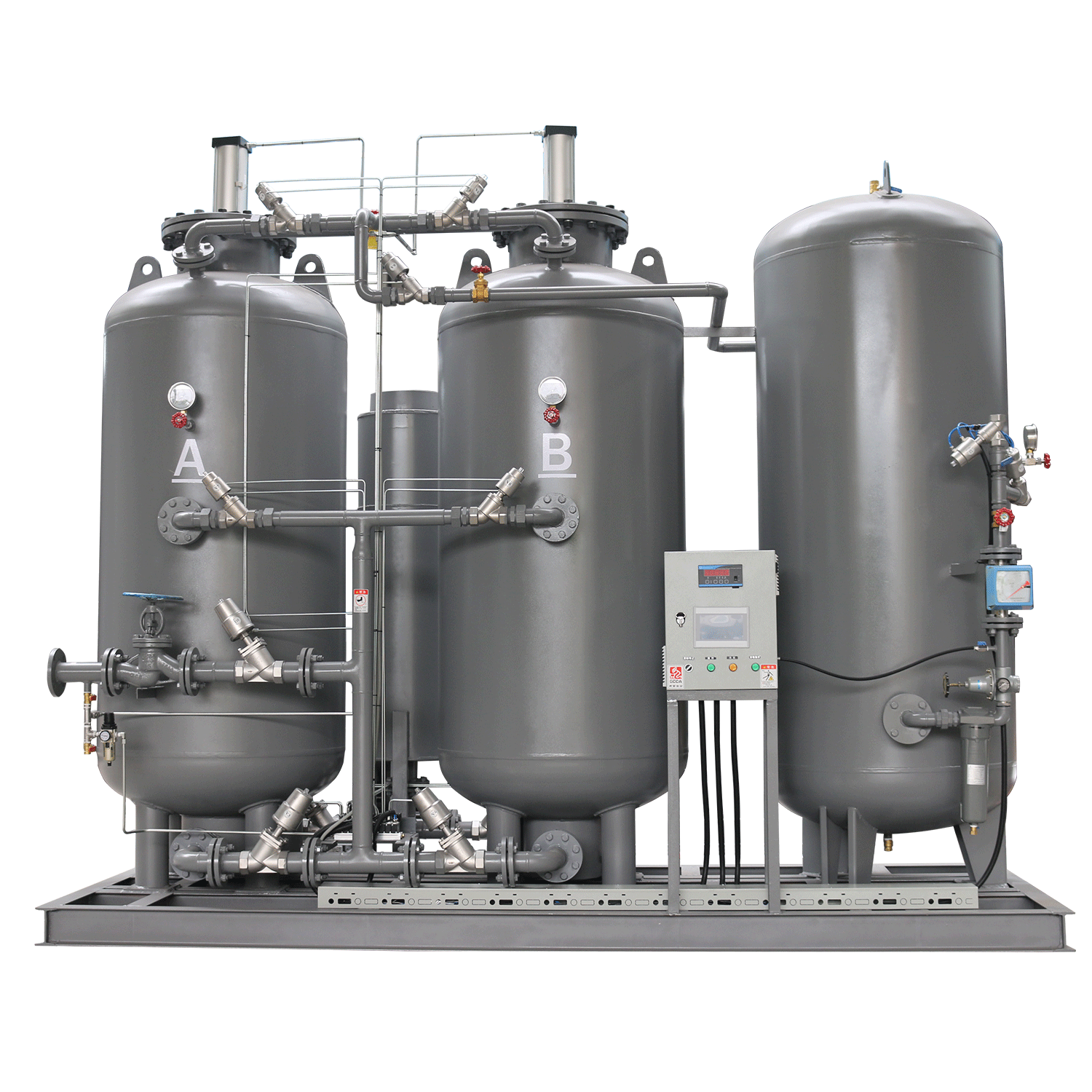
How PSA Nitrogen Generation Works
Pressure Swing Adsorption uses two adsorption towers that alternate between adsorption and regeneration.
Adsorption
Compressed air enters one adsorption tower containing Carbon Molecular Sieve.
The CMS preferentially adsorbs oxygen molecules, while nitrogen passes through the adsorption bed and exits as product gas.
Regeneration
While one tower is producing nitrogen, the other tower is depressurized.
Oxygen retained by the CMS is released during depressurization and discharged to atmosphere with assistance from a small quantity of nitrogen purge gas.
Automatic Tower Switching
When the active adsorption tower reaches its predetermined adsorption capacity, the control system switches the functions of the two towers.
The regenerated tower begins adsorption, while the previously active tower enters regeneration.
This alternating process allows the PSA system to provide a continuous nitrogen supply at the specified purity.
PLC-Controlled Automatic Operation
The PSA nitrogen generator uses PLC-controlled pneumatic valves to manage adsorption, regeneration, pressure changes, and tower switching automatically.
The system supports automatic start and stop, automatic operating-cycle switching, and PLC-controlled pneumatic valve sequencing.
Operators therefore do not need to manually switch adsorption towers during normal production.
Switching Cycle
The standard switching cycle is:
45–60 seconds
Correct sequencing is important because the adsorption and regeneration stages must remain coordinated to maintain stable nitrogen production.
Standard PSA Operating Conditions
The PSA nitrogen generator operates within the following series-level conditions:
| Parameter | Specification |
|---|---|
| Inlet air temperature | ≤40°C |
| Inlet air pressure | 0.5–0.8 MPa |
| Available nitrogen purity | 95%–99.999% |
| Nitrogen dew point | ≤−40°C |
| Ambient temperature | ≤40°C |
| Switching cycle | 45–60 s |
| Power supply | 220 V / 50 Hz |
| Noise level | ≤75 dB |
The broader PSA Series supports nitrogen purity from 95% to 99.999%, while the LYZD-B configuration discussed here is focused specifically on 99% nitrogen purity.
LYZD-B 99% Nitrogen Generator Technical Parameters
Representative LYZD-B specifications are shown below.
| Model | Nitrogen Production | Inlet | Outlet | Overall Dimensions H × L × W | Effective Air Consumption |
|---|---|---|---|---|---|
| LYZD-B15 | 15 m³/h | DN15 | DN15 | 1500 × 850 × 500 mm | 0.55 m³/min |
| LYZD-B25 | 25 m³/h | DN20 | DN15 | 1800 × 900 × 600 mm | 0.91 m³/min |
| LYZD-B50 | 50 m³/h | DN25 | DN25 | 2400 × 1150 × 700 mm | 2.00 m³/min |
| LYZD-B90 | 90 m³/h | DN32 | DN32 | 2600 × 1150 × 800 mm | 3.30 m³/min |
| LYZD-B140 | 140 m³/h | DN40 | DN40 | 2600 × 1500 × 900 mm | 5.13 m³/min |
| LYZD-B220 | 220 m³/h | DN50 | DN40 | 2750 × 1900 × 1000 mm | 8.06 m³/min |
| LYZD-B310 | 310 m³/h | DN65 | DN50 | 3031 × 2350 × 1200 mm | 11.36 m³/min |
| LYZD-B530 | 530 m³/h | DN80 | DN80 | 3350 × 2900 × 1650 mm | 19.43 m³/min |
The LYZD-B530 dimensions are 3350 × 2900 × 1650 mm.
The range also includes intermediate models such as LYZD-B35, B45, B60, B70, B110, B120, B160, B180, B260, B350, B400, B440, and B480. The models in the table are therefore representative selections rather than the complete size range.
Why Compressed-Air Consumption Matters
Nitrogen production capacity cannot be evaluated independently from compressed-air demand.
Each LYZD-B model requires a corresponding amount of compressed air.
For example:
| Model | Nitrogen Production | Effective Air Consumption |
|---|---|---|
| LYZD-B15 | 15 m³/h | 0.55 m³/min |
| LYZD-B140 | 140 m³/h | 5.13 m³/min |
| LYZD-B310 | 310 m³/h | 11.36 m³/min |
| LYZD-B530 | 530 m³/h | 19.43 m³/min |
A facility must therefore confirm that its compressor system can provide sufficient compressed-air flow at the required pressure and quality while also supporting other plant air demand.
Selecting a nitrogen generator only according to the required nitrogen flow can result in an undersized compressed-air supply.
Design Conditions for Rated Performance
The LYZD-B performance data are based on defined operating conditions:
Adsorption pressure: 0.8 MPa(g)
Ambient temperature: 20°C
Feed-air relative humidity: 80%
Actual nitrogen capacity and compressed-air consumption can vary when site pressure, ambient temperature, inlet moisture loading, or other operating conditions differ from these design conditions.
Model selection should therefore consider the actual compressor-station conditions rather than nitrogen demand alone.
Nitrogen Purity and Capacity
PSA nitrogen-generator sizing involves a relationship between nitrogen purity, product flow, and compressed-air consumption.
The PSA Series supports purity levels from 95% to 99.999%, but this LYZD-B configuration is specifically intended for 99% nitrogen production.
A process requiring higher nitrogen purity should be treated as a different technical configuration rather than assuming the same 99% model will retain identical rated nitrogen flow after a purity change.
Users requiring different purity levels can compare the available configurations through Lingyu’s nitrogen generator range.
Nitrogen Dew Point
The standard nitrogen dew point is:
≤−40°C
Nitrogen purity alone does not define the complete gas-quality requirement. Residual moisture can also affect production processes.
Applications sensitive to both oxygen concentration and moisture should therefore define at least two separate parameters:
Required nitrogen purity
Required nitrogen dew point
Both should be considered when selecting the nitrogen-generation system.
Real-Time Nitrogen Purity and Flow Monitoring
The PSA system provides real-time monitoring of nitrogen purity and nitrogen flow rate.
Operators can monitor whether nitrogen production remains within the required process conditions while the system is operating.
The digital touchscreen displays key parameters including pressure, nitrogen purity, flow rate, and system operating status.
This provides direct visibility into both gas quality and PSA operating conditions.
Off-Spec Nitrogen Protection
The PSA nitrogen generator includes off-spec nitrogen alarm and protection functions.
If nitrogen purity falls below the specified value, the system activates an alarm.
If the off-spec condition continues for a preset period, the system automatically shuts down for protection.
This function is particularly important for processes that cannot accept nitrogen below the required purity.
Automatic CMS Compaction
The nitrogen generator includes an automatic Carbon Molecular Sieve compaction system.
The mechanism helps maintain proper CMS packing density and reduces movement within the adsorption bed that could contribute to CMS pulverization.
Stable CMS packing is important because adsorption-bed condition directly affects long-term nitrogen-generator performance.
Maintenance should therefore focus on actual CMS condition and system performance instead of relying on a universal fixed replacement interval.
Pressure Equalization and Energy Efficiency
The PSA system uses an optimized unequal-pressure equalization process.
This process improves nitrogen recovery efficiency and can indirectly reduce overall energy consumption by approximately 5%.
The actual energy benefit depends on operating conditions, production load, compressor performance, nitrogen demand, and system configuration, so the approximately 5% value should not be treated as a guaranteed saving for every installation.
Compressed-Air Pretreatment
Carbon Molecular Sieve should receive compressed air that meets the required inlet quality conditions.
A complete PSA nitrogen-generation system can include an upstream air receiver, refrigerated air dryer, and multiple filtration stages before the compressed air enters the adsorption towers.
Why Pretreatment Matters
Liquid water, oil contamination, and particles can negatively affect CMS performance and long-term adsorption stability.
Proper pretreatment helps protect the adsorption bed and contributes to stable nitrogen purity and flow.
Where additional filtration is required, Lingyu’s precision compressed air filters can be incorporated into the pretreatment system.
Filter grades and arrangement should be selected according to compressor type, inlet-air quality, and nitrogen-generator requirements.
Nitrogen Buffering and Delivery
The complete system can also incorporate a nitrogen buffer tank, nitrogen/oxygen analyzer, off-spec nitrogen outlet, control valve, and final nitrogen supply connection.
Role of the Nitrogen Buffer Tank
The nitrogen buffer tank is not simply a storage vessel.
It can help separate the cyclic PSA production process from fluctuations in downstream nitrogen consumption and support more stable supply conditions.
System design should consider:
- Nitrogen production rate
- Instantaneous nitrogen consumption
- Supply pressure stability
- Buffer volume
- Pipeline demand
- Process operating pattern
The required buffer capacity should therefore be matched to the actual production and consumption profile.
Is 99% Nitrogen Suitable for Every Application?
A 99% purity specification should not be applied universally across different industries.
Food packaging, electronics, pharmaceuticals, laboratories, laser processing, beverages, oil and gas, and other industrial processes may all use nitrogen, but their required purity levels can differ substantially according to the process.
A 99% PSA nitrogen generator is appropriate where the process specification permits approximately 1% residual non-nitrogen components.
Applications requiring lower residual oxygen or a higher nitrogen purity should use a different nitrogen-generation or purification configuration.
For industry-specific compressed-air and gas-treatment information, users can review Lingyu’s food and beverage application.
99% PSA Nitrogen vs. ≥99.999% Purified Nitrogen
A standard 99% LYZD-B PSA nitrogen generator should not be confused with a separate high-purity nitrogen purification system.
A Carbon-Based Deoxygenation Purification System can use PSA-produced nitrogen of approximately 99.9% as feed gas and further increase nitrogen purity to ≥99.999%.
That process uses a deoxygenation catalyst followed by CO₂ and moisture removal and is technically different from the standard 99% LYZD-B PSA process.
The ≥99.999% purity level should therefore not be presented as another operating setting of the same 99% LYZD-B configuration.
Maintenance Priorities
PSA nitrogen-generator maintenance should focus on equipment condition and actual operating performance rather than a fixed universal CMS replacement interval.
Important maintenance areas include compressed-air pretreatment, filter condition, pneumatic valve switching, CMS packing condition, nitrogen-purity trends, nitrogen-flow stability, pressure performance, and condensate control.
Pretreatment System
Inspect filters, dryers, condensate management equipment, and the compressed-air receiver to ensure the CMS receives properly treated air.
Pneumatic Valves
Check valve actuation and switching reliability because the PSA process depends on accurate alternation between adsorption and regeneration.
CMS Condition
Monitor packing condition and adsorption performance. Changes in purity, airflow, pressure behavior, or adsorption stability can help indicate when further inspection is required.
Purity and Flow Trends
Online purity and flow data should be monitored over time rather than only checking whether the generator is currently running.
Changes in these parameters can provide useful information about overall system condition.
How to Select a 99% PSA Nitrogen Generator
The correct LYZD-B model should be selected according to the complete nitrogen and compressed-air operating requirements.
Required Nitrogen Purity
Confirm that 99% nitrogen purity matches the downstream process specification.
If higher purity is required, select the appropriate higher-purity configuration rather than sizing from the 99% table alone.
Required Nitrogen Flow
Determine the normal, minimum, and maximum nitrogen consumption.
The representative LYZD-B range shown here extends from 15 to 530 m³/h.
Available Compressed-Air Capacity
Confirm that the compressor system can supply the required effective airflow.
Across the representative endpoints, effective compressed-air consumption ranges from 0.55 m³/min for LYZD-B15 to 19.43 m³/min for LYZD-B530.
Operating Pressure
The standard inlet-air pressure range is 0.5–0.8 MPa.
The rated performance data are based on an adsorption pressure of 0.8 MPa(g).
Inlet Temperature and Ambient Conditions
The inlet-air temperature and ambient temperature should both be ≤40°C under the standard operating requirements.
Actual site temperature should be considered when selecting the system.
Nitrogen Dew Point
The standard nitrogen dew point is ≤−40°C.
Confirm that this moisture specification meets the downstream process requirement.
Pretreatment Quality
Define the air-drying and filtration system required to protect the Carbon Molecular Sieve.
Buffering and Demand Profile
Evaluate instantaneous demand, production fluctuations, buffer-tank capacity, supply pressure, and pipeline requirements.
Monitoring and Controls
Confirm requirements for PLC automation, real-time nitrogen purity monitoring, flow monitoring, touchscreen display, alarms, and off-spec nitrogen protection.
Users focused specifically on this purity level can review Lingyu’s 99% purity PSA nitrogen generator.
For special capacities, purity requirements, operating conditions, or system-integration requirements, the final configuration should be matched to the actual project.
Conclusion
The LYZD-B 99% PSA nitrogen generator produces nitrogen from compressed air using two CMS-filled adsorption towers that automatically alternate between adsorption and regeneration.
Oxygen is preferentially adsorbed by the Carbon Molecular Sieve, while nitrogen passes through the adsorption bed as product gas. During regeneration, previously adsorbed oxygen is released, and PLC-controlled pneumatic valves automatically manage tower switching.
Standard PSA operating conditions include an inlet-air pressure of 0.5–0.8 MPa, inlet-air temperature of ≤40°C, nitrogen dew point of ≤−40°C, a 45–60 second switching cycle, 220 V / 50 Hz power supply, and noise level of ≤75 dB.
For the 99% LYZD-B configuration, representative nitrogen-production capacities extend from 15 to 530 m³/h, while effective compressed-air consumption ranges from 0.55 to 19.43 m³/min across those endpoints.
The system also incorporates real-time nitrogen purity and flow monitoring, off-spec nitrogen protection, automatic CMS compaction, optimized unequal-pressure equalization, and digital touchscreen monitoring.
For reliable system selection, nitrogen purity should be evaluated together with nitrogen flow, compressed-air capacity, inlet conditions, nitrogen dew point, pretreatment quality, buffer demand, and process consumption profile.