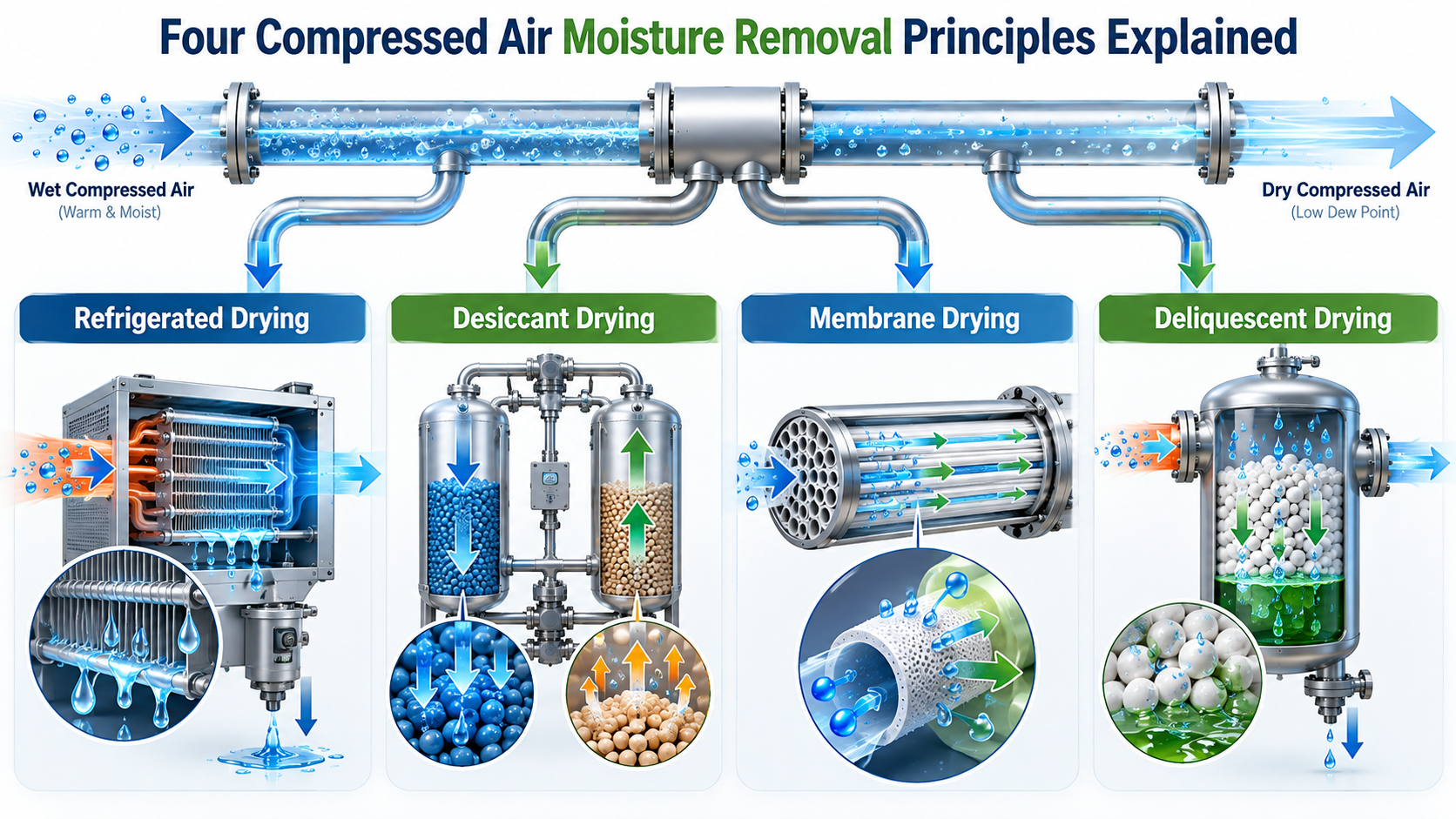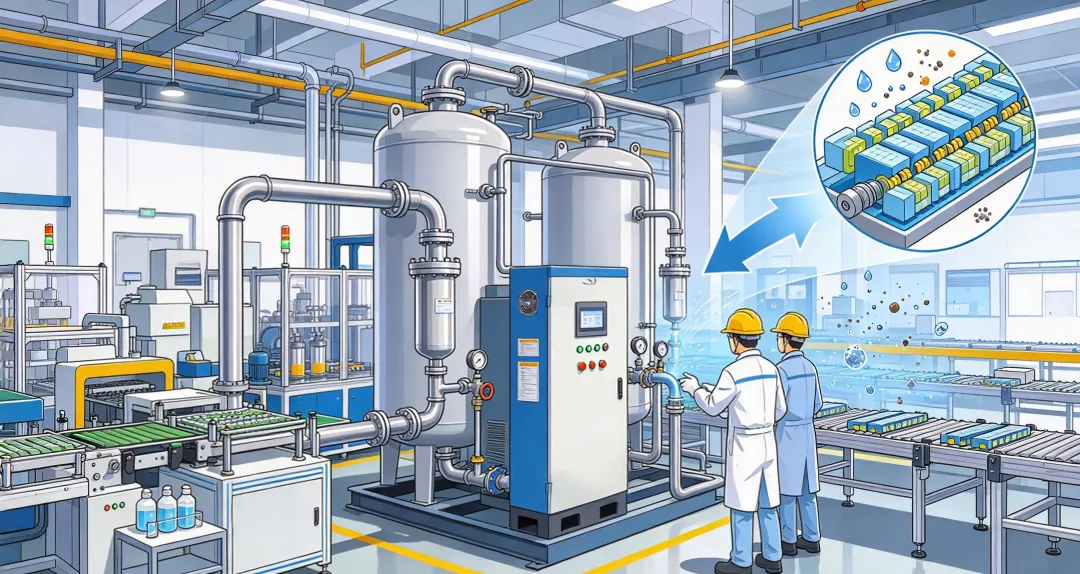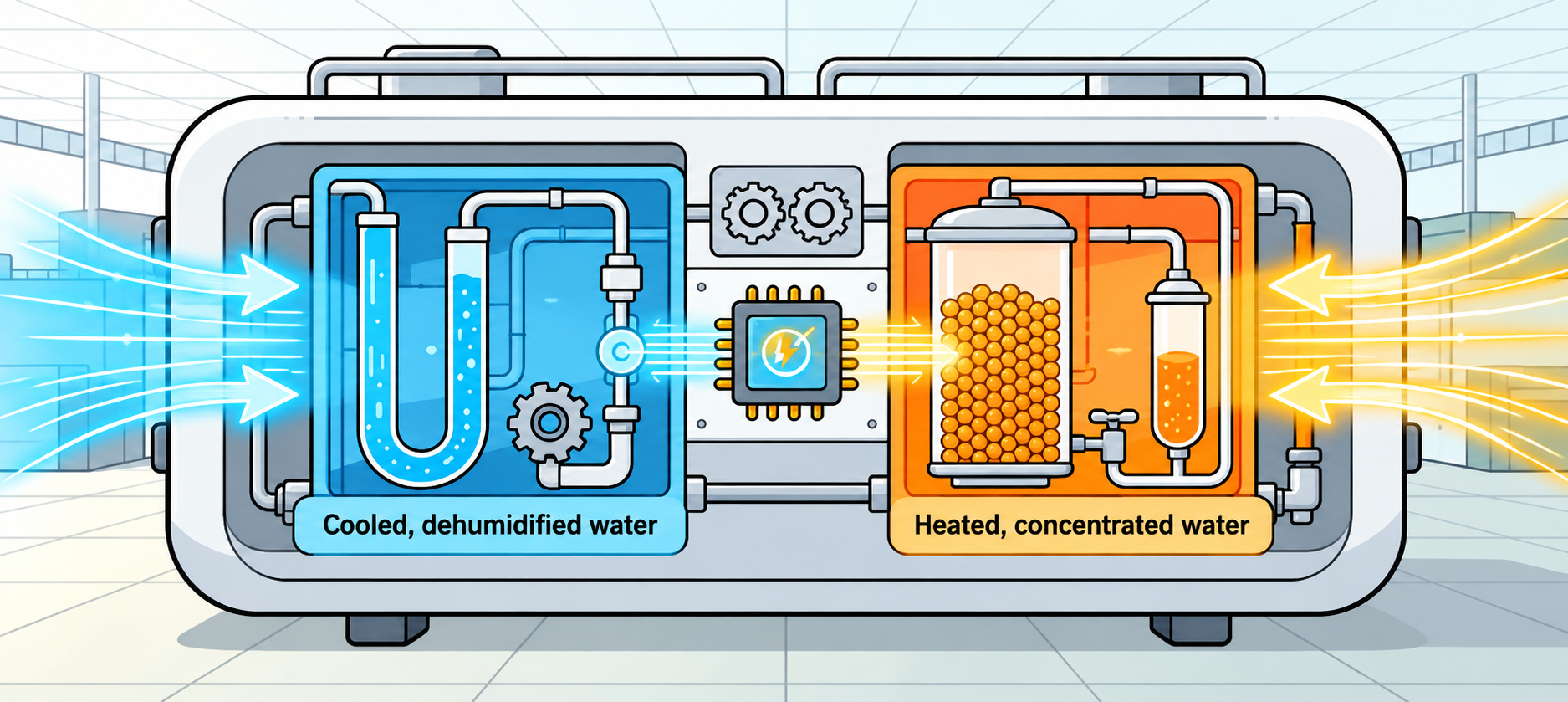
Refrigerated compressed air dryers remove moisture from compressed air by cooling it, condensing water vapor into liquid, separating the condensate, and discharging it from the system.
They are widely used where general industrial compressed air requires reliable moisture control without the very low pressure dew points associated with adsorption drying.
For facilities comparing different capacities and configurations, Lingyu’s refrigerated air dryer range includes air-cooled, water-cooled, energy-saving, and variable-frequency solutions for different operating conditions.
Why Does Compressed Air Need to Be Dried?
Atmospheric air contains water vapor. When air is compressed, this moisture becomes concentrated.
After compression, the air is hot. As it travels through aftercoolers, receivers, piping, and treatment equipment, it cools. Once its temperature falls sufficiently, part of the water vapor condenses into liquid water.
Without adequate moisture treatment, condensate can contribute to:
- Internal pipe corrosion
- Pneumatic component deterioration
- Valve and cylinder problems
- Instrument malfunction
- Production interruptions
- Process or product-quality problems
A refrigerated dryer reduces the amount of water vapor remaining in the compressed air so that downstream condensation can be controlled under the intended operating conditions.
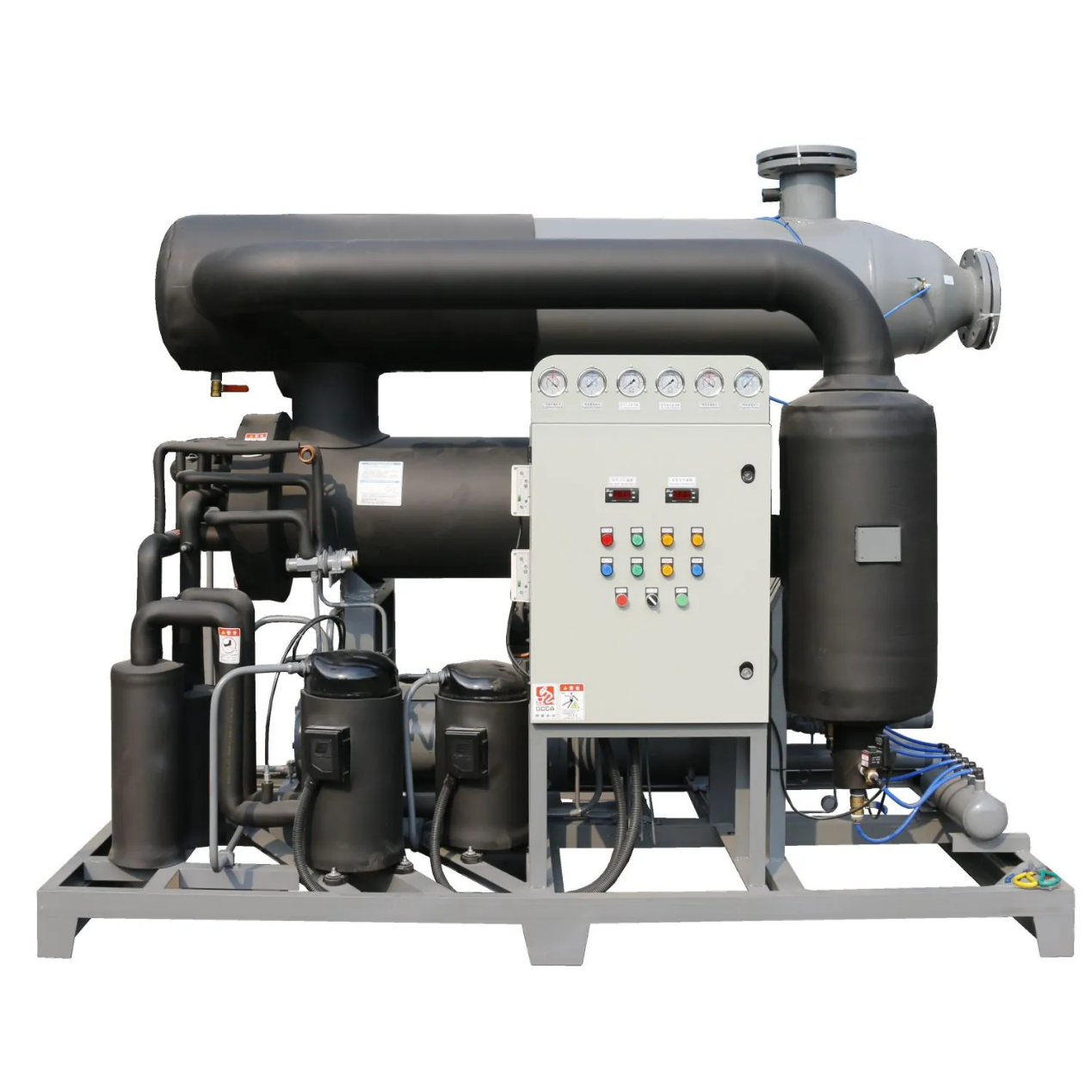
How Does a Refrigerated Compressed Air Dryer Work?
The process involves more than simply passing compressed air through a refrigeration circuit.
For Lingyu’s conventional high-inlet-temperature refrigerated dryer technology, the basic sequence is:
hot, wet compressed air → pre-cooling → refrigeration cooling → condensation → gas-liquid separation → automatic drainage → reheating → dry compressed air
1. Hot Compressed Air Enters the Dryer
Compressed air arriving from the compressor system contains water vapor and may also contain oil and other contaminants.
The incoming air is first pre-cooled before entering the refrigeration evaporator.
2. The Air Is Cooled
The pre-cooled compressed air passes through the evaporator, where its temperature is reduced further.
As the air cools, water vapor reaches its dew point and condenses into liquid droplets.
3. Condensate Is Separated
The air then passes through a gas-liquid separation stage.
Condensed moisture, oil, and some impurities are separated from the compressed air.
4. Liquid Is Automatically Drained
The collected condensate is discharged through an automatic drain.
Correct drain operation is essential because separated liquid that cannot leave the dryer may eventually cause downstream moisture problems.
5. Dry Air Is Reheated
Before leaving the dryer, the cold dried compressed air exchanges heat with the warmer incoming air.
This reheating raises the outlet temperature closer to ambient conditions and reduces the possibility of external condensation on downstream piping.
What Pressure Dew Point Can a Refrigerated Dryer Provide?
Pressure dew point, or PDP, indicates the temperature at which water vapor in compressed air would begin to condense at system pressure.
For Lingyu’s conventional AH air-cooled and WH water-cooled refrigerated dryers, the specified pressure dew point is 2–10°C under rated operating conditions.
This range is suitable for many general industrial applications.
However, it should not be assumed that every refrigerated dryer provides exactly 2–4°C PDP under every operating condition. Actual performance depends on the dryer design and operating conditions.
Typical Operating Conditions
Lingyu’s conventional AH and WH refrigerated dryer series share several important standard operating conditions:
| Parameter | Typical Specification |
|---|---|
| Rated inlet pressure | 0.7 MPa |
| Operating pressure range | 0.6–1.0 MPa |
| Rated inlet temperature | 50°C |
| Maximum inlet temperature | ≤80°C |
| Pressure dew point | 2–10°C |
| Rated ambient temperature | 32°C |
| Ambient operating range | 2–45°C |
| Pressure drop | ≤0.025 MPa |
Other operating pressures can be considered for specific requirements.
These conditions matter because nominal dryer airflow cannot be evaluated independently of pressure, inlet temperature, and ambient conditions.
Air-Cooled Refrigerated Air Dryers
An air-cooled dryer rejects refrigeration heat to the surrounding atmosphere through its condenser.
This configuration eliminates the need for a separate cooling-water supply.
Lingyu’s AH Series uses an air-cooled design and is intended for indoor installation on a level concrete floor.
Approximately 1.5 m of clearance should be maintained around the dryer to support ventilation and maintenance access.
Air-Cooled Dryer Advantages
An air-cooled configuration can be attractive where:
- Cooling water is unavailable
- Installation simplicity is important
- Ambient ventilation is adequate
- Water-system maintenance is undesirable
The installation environment remains important. Restricted airflow, excessive dust, high ambient temperature, or recirculation of hot condenser exhaust can reduce heat-transfer performance.
Users evaluating this configuration can review Lingyu’s air-cooled refrigerated dryer category.
Water-Cooled Refrigerated Air Dryers
Water-cooled dryers reject refrigeration heat through a cooling-water circuit rather than relying primarily on ambient airflow across a condenser.
Lingyu’s WH Series specifies:
- Cooling-water pressure: 0.2–0.4 MPa
- Rated cooling-water temperature: ≤32°C
- Cooling-water operating range: 2–38°C
The required cooling-water flow and connection size should be confirmed for the specific dryer model.
Water-cooled dryers can be useful for larger systems or installations where suitable cooling-water infrastructure is already available.
Lingyu’s water-cooled refrigerated dryer category includes configurations for these applications.
High Inlet Temperature Capability
Inlet temperature is a critical dryer-selection parameter.
Higher-temperature compressed air carries a greater thermal and moisture load, which increases the work required from the drying system.
Lingyu’s conventional AH and WH Series have:
- Rated inlet temperature: 50°C
- Maximum inlet temperature: ≤80°C
The integrated pre-cooling and heat-exchange arrangement helps prepare higher-temperature compressed air before refrigeration cooling.
However, the maximum allowable temperature should not be treated as the preferred continuous operating condition.
Effective compressor aftercooling and upstream condensate separation can reduce the thermal and moisture load entering the dryer.
Pressure Drop and Energy Efficiency
A refrigerated dryer does not automatically reduce compressor energy consumption simply because the air becomes dry.
One of the more important energy considerations is pressure drop.
Every restriction in a compressed air system reduces the useful pressure available downstream.
If excessive pressure loss forces the compressor to operate at a higher discharge pressure, energy consumption can increase.
Lingyu’s conventional AH and WH dryers specify a pressure drop of ≤0.025 MPa under rated conditions.
Total system pressure drop should also include:
- Separators
- Filters
- Dryer
- Valves
- Piping
- Fittings
Energy evaluation should therefore consider the complete compressed air treatment train.
Energy-Saving Refrigerated Dryer Designs
Not all refrigerated dryers use exactly the same heat-exchanger or control architecture.
For applications where energy consumption is a major selection factor, dedicated energy-saving designs may be more appropriate than assuming every conventional refrigerated dryer provides the same efficiency characteristics.
3-in-1 Plate Heat Exchanger Design
Lingyu’s PD Series integrates the evaporator, air-to-air heat exchanger, and water separator into a 3-in-1 aluminum plate heat exchanger.
The design provides:
- Pressure drop below 0.015 MPa
- Inlet/outlet temperature difference within 10°C
- Approximately 20–30% energy reduction compared with conventional shell-and-tube designs under the specified comparison conditions
- R410A/R407C refrigerant options
- RS-485 communication
The 3-in-1 plate heat exchange refrigerated air dryer is therefore a more relevant option when this specific energy-saving architecture is required.
Variable-Frequency Refrigerated Drying
When compressed air demand fluctuates significantly, variable-frequency refrigeration can provide another approach.
Lingyu’s PB Series adjusts refrigeration compressor speed according to load rather than relying solely on fixed-speed operation.
This type of control can be useful for facilities with substantial variation between peak and partial-load compressed air demand.
How to Select the Correct Refrigerated Air Dryer
1. Determine Peak Airflow
Start with the maximum actual compressed air flow expected through the dryer.
Do not size the dryer using average consumption alone.
Consider:
- Compressor output
- Peak production demand
- Simultaneous equipment use
- Compressor sequencing
- Expected expansion
2. Apply Correction Factors
A nominal CFM or m³/min rating is valid only under defined reference conditions.
Effective capacity changes when actual conditions differ.
Important variables include:
- Inlet pressure
- Inlet temperature
- Ambient temperature
- Cooling-water conditions for water-cooled units
A dryer that appears correctly sized by nominal airflow can become effectively undersized under more demanding thermal conditions.
3. Define the Required Pressure Dew Point
For many general industrial systems, a 2–10°C PDP is adequate.
If downstream piping is exposed to freezing temperatures or the process requires a substantially lower pressure dew point, refrigerated drying may not be sufficient.
In these cases, a desiccant air dryer should be considered.
4. Evaluate Pressure
Confirm that actual plant pressure falls within the dryer’s operating range.
For Lingyu’s conventional AH and WH Series, the standard operating range is 0.6–1.0 MPa, with a rated inlet pressure of 0.7 MPa.
5. Evaluate the Installation Environment
For an air-cooled dryer, consider:
- Ambient temperature
- Ventilation
- Dust concentration
- Heat sources
- Available clearance
For a water-cooled dryer, also consider:
- Cooling-water temperature
- Water pressure
- Required water flow
- Water quality
- Heat-rejection capacity
Refrigerated Drying Does Not Replace Filtration
Moisture is only one type of compressed air contamination.
Compressed air may also contain:
- Oil aerosols
- Solid particles
- Rust
- Oil vapor
- Other process contaminants
Appropriate precision compressed air filters can therefore be installed according to the required contamination level.
Upstream filtration helps protect treatment equipment, while downstream filtration can provide additional particle and oil control where required.
The correct filter grades and sequence depend on compressor type and final air-quality specification.
Automatic Drain Maintenance
Condensate separation is only effective if the separated liquid can leave the dryer.
Check the automatic drain for:
- Blockage
- Contamination
- Restricted discharge piping
- Failure to open
- Continuous compressed air leakage
Drain inspection should be based on operating conditions and condensate load rather than an arbitrary universal service interval.
A malfunctioning drain can cause downstream water even when the refrigeration circuit itself is operating correctly.
Condenser Maintenance
For an air-cooled dryer, inspect the condenser regularly.
Dust, fibers, and oil deposits can restrict airflow and reduce heat transfer.
A contaminated condenser can contribute to:
- Higher refrigeration pressure
- Higher operating temperature
- Reduced cooling capacity
- Protection trips
- Poor dew-point performance
Cleaning frequency should reflect the actual environment. A dusty manufacturing facility may require much more frequent inspection than a clean compressor room.
Refrigerant Maintenance
Refrigerant should not normally require routine replacement in a properly sealed refrigeration system.
If refrigeration performance deteriorates or the refrigerant charge is found to be low, qualified personnel should inspect the system for leaks and determine the cause before restoring the correct charge.
Routine annual refrigerant replacement or topping-up should not be treated as standard preventive maintenance.
Applications of Refrigerated Compressed Air Dryers
Automotive and General Manufacturing
In automotive and general manufacturing, refrigerated drying can support pneumatic tools, actuators, assembly equipment, and automated machinery.
Where compressed air is used for painting or finishing, final moisture, oil, and particle requirements should be considered together.
Food and Beverage
In food and beverage production, compressed air can support packaging, conveying, pneumatic machinery, and process operations.
A refrigerated dryer controls moisture, but it should not by itself be assumed to make compressed air suitable for direct food contact. The complete air-quality requirement must be considered.
Electronics Manufacturing
In electronics and precision manufacturing, moisture control can help protect pneumatic systems and moisture-sensitive processes.
Some electronics processes may require a lower pressure dew point than refrigerated drying provides, so the actual process specification should be checked.
Pharmaceutical Production
Pharmaceutical facilities can use compressed air in pneumatic equipment, packaging, conveying, instrumentation, and process operations.
The required treatment configuration should be based on the specific application and validated air-quality requirements rather than assuming that refrigerated drying alone guarantees suitable process air.
Refrigerated vs. Desiccant Dryer
| Factor | Refrigerated Dryer | Desiccant Dryer |
|---|---|---|
| Drying principle | Cooling and condensation | Adsorption |
| Typical Lingyu PDP | 2–10°C | Depends on series; much lower PDP available |
| Regeneration | Not required | Required |
| General factory air | Often suitable | May be unnecessary |
| Below-freezing piping | Usually unsuitable without deeper drying | More appropriate when correctly selected |
| Purge air | No regeneration purge | Depends on regeneration method |
| Complexity | Generally lower | Generally higher |
The better dryer is the one that meets the required pressure dew point efficiently—not necessarily the one that produces the driest possible air.
Frequently Asked Questions
What pressure dew point does a refrigerated compressed air dryer provide?
Lingyu’s conventional AH and WH refrigerated dryer technologies specify a 2–10°C pressure dew point under rated operating conditions.
Exact performance depends on dryer design and operating conditions.
Can I use a refrigerated dryer outdoors in freezing temperatures?
The dryer itself should be installed according to its specified environmental requirements. Lingyu’s conventional AH and WH Series are designed for indoor installation.
More importantly, if downstream compressed air piping is exposed to temperatures below the delivered pressure dew point, condensation and freezing can occur.
A lower-dew-point adsorption dryer may therefore be necessary.
How often should a refrigerated air dryer be serviced?
There is no single six-month or twelve-month interval appropriate for every installation.
Inspection and maintenance should account for:
- Operating hours
- Ambient contamination
- Condenser condition
- Drain performance
- Filter differential pressure
- Refrigeration performance
- Electrical condition
Follow the model-specific maintenance requirements and actual equipment condition.
How long does a refrigerated air dryer last?
Service life cannot reliably be stated as a universal 10–15-year figure.
Actual longevity depends on equipment design, operating load, inlet and ambient temperatures, installation quality, maintenance, condenser cleanliness, electrical conditions, and refrigeration-system condition.
Are refrigerated air dryers energy-efficient?
They can provide an economical drying solution when a refrigerated pressure dew point meets the application requirement.
Energy performance depends on dryer architecture, refrigeration load, pressure drop, operating conditions, and load profile.
For variable-demand applications, dedicated energy-saving or variable-frequency designs may offer additional advantages.
Choosing the Right Refrigerated Compressed Air Dryer
A refrigerated compressed air dryer provides a practical method of controlling moisture for many industrial compressed air systems.
Reliable performance begins with matching the dryer to:
peak airflow + inlet temperature + operating pressure + ambient conditions + required pressure dew point + acceptable pressure drop
Installation and maintenance are equally important. Adequate ventilation, clean heat-transfer surfaces, reliable condensate drainage, appropriate filtration, and correct system pressure help the dryer maintain stable performance over the long term.
For application-specific dryer selection, contact Lingyu with your maximum airflow, operating pressure, inlet temperature, ambient conditions, cooling method, and required pressure dew point.