Large centralized compressed-air systems require a refrigerated dryer that can handle high airflow without introducing excessive pressure loss or unstable moisture removal.
Lingyu’s LY-D1100WH Water-Cooled High-Inlet-Temperature Refrigerated Air Dryer is rated at 110 m³/min, corresponding approximately to the 3885 CFM capacity class. Its defined technical configuration includes 17.0 kW total power, 33 t/h cooling-water flow, G2″ cooling-water connection, DN150 compressed-air connections, 1400 kg weight, and dimensions of 2450 × 1540 × 1850 mm.
This guide focuses on 110 m³/min airflow, high-inlet-temperature treatment, 33 t/h cooling-water demand, dual-compressor control, pressure drop, installation, and maintenance considerations.
For users comparing other capacities or refrigeration configurations, Lingyu’s refrigerated air dryer range includes additional air-cooled, water-cooled, and energy-saving designs.
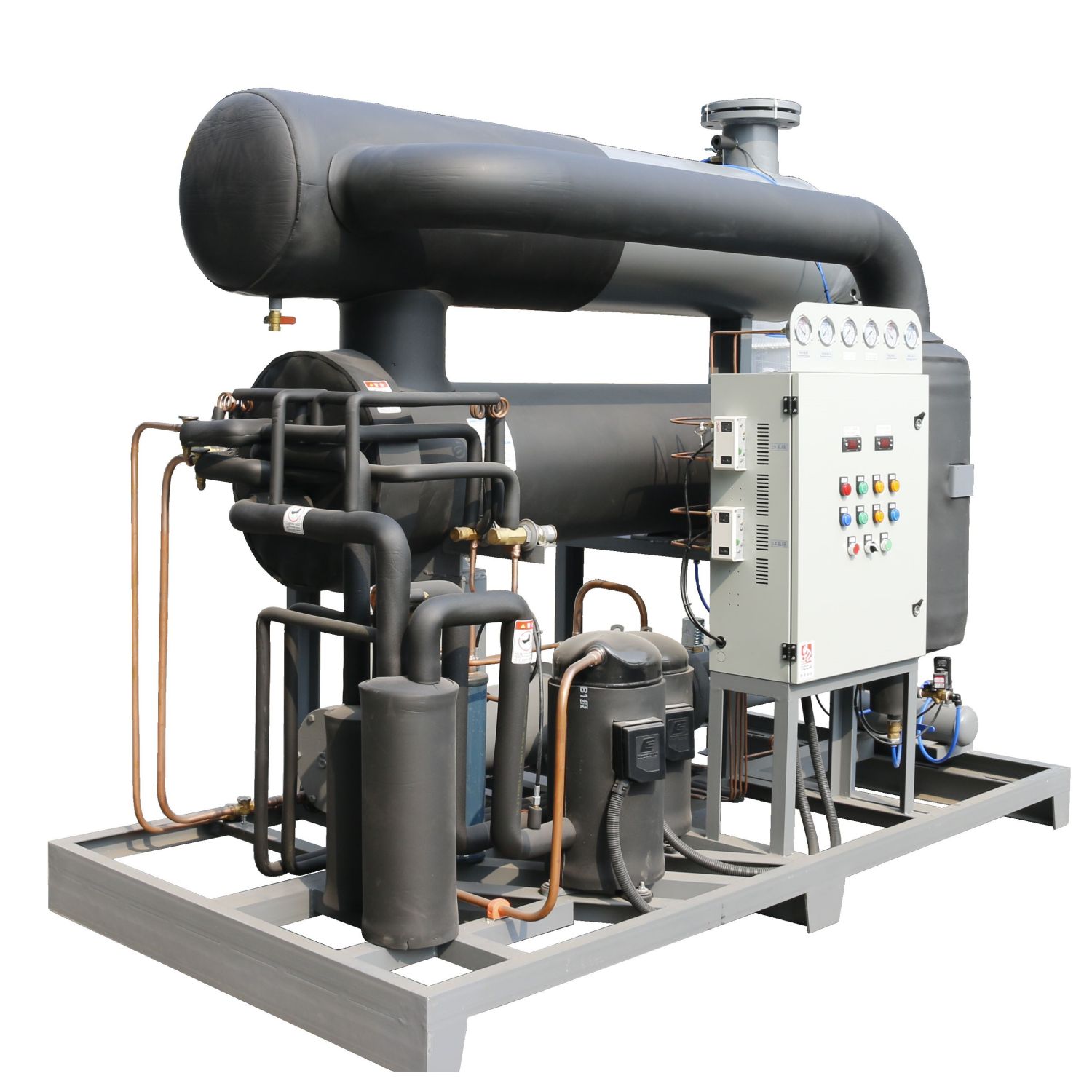
LY-D1100WH Technical Specifications
The LY-D1100WH has the following model-specific parameters:
| Parameter | LY-D1100WH |
|---|---|
| Airflow capacity | 110 m³/min |
| Power supply | 380V / 50Hz |
| Total power | 17.0 kW |
| Cooling-water flow | 33 t/h |
| Cooling-water connection | G2″ |
| Compressed-air inlet/outlet | DN150 |
| Weight | 1400 kg |
| Dimensions | 2450 × 1540 × 1850 mm |
These model-specific values provide a clear basis for evaluating the dryer as part of a complete high-flow compressed-air station.
How the WH Series Drying Process Works
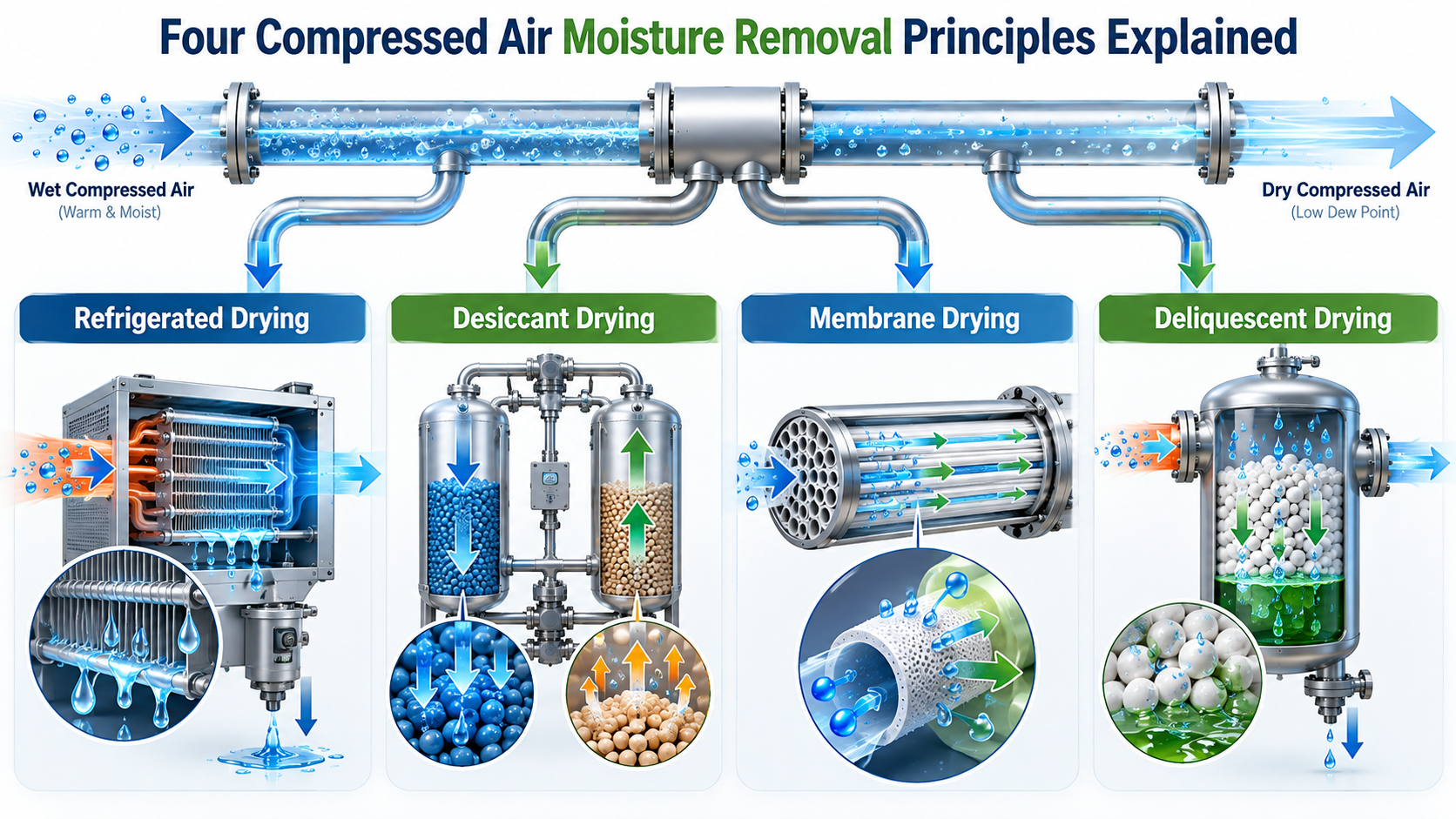
High-temperature compressed air containing moisture and oil first enters a water-cooled pre-cooler and air-to-air heat exchanger.
This stage reduces the compressed-air temperature before the air reaches the main refrigeration evaporator. The pre-cooled air then passes through the evaporator, where further refrigeration lowers its temperature to achieve a 2–10°C pressure dew point.
As the air cools, moisture, oil, and some impurities condense. The resulting liquid is separated by the gas-liquid separation system and discharged through an automatic drain valve.
Finally, the dried compressed air passes through the air-to-air heat exchanger again, where it is reheated toward ambient temperature before being supplied downstream.
The complete treatment sequence is:
Pre-cooling → refrigeration → condensation → moisture separation → automatic drainage → reheating.
Why the Water-Cooled Pre-Cooler Matters
The WH Series is specifically designed as a high-inlet-temperature refrigerated air dryer.
Its inlet-temperature conditions are:
Rated inlet temperature: 50°C
Maximum inlet temperature: ≤80°C
The water-cooled pre-cooler removes part of the heat load before compressed air enters the evaporator. This reduces the thermal burden placed directly on the refrigeration circuit and helps the dryer handle high-temperature compressed air within its specified operating range.
Inlet temperature should therefore be treated as a primary dryer-sizing parameter rather than as a secondary installation detail.
Standard WH Series Operating Conditions
| Operating Parameter | Specification |
|---|---|
| Rated inlet pressure | 0.7 MPa |
| Operating pressure range | 0.6–1.0 MPa |
| Rated inlet temperature | 50°C |
| Maximum inlet temperature | ≤80°C |
| Pressure dew point | 2–10°C |
| Rated ambient temperature | 32°C |
| Ambient operating range | 2–45°C |
| Pressure drop | ≤0.025 MPa |
| Cooling method | Water-cooled |
| Cooling-water pressure | 0.2–0.4 MPa |
| Cooling-water temperature | ≤32°C |
| Cooling-water operating range | 2–38°C |
| Refrigerant | R22 |
| Optional refrigerants | R407C / R410A upon request |
Other working pressures are available upon request.
These defined operating limits are more useful for system design than broad claims that the dryer can operate in all high-temperature environments.
Cooling-Water Requirement: 33 t/h
For the LY-D1100WH, the cooling-water requirement is:
Cooling-water flow: 33 t/h
Cooling-water connection: G2″
The cooling-water system must provide this flow while also meeting the WH Series operating conditions of ≤32°C cooling-water temperature and 0.2–0.4 MPa pressure.
An undersized cooling-water circuit can limit heat rejection even when the refrigeration components themselves are operating normally.
Cooling-water capacity should therefore be confirmed during equipment selection rather than treated as a secondary utility requirement.
Water Cooling and Ambient Conditions
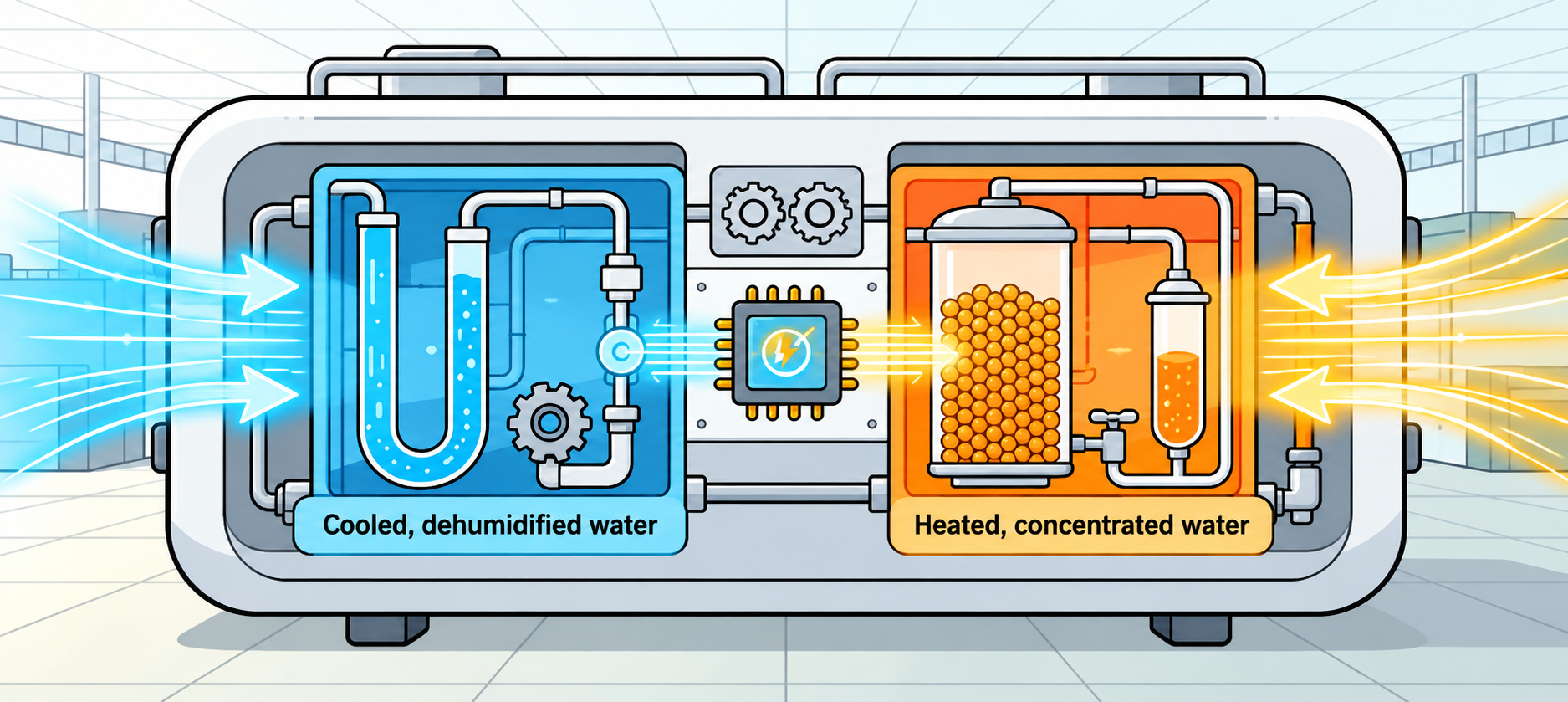
A water-cooled condenser transfers refrigeration heat into the plant’s cooling-water circuit rather than relying primarily on surrounding air for condenser heat rejection.
This can reduce dependence on equipment-room airflow for condenser cooling.
However, water cooling does not make ambient conditions irrelevant. The WH Series has a specified ambient operating range of 2–45°C, and the installation area still needs suitable environmental conditions and service access.
The correct advantage is therefore reduced dependence on ambient ventilation for condenser heat rejection, not complete independence from ambient conditions.
Pressure Drop at High Airflow
The WH Series specifies a pressure drop of:
≤0.025 MPa
At 110 m³/min, pressure loss should be considered at the complete system level. The dryer is normally only one source of pressure drop; filters, piping, valves, receivers, and distribution headers add further resistance.
A useful system relationship is:
Compressor discharge pressure − total treatment and distribution pressure loss = usable downstream pressure.
The objective is not simply to install a dryer with sufficient nominal airflow. The complete system should maintain the required pressure at production equipment without forcing the compressors to operate at unnecessarily high discharge pressure.
1+1 Dual-Compressor Control
The WH Series uses a 1+1 dual-compressor configuration for models from 5 to 180 m³/min.
The second refrigeration compressor automatically starts or stops according to system load. Because the LY-D1100WH is rated at 110 m³/min, it falls directly within this stated range.
This allows refrigeration capacity to respond to variations in compressed-air demand rather than requiring both refrigeration compressors to operate continuously regardless of load.
Load-responsive 1+1 compressor operation therefore provides a specific energy-management mechanism for the LY-D1100WH.
Heat Exchanger and Refrigeration Components
Key heat exchangers are manufactured in-house, while refrigeration compressors are mainly sourced from brands including Panasonic, Copeland, Danfoss, and Hanbell.
The WH Series also uses hydrophilic aluminum foil and standardized heat-exchanger/pre-cooler architecture across the series.
These components support the system’s heat-transfer and moisture-removal functions. Maintenance planning should therefore consider both the refrigeration circuit and the water side of the heat-exchange system.
Moisture Separation Is as Important as Refrigeration
Cooling compressed air below its dew point causes water vapor to condense, but the condensed liquid must then be removed efficiently.
The WH Series incorporates an independently designed water-separation system for moisture removal.
If separation performance deteriorates, liquid moisture can remain in the compressed-air stream even when the evaporator is reaching its target temperature. Separator condition and condensate drainage should therefore be included in routine maintenance.
Automatic Drain Inspection
The automatic drain is a defined component of the WH drying process.
Operators should confirm that condensate is being discharged correctly and that the drain line is not blocked or operating against excessive backpressure.
A failed or restricted drain can result in accumulated liquid inside the dryer and may compromise downstream compressed-air quality. For large continuous-flow systems, drain checks should form part of normal operating inspection.
Refrigerant Options
The standard refrigerant is:
R22
Environmentally friendlier R407C and R410A options are available upon request.
Refrigerant selection should be treated as an engineered configuration rather than an unrestricted interchangeable parameter. The refrigeration compressor, condenser, evaporator, expansion components, and control conditions must all match the selected refrigerant.
Control and Communication Options
The WH Series can be configured with PLC control, dry contacts, Modbus communication, and IoT connectivity.
For centralized compressor stations, these options can support integration of the dryer into a plant monitoring or supervisory control system.
Functions such as real-time dew-point monitoring, automatic diagnostics, and specific alarm packages should not be treated as standard LY-D1100WH features unless they are confirmed for the individual project configuration.
Installation Requirements
The WH Series is designed for indoor installation on a level concrete floor without a foundation, with at least 1.5 m clearance around the dryer.
For the LY-D1100WH specifically:
Dimensions: 2450 × 1540 × 1850 mm
Weight: 1400 kg
Installation planning should provide sufficient space for maintenance access, water piping, compressed-air piping, electrical access, condensate discharge, and future component servicing.
Capacity Selection Should Follow Actual Operating Conditions
A fixed 10–20% oversizing rule should not be applied to the LY-D1100WH because that percentage is not established as a model requirement.
Dryer selection should instead be based on actual airflow, peak demand, pressure, inlet temperature, ambient temperature, cooling-water conditions, and required pressure dew point.
A nominal 110 m³/min dryer may require a different selection decision if actual operating conditions differ substantially from its rated basis.
Filtration and Dryer Protection
The WH refrigerated dryer primarily removes moisture through cooling, condensation, and liquid separation.
If the compressed-air specification also requires control of particles or oil aerosols, additional filtration should be selected according to the required downstream air quality.
Where required, Lingyu’s precision compressed air filters can be incorporated into the complete treatment system.
A universal pre-filter and after-filter arrangement should not be assumed for every installation.
Where a 110 m³/min WH Dryer Fits
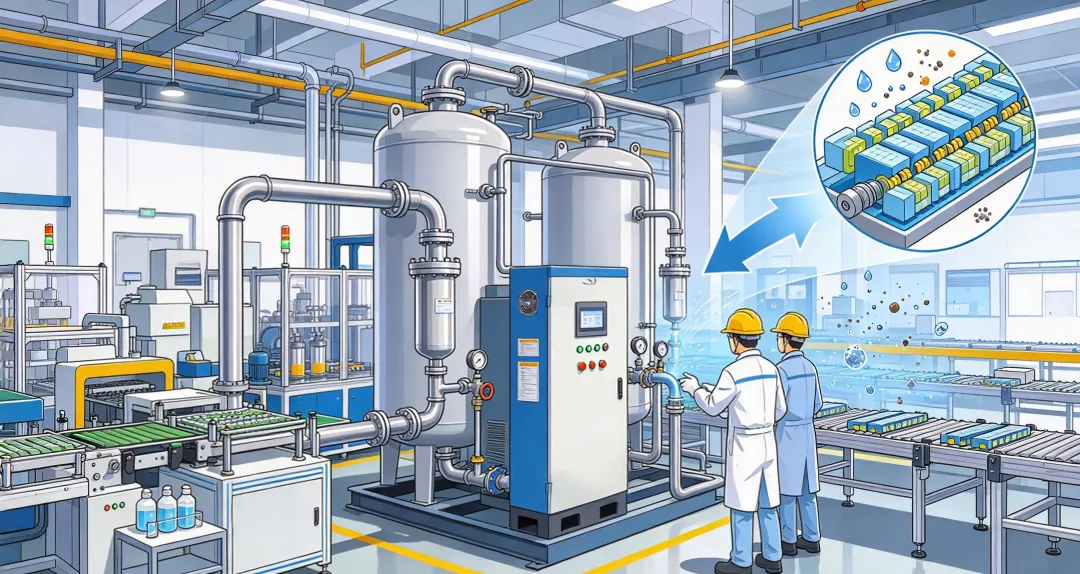
The LY-D1100WH is most naturally suited to centralized industrial compressed-air systems requiring approximately 110 m³/min treatment capacity, water cooling, relatively high inlet-air-temperature tolerance, a 2–10°C pressure dew point, and continuous plant-level compressed-air supply.
The actual operating conditions provide a more useful basis for application selection than a broad list of unrelated industries.
For industry-specific context, users can review Lingyu’s automotive and general manufacturing compressed-air solutions.
Redundancy Is a System-Design Decision
For production facilities where dry compressed air cannot be interrupted, multiple dryers may be arranged to provide standby capacity.
The LY-D1100WH does not require one mandatory redundancy arrangement as a product specification. Redundancy should instead be determined according to acceptable downtime, maintenance strategy, and plant demand.
A dual-dryer system should therefore be treated as a project-level design option rather than a mandatory feature of the dryer itself.
What to Confirm Before Selecting the LY-D1100WH
Before selecting a 3885 CFM-class water-cooled dryer, confirm the actual airflow, peak demand, inlet pressure, inlet temperature, ambient temperature, required dew point, allowable pressure drop, cooling-water temperature, cooling-water pressure, available 33 t/h cooling-water flow, electrical supply, installation clearance, filtration requirement, and control-interface requirement.
Users can review the dedicated 3885 CFM water-cooled high-temperature refrigerated air dryer product page for product-specific information.
For special operating pressures or other non-standard requirements, users can also use Lingyu’s Contact Us page for technical configuration support.
Conclusion
The 3885 CFM water-cooled refrigerated air dryer can be positioned around the standard LY-D1100WH 110 m³/min configuration rather than as a general discussion of water-cooled dryer technology.
Its model-specific parameters include 110 m³/min airflow, 380V / 50Hz power supply, 17.0 kW total power, 33 t/h cooling-water flow, G2″ cooling-water connection, DN150 compressed-air connections, 1400 kg equipment weight, and dimensions of 2450 × 1540 × 1850 mm.
The WH Series also operates with a 0.7 MPa rated inlet pressure, 0.6–1.0 MPa standard pressure range, 50°C rated inlet temperature, ≤80°C maximum inlet temperature, 2–10°C pressure dew point, ≤0.025 MPa pressure drop, 32°C rated ambient temperature, 2–45°C ambient operating range, ≤32°C cooling-water temperature, 0.2–0.4 MPa cooling-water pressure, and 2–38°C cooling-water operating-temperature range.
For this capacity class, the most important selection factors are cooling-water availability, high-inlet-temperature load, pressure drop, load-responsive dual-compressor operation, condensate drainage, installation clearance, and sizing against actual operating conditions.