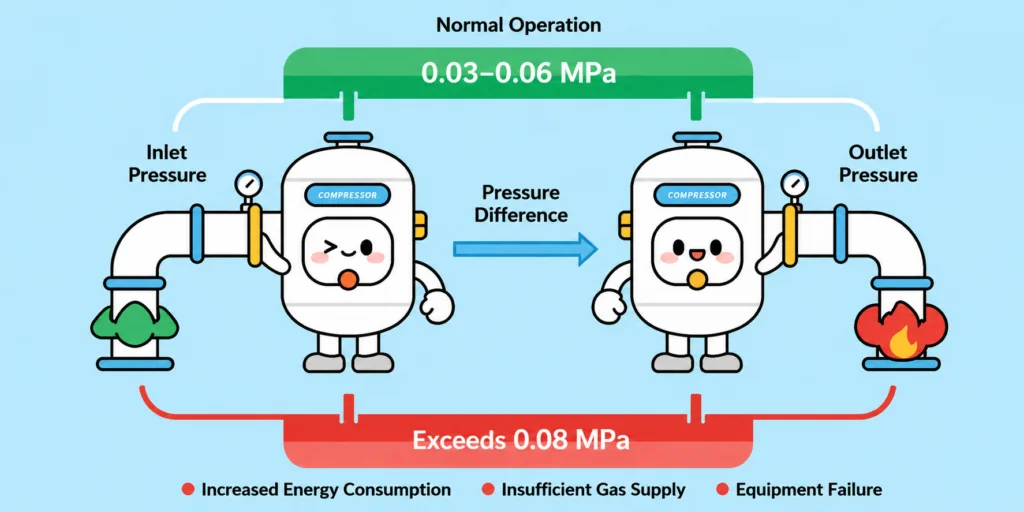
In a compressed air system, the pressure drop of an adsorption dryer—the pressure difference between the dryer inlet and outlet—is an important indicator of equipment operating condition.
However, there is no universal pressure-drop range or alarm threshold that applies to every adsorption dryer. Acceptable differential pressure depends on dryer design, flow rate, piping size, valve configuration, desiccant bed structure, and operating conditions.
Some Lingyu dryer configurations provide inlet-to-outlet differential-pressure monitoring and alarm functions based on a preset equipment limit. Therefore, an abnormal pressure drop should always be evaluated against the specification of the particular dryer.
Troubleshooting should follow the principle of external before internal, simple before complex to avoid unnecessary disassembly.
Step 1: Verify Pressure Measurement Accuracy
Before troubleshooting the dryer itself, confirm that the pressure-drop measurement is reliable.
Check the inlet and outlet pressure gauges or transmitters for:
- Obvious damage
- Blocked pressure tapping ports
- Loose connections
- Abnormal pointer movement or unstable signals
- Calibration status according to the site maintenance program
If a pressure reading fluctuates abnormally, inspect the pressure tapping point and connecting line for contamination or blockage.
Compare Pressure Drop Under Similar Operating Conditions
Operating conditions are equally important.
Pressure drop increases as airflow increases, so comparisons should be made under similar flow and pressure conditions. A reading taken at low load should not be directly compared with one taken when the dryer is operating near or above its rated capacity.
If actual compressed air demand exceeds the dryer capacity, excessive internal air velocity can increase resistance through the valves, piping, distributors, and desiccant bed.
If overload is suspected, compare:
- Actual operating flow
- Inlet pressure
- Inlet temperature
- Dryer rated capacity
For additional sizing guidance, see how to choose a desiccant air dryer and avoid common sizing mistakes.
Step 2: Check the Inlet Piping and External Flow Restrictions
If the pressure measurement is correct, inspect components upstream of the dryer.
Check the Pre-Filters
A heavily loaded upstream filter can create significant pressure loss before the dryer.
Inspect:
- Filter differential pressure
- Filter element condition
- Condensate drainage
- Oil or particulate contamination
- Correct filter sizing
Filter elements should be replaced according to their actual condition, differential-pressure indication, and manufacturer recommendations rather than a universal pressure-drop threshold or fixed three- to six-month interval.
It is also important to distinguish between filter pressure drop and dryer inlet-to-outlet pressure drop.
If the pressure gauges are located directly at the dryer inlet and outlet, an upstream filter restriction is not part of the measured dryer differential pressure. However, it can still reduce the pressure available to the dryer and downstream system.
Check the Inlet and Outlet Valves
Confirm that isolation and operating valves are fully open and operating correctly.
For pneumatic valves, check:
- Control-air supply
- Actuator movement
- Valve opening position
- Mechanical sticking
- Internal contamination
A valve that does not reach its full open position can create a significant local restriction.
Step 3: Inspect the Adsorption Tower and Internal Components
If external components are operating normally and the dryer itself still shows excessive differential pressure, inspect the adsorption system.
Check the Desiccant Condition
After safely shutting down, isolating, and fully depressurizing the dryer according to the operating procedure, inspect the desiccant where the equipment design allows.
Look for:
- Caking
- Excessive dusting
- Oil contamination
- Desiccant breakdown
- Uneven bed condition
Caked or heavily contaminated desiccant can restrict airflow through the adsorption bed.
Oil contamination and liquid-water carryover can contribute to deterioration, while mechanical attrition can produce fine particles that accumulate within screens, distributors, piping, and downstream filters.
If excessive powder is present, do not simply replace the desiccant without identifying why it deteriorated.
For related troubleshooting, see how to prevent desiccant dust carryover in an adsorption air dryer.
When desiccant replacement is required, follow the dryer manufacturer’s filling procedure and verify the condition of support screens and retaining components.
Inspect the Airflow Distributor
The internal airflow distributor is another possible source of abnormal resistance.
Desiccant dust, contamination, or damaged internal components can interfere with airflow distribution and increase localized pressure loss.
Uneven airflow can also create adsorption dead zones and channeling.
Inspect the distributor according to the dryer design and clean or replace damaged components where necessary.
Step 4: Inspect the Switching Valves and Internal Piping
Adsorption dryers depend on correctly operating valves to direct compressed air between adsorption, regeneration, depressurization, and repressurization stages.
A valve that is only partially open can restrict the main airflow and increase dryer differential pressure.
Check for:
- Slow or incomplete valve movement
- Actuator problems
- Solenoid valve faults
- Insufficient control-air pressure
- Valve-seat contamination
- Damaged seals
- Abnormal internal leakage
If a valve is sticking, service it according to the manufacturer’s maintenance procedure.
Internal leakage between towers should also be investigated because it can interfere with normal adsorption and regeneration operation. However, internal leakage should not automatically be assumed to be the direct cause of every high pressure-drop condition.
Check Internal Piping
Inspect accessible internal piping for:
- Desiccant dust
- Oil deposits
- Corrosion products
- Foreign material
- Deformed or restricted flow passages
Cleaning methods should be compatible with the piping, valves, desiccant system, and dryer manufacturer’s instructions.
Avoid introducing cleaning chemicals into the dryer unless the procedure is specifically approved for the equipment.
Step 5: Check the Exhaust System and Downstream Pressure Loss Separately
The regeneration exhaust system can affect dryer regeneration performance, particularly on heatless and heated-purge adsorption dryers.
Inspect the Exhaust Silencer
A heavily contaminated silencer can restrict regeneration exhaust.
Possible symptoms include:
- Poor regeneration
- Abnormal tower pressure during depressurization
- Reduced exhaust flow
- Poor pressure dew point
- Abnormal switching behavior
Inspect the silencer for desiccant dust or other contamination and replace or service it according to its condition and the dryer manufacturer’s instructions.
Do not apply a universal cleaning interval such as every six months.
Check Downstream Filters and Piping
Downstream restrictions should also be inspected, but they must be distinguished from pressure drop across the adsorption dryer itself.
A blocked downstream filter or undersized pipeline can cause excessive system pressure loss between the dryer outlet and the point of use, even when the dryer differential pressure is normal.
To identify the restriction, measure pressure at several locations:
Dryer Inlet → Dryer Outlet → Downstream Filter → Main Header → Point of Use
This helps determine whether the pressure loss is actually inside the dryer or elsewhere in the compressed air system.
For a broader explanation, see how compressed air pressure drop affects system efficiency.
Step 6: Strengthen Routine Maintenance to Prevent Recurrence
Excessive dryer pressure drop is often associated with contamination, restricted components, incorrect operating conditions, or deteriorating desiccant.
Routine maintenance should therefore focus on the actual condition of the system.
Maintain Upstream Air Treatment
Keep condensate separators, drains, and filters operating correctly to reduce liquid water, oil, and particulate contamination entering the adsorption tower.
Keep the Dryer Within Its Rated Operating Conditions
Do not apply one universal inlet-temperature or oil-content limit to every adsorption dryer.
For example, several Lingyu conventional heatless and heated regenerative dryer configurations have:
- Rated inlet temperature: 10–30°C
- Maximum inlet temperature: ≤40°C
- Operating pressure range: 0.6–1.0 MPa
Other dryer technologies, particularly heat-of-compression systems, operate under very different inlet conditions.
Always use the specification of the selected dryer.
Maintain Correct Regeneration
Poor regeneration can contribute to desiccant performance problems and caking.
Heatless, heated-purge, blower-heated, and heat-of-compression dryers use different regeneration methods, so regeneration airflow and operating parameters should follow the specific model requirements.
Monitor Trends Instead of Relying Only on Fixed Intervals
Useful indicators include:
- Dryer inlet-to-outlet differential pressure
- Filter differential pressure
- Pressure dew point
- Regeneration performance
- Valve operation
- Desiccant condition
- Desiccant dust carryover
Trend data can reveal a developing restriction before it becomes severe.
Practical Troubleshooting Sequence
When excessive pressure drop is detected, use the following sequence:
Verify Measurement → Check Actual Flow → Inspect External Valves → Check Desiccant and Distributors → Inspect Switching Valves and Internal Piping → Check Regeneration Exhaust → Separate Dryer Pressure Drop from Downstream System Loss
This sequence helps prevent unnecessary replacement of desiccant, filters, or valves before the actual source of the restriction has been identified.
Conclusion
Troubleshooting excessive pressure drop in an adsorption dryer should be carried out systematically.
Do not replace desiccant, filters, or valves solely because a generic pressure-drop value has been exceeded. The correct limit should come from the specific dryer design and operating requirements.
The most important diagnostic distinction is whether the pressure loss is:
Inside the Dryer → In an Upstream Component → In a Downstream Component → Caused by Operating Conditions
If the dryer continues to show excessive inlet-to-outlet differential pressure after restrictions, contamination, valve problems, and operating conditions have been checked, the issue may be related to dryer sizing or internal airflow design.
In that case, contact Lingyu to discuss the adsorption dryer configuration and actual operating conditions.