A compressed air energy-saving retrofit may involve leak repair, pressure reduction, dryer upgrades, or improved compressor sequencing. But after commissioning, two questions still need to be answered:
How much energy has actually been saved?
Has the system achieved the intended performance without compromising production reliability?
This is the purpose of compressed air system energy-saving acceptance.
A structured acceptance process compares post-retrofit performance with a valid baseline, verifies energy savings under representative operating conditions, identifies remaining system problems, and establishes a new benchmark for long-term energy management.
The objective is not simply to confirm that new equipment has been installed. It is to prove that the complete compressed air system performs better in measurable terms.
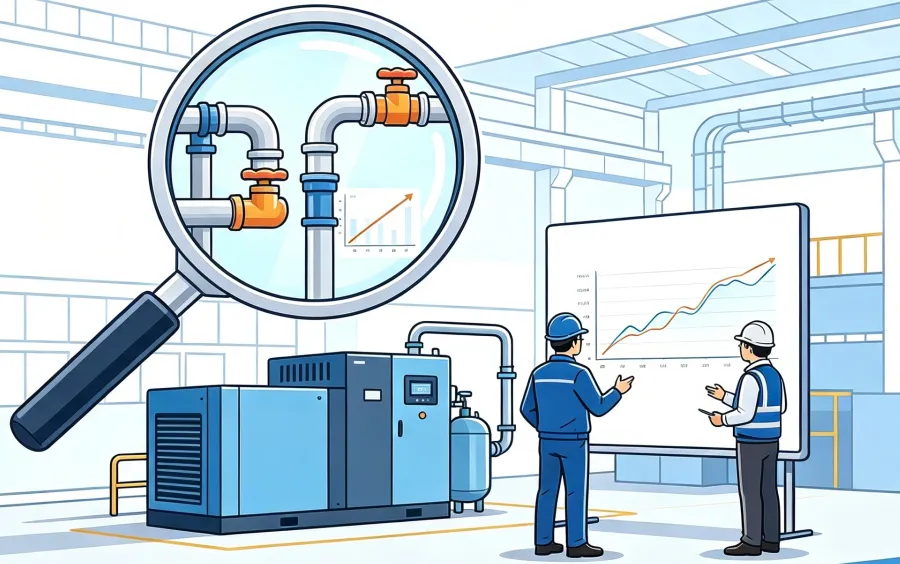
Why Is Energy-Saving Acceptance Important?
A lower electricity bill after a retrofit may appear to prove that the project worked.
But electricity consumption alone can be misleading.
Production output may have decreased. Operating hours may have changed. Air demand may be lower. Seasonal conditions may also be different.
For this reason, energy-saving acceptance should evaluate electricity consumption together with airflow, operating pressure, production load, and other relevant variables.
A professional acceptance process provides three main benefits.
1. Verify Actual Energy Savings
Every retrofit should begin with clearly defined objectives, such as:
- Lower compressor electricity consumption
- Reduced specific energy consumption
- Lower system leakage
- Reduced operating pressure
- Improved pressure stability
- Reduced unloaded compressor operation
- Improved compressor sequencing
Acceptance compares these objectives with actual post-retrofit performance.
A basic energy-saving calculation is:
Energy-Saving Rate = (Baseline Energy Consumption − Post-Retrofit Energy Consumption) ÷ Baseline Energy Consumption × 100%
However, this calculation is meaningful only when the before-and-after operating conditions are reasonably comparable.
2. Identify Remaining System Problems
A retrofit may reduce energy consumption while introducing or leaving other problems unresolved.
Examples include:
- Incorrect VFD settings
- Poor compressor sequencing
- Excessive pressure fluctuations
- Remaining compressed air leaks
- Unexpected pressure drop
- Insufficient air during peak demand
- Poor dryer performance
- Inadequate storage or distribution capacity
Acceptance testing helps identify these issues before the project is considered complete.
3. Establish a New Performance Baseline
After the retrofit, the measured operating condition becomes a reference for future maintenance.
Useful indicators may include:
- Total compressor electricity consumption
- Specific energy consumption
- Compressed air flow
- Main-header pressure
- Point-of-use pressure
- Low-production air demand
- Compressor loading behavior
- Dryer pressure dew point
- Filter and dryer differential pressure
If these indicators deteriorate later, maintenance personnel can investigate the cause before energy losses become severe.
The Five-Step Compressed Air Energy-Saving Acceptance Process
A practical acceptance procedure can be summarized as:
Baseline Preparation → Performance Testing → Energy Evaluation → System Inspection → Acceptance Report
Each step answers a different question about the success of the retrofit.
Step 1: Establish a Valid Baseline
The first step is to determine how the compressed air system performed before the retrofit.
Useful baseline data may include:
- Compressor electricity consumption
- Operating hours
- Production output
- Compressed air flow
- Main system pressure
- Point-of-use pressure
- Compressor load/unload behavior
- Low-production or non-production air demand
Abnormal periods such as shutdowns, major maintenance, temporary production changes, or equipment failures should not be treated as normal baseline operation.
Compare Equivalent Operating Conditions
This is one of the most important acceptance principles.
If production output after the retrofit is substantially lower than before the retrofit, a reduction in electricity consumption does not automatically represent an efficiency improvement.
Where operating conditions differ, normalized indicators should be used.
For example:
kWh per unit of production
or:
kWh per unit volume of compressed air delivered
The objective is to separate true system-efficiency improvement from changes in production demand.
Step 2: Test the System Under Representative Loads
Acceptance should reflect how the plant actually operates.
Testing should include representative conditions such as:
- Peak production
- Normal production
- Partial load
- Low-production periods
- Major intermittent air-demand events
There is no single test duration that is suitable for every compressed air system.
The measurement period should be long enough to capture the plant’s normal operating pattern.
Measure Energy Consumption
Electrical measurements should cover the equipment affected by the retrofit.
Depending on project scope, this may include:
- Individual compressor power
- Total compressor-system power
- VFD input power
- Major auxiliary equipment
Measurement instruments should be appropriate for the expected load and required accuracy.
Measure Airflow and Pressure
Energy consumption should always be evaluated together with compressed air output.
Useful measurements include:
- Total airflow
- Compressor discharge pressure
- Main-header pressure
- Point-of-use pressure
- Pressure across major treatment equipment
This prevents a reduction in air demand from being incorrectly reported as an efficiency improvement.
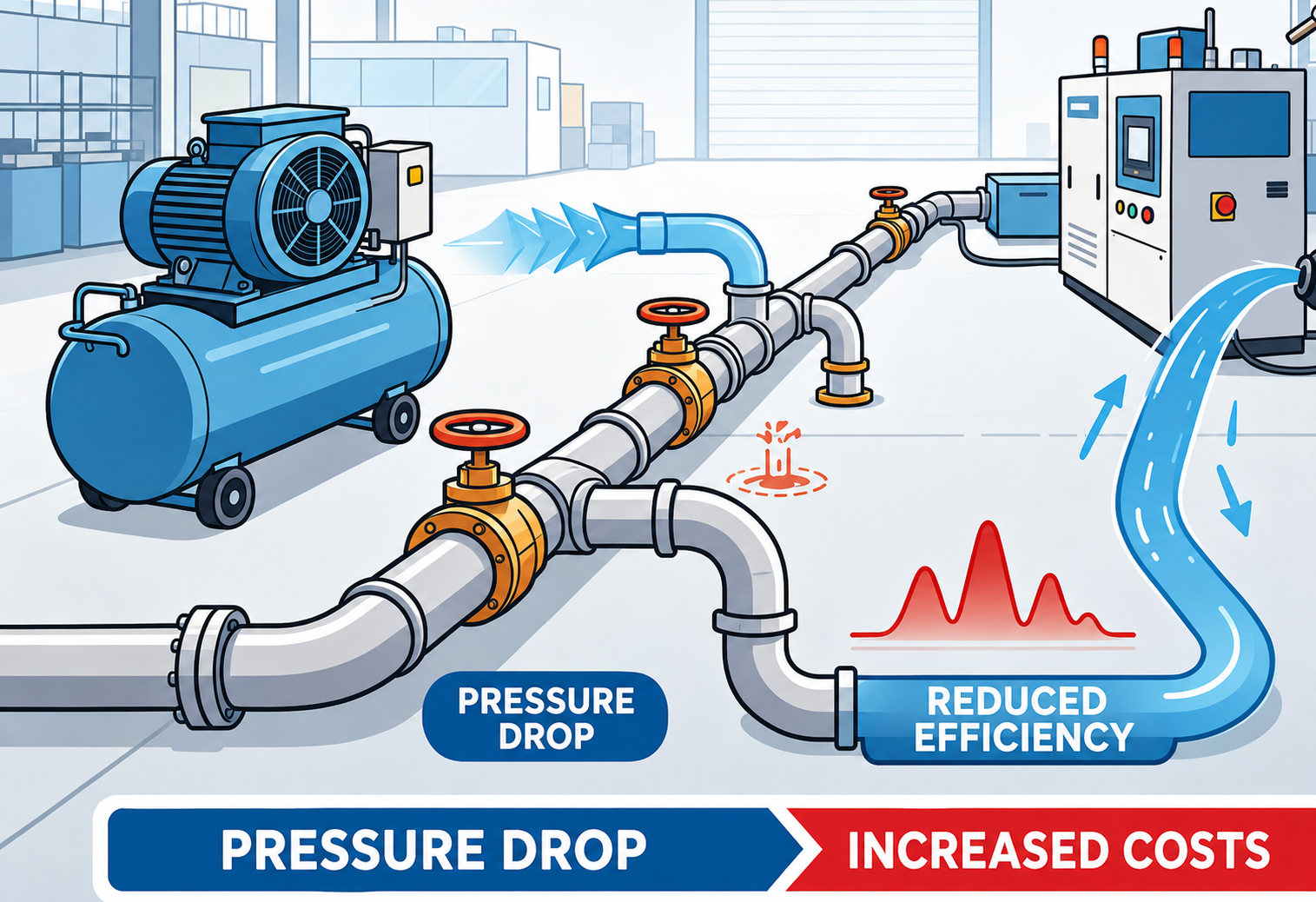
Pressure measurements are also useful for identifying unnecessary system losses. See how compressed air pressure drop affects system efficiency for a more detailed diagnostic approach.
Check Leakage
If leak repair was part of the retrofit, the post-retrofit leakage condition should also be verified.
Useful methods may include:
- Ultrasonic leak detection
- Flow measurement during low-production periods
- Compressor operating analysis
- Pressure decay testing where appropriate
Pressure decay can be useful, but one fixed pressure-decay time should not be treated as a universal leakage percentage because the result depends on system volume, pressure, temperature, and test configuration.
For a complete leak-management process, see compressed air leak detection and repair.
Step 3: Calculate and Normalize Energy Savings
Once representative data has been collected, actual energy performance can be evaluated.
Calculate Energy Savings
For directly comparable periods:
Energy Savings = Baseline Energy Consumption − Post-Retrofit Energy Consumption
Calculate the Energy-Saving Rate
Energy-Saving Rate = Energy Savings ÷ Baseline Energy Consumption × 100%
The result should be interpreted only after confirming that the measurement periods represent comparable operating conditions.
Evaluate Specific Energy Performance
For compressor systems, specific energy consumption can provide a better efficiency indicator than electricity consumption alone.
Conceptually:
Specific Energy Consumption = Electrical Energy Input ÷ Useful Compressed Air Output
For production-oriented facilities, another useful KPI is:
Compressed Air Energy Consumption per Unit of Production
These indicators help determine whether the system is genuinely more efficient rather than simply producing less compressed air.
Estimate Annual Savings and Payback
When the measured period is representative:
Annual Energy Savings = Normalized Energy Savings × Annual Operating Periods
A simple financial indicator can then be calculated:
Simple Payback Period = Project Investment ÷ Annual Monetary Savings
Actual operating hours and electricity prices should be used rather than generic assumptions.
Evaluate the Complete System
Energy savings should not be calculated from compressor power alone if the retrofit affects downstream treatment equipment.
Depending on project scope, the evaluation may also need to include:
- Refrigerated dryer electricity
- Regenerative dryer purge-air consumption
- Dryer heater or blower energy
- Filter pressure drop
- Dryer pressure drop
- Cooling equipment
A system retrofit should improve the total cost of producing usable compressed air—not merely shift energy consumption from one component to another.
Step 4: Verify Pressure, Air Quality, Leakage, and Controls
Meeting an energy-saving target alone is not enough.
The system must still provide the required compressed air quality and production performance.
Verify Pressure Stability
Measure pressure at several points:
Compressor Room → Air Treatment → Main Header → Production Branch → Point of Use
This helps determine whether the retrofit has introduced excessive restrictions or pressure fluctuations.
Do not apply one universal pressure-fluctuation limit to every plant.
The acceptance criterion should be based on the pressure required by downstream equipment.
Verify Dryer Performance
If the system includes an air dryer, verify that the outlet pressure dew point meets the actual process requirement.
Do not apply one universal PDP target to every installation.
Different dryer technologies are designed for different air-quality requirements. For example, a refrigerated dryer and a desiccant dryer should not automatically be evaluated against the same pressure dew point target.
The correct acceptance principle is:
Required Process Air Quality = Delivered Air Quality
Inspect Filters and Air-Treatment Equipment
Check that treatment equipment provides the required air quality without unnecessary pressure loss.
Typical checks include:
- Filter differential pressure
- Dryer pressure drop
- Condensate drains
- Dryer operating condition
- Relevant sensors and instruments
Energy efficiency should never be achieved by allowing treatment performance to deteriorate.
Verify Compressor Controls
For VFD or multi-compressor systems, check:
- Stable speed control
- Compressor sequencing
- Base-load and trim-compressor behavior
- Standby response
- Pressure control
- Alarm and protection functions
A high-efficiency compressor can still operate inefficiently if multiple compressors continuously compete with each other because of poor control logic.
Recheck Leak Repairs
Previously identified leaks should be inspected again after repair.
A leak should not be considered closed simply because a fitting has been tightened or replaced.
The proper process is:
Detect → Record → Repair → Verify
Step 5: Prepare the Acceptance Report and Monitoring Baseline
The final result should be documented in a formal acceptance report.
The report should include:
- Project scope
- Baseline period
- Baseline performance
- Post-retrofit measurement period
- Production conditions
- Measurement methods
- Energy consumption
- Airflow and pressure
- Relevant air-quality results
- Before-and-after comparison
- Normalization method
- Calculated energy savings
- Financial results where applicable
- Remaining defects
- Corrective actions
- Final verification results
Each project objective should ideally be classified as:
Achieved / Partially Achieved / Not Achieved
This provides more useful information than simply stating that the project has passed acceptance.
Establish Post-Retrofit Monitoring
The acceptance data should also become the new system-performance baseline.
Useful long-term monitoring indicators may include:
- Compressor energy consumption
- Specific energy consumption
- Compressed air flow
- Main-header pressure
- Point-of-use pressure
- Leakage indicators
- Compressor operating hours
- Unloaded operating time
- Dryer pressure dew point
- Filter and dryer differential pressure
If these indicators gradually deteriorate, maintenance teams can investigate before the original energy-saving benefits are lost.
Common Mistakes During Energy-Saving Acceptance
Several mistakes can make a retrofit appear more successful—or less successful—than it actually is.
Comparing Electricity Consumption Without Production Output
Lower production may create lower energy use even if system efficiency has not improved.
Before-and-after electricity consumption should therefore be evaluated against production output, compressed air delivery, or another appropriate normalized indicator.
Measuring Only Compressor Power
Airflow, pressure, and relevant treatment-system performance should also be evaluated.
A lower compressor power reading alone does not demonstrate that the complete system has become more efficient.
Reducing Pressure Without Checking the Point of Use
The lowest compressor discharge pressure is not necessarily the optimal operating pressure.
Pressure must remain sufficient at the point of use under representative production conditions.
Ignoring Compressed Air Quality
A retrofit is not successful if lower energy consumption causes the dryer or filtration system to fail to meet process requirements.
Pressure dew point and other relevant air-quality indicators should therefore remain part of the acceptance process.
Treating Leak Repair as Permanent
New leaks develop over time.
The post-retrofit leakage condition should become a baseline for future leak management rather than being treated as a permanent result.
Define Acceptance Criteria Before the Project Starts
One of the best ways to avoid disputes is to agree on the acceptance method before implementation.
The customer and supplier should define:
- Baseline period
- Measurement boundary
- Performance indicators
- Production normalization method
- Energy-saving target
- Required system pressure
- Required compressed air quality
- Test period
- Savings calculation method
- Final acceptance criteria
The measurement boundary is particularly important.
For example, determine whether the project evaluates:
Compressors only
or:
Compressors + dryers + cooling + compressed air treatment equipment
Without a clearly defined boundary, different calculation methods can produce very different savings results.
Five Questions to Ask Before Final Acceptance
Before signing off on a compressed air energy-saving project, confirm that the measured data can answer five questions:
- Did energy consumption decrease under comparable operating conditions?
- Does the system still provide the required airflow and pressure to production?
- Does compressed air quality still meet the process requirement?
- Have leakage, pressure drop, compressor controls, and treatment equipment been checked for remaining problems?
- Has a documented post-retrofit performance baseline been established?
If these questions cannot be answered with measured data, the project may not yet be ready for final acceptance.
Conclusion: Turn Energy-Saving Investment Into Measurable Performance
A compressed air energy-saving retrofit is not complete when the new equipment starts operating.
It is complete when the system demonstrates, through comparable and documented measurements, that the expected improvement has actually been achieved.
A practical acceptance process should follow:
Baseline → Measure → Normalize → Evaluate → Inspect → Verify → Document → Monitor
Energy savings should always be evaluated together with airflow, system pressure, point-of-use pressure, compressed air quality, leakage, and production conditions.
This prevents three common mistakes:
- Mistaking lower production for energy savings
- Reducing energy consumption at the expense of production performance
- Closing the project before remaining system problems have been corrected
When acceptance is performed correctly, it does more than verify return on investment.
It establishes a measurable operating baseline that supports continuous compressed air energy management and helps protect the long-term value of the retrofit.
If you need support evaluating compressed air treatment performance as part of an energy-saving project, contact Lingyu for technical support.