Compressed air is widely used to power pneumatic tools, automation equipment, production machinery, control systems, and many other industrial processes.
But not all of the compressed air produced by the compressor reaches useful production equipment.
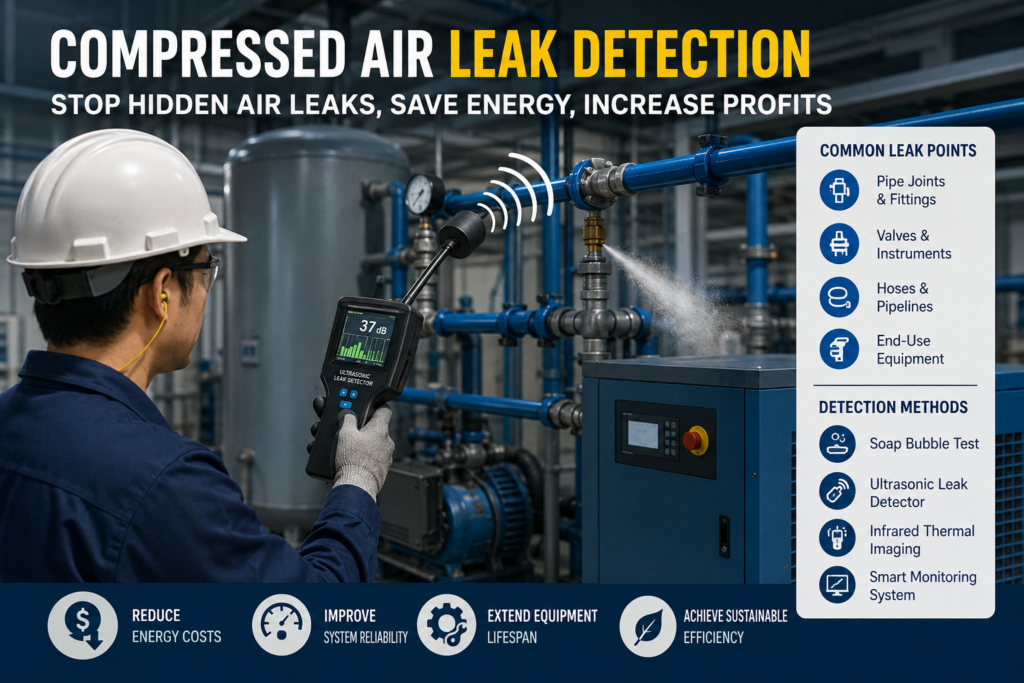
Leaks at pipe joints, hoses, valves, couplings, pneumatic components, and other connection points can continuously release compressed air into the surrounding environment.
Unlike a major equipment failure, compressed air leakage may not immediately stop production. Instead, it creates a hidden and continuous load on the system.
The compressor must produce additional air to compensate for what is being lost, which can increase electricity consumption, reduce system pressure stability, and raise operating costs.
A structured compressed air leak detection program should therefore follow a simple principle:
Detect → Record → Repair → Verify → Monitor
This guide explains where compressed air leaks commonly occur, how they affect system efficiency, how they can be detected, and how to establish a practical long-term leak management program.
1. Why Compressed Air Leaks Waste Energy
A compressed air leak is essentially air that has already been compressed—and therefore already consumed energy—but never performs useful work.
The energy impact of a leak depends on several factors, including:
- Leak size
- System pressure
- Annual operating hours
- Compressor efficiency
- Electricity cost
- Number of leak points
- Compressor control strategy
A single small leak may appear insignificant. However, multiple leaks operating continuously throughout a plant can create substantial unnecessary air demand.
The result is not only wasted compressed air. Leakage can affect the entire operating condition of the compressed air system.
2. Leaks Increase Total Compressed Air Demand
When air escapes through leaks, the compressor system must supply both:
Useful production demand + leakage demand
If leakage increases, total airflow through the main distribution network may also increase.
Higher airflow can increase velocity and friction losses in piping, filters, dryers, valves, and other components. As a result, leakage can contribute indirectly to higher system pressure drop.
For a broader explanation of this relationship, see how compressed air pressure drop affects system efficiency.
3. Leaks Can Reduce Pressure Stability at the Point of Use
Compressed air equipment is normally designed to operate within a defined pressure range.
When leakage increases system demand, the pressure available at production equipment may become less stable, particularly during periods of high plant consumption.
Possible effects include:
- Reduced pneumatic tool output
- Slower cylinder movement
- Reduced actuator force
- Unstable machine operation
- Longer production cycles
- Inconsistent process performance
This does not mean every low-pressure problem is caused by leakage.
Undersized piping, clogged filters, excessive dryer pressure drop, insufficient compressor capacity, inadequate storage, and peak demand can produce similar symptoms.
That is why pressure and airflow should be measured before concluding that a system-pressure problem is caused entirely by leaks.
4. Leaks Can Increase Compressor Operating Time
When a compressed air system loses air continuously, the compressor or compressor group must compensate for that additional demand.
Depending on the compressor control system and plant operating profile, this may result in:
- Longer loaded operating periods
- Additional compressor starts or sequencing
- Reduced unloaded opportunities
- Additional electrical energy consumption
- Increased operating hours
Over time, unnecessary compressor operation can also increase maintenance requirements.
Leak repair therefore supports both energy management and equipment utilization.
The objective is simple:
Do not generate compressed air that the production process does not need.
5. Where Do Compressed Air Leaks Commonly Occur?
Leaks can develop anywhere compressed air passes through a connection, seal, hose, valve, or pneumatic component.
Pipe Joints and Fittings
Connection points deserve particular attention during inspections.
Potential leak locations include:
- Threaded connections
- Couplings
- Unions
- Elbows
- Tees
- Flanges
- Quick-connect fittings
Leaks may develop because of loosening, vibration, aging sealing materials, installation problems, or mechanical damage.
Valves and Instrument Connections
Compressed air systems contain many components with seals and connection points.
Inspect areas such as:
- Shut-off valves
- Pressure-reducing valves
- Solenoid valves
- Control valves
- Gauge connections
- Pressure sensor connections
- Flow-meter fittings
Small continuous leaks at these points can be difficult to notice during normal production.
Flexible Hoses
Flexible compressed air hoses may experience repeated bending, vibration, abrasion, heat exposure, or mechanical impact.
Potential problems include:
- Cracks
- Abrasion
- Loose connections
- Damaged hose ends
- Aging material
- Improper routing
Because hoses are frequently located close to operating equipment, leak noise may be hidden by normal production noise.
End-Use Equipment
A significant part of the leak survey should be performed at the actual point of use rather than only in the compressor room.
Potential leak sources include:
- Pneumatic cylinder seals
- Tool connections
- Machine-side hoses
- Quick couplers
- Air preparation units
- Blow-off equipment
- Automatic drains
- Pneumatic valves
A plant may have a relatively efficient main distribution system while still losing substantial air through end-use equipment.
6. Soap Bubble Testing: A Simple Confirmation Method
For accessible connections where a leak is suspected, a soap solution can be used as a simple confirmation method.
The solution can be applied to areas such as:
- Threaded fittings
- Valve connections
- Hose couplings
- Pipe joints
If escaping compressed air causes bubbles to form and expand, the leak location can be identified.
Soap testing is inexpensive and useful for confirming individual suspected leaks.
However, it is relatively slow for surveying a large plant and requires physical access to the suspected connection.
For that reason, it is often more useful as a confirmation tool than as the only method used for a comprehensive leak survey.
7. Audible Inspection Can Find Larger Leaks
Some compressed air leaks can be identified by their characteristic hissing sound.
This can be useful during periods when surrounding machinery is stopped.
However, audible inspection has obvious limitations.
In an operating industrial facility, sound from compressors, motors, production equipment, ventilation systems, and pneumatic machinery can easily mask the noise produced by smaller leaks.
Therefore, the absence of an audible leak does not mean the system is leak-free.
8. Ultrasonic Leak Detection for Industrial Surveys
Ultrasonic leak detection is commonly used when leak surveys need to be performed in noisy industrial environments.
Compressed air escaping through a small opening can produce ultrasonic-frequency sound that can be detected using suitable instrumentation.
This allows maintenance personnel to search components such as:
- Pipe connections
- Valves
- Couplings
- Hoses
- Pneumatic equipment
- Elevated pipework
- Difficult-to-access connections
The actual detection capability depends on the instrument, leak characteristics, pressure, distance, background conditions, and inspection environment.
For this reason, follow the detector manufacturer’s operating specifications rather than applying one universal detection-distance claim.
9. Thermal Imaging as a Supplementary Method
Thermal imaging can sometimes reveal temperature differences associated with expanding gas, abnormal airflow, or equipment conditions.
It may be useful in specific situations, particularly when inspecting difficult-to-access equipment or evaluating broader thermal behavior.
However, it should not be treated as a universal replacement for dedicated compressed air leak detection techniques.
For routine plant leak management, direct leak localization methods and compressed air system measurements are generally more useful.
10. Flow and Pressure Monitoring Can Reveal Hidden System Changes
Individual leak detectors locate specific leak points. System monitoring serves a different purpose.
By measuring variables such as:
- Compressed air flow
- System pressure
- Compressor operating status
- Electrical power
- Production load
operators can identify changes in the overall compressed air balance.
For example, if production output remains similar but baseline compressed air flow gradually increases, leakage or another form of unnecessary air consumption may be developing.
Similarly, if system pressure falls while compressor output and demand increase unexpectedly, the distribution system should be investigated.
Continuous monitoring therefore does not replace physical leak detection. Instead, the two methods complement each other:
Monitoring identifies abnormal system behavior.
Leak detection identifies the individual source.
11. Measure Leakage During Low-Production Periods
One useful way to understand baseline compressed air demand is to observe the system when production equipment is stopped or operating at minimal load.
If significant compressed air consumption continues even when legitimate production demand is very low, investigate where that air is being used.
Possible causes may include:
- System leakage
- Equipment left pressurized unnecessarily
- Open blow-off applications
- Automatic drains
- Idle pneumatic equipment
- Control-air consumption
The operating conditions should be documented so that repeated measurements can be compared over time.
This provides a more reliable basis for leak-management decisions than relying only on isolated observations.
12. Record Every Leak Before Managing Repairs
Finding a leak does not automatically create an energy saving. The leak must also be repaired.
For larger plants, every detected leak should therefore be entered into a leak register.
Useful information includes:
- Leak identification number
- Location
- Machine or pipeline
- Date detected
- Leak severity
- Operating pressure
- Recommended repair
- Responsible department or technician
- Repair status
- Verification date
This transforms leak detection from an inspection activity into a closed-loop maintenance process.
A leak tag or identification number can also help technicians relocate the exact point during the repair stage.
13. Prioritize Repairs Instead of Treating Every Leak Equally
Not all leaks have the same financial or operational impact.
A useful repair strategy considers factors such as:
- Leak severity
- System pressure
- Operating hours
- Production importance
- Accessibility
- Safety requirements
- Whether equipment shutdown is required
A large leak on a continuously pressurized main line should normally receive higher priority than a very small leak on equipment that operates only occasionally.
This helps maintenance teams direct resources toward the repairs with the greatest likely benefit.
14. Verify Every Repair
A leak should not be considered closed simply because a fitting has been tightened or a component replaced.
After repair, inspect the location again.
Verification confirms whether:
- The original leak has been eliminated
- A new leak was introduced during repair
- The replacement component is sealing correctly
- Additional nearby leaks are present
For important repairs, changes in local airflow or system measurements may also be reviewed where practical.
The leak-management cycle should therefore be:
Detect → Record → Repair → Verify
not simply:
Detect → Repair
15. Reinspect the System Regularly
Compressed air systems change over time.
New leaks can develop because of:
- Vibration
- Seal aging
- Repeated hose movement
- Equipment modifications
- Production-line changes
- Mechanical damage
- Corrosion
- Maintenance work
For this reason, a one-time leak survey cannot permanently solve the problem.
Inspection frequency should be determined according to the plant’s operating conditions, system age, production criticality, leak history, and maintenance resources.
Rather than imposing one universal weekly, monthly, or annual schedule on every facility, establish a frequency appropriate to the actual system.
Critical areas and locations with recurring problems can be inspected more frequently.
16. Repeated Leaks May Indicate a Component or Design Problem
If the same connection repeatedly develops leakage, continuing to tighten or reseal it may not address the root cause.
Investigate whether the problem is associated with:
- Excessive vibration
- Incorrect hose routing
- Mechanical stress
- Unsuitable connection type
- Damaged threads
- Poor component quality
- Incorrect installation
- Pressure or temperature conditions outside the component specification
Repair materials and connection methods should always be compatible with the compressed air system’s pressure, temperature, lubricant exposure, and environmental conditions.
Avoid prescribing one sealing material for all applications. The correct repair depends on the component and manufacturer requirements.
17. Include Automatic Drains and Air-Treatment Equipment in Leak Inspections
Compressed air treatment equipment also contains valves, drains, fittings, and pneumatic components that should be included in leak inspections.
Potential areas include:
- Filter housings
- Automatic condensate drains
- Dryer valves
- Pneumatic control tubing
- Gauge connections
- Separator drains
- Regeneration circuits
A malfunctioning drain, for example, may release more compressed air than intended.
Similarly, leakage within regenerative dryer valves can affect both compressed-air consumption and drying performance.
Lingyu’s compressed air purification systems include equipment such as dryers and precision compressed-air filters, so these treatment components should be included when evaluating the complete air path rather than inspecting only the distribution piping.
18. Manage Leakage and System Pressure Together
A common response to inadequate point-of-use pressure is to increase compressor discharge pressure.
If leakage is part of the problem, this approach can be counterproductive.
Higher pressure can increase the amount of air escaping through existing leak openings and may also increase unnecessary compressed air consumption elsewhere in the system.
A better process is:
Measure pressure → Check demand → Identify leaks and restrictions → Repair the causes → Optimize system pressure
This helps the plant operate at the lowest practical pressure that still satisfies production requirements.
19. Do Not Confuse Leakage With Pressure Drop
Leakage and pressure drop are related, but they are not the same problem.
A leak is a loss of compressed air flow.
Pressure drop is a loss of pressure between two points in the system.
Leakage can increase total airflow demand, which may then increase pressure drop through undersized piping or restrictive equipment.
But excessive pressure drop may also exist even in a system with relatively little leakage.
For example, pressure loss may be caused by:
- Undersized piping
- Loaded filter elements
- Restrictive valves
- Excessive dryer pressure drop
- Too many fittings
- High peak airflow
This distinction is important when diagnosing low pressure at production equipment.
20. Evaluate Filters and Dryers Alongside Leak Reduction
Repairing leaks reduces unnecessary flow demand, but the complete compressed air treatment system should also be evaluated for restrictions.
Filters must provide the required air quality without creating unnecessary differential pressure.
Air dryers must provide the required pressure dew point while maintaining appropriate airflow capacity and pressure loss.
Some Lingyu dryer configurations include differential-pressure monitoring so that changes in dryer inlet-to-outlet pressure loss can be identified against preset equipment limits.
Combining leak control with pressure-drop management provides a more complete efficiency strategy than addressing either issue independently.
21. Build Leak Awareness Into Daily Plant Operations
Maintenance specialists should manage the formal leak-detection program, but production personnel can also help identify problems.
Operators can be encouraged to report:
- Newly audible leaks
- Damaged hoses
- Loose couplings
- Unexpected pressure changes
- Continuously flowing air from idle equipment
- Abnormal pneumatic equipment operation
It is also useful to review whether compressed air is being used for applications that could be performed more efficiently by another method.
The objective is to treat compressed air as an energy resource rather than as an unlimited utility.
22. Track Leak-Management Performance
A leak program becomes more useful when its results can be measured.
Possible performance indicators include:
- Number of leaks detected
- Number or percentage repaired
- Outstanding high-priority leaks
- Average repair response time
- Baseline compressed air demand
- System airflow during low-production periods
- Compressor operating hours
- System pressure
- Specific compressor energy consumption where measured
- Repeat leak locations
Estimated savings can also be calculated where sufficient data is available, but estimates should use actual system pressure, compressor performance, operating hours, electricity cost, and measured or appropriately estimated leak flow.
Generic savings figures should not be treated as if they apply equally to every plant.
23. A Practical Compressed Air Leak Detection Workflow
For a plant-wide leak program, use this sequence:
Measure → Survey → Tag → Record → Prioritize → Repair → Verify → Monitor
Begin by establishing baseline flow and pressure conditions.
Then survey the piping system, treatment equipment, production machines, hoses, valves, and end-use connections.
Tag and record each leak so that it can be located again.
Prioritize repairs according to severity and operating impact.
After repair, verify that the leak has actually been eliminated.
Finally, continue monitoring the system so that new leakage can be identified as operating conditions change.
Conclusion: Leak Detection Should Be a Continuous Energy-Management Process
Compressed air leaks are easy to overlook because they often do not cause an immediate production shutdown.
But every leak creates unnecessary compressed air demand.
When multiple leaks remain active throughout a facility, the compressor system must generate additional air that provides no productive value.
The consequences can include:
- Higher electricity consumption
- Greater compressor utilization
- Reduced pressure stability
- Increased distribution pressure loss
- Higher operating costs
The solution is not a single leak survey.
A sustainable program follows a continuous cycle:
Detect → Record → Repair → Verify → Monitor
Leak detection should also be integrated with pressure management, filter and dryer maintenance, airflow measurement, and compressor control.
When the complete system is evaluated together, facilities can reduce unnecessary compressed air demand while improving pressure stability and overall system efficiency.
For plants experiencing both leakage and pressure problems, start by evaluating how compressed air pressure drop affects system efficiency and then separate true airflow leakage from piping or air-treatment restrictions.
If you need support evaluating compressed air treatment equipment as part of a broader system-efficiency project, contact Lingyu for technical support.