Blower Heated Adsorption Air Dryers for Industrial Compressed Air Systems
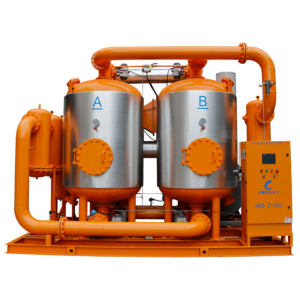
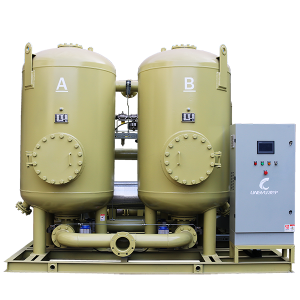
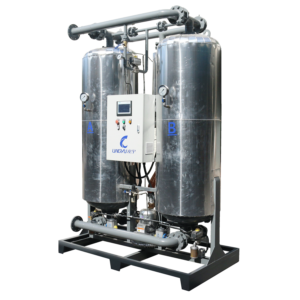
Blower heated adsorption air dryers remove moisture from compressed air through desiccant adsorption and use a blower and external heater to regenerate the desiccant.
Unlike heatless and externally heated purge dryers, the blower draws ambient air for heated regeneration, significantly reducing the amount of compressed air consumed during regeneration.
Lingyu offers two configurations:
- HRB-E Low-Purge Blower-Heated Dryer: 2–3% regeneration air consumption
- HRB-Z Zero-Purge Blower-Heated Dryer: approximately 0% regeneration compressed air consumption
These dryers are particularly suitable for medium and large compressed air systems where reducing purge air loss can significantly affect long-term operating costs.
How Does a Blower Heated Adsorption Air Dryer Work?
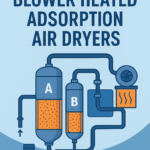
A blower heated dryer uses two desiccant towers that alternate between adsorption and regeneration.
Adsorption: Moist compressed air passes through one tower, where the desiccant adsorbs water vapor and dry compressed air flows downstream.
Heated Regeneration: Ambient air is drawn in by the blower, heated by an external heater, and passed through the saturated desiccant bed to remove adsorbed moisture.
Cooling: After heating, the regenerated desiccant must be cooled before returning to adsorption service.
Switching: The dryer automatically completes regeneration, cooling, repressurization, and tower switching to maintain continuous dry compressed air production.
Process flow: Adsorption → Blower Heating → Desorption → Cooling → Repressurization → Tower Switching
Low-Purge vs Zero-Purge Blower Heated Dryer
The main difference between the HRB-E and HRB-Z Series is how the desiccant is cooled after heated regeneration.
| Parameter | HRB-E Low-Purge | HRB-Z Zero-Purge |
|---|
| Regeneration heating | Blower + heater | Blower + heater |
| Regeneration air consumption | 2–3% | ≈0% |
| Cooling method | Dry compressed purge air | Closed-loop cooling |
| Compressed air used for cooling | Yes, limited amount | No |
| Standard capacity | 13.5–260 m³/min | 13.5–210 m³/min |
| Approx. capacity | 477–9,181 CFM | 477–7,416 CFM |
| Pressure dew point | -20°C / -40°C optional | -20°C / -40°C optional |
| Typical selection | Low purge + simpler cooling | Minimize compressed air loss |
The HRB-E uses approximately 2–3% of system airflow as cooling purge air after heated regeneration.
The HRB-Z adds a closed-loop cooling system so that dry product air is not required for regeneration cooling, reducing regeneration compressed air consumption to approximately zero.
Operating Conditions & Technical Range
| Parameter | HRB-E | HRB-Z |
|---|
| Rated inlet pressure | 0.7 MPa | 0.7 MPa |
| Operating pressure | 0.6–1.0 MPa | 0.6–1.0 MPa |
| Rated inlet temperature | 10–30°C | 10–30°C |
| Maximum inlet temperature | ≤40°C | ≤40°C |
| Inlet pressure dew point | ≤25°C | ≤25°C |
| Outlet pressure dew point | -20°C / -40°C optional | -20°C / -40°C optional |
| Regeneration air consumption | 2–3% | ≈0% |
| Rated ambient temperature | 35°C | 35°C |
| Ambient operating range | 2–40°C | 2–40°C |
| Installed power range | 12.1–257.5 kW | 12.1–230.5 kW |
For the HRB-Z Series, the technical data also specifies cooling-water temperature ≤32°C and cooling-water pressure 0.2–0.6 MPa.
Purge Loss, Blower Power & Heater Power
Blower heated dryers reduce compressed air regeneration losses, but their operating cost should be evaluated together with blower and heater electricity consumption.
For example, at 100 m³/min inlet airflow:
| Regeneration Air Rate | Approx. Compressed Air Consumption |
|---|
| Heatless: 8–14%* | 8–14 m³/min |
| Externally heated: 4–8%* | 4–8 m³/min |
| HRB-E: 2–3% | 2–3 m³/min |
| HRB-Z: ≈0% | ≈0 m³/min |
*Based on the Lingyu heatless and externally heated series technical data.
However, lower purge loss does not automatically mean lower total energy consumption. Blower-heated systems require electrical power for the blower and heater, and the required installed power increases with dryer capacity.
For example:
| Model | Capacity | Installed Power |
|---|
| HRB-E100 | 13.5 m³/min | 12.1 kW |
| HRB-E300 | 37 m³/min | 36.5 kW |
| HRB-E500 | 55 m³/min | 57.5 kW |
| HRB-E1000 | 110 m³/min | 77.5 kW |
| HRB-E1600 | 160 m³/min | 143 kW |
| HRB-E2600 | 260 m³/min | 257.5 kW |
Therefore, total operating cost should consider:
Purge air loss + blower/heater electricity + annual operating hours + compressor efficiency + maintenance
When to Choose a Blower Heated Desiccant Air Dryer
Blower heated regeneration is particularly suitable when:
- Medium or large compressed air capacity is required
- The compressed air system operates for long hours
- Purge air loss represents a significant operating cost
- A PDP of -20°C or -40°C is required
- Reducing compressed air consumption is more important than minimizing initial investment
Choose HRB-E Low-Purge when 2–3% regeneration air consumption is acceptable and a simpler blower-heated configuration is preferred.
Choose HRB-Z Zero-Purge when minimizing compressed air regeneration loss is a priority and the required cooling-water conditions can be provided.
Heatless vs Externally Heated vs Blower Heated
| Factor | Heatless | Externally Heated | Blower Heated |
|---|
| Regeneration heat | No | External heater | Blower + heater |
| Purge air | 8–14%* | 4–8%* | 0–3%* |
| Electrical regeneration demand | Low | Medium | Higher |
| System complexity | Low | Medium | Higher |
| Initial investment | Lower | Medium | Higher |
| Main energy cost | Compressed air loss | Purge + heater | Blower/heater + low purge |
| Typical application | Small / simple systems | Medium–large systems | Medium–large continuous systems |
*Based on the corresponding Lingyu series technical data.
For large systems, dryer selection should be based on total cost of ownership (TCO) rather than purge percentage or purchase price alone.
Frequently Asked Questions
Does a blower heated desiccant dryer use purge air?
It depends on the configuration. The Lingyu HRB-E Series uses approximately 2–3% regeneration air, while the HRB-Z Series reduces regeneration compressed air consumption to approximately 0%.
What pressure dew point can it provide?
The HRB-E and HRB-Z Series are available with -20°C or -40°C pressure dew point configurations.
Is zero purge the same as zero energy consumption?
No. Zero purge means compressed product air is not consumed for regeneration. The blower, heater, control system, and cooling system still consume energy.
What capacity range is available?
The HRB-E Series covers 13.5–260 m³/min (approximately 477–9,181 CFM). The HRB-Z Series covers 13.5–210 m³/min (approximately 477–7,416 CFM) in the provided standard model range.
When should I choose zero purge instead of low purge?
Zero purge should be considered when compressed air loss has a significant impact on operating cost, particularly in larger systems with long annual operating hours. Cooling-water availability and total electrical consumption should also be considered.
Regarding Blower Heated Adsorption Air Dryers
The Ultimate Guide to Blower Heated Adsorption Air Dryers
In industrial compressed air systems, moisture control is critical to ensuring equipment reliability […]
Read More