Compressed Air Filters for Industrial Air Treatment Systems
Lingyu compressed air filters remove solid particles, liquid water, oil aerosols, and oil vapor from compressed air before contaminants reach dryers, pneumatic equipment, production processes, or critical downstream applications.
Different contaminants require different filtration grades. A complete compressed air treatment system therefore often uses several filters in sequence rather than relying on a single filter.
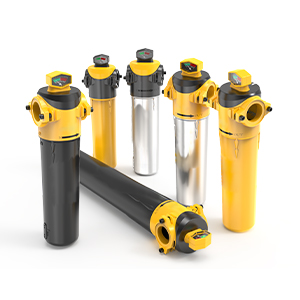
Lingyu D Series precision filters cover airflow capacities from 1.5 to 170 m³/min (approximately 53 to 6,003 CFM), with filtration grades for pre-filtration, fine oil and particle removal, high-efficiency oil removal, and activated carbon treatment.
What Contaminants Do Compressed Air Filters Remove?
Compressed air can contain several types of contamination originating from ambient air, the compressor, piping, and the compressed air system itself.
| Contaminant | Typical Source | Recommended Filtration |
|---|
| Dust / rust / scale | Ambient air and piping | AO pre-filter |
| Liquid water | Cooling and condensation | Separator / AO pre-filter |
| Oil aerosols | Compressor and air system | AA / AX coalescing filter |
| Fine particles | Compressor / piping / upstream equipment | AA / AX |
| Oil vapor / odor | Compressor hydrocarbons | ACS activated carbon |
It is important to distinguish liquid oil and oil aerosols from oil vapor. Fine coalescing filters remove aerosols and particles, while activated carbon is used when residual oil vapor must also be reduced.
Compressed Air Filter Grades
Lingyu D Series uses different filter grades according to the required air quality.
| Grade | Application | Particle Filtration | Residual Oil Content |
|---|
| AO | Pre-Filter | ≥1.0 μm | ≤3 ppm |
| AA | Oil & Particulate Removal | ≥0.1 μm | ≤0.1 ppm |
| AX | High-Efficiency Oil Removal | ≥0.01 μm | ≤0.05 ppm |
| ACS | Activated Carbon Oil Removal | N/A | ≤0.003 ppm |
A typical system may therefore use:
AO → AA → AX → ACS
The exact combination depends on compressor type, dryer technology, required air quality, and downstream process.
How to Select a Compressed Air Filter
Start with the contaminant that must be removed and the required downstream air quality.
| Requirement | Recommended Grade |
|---|
| Remove larger particles, rust and bulk contamination | AO |
| General oil aerosol + particle removal | AA |
| Fine oil aerosol and submicron particle removal | AX |
| Reduce oil vapor / hydrocarbon odor | ACS |
| Protect refrigerated air dryer | AO / suitable pre-filtration |
| Protect desiccant air dryer | AO + AA / AX according to inlet condition |
| Protect downstream process after dryer | AA / AX according to required air quality |
| Very low residual oil requirement | AX + ACS |
Filter capacity must also match the actual system airflow and working pressure. Undersized filters increase air velocity and pressure drop and can reduce filtration performance.
Filter Installation Before & After an Air Dryer
Correct filter position depends on the dryer technology.
A typical arrangement is:
Compressor → Aftercooler / Separator → Pre-Filter → Refrigerated Dryer → Fine Filter → Process
The upstream filter helps remove particles, liquid contamination, and oil aerosols before they enter the dryer.
A downstream fine filter can then be selected according to the required process air quality.
A typical arrangement is:
Compressor → Separator → AO → AA / AX → Desiccant Dryer → Dust Filter → Process
High-efficiency upstream filtration is especially important because oil contamination can reduce desiccant adsorption performance and service life.
A downstream particulate filter is commonly used to capture desiccant dust before compressed air reaches sensitive equipment.
The final filter combination should be selected according to compressor type, dryer requirements, and required air quality.
Compressed Air Filters and ISO 8573-1
ISO 8573-1 classifies compressed air quality according to three major contaminants:
Particles · Water · Oil
Filters primarily control the particle and oil portions of the compressed air quality system, while dryers control the required water vapor / pressure dew point.
This means an ISO 8573-1 air quality target should normally be achieved by selecting the complete treatment train rather than a filter alone.
For example:
Compressor → Water Separation → Particle/Oil Filtration → Air Dryer → Final Filtration → Process
The required ISO 8573-1 class should therefore be specified before selecting the final filter and dryer configuration.
Important: The individual D Series filtration values should not automatically be presented as a guaranteed ISO 8573-1 class for the complete compressed air system. Final air quality depends on the complete treatment configuration and operating conditions.
Flow Capacity & Housing Selection
The D Series covers small compressed air systems through large centralized installations.
| Filter Construction | Airflow Range | Typical Connection |
|---|
| Precision-cast aluminum alloy | 1.5–28.8 m³/min | RC3/4" – RC3" |
| Flanged carbon steel | 22–170 m³/min | DN80 – DN200 |
This provides standard filter configurations from approximately 53 CFM to 6,003 CFM.
For overlapping capacities, connection size, allowable pressure drop, piping arrangement, filtration grade, and installation requirements should be considered during model selection.
Pressure Drop & Energy Consumption
Every compressed air filter creates some pressure drop.
As contamination accumulates in the filter element, differential pressure can increase, requiring the compressor to work at a higher discharge pressure to maintain the required downstream pressure.
Lingyu D Series filters use an enlarged internal flow path designed to minimize pressure loss and are equipped with a differential pressure indicator to help identify when filter-element service is required.
When selecting a filter, consider:
Initial Pressure Drop + Operating Pressure Drop + Airflow + Filter Loading + Energy Cost
Because the provided D Series technical data does not specify a single rated differential-pressure value, actual pressure-drop requirements should be confirmed for the selected model and operating condition.
Filter Element Replacement & Maintenance
Filter elements should not be replaced only after obvious air-quality problems appear.
Maintenance should consider:
- Differential pressure indication
- Operating hours
- Compressor condition
- Oil and condensate loading
- Ambient contamination
- Required downstream air quality
- Manufacturer maintenance interval
A heavily loaded element can increase pressure drop and operating cost even before complete blockage occurs.
For critical applications, filter-element replacement should therefore be included in preventive maintenance rather than based solely on visible contamination.
Typical Filter Configurations
General Industrial Compressed Air
AO → Refrigerated Dryer → AA
Suitable for general manufacturing and pneumatic equipment where basic particle, moisture, and oil aerosol control is required.
Desiccant Dryer Protection
AO → AA / AX → Desiccant Dryer → Particulate Filter
Protects the desiccant from oil and contamination while controlling desiccant dust downstream.
Low Residual Oil Application
AO → AA → AX → Dryer → ACS
Used where fine oil aerosol and oil vapor reduction are important.
The exact configuration should always be selected according to the required air quality rather than simply installing the maximum number of filters.
Frequently Asked Questions
What micron rating do I need for compressed air?
It depends on the contaminant and downstream requirement. The Lingyu D Series provides filtration grades from ≥1.0 μm for pre-filtration to ≥0.01 μm for high-efficiency oil and particle removal.
What is the difference between AO, AA and AX filters?
AO is primarily used as a pre-filter. AA provides finer oil aerosol and particle removal, while AX provides high-efficiency filtration down to the D Series rated ≥0.01 μm level.
Does an activated carbon filter remove oil?
Activated carbon is primarily used to reduce oil vapor and hydrocarbon contamination. It should normally be installed after suitable particulate and coalescing filtration rather than used as the only oil-removal filter.
Should filters be installed before or after the air dryer?
Usually both positions may be required. Upstream filters protect the dryer from particles, oil, and liquid contamination, while downstream filters protect the final process and, for desiccant dryers, can remove desiccant dust.
How do I know when to replace the filter element?
Monitor differential pressure, operating hours, contamination loading, and downstream air-quality requirements. The D Series includes a differential pressure indicator to help identify increased element resistance.
Can a compressed air filter achieve an ISO 8573-1 class by itself?
Usually not. ISO 8573-1 considers particles, water, and oil. The required air quality normally depends on the complete combination of filtration, drying, condensate separation, and system operating conditions.
Regarding Compressed Air Filters
AO/AA/AX/ACS Compressed Air Filters: Selection, Applications, and Maintenance Guide
While technical data for AO, AA, AX, and ACS grade compressed air filters is important, users often […]
Read More
Compressed Air Filters & Dryers — Ensure Clean, Dry, Reliable Air
When it comes to maintaining high-quality compressed air, air compressor filters and dryers play a c […]
Read More