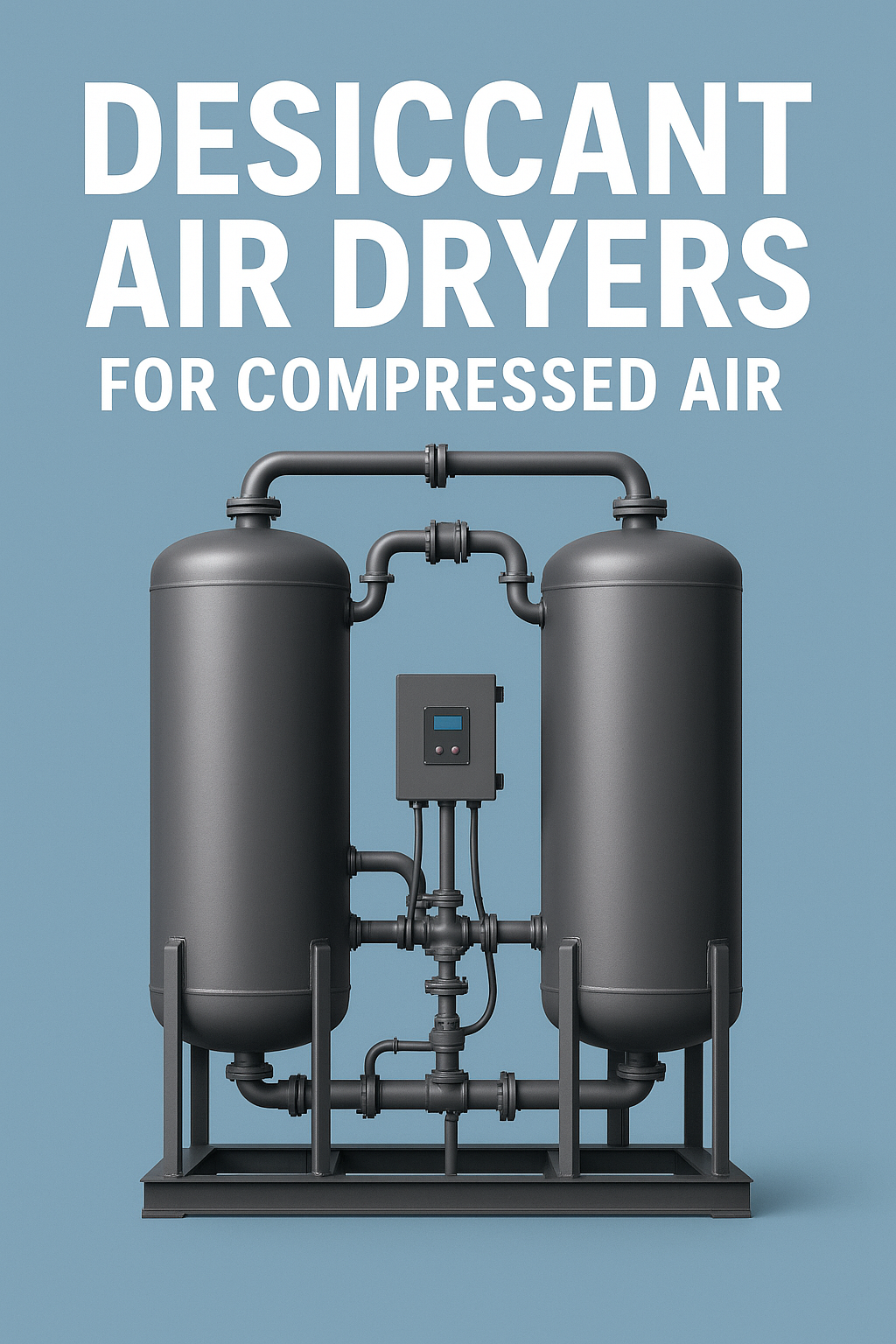
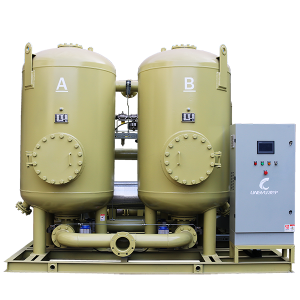
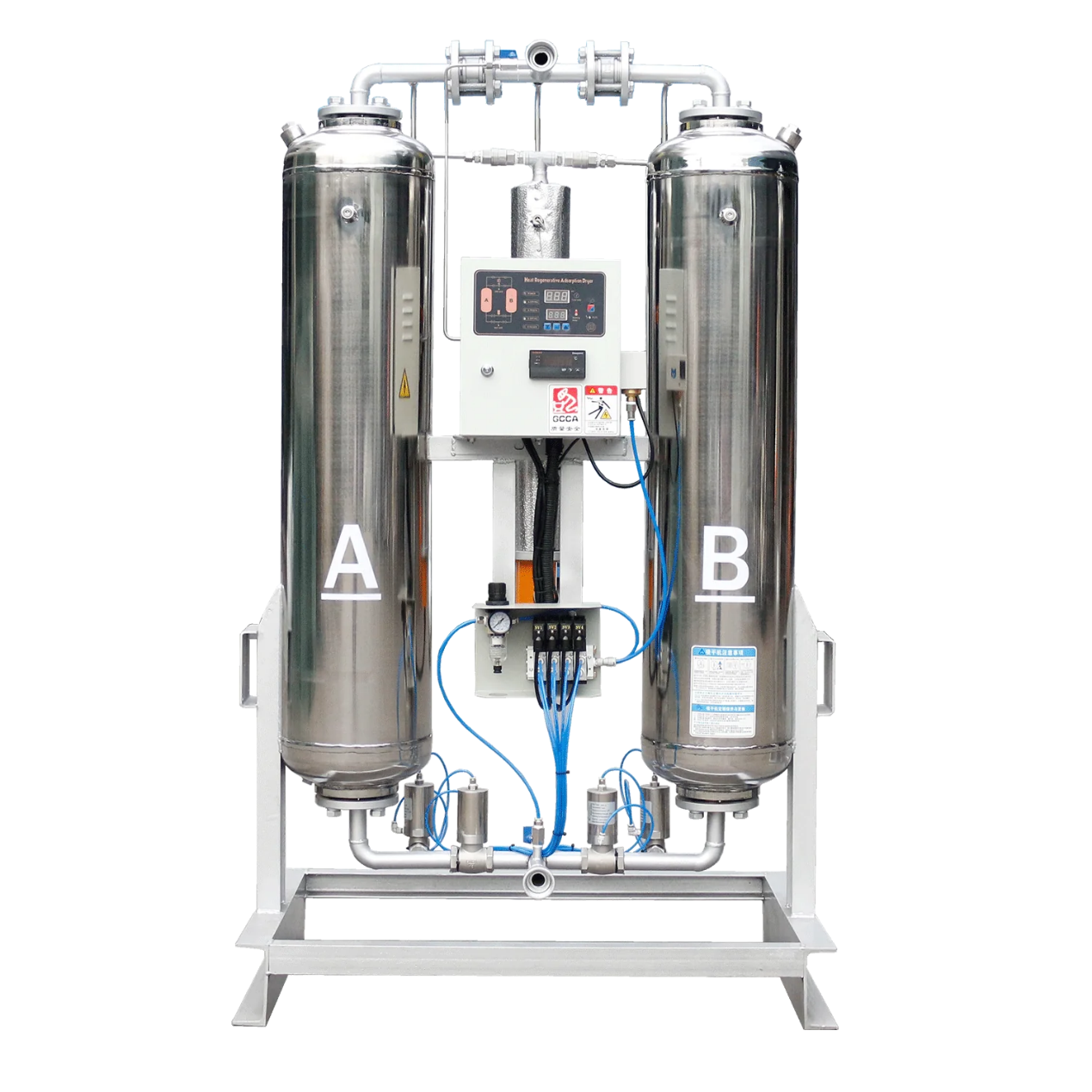
Desiccant Air Dryers for Industrial Compressed Air Systems
Lingyu provides industrial desiccant air dryers, also known as adsorption air dryers, for compressed air systems requiring low pressure dew points and reliable moisture removal.
Desiccant and adsorption describe the same drying principle: water vapor is adsorbed onto a desiccant material such as activated alumina or molecular sieve, while the desiccant is periodically regenerated for continuous operation.
Lingyu desiccant air dryer technologies include:
- Heatless regeneration
- Externally heated regeneration
- Blower-heated regeneration
- Heat of Compression (HOC) regeneration
- Modular heatless drying
These configurations are designed for different airflow capacities, pressure dew points, purge-air requirements, energy costs, and industrial operating conditions.
How Does a Desiccant / Adsorption Air Dryer Work?
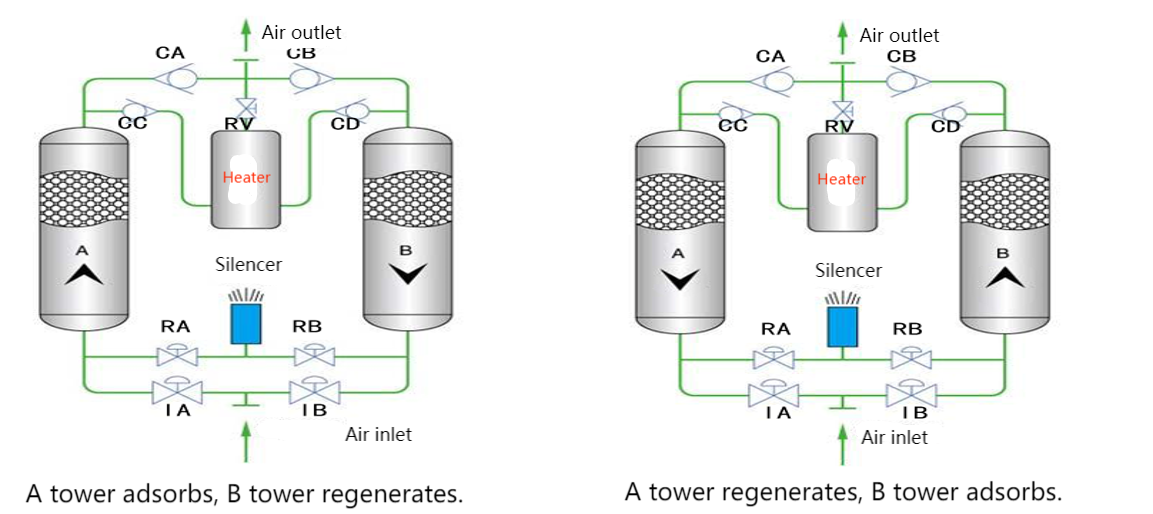
Most industrial desiccant dryers use two adsorption vessels or multiple adsorption modules.
During the adsorption cycle, compressed air passes through the desiccant bed, where water vapor is removed.
During regeneration, moisture is released from the saturated desiccant using dry purge air, external heat, blower-heated air, or recovered compression heat depending on the dryer technology.
The system automatically switches between drying and regeneration to maintain continuous dry compressed air delivery.
Desiccant Air Dryer Technologies
Heatless Desiccant Air Dryers
Heatless dryers regenerate the desiccant using dry compressed purge air and require no external heater.
Lingyu CH / HH heatless series provide:
- Capacity up to 150 m³/min
- Operating pressure: 0.6–1.0 MPa
- Purge air consumption: 8–14%
- CH Series PDP: -50°C to -20°C
- HH Series PDP: ≤-40°C
Heatless dryers are typically selected when simple operation, lower initial investment, and low electrical regeneration demand are priorities.
Heated Regeneration Desiccant Air Dryers
heated regeneration dryers use an electric heater together with a reduced amount of purge air to regenerate the desiccant.
Compared with heatless dryers, Lingyu externally heated CH / HH configurations reduce average purge air consumption to approximately 4–8%.
They are generally suitable for medium and large compressed air systems where reducing compressed air loss can offset the added heater energy.
Blower-Heated Desiccant Air Dryers
Blower-heated dryers use ambient air supplied by a blower and heated for desiccant regeneration.
Lingyu offers:
- HRB-E Low-Purge: approximately 2–3% regeneration air
- HRB-Z Zero-Purge: approximately 0% regeneration compressed air
Standard capacities extend up to approximately 260 m³/min, with -20°C / -40°C PDP options depending on configuration.
Blower-heated dryers are typically considered for large, continuously operating systems where purge-air cost is significant.
Heat of Compression Desiccant Air Dryers
Heat of Compression dryers(HOC) recover high-temperature compressor discharge heat for desiccant regeneration.
Lingyu provides:
- HOC-E Low-Purge: regeneration air consumption ≤3%
- HOC-Z Zero-Purge: regeneration air consumption 0%
- Standard capacity up to 260 m³/min
- Rated inlet temperature: 120°C
- Allowable inlet temperature: 110–180°C
- PDP options: -20°C / -40°C
HOC dryers are best suited for large compressed air systems where sufficient and stable compression heat is available.
Modular Heatless Desiccant Air Dryers
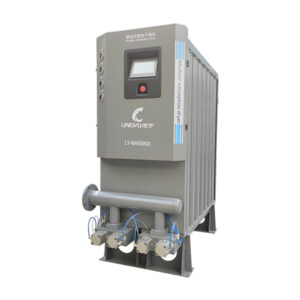
Lingyu M Series modular dryers use multiple adsorption modules instead of conventional large twin towers.
The standard M Series provides:
- Capacity: 1.5–55 m³/min
- Approximately 53–1,942 CFM
- Operating pressure: 0.6–1.0 MPa
- Purge air consumption: 5–8%
- Standard PDP: ≤-20°C
- Optional PDP: ≤-40°C
The modular architecture is particularly suitable where compact installation, future expansion, maintenance flexibility, or N+1 redundancy is required.
Desiccant Air Dryer Comparison
| Technology | Capacity Range* | Purge Air | PDP | Main Regeneration Energy | Best Suited For |
|---|
| Heatless | Up to 150 m³/min | 8–14% | -50°C to -20°C / ≤-40°C | Compressed purge air | Simple small–medium systems |
| Externally Heated | Up to 150 m³/min | 4–8% | -50°C to -20°C / ≤-40°C | Heater + reduced purge | Medium–large systems |
| Blower Heated | Up to 260 m³/min | 0–3% | -20°C / -40°C | Blower + heater | Large continuous systems |
| Heat of Compression | Up to 260 m³/min | 0–3% | -20°C / -40°C | Compressor discharge heat | Large systems with usable compression heat |
| Modular Heatless | 1.5–55 m³/min | 5–8% | ≤-20°C / ≤-40°C optional | Compressed purge air | Compact / expandable / redundant systems |
*Based on the Lingyu series technical data provided. Exact capacity depends on the selected series and operating conditions.
Purge Air Loss & Operating Cost
Regeneration method has a major impact on desiccant dryer operating cost.
For a system processing 100 m³/min, the approximate regeneration compressed-air demand would be:
| Dryer Type | Purge / Regeneration Air | Approx. Air Used at 100 m³/min |
| Heatless | 8–14% | 8–14 m³/min |
| Externally Heated | 4–8% | 4–8 m³/min |
| Blower Heated Low-Purge | 2–3% | 2–3 m³/min |
| Blower Heated Zero-Purge | ≈0% | ≈0 m³/min |
| HOC Low-Purge | ≤3% | ≤3 m³/min |
| HOC Zero-Purge | 0% | 0 m³/min |
| Modular Heatless | 5–8% | 5–8 m³/min |
Lower purge air does not automatically mean lower total energy consumption.
Heated and blower technologies consume electrical energy, while HOC performance depends on available compressor discharge heat. Dryer selection should therefore consider purge loss, heater/blower power, compressor efficiency, annual operating hours, and maintenance together.
How to Select a Desiccant Air Dryer
| Selection Requirement | What to Check |
| Required pressure dew point | -20°C / -40°C or other project requirement |
| Airflow | CFM / SCFM / m³/min |
| Working pressure | Typically 0.6–1.0 MPa for standard series |
| Inlet temperature | Depends on regeneration technology |
| Purge-air cost | Important for continuous operation |
| Annual operating hours | Higher hours increase TCO impact |
| Compressor type | Critical for HOC dryers |
| Compressor discharge temperature | Critical for HOC regeneration |
| Cooling water | Required for some blower/HOC configurations |
| Installation space | Important for modular systems |
| Redundancy requirement | Consider modular N+1 configuration |
| Power supply | Heater / blower requirements where applicable |
Quick Selection Guide
| Operating Requirement | Recommended Technology |
| Simple low-PDP system | Heatless |
| Reduce purge loss vs heatless | Externally Heated |
| Large continuous system with low purge priority | Blower Heated |
| Zero-purge requirement | HRB-Z or HOC-Z, subject to system conditions |
| High-temperature compressor discharge heat available | Heat of Compression |
| Compact or expandable installation | Modular Heatless |
| N+1 redundancy required | Modular configuration |
| ≤-40°C PDP required | Select suitable HH / blower / HOC / modular option according to series |
Typical Applications
Desiccant air dryers are commonly used in applications where refrigerated drying does not provide sufficiently low pressure dew point, including:
- Instrument air systems
- Electronics manufacturing
- Pharmaceutical production
- Chemical and petrochemical plants
- Precision manufacturing
- Low-temperature compressed air networks
- Centralized industrial compressed air stations
- Moisture-sensitive pneumatic processes
Application Examples
Instrument Air System
Requirement: Low pressure dew point and continuous dry compressed air
Typical Selection: Heatless, externally heated, blower-heated, or HOC depending on airflow and operating hours
For smaller or simpler systems, heatless regeneration may be suitable. For larger continuously operating systems, purge-air and regeneration-energy costs should be compared before selection.
Large Centralized Compressed Air Station
Requirement: High airflow with reduced compressed-air loss
Typical Selection: Blower-heated or Heat of Compression
Where compressor discharge heat is available, HOC technology can recover this energy for regeneration. Where compressor conditions are unsuitable for HOC, blower-heated regeneration may provide a more flexible alternative.
Space-Limited or Redundant System
Requirement: Compact installation, future expansion, or standby capacity
Typical Selection: Modular Heatless
M Series modular dryers can be configured according to current capacity and future expansion requirements, including N+1 redundancy where the complete system is designed accordingly.