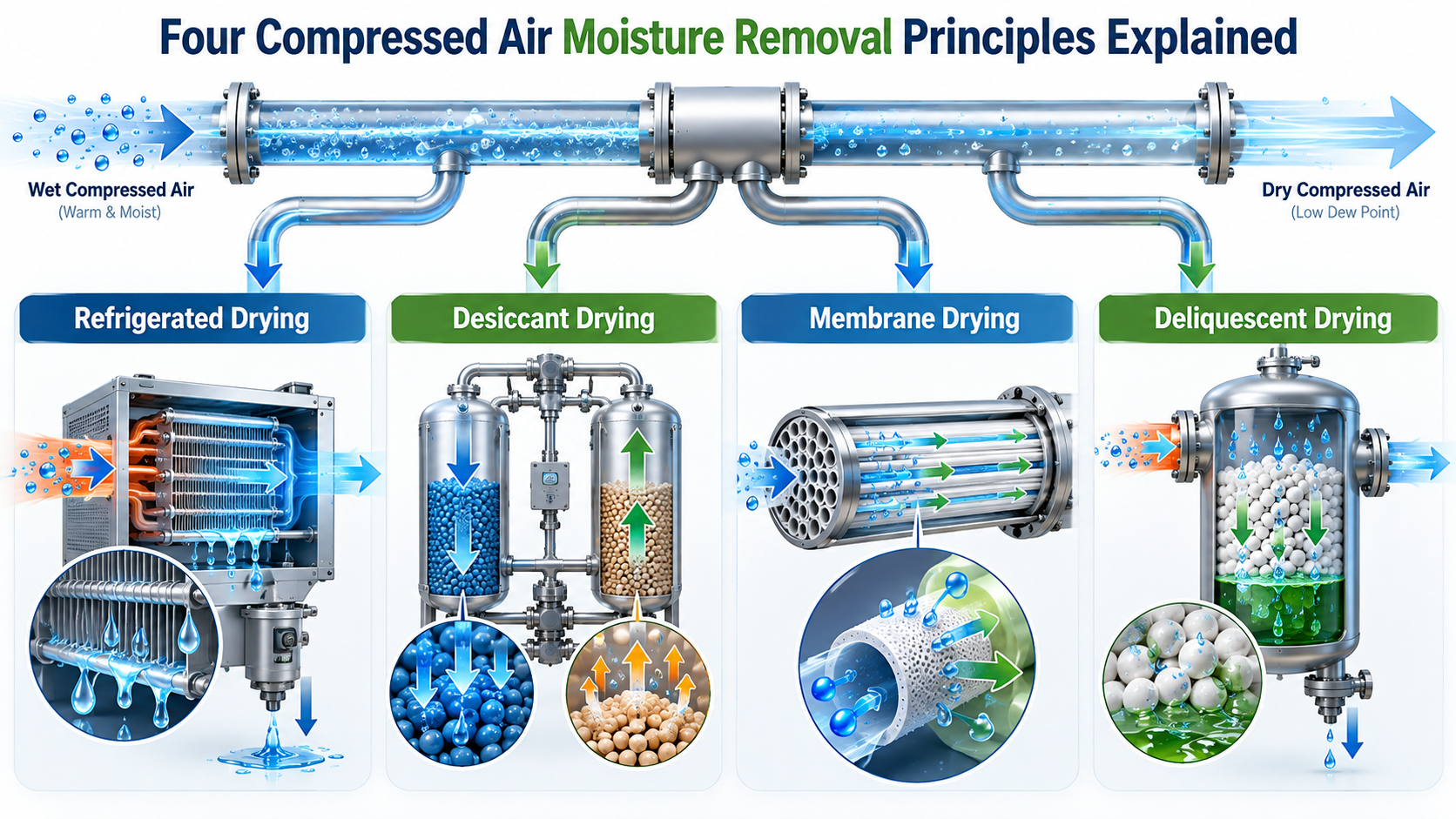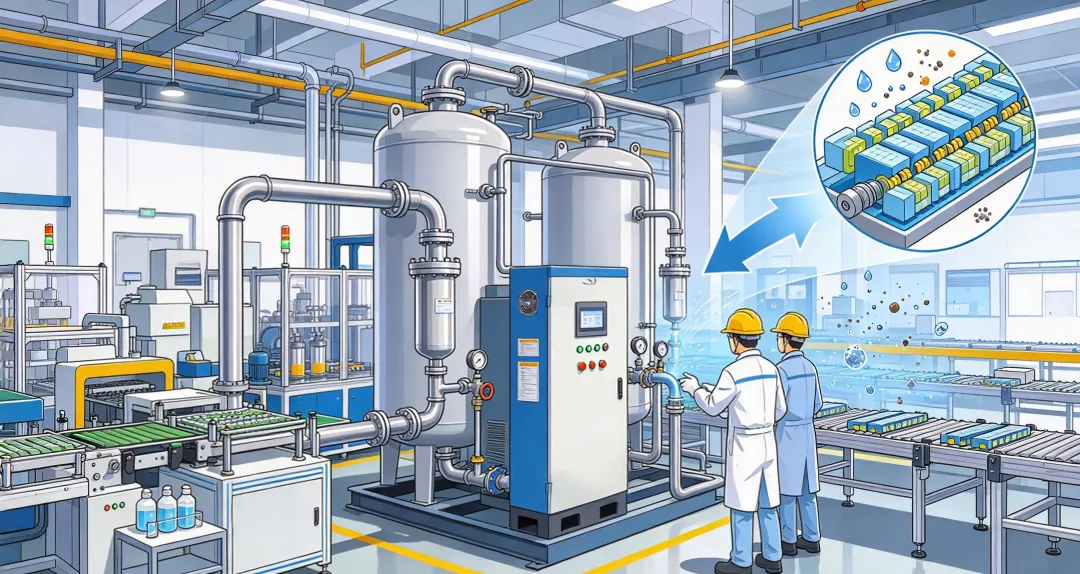
A desiccant air dryer, also known as an adsorption air dryer, removes water vapor from compressed air through adsorption. It is used when compressed air must be substantially drier than the air typically produced by a refrigerated dryer.
Depending on dryer design and operating conditions, adsorption drying can provide very low pressure dew points for moisture-sensitive industrial processes. Lingyu’s desiccant air dryer range includes heatless, heated regeneration, modular, blower-purge, and heat-of-compression technologies for different air-quality and energy requirements.
The key to selecting the right dryer is not simply choosing the lowest possible dew point. The required pressure dew point, airflow, inlet temperature, operating pressure, regeneration method, pressure drop, and lifecycle operating cost should all be considered.
What Is a Desiccant Air Dryer?
A desiccant air dryer passes compressed air through a bed of moisture-attracting material.
Instead of cooling the air until water vapor condenses—as a refrigerated dryer does—the desiccant captures water vapor on its internal and external surfaces.
This adsorption process enables much deeper drying.
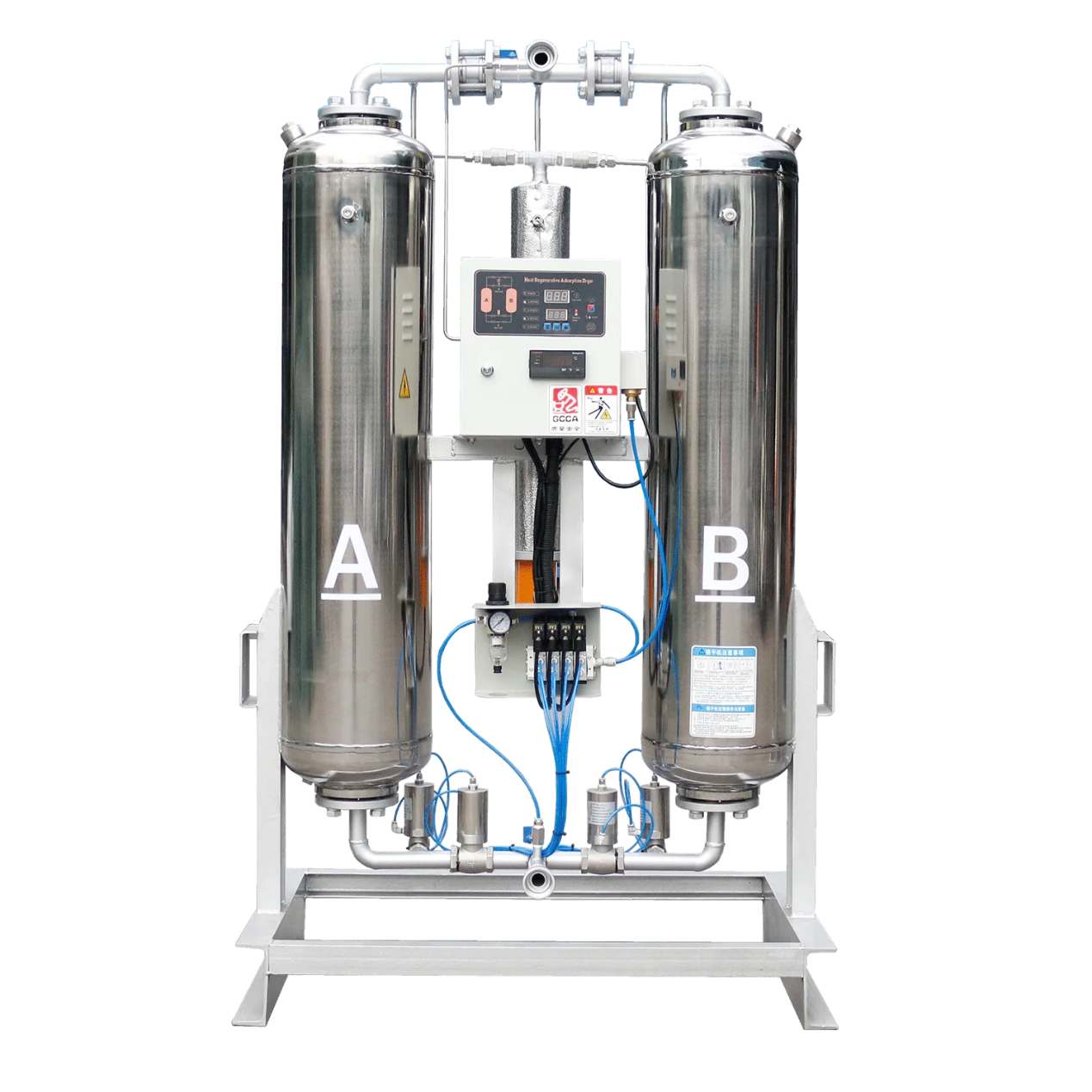
Industrial adsorption dryers commonly use twin towers so that one tower can dry the compressed air while the other undergoes regeneration.
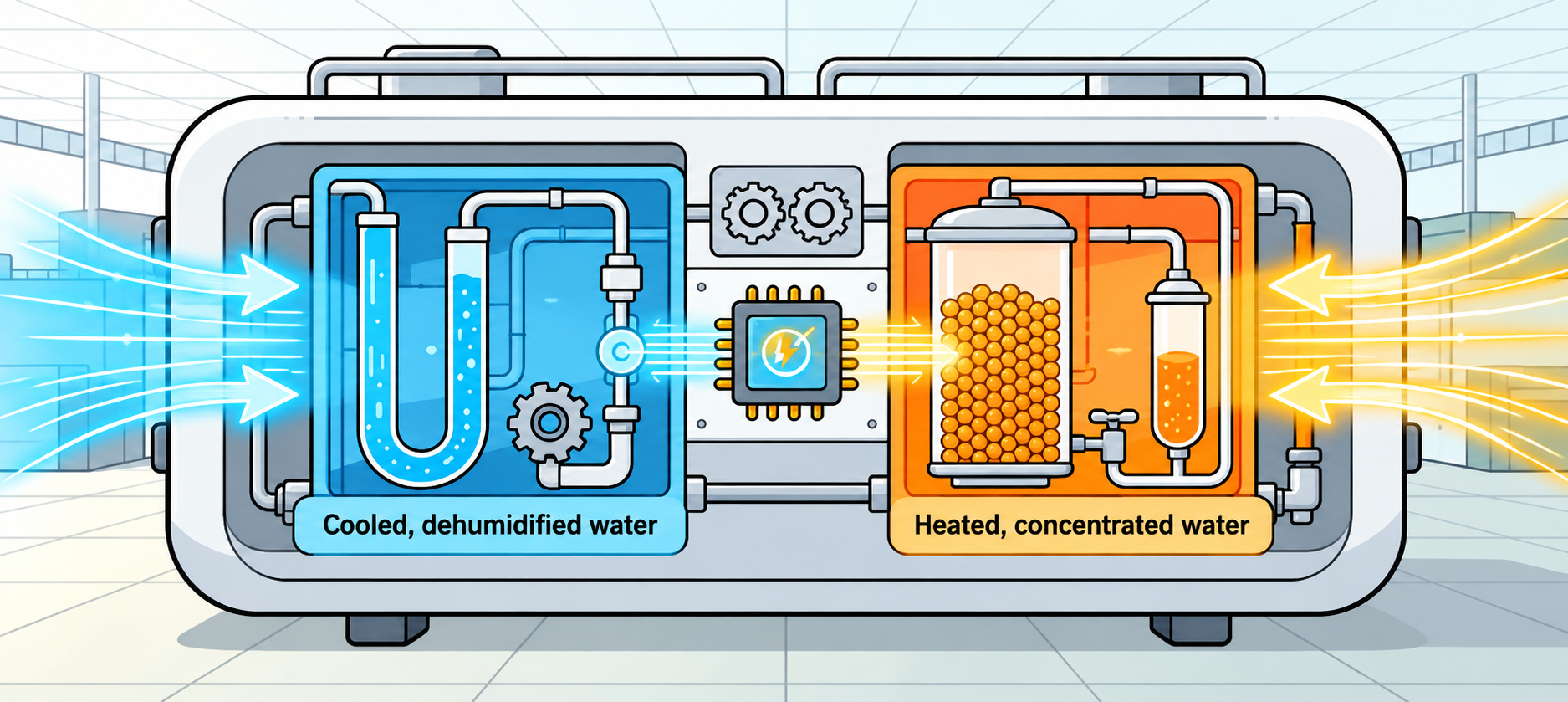
Adsorption vs. Absorption
Although the words sound similar, adsorption and absorption describe different processes.
Adsorption
During adsorption, water molecules attach to the surface of the desiccant.
Industrial desiccants contain extensive pore structures that provide a very large surface area for moisture capture.
Absorption
During absorption, a substance penetrates into the bulk of another material.
Compressed air desiccant dryers operate primarily through adsorption, which is why “adsorption air dryer” is commonly used as another name for this technology.
How Does a Desiccant Air Dryer Work?
A typical twin-tower dryer continuously alternates between drying and regeneration.
Step 1: Compressed Air Enters the Dryer
Wet compressed air first passes through appropriate upstream treatment before entering the adsorption vessel.
Pre-filtration is important because liquid water, oil aerosols, and solid contamination can reduce desiccant performance.
Step 2: Air Passes Through the Active Desiccant Bed
The compressed air flows through one tower containing desiccant.
Water vapor molecules are attracted to and retained on the desiccant’s surface.
Step 3: Dry Compressed Air Leaves the Tower
As moisture is removed, compressed air exits the active tower at a substantially lower pressure dew point.
The achievable PDP depends on the dryer series, desiccant, regeneration method, airflow, temperature, pressure, and operating condition.
Step 4: The Offline Tower Regenerates
Desiccant has a finite adsorption capacity.
Once loaded with moisture, it must be regenerated by removing the adsorbed water.
Depending on dryer technology, regeneration can use:
- Dry purge air
- Heated purge air
- Blower-supplied air
- Heat recovered from the compression process
Step 5: The Towers Switch
Before the regenerated tower returns to adsorption, the operating sequence may include cooling and pressure equalization.
The towers then change roles:
Tower A: adsorption → Tower B: regeneration
followed by:
Tower B: adsorption → Tower A: regeneration
This alternating cycle provides a continuous supply of dry compressed air.
What Desiccant Materials Are Used?
Desiccant selection affects achievable dew point, regeneration performance, mechanical durability, and long-term stability.
Activated Alumina
Activated alumina is widely used in industrial compressed air dryers because of its moisture adsorption capability and mechanical durability.
Lingyu’s CH Series heatless and heated regeneration dryers use activated alumina.
Molecular Sieve
Molecular sieve has a strong affinity for water and can be used where deeper drying is required.
Lingyu’s HH Series uses activated alumina together with high-performance molecular sieve for low-dew-point compressed air treatment.
Mixed or Layered Desiccant Beds
Combining different desiccants can help balance moisture-removal performance, mechanical strength, and operating requirements.
The desiccant should therefore be selected as part of the dryer design rather than substituted solely according to a generic dew-point table.
Understanding Desiccant Dryer Pressure Dew Point
Pressure dew point, or PDP, indicates the temperature at which moisture in compressed air would begin to condense at operating pressure.
The lower the PDP, the drier the compressed air.
However, specifying a lower dew point than the process actually requires can increase capital and operating costs.
−20°C PDP
A −20°C pressure dew point can be appropriate for applications requiring substantially drier air than conventional refrigerated drying without requiring the deepest available adsorption drying.
−40°C PDP
A pressure dew point around −40°C is frequently required for demanding industrial applications such as:
- Instrument air
- Moisture-sensitive manufacturing
- Cold-environment compressed air systems
- Certain chemical processes
- Electronics production
Actual requirements should always come from the process or applicable air-quality specification.
What About −70°C PDP?
Some specialized adsorption systems can be engineered for extremely low pressure dew points such as −70°C.
However, −70°C should not be presented as a standard performance specification for every Lingyu desiccant dryer.
The product series discussed here have their own defined pressure dew-point ranges. Where an application requires unusually deep drying, the dryer configuration and achievable performance should be confirmed specifically for the project.
Desiccant Dryer vs. Refrigerated Dryer
The fundamental difference is how moisture is removed and how dry the compressed air can become.
| Factor | Refrigerated Air Dryer | Desiccant Air Dryer |
|---|---|---|
| Moisture-removal principle | Cooling and condensation | Adsorption |
| Typical Lingyu PDP | 2–10°C | Depends on series; substantially lower PDP available |
| Regeneration | Not required | Required |
| Best suited to | General industrial moisture control | Low-dew-point applications |
| Below-freezing air systems | Often insufficient | Generally more suitable |
| System complexity | Lower | Higher |
| Purge requirement | None for desiccant regeneration | Depends on regeneration method |
For applications where a 2–10°C PDP is sufficient, a refrigerated air dryer can often provide a simpler solution.
Adsorption drying becomes particularly valuable when the process or environmental conditions require a substantially lower pressure dew point.
Main Desiccant Dryer Regeneration Methods
Regeneration technology is one of the most important differences between adsorption dryers.
1. Heatless Regeneration
A heatless dryer uses a portion of the already dried compressed air to regenerate the offline tower.
The dry purge air expands to a lower pressure and passes through the moisture-loaded desiccant, carrying the released moisture out through the exhaust system.
Lingyu’s CH Series Heatless Regeneration Adsorption Dryer operates with:
- Rated inlet pressure: 0.7 MPa
- Operating pressure range: 0.6–1.0 MPa
- Rated inlet temperature: 10–30°C
- Maximum inlet temperature: ≤40°C
- Average purge air consumption: 8–14%
- Outlet pressure dew point: −50°C to −20°C
- Desiccant: Activated alumina
- Ambient operating range: 2–45°C
Heatless regeneration has a comparatively straightforward design, but purge air represents compressed air that has already consumed energy during compression.
2. Heated Regeneration
A heated regeneration dryer adds an external heat source to improve moisture desorption.
Heating reduces the quantity of dry compressed air required for regeneration compared with conventional heatless operation.
Lingyu’s CH Series Heated Regeneration Adsorption Air Dryer operates with:
- Rated inlet pressure: 0.7 MPa
- Operating pressure range: 0.6–1.0 MPa
- Rated inlet temperature: 10–30°C
- Maximum inlet temperature: ≤40°C
- Average purge air consumption: 4–8%
- Outlet pressure dew point: −50°C to −20°C
- Desiccant: Activated alumina
- Ambient operating range: 2–45°C
Its regeneration sequence uses heated desorption followed by cooling before the tower returns to adsorption service.
3. Blower-Purge Regeneration
A blower-heated adsorption dryer uses a blower as part of the regeneration process, reducing dependence on compressed product air.
This approach can be attractive for larger compressed air systems where the cost of purge-air consumption becomes significant.
Blower systems include additional equipment such as:
- Blower
- Heater
- Valves
- Controls
- Regeneration-air circuit
The energy comparison should therefore consider total system consumption rather than purge-air percentage alone.
Lingyu’s blower zero-purge adsorption dryer provides another regeneration option for applications where reducing compressed-air consumption is a priority.
4. Heat-of-Compression Regeneration
Heat-of-compression, or HOC, dryers use thermal energy available from the compression process to regenerate the desiccant.
This can substantially reduce the need for an independent regeneration heat source when the compressor and dryer are appropriately integrated.
Lingyu’s HOC-Z Zero-Gas-Consumption Heat-of-Compression Dryer is designed around this principle.
HOC technology should be evaluated as part of the complete compressor station because inlet temperature, compressor configuration, load profile, cooling, and required dew point all influence system performance.
Why Is Pre-Filtration Important?
Desiccant is highly effective at removing water vapor, but it must be protected from other contaminants.
Liquid water and oil contamination can:
- Reduce effective adsorption capacity
- Contaminate desiccant surfaces
- Increase pressure drop
- Reduce dew-point performance
- Shorten useful desiccant life
Appropriate precision compressed air filtration should therefore be selected according to the compressor, dryer, and required downstream air quality.
A downstream particulate filter may also be appropriate to capture desiccant dust before the air reaches sensitive equipment.
Typical Desiccant Dryer System Arrangement
A simplified treatment sequence may look like:
compressor → aftercooler/separation → air receiver → pre-filtration → desiccant dryer → downstream filtration → distribution system
The exact arrangement varies by compressor type, dryer design, and final air-quality requirement.
For example, an oil-lubricated compressor may require more extensive oil-aerosol control before the adsorption dryer than an appropriately configured oil-free system.
How to Select the Right Desiccant Air Dryer
1. Define the Required Dew Point
Start with the process requirement.
Do not specify −40°C, −50°C, or an even lower PDP simply because the dryer can potentially achieve it.
The correct pressure dew point is the one that reliably protects the process and piping under the expected operating conditions.
2. Determine Maximum Airflow
The dryer must accommodate the maximum compressed air flow that will actually pass through it.
If several compressors can operate simultaneously, consider the combined airflow where applicable.
3. Check Inlet Temperature
Adsorption performance is strongly affected by temperature.
For Lingyu’s CH and HH conventional heatless/heated series, the standard inlet range is 10–30°C, with a maximum inlet temperature of ≤40°C.
Excessive inlet temperature increases the moisture load on the desiccant and can adversely affect drying capacity.
4. Check Operating Pressure
Dryer performance and purge requirements depend on pressure.
Lingyu’s conventional CH and HH adsorption series have a rated inlet pressure of 0.7 MPa and a standard operating range of 0.6–1.0 MPa, with other pressures available upon request.
5. Select the Regeneration Method
Consider the trade-offs among:
- Heatless
- Heated purge
- Blower purge
- Heat-of-compression
Selection should account for:
- Airflow
- Operating hours
- Electricity cost
- Cost of compressed purge air
- Compressor configuration
- Required dew point
- Maintenance capability
- Available utilities
- Initial investment
For a smaller intermittent system, the simplicity of heatless regeneration may be attractive.
For a large continuously operating system, reducing purge-air consumption may have a much greater economic impact.
Pressure Drop Matters
A dryer that achieves the required dew point but creates excessive pressure loss can still increase overall system energy cost.
Pressure loss reduces the useful pressure available downstream and may force the compressor to operate at a higher discharge pressure.
When evaluating a complete adsorption drying system, consider pressure drop across:
- Pre-filters
- Dryer
- After-filters
- Valves
- Piping
- Other treatment components
Filter differential pressure should also be monitored during operation.
Applications of Desiccant Air Dryers
Instrument Air
Low-dew-point air can help protect pneumatic instruments, actuators, valves, and exposed tubing from moisture and freezing.
The required PDP should be established from the instrument-air specification and minimum environmental temperature.
Electronics and Semiconductor Manufacturing
In semiconductor and PCB manufacturing, moisture-sensitive processes may require significantly drier compressed air than conventional refrigerated drying provides.
Particle and oil requirements should be considered together with moisture control.
Pharmaceutical Production
Pharmaceutical and biopharmaceutical applications can use dry compressed air for pneumatic equipment, process operations, conveying, packaging, and instrumentation.
The appropriate dryer and filtration system should be selected according to the specific process requirement.
Chemical and Petrochemical Processing
For petrochemical and chemical processing, low-dew-point compressed air can support instrument and process-air applications where moisture could affect reliability or product quality.
Cold-Environment Compressed Air Systems
If compressed air piping is exposed to temperatures below freezing, moisture can condense and freeze when the pressure dew point is too high.
The selected PDP should provide an appropriate margin below the minimum temperature expected in the relevant compressed air system.
Desiccant Air Dryer Maintenance
Adsorption dryers require maintenance to preserve dew-point performance and minimize unnecessary energy consumption.
Inspect the Desiccant
Over time, desiccant can become:
- Contaminated
- Mechanically degraded
- Less effective at adsorption
- Dust-producing
Desiccant condition should be evaluated according to operating performance and the manufacturer’s maintenance requirements rather than replaced on an arbitrary universal schedule.
Maintain Pre-Filters
Failure of upstream filtration can expose the desiccant to oil, liquid water, and particles.
Monitor filter differential pressure and element condition.
Inspect Switching Valves
Twin-tower dryers depend on reliable valve operation.
Valve leakage or incomplete switching can contribute to:
- Excessive purge consumption
- Pressure fluctuations
- Poor regeneration
- Deteriorating dew point
Check Silencers and Exhaust Components
Heatless and purge-based dryers discharge regeneration air through exhaust components and silencers.
Excessive restriction can create regeneration backpressure and interfere with proper dryer operation.
Monitor Pressure Dew Point
For critical processes, dew-point monitoring provides valuable information about actual dryer performance.
A deteriorating dew point may indicate:
- Excessive airflow
- High inlet temperature
- Desiccant deterioration
- Oil or water contamination
- Valve leakage
- Poor regeneration
- Filter problems
Trend monitoring can reveal a developing problem before visible moisture appears downstream.
Frequently Asked Questions
Is a desiccant air dryer the same as an adsorption air dryer?
Generally, yes.
“Desiccant” refers to the moisture-removing material, while “adsorption” describes the mechanism by which water molecules attach to its surface.
What pressure dew point can a desiccant dryer achieve?
It depends on the dryer series and operating conditions.
For example, Lingyu’s CH Series heatless and heated regeneration dryers specify an outlet PDP of −50°C to −20°C, while the HH Series heatless design specifies ≤−40°C.
Specialized applications requiring still lower dew points should be evaluated according to the specific dryer configuration rather than assuming one standard value across all adsorption dryers.
Does a desiccant dryer require filters?
Yes, appropriate filtration is important.
Upstream filtration protects the adsorption material from liquid water, oil, and particles. Downstream filtration may be used to prevent desiccant dust from entering sensitive equipment.
Is a desiccant dryer better than a refrigerated dryer?
Not universally.
For many general industrial systems, refrigerated drying to approximately 2–10°C PDP is sufficient and may provide a simpler and more economical solution.
A desiccant dryer becomes appropriate when the process or environment requires substantially drier compressed air.
Which regeneration method is most energy-efficient?
There is no single answer for every installation.
Heatless dryers consume more compressed purge air but have a comparatively straightforward design. Heated, blower-purge, and heat-of-compression technologies can reduce purge-air requirements but introduce other energy inputs, components, and operating considerations.
The correct comparison is based on total lifecycle cost under the site’s actual load profile.
Choosing the Right Adsorption Drying System
A desiccant air dryer provides low-dew-point compressed air by repeatedly cycling between adsorption and regeneration. This makes it particularly valuable for moisture-sensitive processes and compressed air systems exposed to low temperatures.
Reliable selection requires matching the dryer to the actual pressure dew point, peak airflow, inlet temperature, operating pressure, regeneration strategy, filtration requirements, and expected operating hours.
Rather than automatically choosing the lowest achievable dew point, specify the air quality the process genuinely requires and select the drying technology that can maintain it efficiently.
For application-specific dryer selection, contact Lingyu with your required pressure dew point, airflow, operating pressure, inlet temperature, compressor type, and operating schedule.