Moisture is one of the most persistent problems in industrial compressed-air systems. Even after liquid condensate is removed, compressed air can still contain water vapor that may later condense as pressure and temperature conditions change.
This moisture can contribute to pipeline corrosion, pneumatic equipment problems, process instability, and product-quality issues.
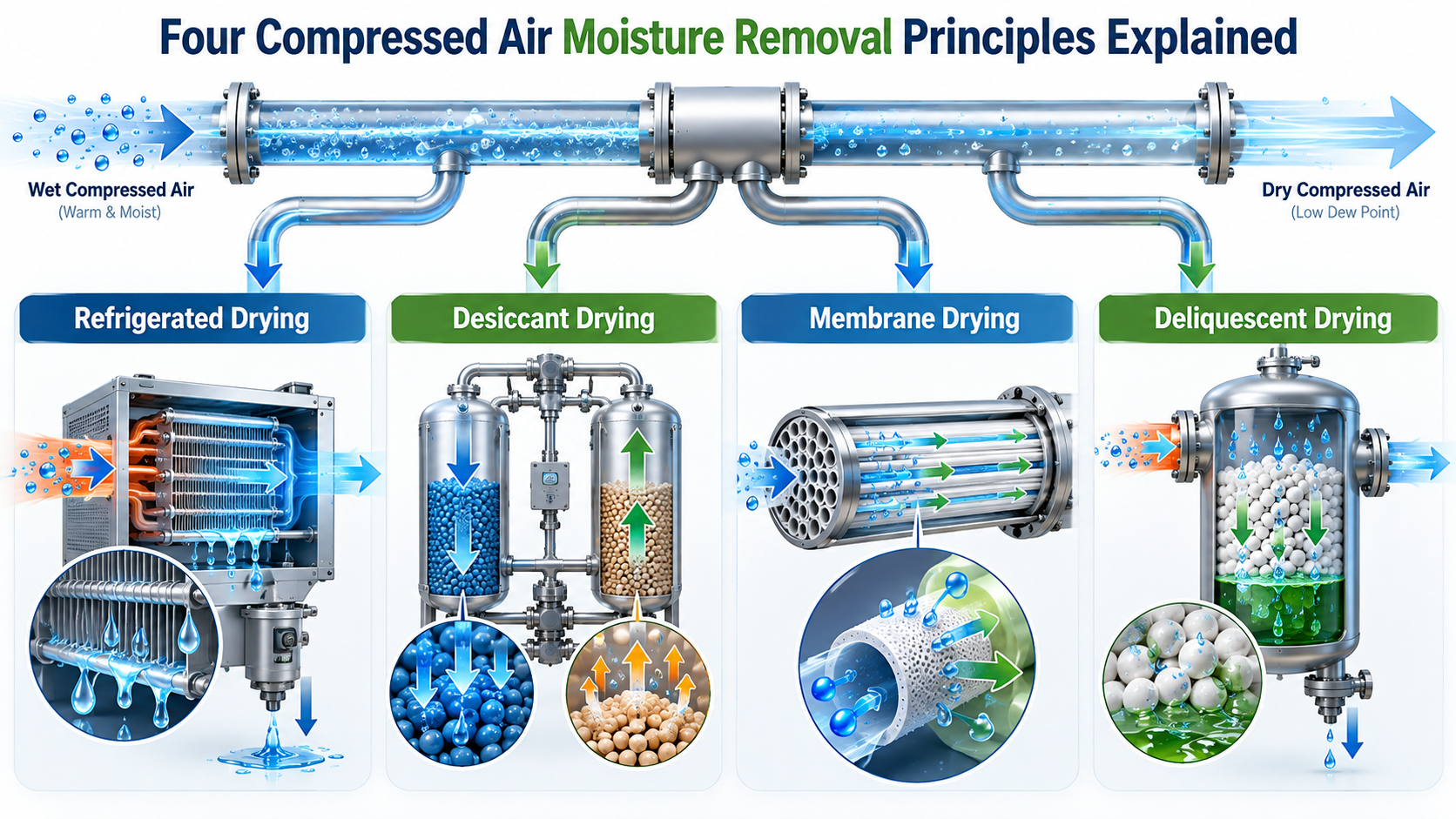
When a refrigerated dryer cannot provide a sufficiently low pressure dew point, a desiccant air dryer—also called an adsorption air dryer—is often the next level of compressed-air treatment. Unlike refrigerated dryers, which remove moisture primarily through cooling and condensation, desiccant dryers use an adsorbent material to capture water vapor from the compressed-air stream.
Lingyu’s adsorption dryer portfolio includes heatless, heated-purge, modular heatless, blower-heated, Heat of Compression, and combined refrigerated-plus-adsorption drying technologies.
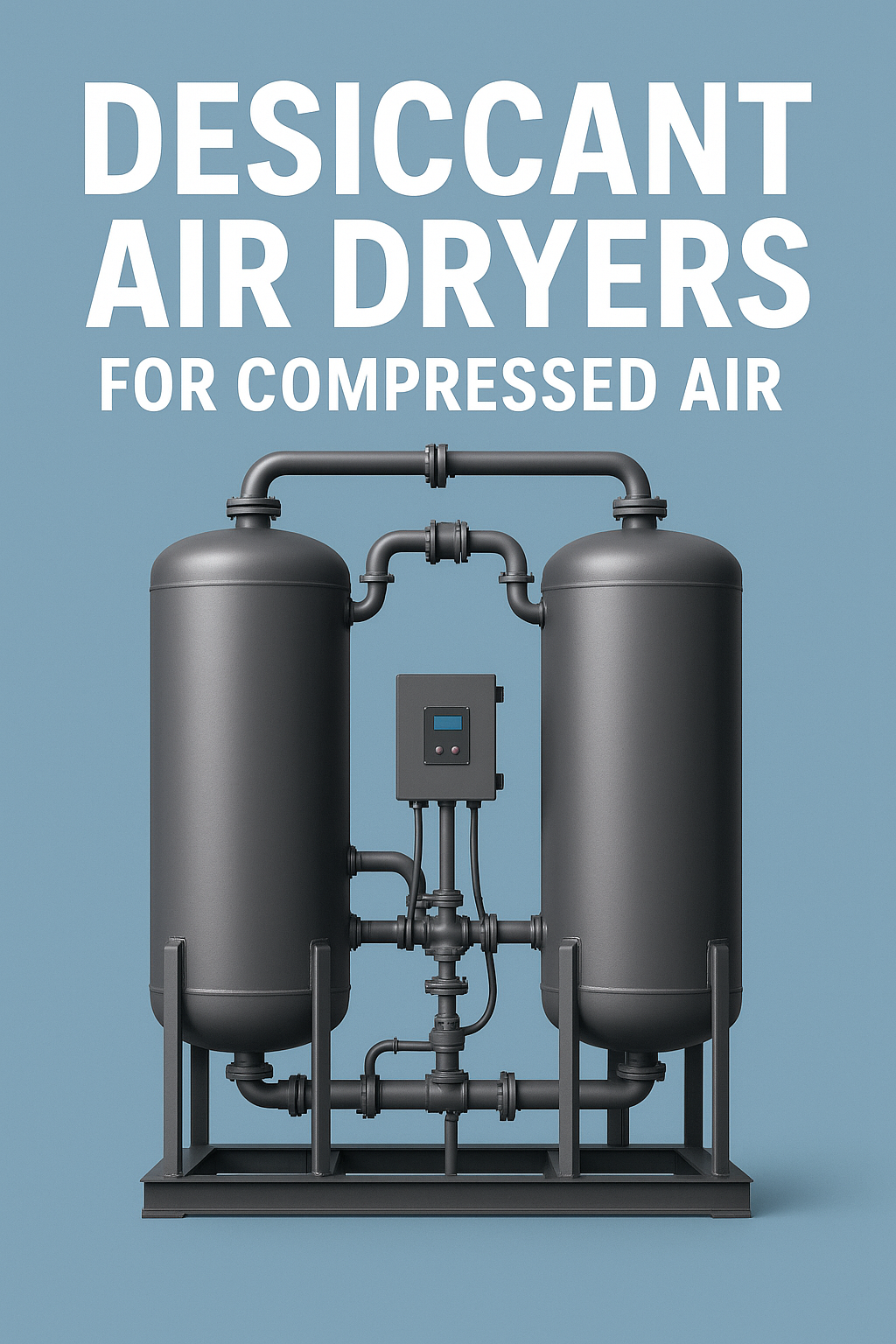
What Is a Desiccant Air Dryer?
A desiccant air dryer removes water vapor from compressed air through adsorption.
During adsorption, water molecules are attracted to and retained on the surface and within the pore structure of the desiccant material. Once the active desiccant bed has accumulated sufficient moisture, it must be regenerated so that it can be used again.
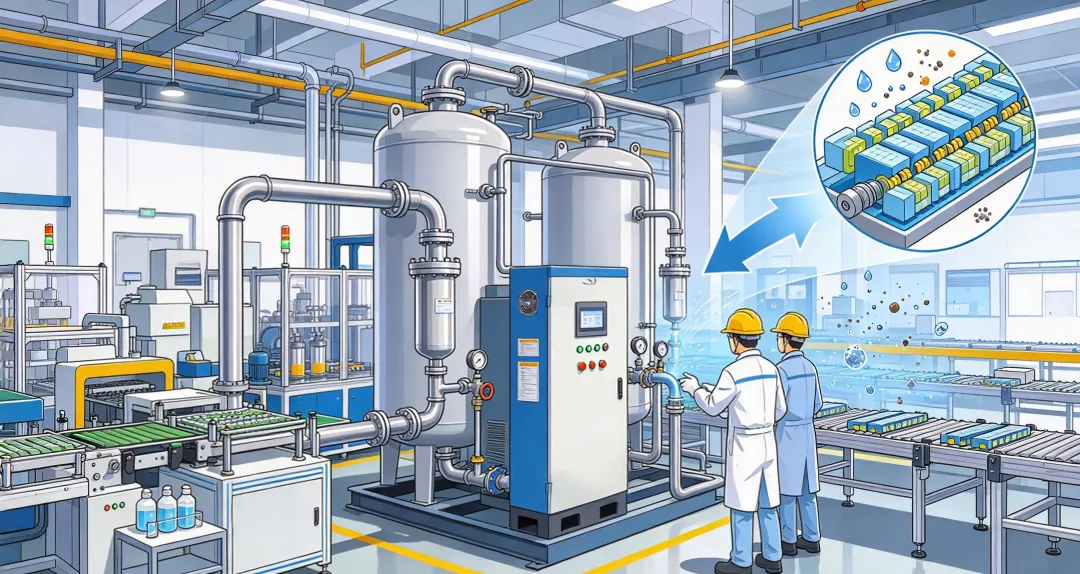
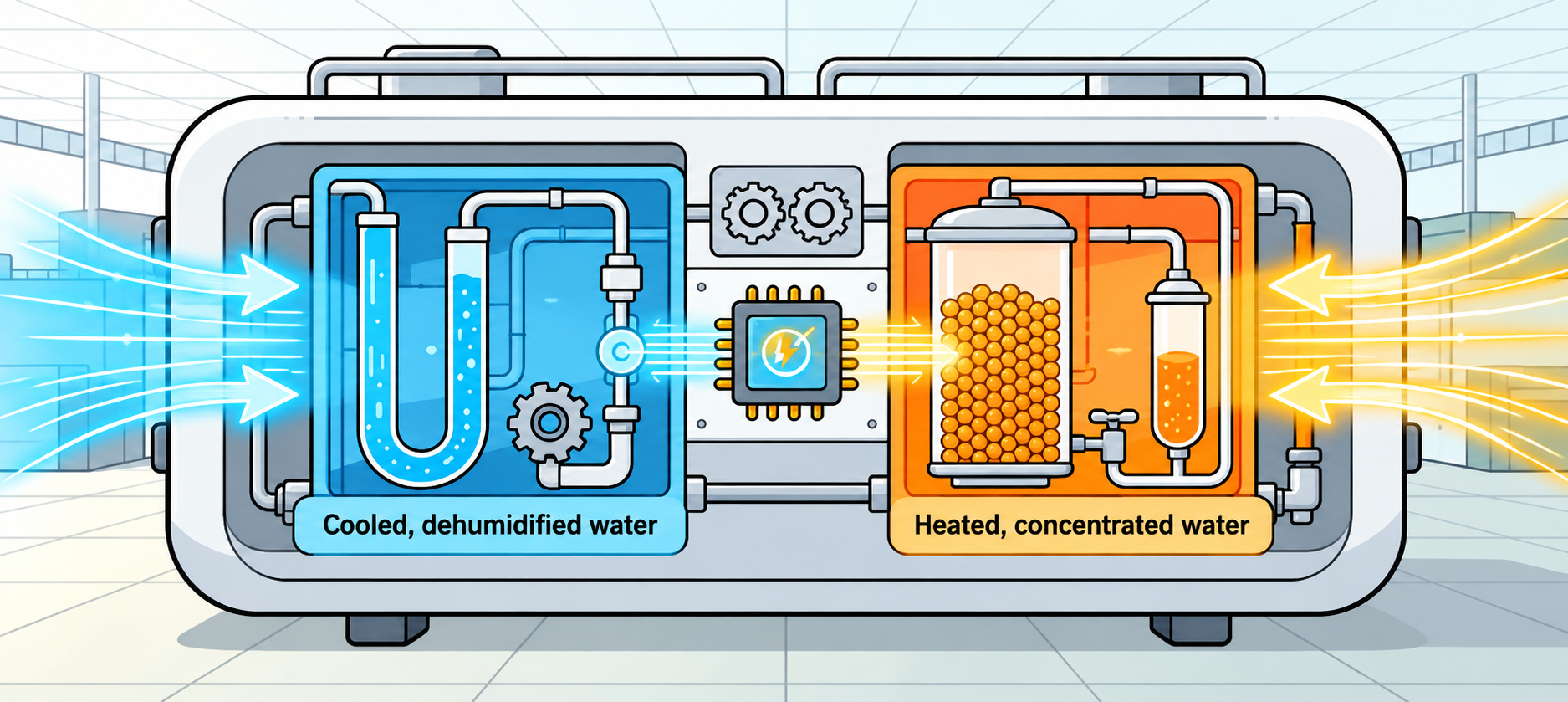
Most industrial regenerative desiccant dryers therefore use two adsorption vessels. While one tower dries compressed air, the other regenerates. After regeneration, the towers switch duties.
This alternating arrangement allows the dryer to provide a continuous supply of low-dew-point compressed air.
For a detailed explanation of this process, see how a twin-tower desiccant dryer achieves continuous drying.
Adsorption vs. Absorption
For regenerative compressed-air dryers, adsorption is the more accurate technical term.
In adsorption, water molecules accumulate on the surface and within the internal pore structure of the desiccant rather than becoming uniformly dissolved throughout the material.
This distinction is why these products are also commonly described as adsorption air dryers.
How Does a Desiccant Air Dryer Work?
Although regeneration methods differ between dryer technologies, the core drying cycle is similar.
1. Moist Compressed Air Enters the Active Tower
Compressed air enters a vessel containing desiccant.
As the air passes through the bed, water vapor is adsorbed by the desiccant. The dried compressed air then leaves the active tower and flows downstream.
2. The Offline Tower Is Regenerated
While one tower dries the air, the second tower releases the moisture accumulated during its previous adsorption period.
The way this moisture is removed defines the major desiccant dryer technologies.
Regeneration can use dry compressed purge air, external heating, heated ambient blower air, or heat recovered from compressor discharge.
3. The Towers Repressurize and Switch
After regeneration—and cooling when required—the regenerated tower is returned to system pressure.
The two vessels then exchange functions, and the repeating sequence provides continuous drying.
Main Types of Desiccant Air Dryers
Lingyu’s principal adsorption-dryer families include heatless regenerative dryers, heated-purge regenerative dryers, modular heatless dryers, blower-heated regenerative dryers, Heat of Compression dryers, and combined refrigerated-plus-adsorption dryers.
Each technology solves the same basic moisture problem but uses a different regeneration strategy.
Heatless Desiccant Air Dryers
A heatless regenerative dryer uses a portion of the already dried compressed air to regenerate the offline desiccant tower.
The dry purge air is expanded to lower pressure and passed through the saturated desiccant, creating conditions for moisture desorption. This approach does not require a regeneration heater.
For Lingyu’s conventional CH and HH heatless dryers, average purge-air consumption is specified at 8–14%.
The CH configuration is specified for a pressure dew point of −50°C to −20°C, while the HH configuration is specified at ≤−40°C.
Users considering this technology can review Lingyu’s heatless desiccant dryer range.
The principal trade-off is simple regeneration versus the energy cost of producing compressed purge air that is subsequently exhausted.
Heated-Purge Desiccant Air Dryers
A heated-purge dryer adds an external heat source to the regeneration process.
Heat assists desorption, so less dry compressed air is required for regeneration than in a conventional heatless design.
Lingyu’s CH and HH heated-purge dryers specify average purge-air consumption of 4–8%.
The regeneration cycle also includes cooling because heated desiccant must return toward its adsorption temperature before stable drying performance resumes.
Buyers comparing this technology can explore Lingyu’s externally heated desiccant dryer range.
Modular Heatless Desiccant Air Dryers
Modular dryers still use heatless regeneration, but their mechanical arrangement differs from a conventional large twin-vessel design.
Lingyu’s M Series uses a modular structure developed from the conventional twin-tower concept. The design uses straight-through chambers, inlet buffering, and a controlled desiccant-filling arrangement intended to improve airflow distribution and reduce channeling and uneven utilization of the adsorption bed.
The M Series specifies regeneration-air consumption of approximately 5–8% and outlet PDP of ≤−20°C as standard, with −40°C optional.
For applications where compact modular construction is valuable, see the modular heatless desiccant dryer category.
Blower-Heated Desiccant Air Dryers
A blower-heated dryer reduces the amount of compressed product air required for regeneration by drawing ambient air through a blower and heater.
Lingyu separates this technology into two configurations.
The HRB-E low-purge blower-heated dryer uses heated ambient blower air during regeneration and approximately 2% dry product air during cooling. Total regeneration-air consumption is specified at 2–3%.
The HRB-Z zero-purge configuration uses closed-loop intercooler cooling without dry product air and specifies regeneration-air consumption at approximately 0%.
The corresponding products are available in Lingyu’s blower-heated and zero-purge adsorption dryer range.
Zero purge does not mean zero energy consumption. Blowers, heaters, cooling systems, and controls still require energy.
Heat of Compression Desiccant Air Dryers
A Heat of Compression, or HOC, dryer uses thermal energy contained in high-temperature compressor discharge air to regenerate the desiccant.
Lingyu offers two HOC configurations.
The HOC-E low-purge version uses compressor heat during regeneration and only a small quantity of dry product air during cooling, with regeneration-air consumption specified at ≤3%.
The HOC-Z configuration is designed for 0% regeneration-air consumption, with outlet PDP options of −20°C / −40°C.
Facilities evaluating compressor-heat recovery can review the Heat of Compression dryer range.
HOC can be highly attractive in the right system, but compressor discharge temperature, load profile, cooling, and integration requirements must all be checked during selection.
Combined Refrigerated and Desiccant Dryers
Another option is to combine refrigerated drying and adsorption drying in a single treatment train.
In Lingyu’s combined dryer design, compressed air is first cooled through the refrigeration stage to a PDP of approximately 2–10°C. This removes a large portion of the incoming moisture before the air reaches the adsorption bed.
The partially dried air then passes through oil-removal filtration and the adsorption stage for deeper moisture removal.
Reducing the moisture load before the adsorption stage can reduce regeneration-air demand and extend desiccant service life compared with placing the entire incoming moisture load directly on the adsorption stage.
Combined drying can therefore be useful when a low PDP is required but incoming moisture loading is relatively high.
Desiccant Materials Used by Lingyu
Desiccant selection varies by dryer family.
For Lingyu’s CH heatless and heated-purge dryers, the specified desiccant is activated alumina.
For the HH heatless and heated-purge dryers, the specified configuration is activated alumina + high-performance molecular sieve.
Other advanced product families use customized or high-performance desiccants depending on the configuration.
Silica gel should therefore not be treated as a standard desiccant across Lingyu’s product range without model-specific technical support.
What Pressure Dew Point Can a Desiccant Dryer Achieve?
One of the strongest reasons to use adsorption drying is its ability to produce compressed air substantially drier than conventional refrigerated drying.
However, there is no single PDP specification that applies to every Lingyu desiccant dryer.
| Dryer Type | Lingyu PDP Reference |
|---|---|
| CH heatless | −50°C to −20°C |
| HH heatless | ≤−40°C |
| CH heated purge | −50°C to −20°C |
| HH heated purge | ≤−40°C |
| M modular heatless | ≤−20°C standard, −40°C optional |
| HRB-E / HRB-Z blower-heated | −20°C / −40°C optional |
| HOC-E / HOC-Z | −20°C / −40°C optional |
| Combined dryer | ≤−40°C depending on configuration |
The appropriate PDP should therefore be taken from the selected product family rather than applying one generic desiccant-dryer value to every system.
Why Pressure Dew Point Matters
Pressure dew point indicates the moisture condition of compressed air under pressure.
A lower PDP means less water vapor remains in the compressed-air stream.
However, lower is not automatically better. A dryer designed for −40°C PDP may consume more energy or require a more complex regeneration process than a system designed for −20°C.
The target should match the actual process requirement. Selecting a lower PDP than necessary can increase equipment and operating costs without providing useful process value.
Desiccant Dryer vs. Refrigerated Dryer
The primary differences are the moisture-removal method and achievable pressure dew point.
| Factor | Refrigerated Dryer | Desiccant Dryer |
|---|---|---|
| Moisture-removal principle | Cooling, condensation, separation | Adsorption |
| Typical Lingyu reference | AH Series: 2–10°C PDP | Product-dependent, often −20°C or −40°C ranges |
| Regeneration required | No desiccant regeneration | Yes |
| Main energy considerations | Refrigeration power, pressure drop | Purge air, heaters/blowers, cooling, pressure drop |
| Best selection basis | Required PDP and operating conditions | Required PDP and regeneration economics |
For a broader comparison, see refrigerated vs. desiccant air dryers.
Advantages of Desiccant Air Dryers
The principal advantage is low pressure dew point.
Desiccant dryers can provide air significantly drier than conventional refrigerated drying, making them suitable where downstream equipment or processes are particularly sensitive to moisture.
Another advantage is the range of available regeneration technologies. A plant can choose between simpler heatless regeneration, lower-purge heated regeneration, blower-assisted systems, compressor-heat recovery, or combined refrigerated/adsorption drying.
This allows the drying system to be optimized around airflow, annual operating hours, energy cost, installation conditions, and required PDP.
Important Limitations
Desiccant dryers should not automatically be considered superior to refrigerated dryers.
Depending on the regeneration method, a desiccant system may involve purge-air loss, electric heater consumption, blower power, cooling requirements, additional valves and controls, desiccant maintenance, and greater system complexity.
The correct technology should therefore be selected according to the required air quality and lifecycle economics rather than simply choosing the dryer capable of the lowest dew point.
Purge-Air Consumption and Lifecycle Cost
For regenerative desiccant dryers, purge-air consumption can be one of the most important lifecycle-cost factors.
The Lingyu portfolio illustrates how significantly regeneration-air demand varies by technology:
| Dryer Technology | Regeneration-Air Consumption |
|---|---|
| Conventional heatless | 8–14% |
| M Series modular heatless | 5–8% |
| Heated purge | 4–8% |
| HRB-E blower-heated | 2–3% |
| HRB-Z blower-heated | ≈0% |
| HOC-E | ≤3% |
| HOC-Z | 0% |
Compressed air used for regeneration has already consumed compressor energy, so purge-air loss represents a real operating cost. This is why initial dryer price alone is not enough for a meaningful economic comparison.
Pressure Drop Also Affects Energy Cost
Pressure drop across the dryer and associated filters can influence compressor energy demand.
If the treatment system creates excessive resistance, the compressor may need to operate at a higher discharge pressure to maintain the required pressure downstream.
A complete lifecycle analysis should therefore consider:
Dryer electrical energy + purge-air loss + cooling energy + pressure drop + maintenance
rather than looking only at the dryer’s connected electrical power.
Why Inlet Air Quality Matters
A desiccant bed is designed primarily to remove water vapor.
Liquid water, excessive oil, and particles entering the adsorption vessel can interfere with desiccant performance.
Appropriate separation and filtration should therefore be included in the compressed-air treatment train.
This is particularly clear in Lingyu’s combined dryer flow, where partially dried air passes through an oil-removal filter before entering the adsorption bed, followed by particulate filtration downstream.
A desiccant dryer should not be treated as a substitute for all other compressed-air purification components.
How to Select the Right Desiccant Air Dryer
The main selection factors are required pressure dew point, maximum actual airflow, inlet pressure, inlet temperature, moisture loading, regeneration-air consumption, heater or blower energy, compressor compatibility for HOC, pressure drop, annual operating hours, installation environment, filtration and contamination control, and maintenance capability.
For a more detailed selection process, see how to choose a desiccant air dryer and avoid common sizing mistakes.
The correct choice is rarely determined by nominal airflow alone.
Choosing by System Size and Operating Profile
There is no universal rule that heatless dryers are always for small systems and blower-heated or HOC dryers are always for large systems.
However, purge-air economics become increasingly important as airflow and annual operating hours increase.
At relatively modest airflow or intermittent operation, the simplicity of heatless regeneration may be attractive.
At high airflow and long operating hours, reducing purge-air loss can become more economically important, making heated, blower-heated, or HOC technologies worth evaluating.
The final decision should be based on actual lifecycle cost.
Applications of Desiccant Air Dryers
Desiccant dryers are relevant where the required PDP is below the practical range of conventional refrigerated drying.
Typical duties may include instrument air, pneumatic controls exposed to low temperatures, moisture-sensitive manufacturing, electronics, chemical processing, pharmaceutical utilities, and other applications requiring low-dew-point compressed air.
However, industry name alone does not determine the dryer type.
A pharmaceutical plant may have one utility that only needs refrigerated drying and another that requires −40°C PDP. Likewise, an electronics factory may contain both general pneumatic loads and highly moisture-sensitive processes.
The process specification should always define the required treatment level.
Maintenance Considerations
Desiccant dryer maintenance depends strongly on the regeneration technology.
Common inspection areas include desiccant condition, switching valves, filters, silencers, purge circuits, heaters, blowers, cooling systems, pressure equalization, sensors, and pressure-dew-point performance.
A fixed universal desiccant replacement period should not be assumed. Replacement should instead be based on actual performance, contamination, mechanical condition, pressure drop, and model-specific service recommendations.
Rising outlet dew point can result from excessive airflow, poor regeneration, valve leakage, contamination, inadequate cooling, or desiccant deterioration.
Which Desiccant Dryer Type Is Right for You?
A practical first-pass comparison is:
| Dryer Type | Main Regeneration Method | Key Trade-Off |
|---|---|---|
| Heatless | Dry compressed purge air | Simple, but higher purge loss |
| Heated purge | Heat + dry purge air | Lower purge, adds heater |
| Modular heatless | Dry purge air in modular design | Compact, lower purge than conventional heatless |
| Blower-heated | Heated ambient blower air | Very low compressed-air loss, more auxiliaries |
| HOC | Compressor discharge heat | Very low purge, requires system integration |
| Combined dryer | Refrigeration + adsorption | Reduces moisture load before adsorption |
This comparison is more useful than ranking one technology as universally best.
Conclusion
A desiccant air dryer removes water vapor from compressed air through adsorption and regenerates the desiccant so that it can be reused continuously.
The major difference between desiccant dryer types is the regeneration method. Lingyu’s current product range includes conventional heatless, heated-purge, modular heatless, blower-heated, HOC, and combined refrigerated/adsorption configurations.
Their pressure-dew-point capability and regeneration-air consumption vary significantly, so the correct system should be selected according to actual process requirements rather than applying one generic specification to all adsorption dryers.
Key Lingyu reference values include 8–14% purge for conventional heatless dryers, 5–8% for the M Series, 4–8% for heated-purge dryers, 2–3% for HRB-E, ≈0% for HRB-Z, ≤3% for HOC-E, and 0% for HOC-Z. Product-family PDP references include −50°C to −20°C, ≤−40°C, ≤−20°C standard with −40°C optional, and −20°C / −40°C optional, depending on the selected dryer technology.
For industrial systems requiring substantially drier air than a conventional refrigerated dryer can provide, the appropriate adsorption dryer can deliver reliable low-dew-point compressed air. The most technically advanced regeneration method, however, is not automatically the most economical choice for every installation.