The 1340 SCFM Water-Cooled Refrigerated Air Dryer is designed for high-flow industrial compressed air systems where reliable moisture removal and stable continuous operation are required.
Unlike an air-cooled dryer, a water-cooled unit transfers refrigeration heat to a cooling-water circuit. This can make it particularly suitable for facilities that already have reliable cooling-water infrastructure or installations where rejecting large amounts of heat into the compressor room is undesirable.
The 1340 SCFM Water-Cooled Refrigerated Air Dryer should be selected and installed according to actual airflow, inlet pressure and temperature, cooling-water conditions, and required pressure dew point.
How Does a Water-Cooled Refrigerated Air Dryer Work?
High-temperature compressed air containing moisture first passes through the water-cooled pre-cooler and air-to-air heat exchanger, where its temperature is reduced.
The pre-cooled compressed air then enters the evaporator. Refrigeration further lowers the air temperature, causing water vapor, oil, and some impurities to condense.
An air-water separator removes the resulting condensate, and the liquid is discharged through an automatic drain.
Finally, the dried compressed air passes through the air-to-air heat exchanger, where it is reheated closer to ambient temperature before leaving the dryer.
Under specified operating conditions, this process provides a pressure dew point of 2–10°C.
Typical Operating Conditions
For Lingyu’s WH Series water-cooled refrigerated drying technology, standard operating conditions include:
- Rated inlet pressure: 0.7 MPa
- Operating pressure range: 0.6–1.0 MPa
- Rated inlet temperature: 50°C
- Maximum inlet temperature: ≤80°C
- Pressure dew point: 2–10°C
- Rated ambient temperature: 32°C
- Ambient operating range: 2–45°C
- Pressure drop: ≤0.025 MPa
- Cooling method: Water-cooled
- Cooling-water pressure: 0.2–0.4 MPa
- Maximum cooling-water temperature: ≤32°C
- Cooling-water operating temperature range: 2–38°C
- Installation: Indoor installation on a level concrete floor
- Recommended clearance: At least 1.5 m around the unit
Actual operating parameters and model configuration should be confirmed for the specific installation.
Installation Requirements for Reliable Operation
A high-capacity water-cooled dryer needs correct installation on both the compressed-air side and the cooling-water side.
Choose a Suitable Indoor Location
Install the dryer indoors on a level surface with enough space for inspection and maintenance.
Although a water-cooled dryer does not depend on condenser airflow in the same way as an air-cooled unit, the surrounding area should still be clean and ventilated.
Keep the dryer away from unnecessary heat sources and highly contaminated areas where possible.
Maintain Service Clearance
A minimum clearance of approximately 1.5 m around the dryer provides space for:
- Routine inspection
- Heat exchanger maintenance
- Refrigeration servicing
- Drain maintenance
- Electrical access
- Piping inspection
Avoid positioning other equipment where it prevents access to major service components.
Size the Compressed Air Piping Correctly
High airflow requires properly sized piping.
Incorrect pipe sizing, unnecessary elbows, restrictive valves, and poorly designed fittings can increase pressure drop independently of the dryer itself.
The complete air path should therefore be evaluated rather than selecting pipework solely according to a convenient connection size.
Install a Bypass Where Appropriate
For facilities where compressed air supply cannot be interrupted, isolation valves and a correctly designed bypass can simplify maintenance.
During normal operation, the bypass should remain closed to prevent untreated wet compressed air from entering the downstream system.
Cooling-Water Requirements
Cooling-water quality and stability are central to the performance of a water-cooled refrigerated dryer.
Maintain the Correct Water Temperature
Cooling-water temperature should remain ≤32°C under specified operating conditions.
Warmer water reduces the condenser’s ability to reject refrigeration heat and can lead to elevated refrigeration pressures and reduced drying performance.
Maintain Cooling-Water Pressure
The specified cooling-water pressure range is 0.2–0.4 MPa.
Pressure alone, however, does not confirm that adequate water is moving through the condenser. The actual water circuit should be designed to provide the flow required by the specific dryer model.
Avoid Assuming a Generic Flow Rate
Cooling-water demand varies with dryer size, heat load, inlet conditions, and model configuration.
A fixed figure such as 80–100 L/min should therefore not be applied to every installation unless it is confirmed for the exact model.
Cooling-water piping, valves, pumps, and heat-rejection equipment should be sized from the model-specific technical requirements.
Control Scaling and Fouling
Poor water quality can cause mineral scale or other deposits inside the water-cooled heat exchanger.
These deposits reduce heat transfer and can increase refrigeration pressure.
Facilities with hard or contaminated cooling water should consider appropriate water treatment and establish an inspection schedule based on actual water quality.
Water-Cooled vs. Air-Cooled Drying
Both cooling methods can provide effective refrigerated drying, but site conditions determine which is more appropriate.
A water-cooled dryer can be attractive when:
- Cooling water is already available
- Compressor-room heat rejection is a concern
- Ambient conditions make air cooling difficult
- High-capacity continuous operation is required
- The plant has centralized cooling infrastructure
An air-cooled dryer may be preferable where cooling water is unavailable or where simplified utility connections are more important.
Users comparing both configurations can review Lingyu’s broader refrigerated air dryer range.
Energy Efficiency: Focus on Heat Transfer and Pressure Drop
A water-cooled design is not automatically more energy-efficient than every air-cooled dryer. Overall efficiency depends on the dryer itself and on the energy required to supply and reject cooling water.
For this reason, optimization should focus on the complete system.
Maintain Stable Cooling-Water Conditions
Inadequate water flow or excessively warm water reduces condenser performance.
Keep cooling-water temperature and pressure within the specified operating range and investigate significant changes promptly.
Keep Heat Exchangers Clean
Scaling, fouling, and contamination reduce heat-transfer efficiency.
Inspection and cleaning intervals should reflect actual cooling-water quality rather than following one universal schedule.
Maintain Low Compressed-Air Pressure Drop
The WH Series specifies pressure drop of ≤0.025 MPa under rated conditions.
However, total system pressure loss also includes filters, valves, piping, separators, and fittings.
Keeping these components properly sized and maintained helps avoid unnecessary compressor discharge pressure.
Avoid Operating Above Dryer Capacity
Excessive airflow increases both the thermal load and the amount of moisture the dryer must remove.
If production demand regularly exceeds the dryer’s rated capacity under actual operating conditions, a larger dryer or revised system configuration should be considered.
Control Inlet Temperature
The rated inlet temperature is 50°C, with a maximum of 80°C.
An effective compressor aftercooler and upstream condensate separator can reduce the thermal and moisture load reaching the dryer.
Filtration and Condensate Management
A refrigerated dryer primarily controls moisture. It should not be expected to provide all required particle and oil removal by itself.
Appropriate upstream filtration helps prevent contaminants from reaching the dryer and downstream equipment.
Lingyu’s precision compressed air filters can be configured for different levels of particle and oil removal according to the required final air quality.
Condensate also requires proper management.
The automatic drain should discharge freely into a suitable condensate collection or treatment system. Avoid drain piping arrangements that create excessive backpressure or encourage blockage.
Routine Maintenance for a 1340 SCFM Water-Cooled Dryer
Maintenance should be condition-based wherever practical rather than relying solely on fixed calendar intervals.
Inspect the Automatic Drain
Confirm that condensate is discharged correctly.
Check for:
- Blockage
- Valve malfunction
- Restricted discharge piping
- Continuous compressed air leakage
- Accumulated contamination
Drain problems can quickly lead to moisture carryover.
Monitor Cooling-Water Conditions
Record cooling-water temperature and pressure during normal operation.
Changes can indicate problems elsewhere in the cooling system before they result in a dryer shutdown.
Inspect the Water-Cooled Condenser
Check the water side of the heat exchanger for:
- Scale
- Sediment
- Corrosion
- Restricted flow
- Fouling
Cleaning frequency should be determined by water quality and actual heat-exchanger condition.
Inspect the Refrigeration System
Refrigeration-system checks should include operating pressures, temperatures, compressor condition, controls, and other relevant components.
Suspected refrigerant leakage or abnormal refrigeration performance should be diagnosed by qualified personnel.
Refrigerant should not be treated as a consumable that needs routine annual refilling in a properly sealed system.
Check Electrical Components
Periodically inspect:
- Electrical terminals
- Contactors
- Protection devices
- Wiring
- Sensors
- Control components
Loose or deteriorated electrical connections can cause unreliable operation and unexpected downtime.
Keep an Operating Record
Recording a few key parameters can make troubleshooting much easier.
Useful data includes:
- Compressed-air inlet temperature
- Operating pressure
- Airflow
- Pressure dew point
- Cooling-water inlet temperature
- Cooling-water pressure
- Pressure drop
- Drain operation
- Refrigeration operating condition
Trend changes are often more useful than a single measurement.
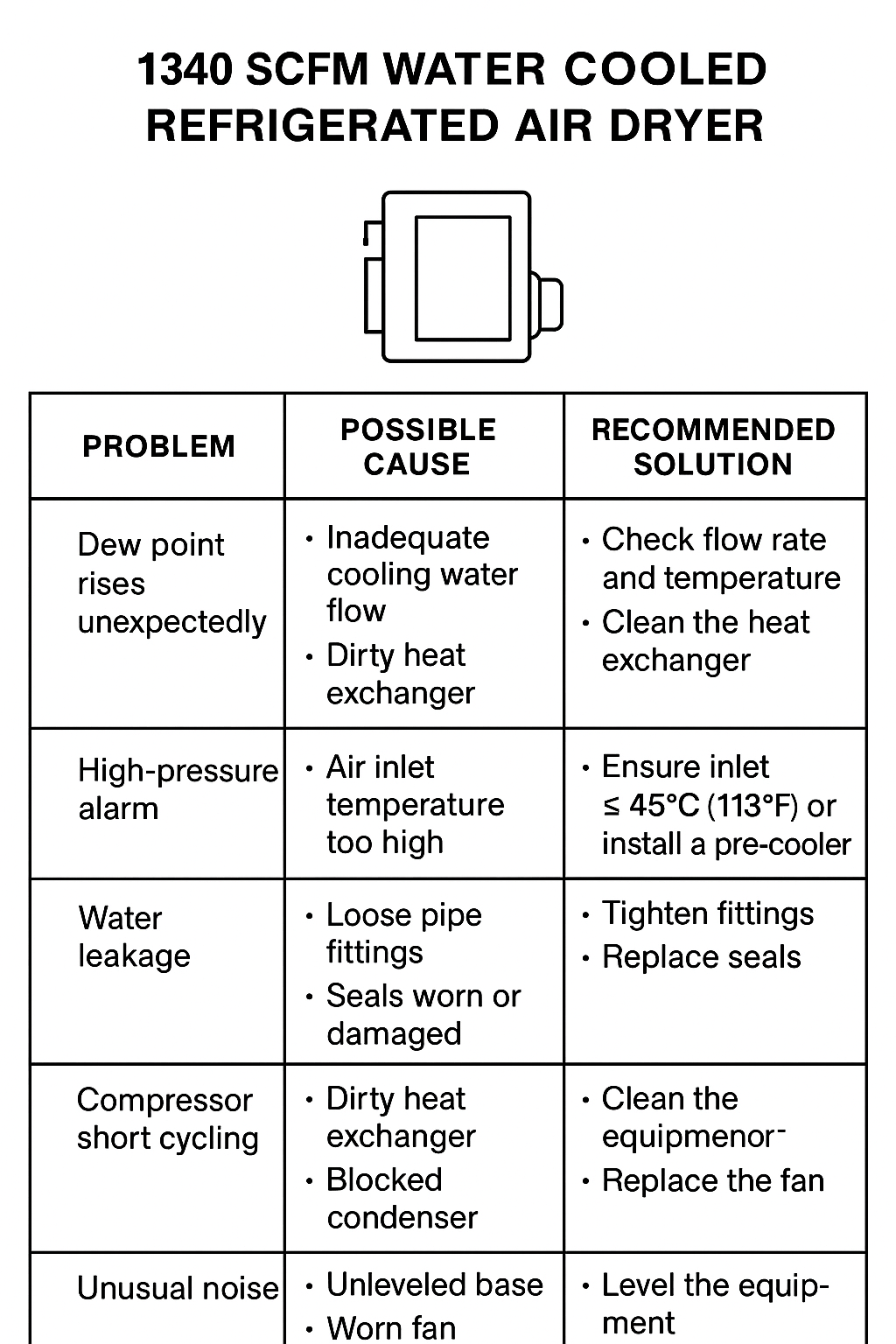
Troubleshooting High Outlet Dew Point
If the pressure dew point begins to rise, possible causes include:
- Airflow above rated capacity
- Excessive inlet air temperature
- Cooling-water temperature too high
- Insufficient cooling-water flow
- Fouled water-cooled condenser
- Drain malfunction
- Heat exchanger contamination
- Refrigeration-system fault
Do not immediately assume low refrigerant.
Start by comparing current airflow, air temperature, cooling-water conditions, and condensate drainage with normal operating data.
High Refrigeration Pressure
A high-pressure alarm can indicate inadequate heat rejection.
Potential causes include:
- Cooling-water temperature above the required limit
- Insufficient water flow
- Restricted water circuit
- Scale or fouling inside the condenser
- Incorrect valve position
- Refrigeration-system problems
Correct the underlying condition rather than repeatedly resetting the protection.
Cooling-Water Leakage
If water leakage occurs, identify its source before returning the dryer to normal service.
Inspect:
- Pipe connections
- Valves
- Flanges
- Seals
- Heat exchanger
- Drain and surrounding piping
External fitting leakage and internal heat-exchanger leakage are very different problems and should not be treated as equivalent.
Abnormal Compressor Cycling
Frequent refrigeration compressor cycling may result from changing compressed-air load, unstable cooling-water conditions, control settings, refrigeration-system issues, or other operating factors.
Check actual system conditions before replacing components.
The WH Series also uses load-responsive compressor control on applicable models to improve adaptation to fluctuating compressed-air demand.
Where Is a High-Capacity Water-Cooled Dryer Used?
A 1340 SCFM water-cooled dryer can serve centralized compressed air systems across a range of industries.
Heavy and General Manufacturing
Large production facilities often operate many pneumatic machines simultaneously.
In automotive and general manufacturing, refrigerated drying can support pneumatic controls, assembly equipment, air tools, and automated machinery.
Petrochemical and Chemical Processing
Compressed air may be used for instrumentation, pneumatic valves, and general utility service.
For petrochemical and chemical processing, dryer selection should reflect the required dew point, final air quality, and site-specific process requirements.
Food and Beverage Production
In food and beverage applications, compressed air can serve packaging equipment, pneumatic machinery, and other production processes.
Filtration and drying requirements should be selected according to how the compressed air is used and the required final air quality.
Power and Utility Facilities
Large utility plants can have substantial demand for instrument and service air.
For power and utility applications, a water-cooled configuration can be practical where centralized cooling-water infrastructure is already available.
Is a 2–10°C Dew Point Dry Enough?
A pressure dew point of 2–10°C is appropriate for many general industrial compressed air applications.
However, refrigerated drying is not intended to replace adsorption drying where extremely low dew points are required.
Applications involving freezing ambient conditions, very moisture-sensitive production processes, or stringent instrument-air specifications may require an adsorption dryer.
The required pressure dew point should therefore be defined before selecting drying technology.
Avoid Assuming ISO 8573-1 Class From the Dryer Alone
A refrigerated dryer, pre-filter, and post-filter do not automatically guarantee a particular complete ISO 8573-1 compressed air purity class.
Final air quality depends on multiple parameters, including:
- Particle concentration
- Water content or pressure dew point
- Oil concentration
- Filter performance
- Compressor type
- System configuration
- Operating conditions
If a specific air-quality class is required, the complete treatment system should be designed and verified against that requirement.
Long-Term Reliability Depends on Operating Conditions
The useful life of a refrigerated dryer cannot be predicted accurately from a single generic number.
Long-term reliability depends on:
- Operating hours
- Airflow loading
- Inlet temperature
- Cooling-water quality
- Cooling-water stability
- Maintenance
- Installation quality
- Refrigeration-system condition
- Electrical condition
Maintaining the dryer within its specified operating envelope and tracking changes in performance provides a more reliable maintenance strategy than relying solely on fixed service intervals.
Reliable Moisture Control for High-Flow Industrial Systems
The 1340 SCFM Water-Cooled Refrigerated Air Dryer provides a practical solution for high-flow compressed air systems where cooling-water infrastructure is available.
Proper installation, stable cooling-water supply, effective condensate drainage, suitable filtration, clean heat exchangers, and low system pressure drop are all essential to achieving reliable 2–10°C pressure dew-point performance.
For model selection or project-specific cooling-water requirements, contact Lingyu with your airflow, operating pressure, inlet temperature, cooling-water temperature and pressure, and required outlet pressure dew point.