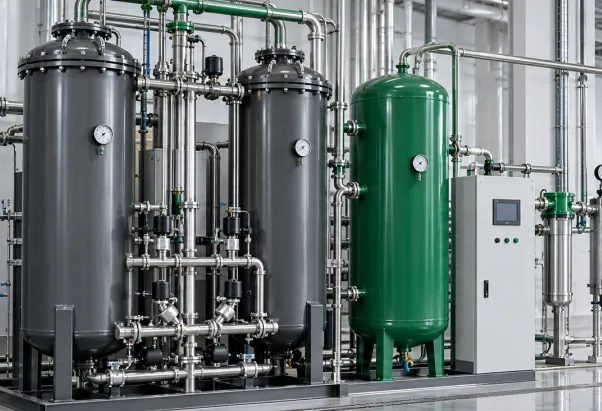
Your PSA nitrogen generator is switching between adsorption towers as usual. The pressure gauges appear normal, but the nitrogen purity remains below the required specification.
At this point, it may be tempting to conclude that the carbon molecular sieve (CMS) has reached the end of its service life and needs replacement.
However, low nitrogen purity does not necessarily mean the carbon molecular sieve has failed.
Excessive nitrogen demand, inaccurate oxygen measurements, unstable feed-air conditions, inadequate compressed air treatment, or malfunctioning valves can produce similar symptoms.
Replacing the CMS before checking these factors may increase maintenance costs without fixing the underlying problem.
A more effective approach is to follow a systematic diagnostic sequence that starts with measurement verification and ends with the condition of the adsorbent.
This article explains six practical checks to perform before replacing carbon molecular sieve in a PSA nitrogen generator, with particular attention to nitrogen flow, oxygen concentration, feed-air quality, and adsorption tower operation.
For a broader overview of potential faults, see Lingyu’s guide to the common causes of impure nitrogen from PSA generators.
1. Verify the Oxygen Analyzer Before Assuming Nitrogen Purity Is Low
The first question is whether the nitrogen is actually below specification or the measurement is inaccurate.
Most PSA nitrogen generators monitor product quality using an oxygen analyzer. If the analyzer or its sampling system is faulty, the displayed oxygen concentration may not represent the actual gas quality.
This is particularly important for high-purity nitrogen systems, where even a small amount of oxygen contamination can significantly affect the reading.

Check Analyzer Calibration and Sampling Conditions
Review the following items:
Oxygen analyzer calibration status.
Sensor condition and diagnostic alarms.
Sampling pressure and flow rate.
Condition of sampling tubes and fittings.
Possible leaks or ambient air ingress.
Suitability of the analyzer for the required oxygen measurement range.
Where appropriate, verify the reading using a suitable certified calibration gas or a reliable reference instrument.
Follow the analyzer manufacturer’s instructions for calibration and sampling.
Compare Oxygen Readings at Different Locations
If suitable sampling points are available, compare the readings at:
The PSA nitrogen generator outlet.
The nitrogen buffer tank outlet.
The final point of use.
These measurements can help identify the section where the gas quality changes.
For example, if nitrogen meets specification at the generator outlet but shows excessive oxygen at the point of use, the adsorption towers may not be responsible.
Instead, investigate downstream sampling connections, pipelines, valves, and potential air ingress.
Inspection priority: Confirm the oxygen measurement and sampling integrity before making changes to the generator.
2. Check Actual Nitrogen Flow When Purity Drops
One of the most useful diagnostic clues is whether nitrogen purity decreases when consumption increases.
For the same PSA nitrogen generator, the maximum nitrogen production capacity generally becomes lower as the required purity increases.
This means a generator cannot necessarily deliver its maximum advertised flow at every purity setting.

Why Excessive Flow Affects Nitrogen Purity
Several operating changes may increase nitrogen demand:
Additional nitrogen-consuming equipment.
Higher consumption at existing process points.
Multiple machines operating simultaneously.
Increased valve openings.
Sudden peak demand.
Insufficient buffer capacity for short-term fluctuations.
If the actual withdrawal rate exceeds the generator’s specified capacity at the required purity, oxygen breakthrough may increase and the nitrogen purity may fall.
Measure Flow, Pressure, and Oxygen Together
Record three parameters during operation:
Nitrogen flow rate + nitrogen outlet pressure + oxygen concentration
Compare these values under normal and high-demand conditions.
If oxygen concentration increases when nitrogen flow rises, then decreases when demand returns within the rated operating range, excessive consumption is a strong possibility.
This observation does not conclusively establish that the CMS is undamaged. However, it suggests that capacity matching and peak demand should be investigated before adsorbent replacement.
What Should You Do If Flow Is Too High?
Possible corrective actions include:
Reducing unnecessary nitrogen consumption.
Reviewing simultaneous demand peaks.
Checking whether buffer storage is adequate.
Comparing actual flow with the generator’s performance curve.
Reassessing the system capacity if production demand has permanently increased.
When changing the target purity, always refer to the manufacturer’s corresponding nitrogen capacity data.
Inspection priority: If purity recovers when flow decreases, investigate demand and capacity before replacing CMS.
3. Verify Feed-Air Pressure and Temperature at the Generator Inlet
PSA nitrogen generation depends on repeated adsorption and regeneration cycles.
Carbon molecular sieve provides selective gas separation under the pressure and flow conditions specified for the system.
If the feed-air conditions change, the generator’s separation performance may also change.

Check Dynamic Inlet Pressure
Do not rely only on the pressure setting displayed by the air compressor.
The important measurement is the actual pressure at the PSA nitrogen generator inlet while the machine is operating.
Pressure may decrease between the compressor and nitrogen generator because of:
Excessive filter differential pressure.
Pressure loss through an air dryer.
Undersized connecting pipelines.
Partially closed valves.
Compressed air leakage.
Insufficient air compressor capacity.
A pressure gauge that looks normal at one moment may not reveal fluctuations during high demand or tower switching.
If suitable instruments are available, review the inlet pressure trend over several PSA cycles.
For detailed diagnosis of inadequate supply pressure, see our PSA nitrogen generator low-pressure troubleshooting guide.
Confirm Feed-Air Temperature
Inlet air temperature also affects PSA separation performance.
Higher-than-specified feed-air temperatures may reduce the achievable nitrogen output or affect purity.
Check the actual inlet temperature and compare it with the manufacturer’s operating limits.
The temperature and pressure requirements must be evaluated together with nitrogen demand and the specified product purity.
Inspection priority: Check the conditions at the nitrogen generator inlet, not only at the air compressor outlet.
4. Inspect Compressed Air Pretreatment Before Replacing CMS
Clean, dry compressed air is essential for reliable PSA nitrogen generation.
The system’s feed-air quality must meet the nitrogen generator manufacturer’s requirements for moisture, oil, and particulate contamination.
If liquid water, oil aerosols, or excessive particles enter the adsorption towers, they may interfere with separation performance and contaminate or damage the CMS.
Severe contamination may lead to lasting deterioration.

Check the Compressed Air Dryer
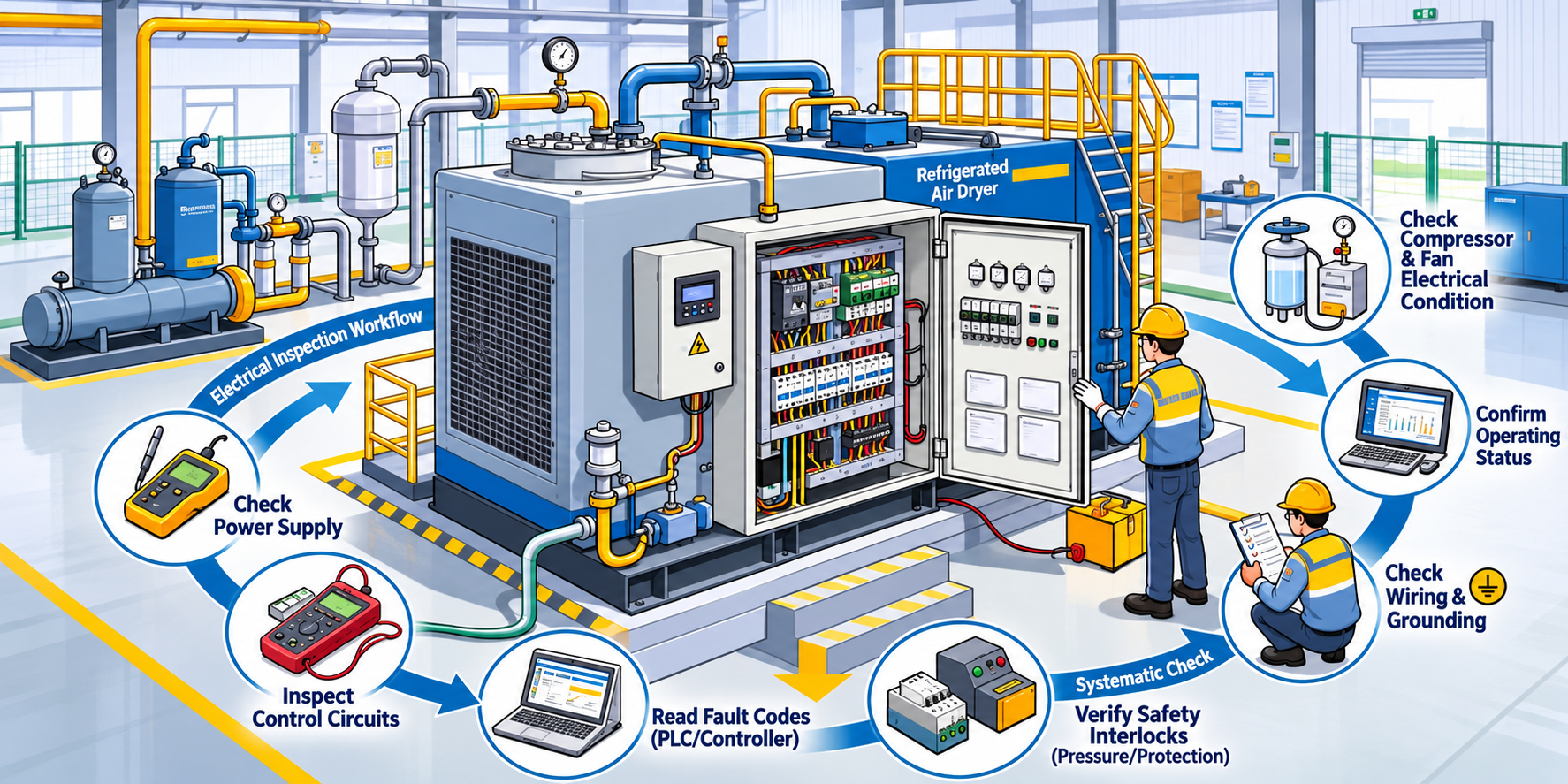
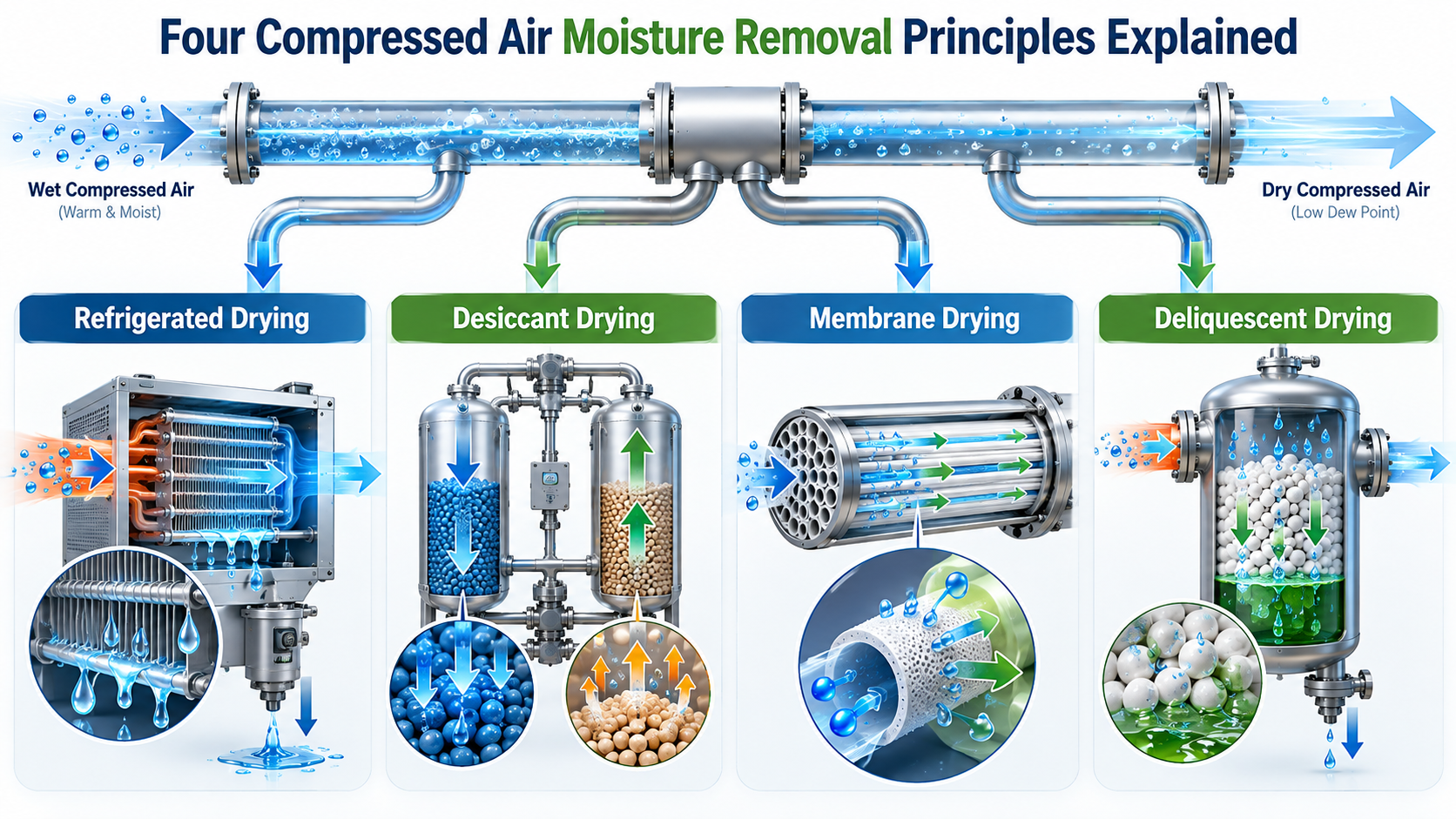
Inspect the upstream refrigerated or desiccant air dryer.
Key checks include:
Pressure dew point.
Dryer operating status.
Abnormal pressure loss.
Condensate drainage.
Water carryover.
Bypass valve position.
The required pressure dew point is specific to the nitrogen generator and its operating conditions.
Do not assume every PSA system uses the same air-drying specification.
Check Filters, Drains, and Oil Contamination
Inspect the filtration system for:
Excessive filter differential pressure.
Saturated or damaged filter elements.
Oil aerosol carryover.
Condensate accumulation.
Automatic drain malfunctions.
Incorrectly installed or bypassed filtration stages.
A blocked filter can reduce feed-air pressure, while insufficient filtration can allow contaminants to reach the CMS.
Both problems can reduce nitrogen production performance.
For suitable compressed-air pretreatment configurations, see Lingyu’s precision compressed air filters.
Why Pretreatment Comes Before CMS Replacement
If the pretreatment problem remains unresolved, new CMS may be exposed to the same moisture or oil contamination as the old material.
This can shorten the effective service life of the replacement bed.
Inspection priority: Restore the required feed-air quality before evaluating or replacing the adsorbent.
5. Check PSA Valves, Regeneration Exhaust, and Downstream Piping
A PSA nitrogen generator can appear to switch normally while one or more valves are leaking or failing to operate completely.
The correct adsorption and regeneration cycle depends on the coordinated operation of the valve system.
Inspect the Switching Sequence
Depending on the generator design, inspect the operating condition of:
Feed-air inlet valves.
Pressure equalization valves.
Exhaust valves.
Product outlet valves.
Check valves.
Pneumatic actuators and solenoid valves.
A valve that closes incompletely or moves at the wrong time can disturb pressure equalization, adsorption, or regeneration.
Compare controller indications with the actual pressure trends of both adsorption towers.
A normal switching indication on the display does not necessarily prove that every valve seals correctly.
Check the Exhaust Silencer and Regeneration Pressure
A blocked exhaust silencer or restricted exhaust line may prevent proper depressurization during regeneration.
Look for abnormal changes in:
Exhaust sound.
Tower pressure during regeneration.
Depressurization behavior.
Switching sequence.
Nitrogen purity trends.
Exhaust noise is only one diagnostic clue and must be evaluated alongside other operating data.
Do not dismantle valves or exhaust components while the system remains pressurized.
Inspect the Nitrogen Buffer Tank and Distribution Lines
If nitrogen purity is acceptable at the generator outlet but unacceptable at a downstream point, inspect the buffer tank and distribution network.
Possible causes include incorrect connections, air ingress, residual air following maintenance, inadequate line purging, or contamination introduced through other process equipment.
For high-purity applications, consider the suitability of flexible tubing and sampling line materials.
Some materials may allow oxygen permeation, making them unsuitable for demanding low-oxygen applications.
Inspection priority: Distinguish gas quality problems inside the PSA generator from contamination introduced after the product outlet.
6. Evaluate Carbon Molecular Sieve Only After Excluding Other Causes
Carbon molecular sieve is the core separation material in a PSA nitrogen generator.
However, low nitrogen purity alone does not justify immediate replacement.
A CMS performance investigation becomes appropriate after confirming that:
The oxygen analyzer is accurate.
Sampling conditions are reliable.
Nitrogen demand does not exceed the rated flow.
Feed-air pressure and temperature meet the required conditions.
Air drying and filtration are operating correctly.
Valve switching and regeneration are normal.
Downstream contamination has been excluded.
If purity remains below specification under verified operating conditions, the adsorption material should then be assessed.
Possible Signs of CMS Deterioration
Supporting evidence may include:
Persistent purity loss under stable, rated conditions.
Black CMS dust appearing downstream.
Unusual adsorption tower pressure behavior.
Evidence of moisture or oil contamination.
Adsorbent settlement or excessive particle wear.
Reduced separation performance confirmed through appropriate testing.
Actual CMS life depends on operating conditions, compressed-air quality, mechanical stability, and maintenance.
There is no universal replacement interval suitable for every PSA nitrogen generator.
If powdering or structural damage is suspected, refer to our separate guide on PSA nitrogen generator adsorbent powdering and prevention.
Inspection or replacement inside an adsorption vessel must follow the equipment manufacturer’s approved shutdown, isolation, depressurization, and pressure-vessel maintenance procedures.
Inspection priority: Replace CMS only when the diagnostic evidence supports adsorbent deterioration and the underlying cause has been addressed.
PSA Nitrogen Purity Troubleshooting Checklist
Use the following table to organize site inspections and maintenance records.
| Symptom | First Check | Possible Direction |
|---|---|---|
| Analyzer indicates low purity, but equipment appears normal | Oxygen analyzer and sampling system | Calibration error or sampling contamination |
| Purity falls when nitrogen consumption increases | Actual nitrogen flow | Excessive demand or insufficient buffer capacity |
| Purity changes with inlet pressure | Feed-air supply | Air compressor capacity, filters, dryer pressure drop, piping |
| Purity declines after a pretreatment fault | Air dryer and filters | Moisture, oil, or particulate contamination |
| Purity fluctuates during tower switching | Valves and regeneration | Internal valve leakage or incomplete depressurization |
| Generator outlet purity is normal, but the point of use is not | Buffer tank and distribution | Downstream contamination or sampling differences |
| Purity remains low under verified operating conditions | CMS condition | Adsorbent deterioration or internal bed problems |
Recommended Troubleshooting Sequence
1. Verify oxygen analyzer readings → 2. Check actual nitrogen flow → 3. Verify feed-air conditions → 4. Inspect pretreatment → 5. Check valves and piping → 6. Evaluate CMS
Following this order helps avoid unnecessary adsorption tower disassembly and improves the likelihood of identifying the real cause.
Safety Considerations During PSA Nitrogen Generator Inspection
Nitrogen is not toxic, but it can displace oxygen and create an oxygen-deficient atmosphere.
During troubleshooting:
Maintain adequate ventilation.
Follow the facility’s oxygen-deficiency safety procedures.
Use appropriate atmospheric monitoring where required.
Avoid venting nitrogen into poorly ventilated enclosed areas.
Isolate and depressurize equipment before opening pressurized components.
Follow the manufacturer’s instructions when inspecting adsorption vessels.
Never assume that normal pressure readings mean the surrounding atmosphere is safe.
Conclusion: Low Nitrogen Purity Does Not Automatically Mean CMS Failure
When a PSA nitrogen generator cannot reach its specified purity, carbon molecular sieve replacement should not be the first response.
Start by confirming the oxygen analyzer reading, then examine actual nitrogen consumption and the feed-air conditions.
Next, verify the air dryer, filters, valves, exhaust system, and downstream distribution network.
Only when these factors meet the required conditions and the purity remains consistently low should the condition of the CMS become the primary focus.
The goal is to identify the actual cause of low nitrogen purity before committing to major equipment maintenance.
Need Technical Support for Your PSA Nitrogen Generator?
Lingyu provides industrial PSA nitrogen generator systems for different nitrogen purity and flow requirements.
To support a technical assessment, prepare the generator model, required purity, actual nitrogen flow, oxygen readings, feed-air pressure and temperature, and any relevant alarm history.
Contact Lingyu for PSA nitrogen generator technical support.
Does your nitrogen purity fall only when consumption increases, or does it remain below specification even at normal flow?
These two symptoms suggest different diagnostic starting points.