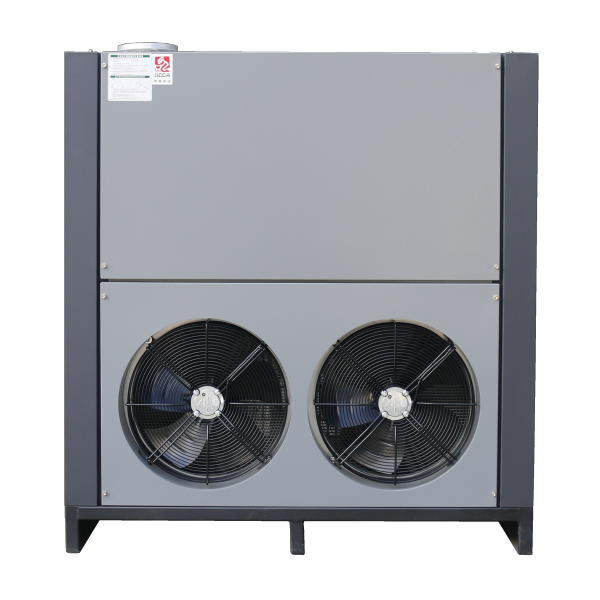
The PD Series Plate Heat Exchanger Refrigerated Air Dryer is designed for compressed-air systems that require compact construction, stable moisture removal, low pressure drop, and efficient heat transfer.
Its key feature is an integrated 3-in-1 aluminum-alloy plate heat exchanger that combines the evaporator, air-to-air heat exchanger, and water separator in one compact assembly. Compared with a conventional shell-and-tube configuration, this integrated design reduces equipment size while improving heat-transfer efficiency.
This article focuses specifically on the PD Series structure, operating conditions, energy-saving characteristics, air-cooled and water-cooled configurations, and model selection.
What Is the 3-in-1 Plate Heat Exchanger?
The core of the PD Series is its integrated plate heat exchanger.
Instead of arranging the evaporator, air-to-air heat exchanger, and moisture separator as completely separate assemblies, the PD design integrates these functions into a compact aluminum-alloy heat-exchange structure.
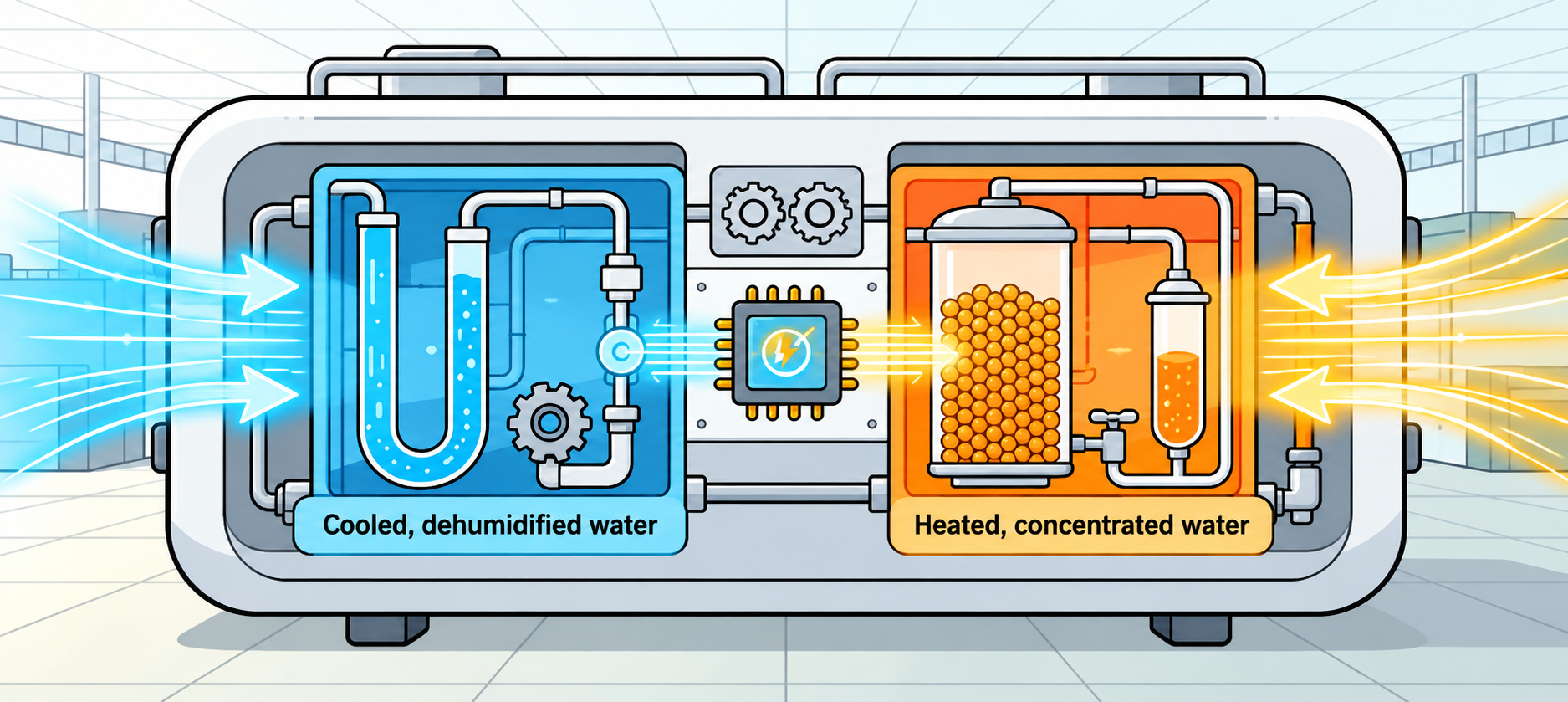
Incoming compressed air first exchanges heat with the cold dried air leaving the refrigeration section. This reduces the temperature of the incoming air before it reaches the evaporator.
The pre-cooled air then enters the refrigeration section, where additional cooling causes water vapor to condense. The integrated separation structure removes the condensed liquid before the dried compressed air is reheated by the incoming air stream.
The temperature difference between inlet and outlet air can be maintained within approximately 10°C while providing stable pressure dew point performance.
Why the Integrated Design Matters
The advantage of the PD Series is not simply that three functions are placed inside one component. The integrated design affects heat recovery, equipment footprint, and thermal performance.
Heat Recovery
Cold dry compressed air leaving the evaporator is used to pre-cool the warmer incoming air.
This internal heat exchange reduces the refrigeration load because part of the cooling requirement is handled before the incoming air reaches the evaporator.
Compact Construction
Integrating several heat-exchange functions reduces the number of separate heat-exchanger assemblies and associated piping.
This allows the dryer to achieve a more compact footprint compared with some conventional shell-and-tube configurations.
Reduced Thermal Loss
A compact heat-exchange path can reduce unnecessary thermal losses between separate components and make better use of the available refrigeration capacity.
These characteristics position the PD Series primarily as an integrated plate heat exchanger refrigerated dryer rather than simply another conventional refrigerated air dryer.
Energy Consumption
Energy efficiency is one of the distinguishing characteristics of the PD Series.
The 3-in-1 plate heat exchanger design can reduce overall energy consumption by approximately 20–30% compared with the referenced conventional configuration. This benefit comes primarily from more efficient internal heat exchange.
When incoming compressed air is pre-cooled by outgoing dry air, the refrigeration compressor has less heat to remove in the evaporator. At the same time, the outgoing compressed air is reheated before entering the downstream piping system.
Actual energy consumption still depends on operating conditions. Airflow, inlet temperature, operating pressure, ambient temperature, and cooling method all affect real system performance.
Standard Operating Conditions
The PD Series standard operating conditions are:
| Parameter | Specification |
|---|---|
| Applicable medium | Compressed air / non-corrosive air |
| Rated inlet pressure | 0.7 MPa |
| Operating pressure range | 0.6–1.6 MPa |
| Rated inlet temperature | 42°C |
| Maximum inlet temperature | ≤45°C |
| Full-load pressure drop | ≤0.015 MPa |
| Outlet pressure dew point | 2–10°C |
| Rated ambient temperature | 35°C |
| Ambient operating range | 2–40°C |
| Cooling method | Air-cooled / water-cooled optional |
These specifications differ from some other refrigerated dryer series, particularly AH high-inlet-temperature models and DD low-pressure-drop models. The distinction is important when selecting equipment for different operating conditions.
Pressure Dew Point Performance
Under standard operating conditions, the PD Series is designed to provide a pressure dew point of 2–10°C.
This range is suitable for many industrial compressed-air systems where the objective is to control downstream condensation without requiring the substantially lower dew points associated with adsorption dryers.
The PD Series also uses an electronic bypass valve to support stable refrigeration operation.
A lower numerical dew point should not automatically be considered better. The required dew point should be determined by the actual production process.
If a process requires a negative pressure dew point such as −20°C or −40°C, a refrigerated dryer alone generally does not provide the same treatment level, and another dryer configuration should be evaluated.
Pressure Drop
The PD Series specifies a full-load pressure drop of ≤0.015 MPa.
Pressure drop matters because every restriction between the compressor and the point of use consumes part of the system’s available pressure. A dryer with excessive resistance can contribute to a higher required compressor discharge pressure.
Pressure drop should therefore be evaluated together with the rest of the compressed-air treatment system, including piping, valves, receivers, and filters.
The PD Series provides relatively low pressure loss, but it should be distinguished from the DD Series, whose main product positioning places greater emphasis on ultra-low pressure drop.
Refrigerants and Refrigeration Stability
The PD Series uses R410A/R407C refrigerants and supports a maximum working pressure of up to 1.6 MPa.
The design also includes an enlarged condenser intended to improve refrigeration stability under higher inlet and ambient conditions.
Stable condenser performance matters because insufficient heat rejection can increase refrigeration pressures and reduce effective cooling capacity.
Correct installation therefore requires sufficient ventilation for air-cooled versions or suitable cooling-water conditions for water-cooled versions.
Intelligent Control and RS-485 Communication
The PD Series includes an intelligent controller for automatic operation and temperature display.
A standard RS-485 communication interface allows dryer operating information to be integrated into compatible monitoring or plant-control systems.
For centralized compressor stations, this makes the dryer easier to integrate into broader equipment monitoring and maintenance management.
Air-Cooled PD Series Technical Parameters
Representative air-cooled PD Series models are shown below.
| Model | Airflow | Power Supply | Total Power | Connection | Dimensions |
|---|---|---|---|---|---|
| LY-PD10A | 1.6 m³/min | 220 V / 50 Hz | 0.70 kW | RC1″ | 500×380×750 mm |
| LY-PD20A | 2.6 m³/min | 220 V / 50 Hz | 0.79 kW | RC1″ | 500×380×750 mm |
| LY-PD30A | 3.8 m³/min | 220 V / 50 Hz | 0.90 kW | RC1″–1½” | 520×450×920 mm |
| LY-PD50A | 6.5 m³/min | 220 V / 50 Hz | 1.20 kW | RC1″–1½” | 520×450×920 mm |
| LY-PD75A | 10.5 m³/min | 220 V / 50 Hz | 2.00 kW | RC2″ | 670×560×1060 mm |
| LY-PD100A | 13.5 m³/min | 220 V / 50 Hz | 2.22 kW | RC2″ | 670×560×1060 mm |
| LY-PD120A | 17 m³/min | 220 V / 50 Hz | 2.80 kW | RC2″–2½” | 1200×700×1480 mm |
| LY-PD150A | 21.5 m³/min | 380 V / 50 Hz | 3.90 kW | DN80 | 1460×700×1480 mm |
| LY-PD200A | 28.5 m³/min | 380 V / 50 Hz | 4.90 kW | DN80 | 1480×740×1600 mm |
| LY-PD300A | 37 m³/min | 380 V / 50 Hz | 7.80 kW | DN100 | 1640×840×1750 mm |
| LY-PD400A | 45 m³/min | 380 V / 50 Hz | 8.80 kW | DN100 | 1640×840×1750 mm |
| LY-PD500A | 55 m³/min | 380 V / 50 Hz | 10.10 kW | DN125 | 1740×840×1750 mm |
| LY-PD600A | 65 m³/min | 380 V / 50 Hz | 10.10 kW | DN125 | 1890×840×1803 mm |
| LY-PD800A | 85 m³/min | 380 V / 50 Hz | 13.70 kW | DN125 | 2220×950×2063 mm |
The air-cooled range shown above extends to 85 m³/min, while water-cooled PD models extend to 165 m³/min.
For detailed equipment information, users can review the 3-in-1 plate heat exchange refrigerated air dryer product page.
Air-Cooled vs. Water-Cooled PD Configurations
The PD Series supports both air-cooled and water-cooled configurations.
Air-cooled models reject refrigeration heat directly into the surrounding air and can simplify installation where plant cooling water is unavailable.
Water-cooled models use a separate cooling-water circuit and can be useful where a facility already has reliable cooling-water infrastructure or where heat rejection into the equipment room is undesirable.
The water-cooled range extends through the LY-PD1600W model at 165 m³/min.
Selection should therefore consider not only airflow but also available utilities and the installation environment.
Heat-Exchange Materials and Application Considerations
The PD Series uses aluminum alloy and/or stainless-steel heat-exchange construction intended to reduce rust, debris, and secondary contamination.
The product configuration identifies pharmaceutical and food applications as suitable areas for this material approach. However, actual compressed-air quality requirements should still be evaluated at the system level rather than treating the dryer alone as a complete hygienic or contamination-control solution.
For an industry-specific example, users can review Lingyu’s food and beverage compressed-air solutions.
Filtration and Complete Air Treatment
A refrigerated dryer primarily removes moisture through cooling and condensation.
Oil aerosols and solid particles may still require separate filtration depending on the required compressed-air quality.
For that reason, a PD Series dryer can be integrated with appropriate precision compressed-air filters before or after the dryer according to the treatment requirement.
This keeps the role of each component clear: the plate heat exchanger dryer handles moisture removal, while filtration addresses contaminants requiring dedicated filter media.
How to Select a PD Series Dryer
Correct selection should consider more than nominal compressor airflow. The main project data to confirm are actual airflow, operating pressure, maximum inlet temperature, ambient temperature, required pressure dew point, preferred cooling method, available installation space, and expected operating hours.
The distinction between inlet temperature and airflow is particularly important. The PD Series is rated at 42°C inlet temperature with a maximum of 45°C. If the actual application routinely receives significantly hotter compressed air, a high-inlet-temperature refrigerated dryer may be more appropriate instead of oversizing the PD Series.
Likewise, if ultra-low pressure drop is the dominant requirement, the DD Series should be evaluated separately, while applications with highly variable load and strong energy-saving priorities may justify evaluating a variable-frequency configuration.
This gives each refrigerated dryer family a clear role instead of treating all models as interchangeable.
Maintenance Considerations
Routine maintenance should focus on preserving heat-transfer efficiency, condensate removal, and refrigeration stability.
The condition of the condenser, evaporator, separator, drain system, refrigerant circuit, and upstream filters should be inspected according to operating conditions.
A blocked condenser or poor cooling-water condition can reduce heat rejection, while an ineffective condensate drain can allow separated water to remain inside the system.
Maintenance should therefore be based on actual operating performance rather than only a fixed service interval.
Requesting a PD Series Configuration
Before requesting a quotation or technical proposal, provide the actual airflow, operating pressure, inlet temperature, ambient conditions, required pressure dew point, preferred cooling method, and any special material or installation requirements.
For non-standard conditions or capacities, users can use Lingyu’s contact page for technical configuration support.
Conclusion
The PD Series 3-in-1 Plate Heat Exchanger Refrigerated Air Dryer combines the evaporator, air-to-air heat exchanger, and water separator in an integrated plate heat exchanger assembly.
Its key characteristics include a 2–10°C pressure dew point, ≤0.015 MPa full-load pressure drop, approximately 20–30% lower overall energy consumption compared with the referenced conventional configuration, 0.7 MPa rated inlet pressure, 0.6–1.6 MPa operating pressure, 42°C rated inlet temperature, ≤45°C maximum inlet temperature, 2–40°C ambient range, R410A/R407C refrigerants, air- or water-cooled configurations, and RS-485 communication.
For correct selection, users should focus on actual airflow, inlet temperature, system pressure, cooling method, required dew point, and installation conditions rather than choosing a dryer from nominal capacity alone.