A refrigerated air dryer not starting is a common but potentially disruptive problem in industrial compressed air systems.
When the dryer is unable to operate, moisture removal may be compromised. Depending on system conditions and whether backup drying capacity is available, this can increase the risk of condensate entering downstream piping and equipment, potentially affecting pneumatic components, instruments, production processes, and product quality.
The cause is not always the refrigeration compressor itself.
A no-start condition can originate from the electrical supply, control circuit, safety protection devices, refrigeration system, compressor starting components, external interlocks, or other auxiliary devices.
For maintenance personnel, the most effective approach is therefore to troubleshoot the system in a logical sequence:
Electrical and control system → Refrigeration protection system → Compressor and interlock conditions
This guide explains how to work through each stage and identify the likely root cause without immediately disassembling the dryer.
Safety Note: Refrigerated air dryers contain electrical circuits, pressurized compressed air, and refrigerant circuits. Electrical and refrigeration work should only be carried out by appropriately trained and qualified personnel in accordance with the equipment manufacturer’s instructions and applicable regulations.
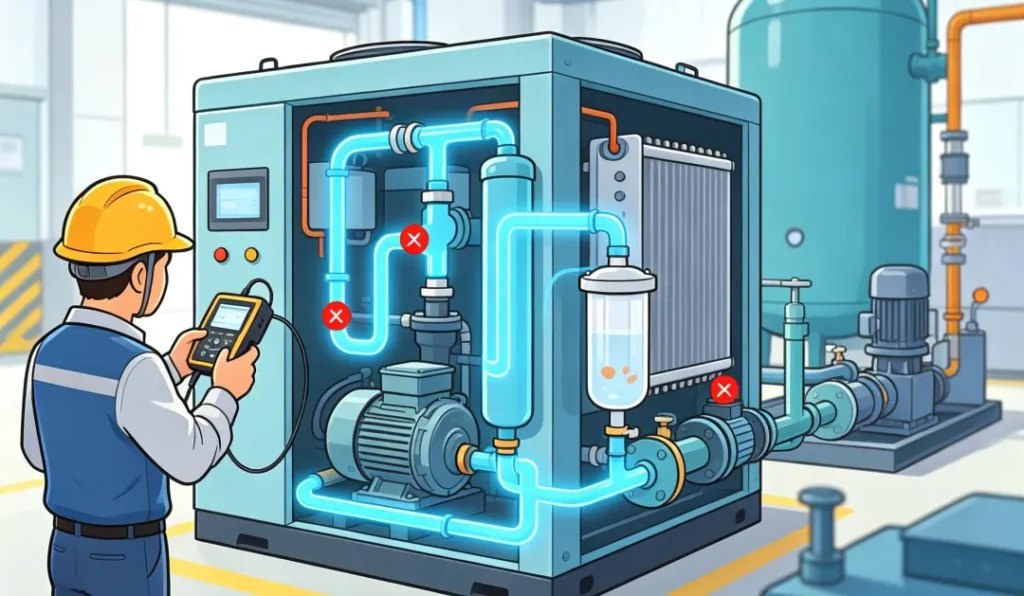
Why Does a Refrigerated Air Dryer Fail to Start?
Before troubleshooting individual components, it helps to understand what must happen before a typical refrigerated dryer is allowed to operate.
Depending on the design, the control system may check several conditions before permitting compressor operation, including:
- incoming power supply;
- phase condition;
- overload protection;
- high- and low-pressure protection;
- temperature controls;
- compressor protection;
- external start/stop signals;
- PLC or controller alarms;
- condensate drain or other auxiliary alarms.
If one of these conditions is outside the permitted operating range, the dryer may remain stopped even though the refrigeration compressor itself is mechanically sound.
Understanding the refrigeration cycle and control logic makes troubleshooting considerably easier. For additional background, see how a refrigerated air dryer works.
Step 1: Check the Electrical Supply and Control Circuit
Electrical and control faults should be among the first areas investigated when a refrigerated air dryer will not start.
Troubleshooting should follow appropriate lockout/tagout procedures and the electrical schematic supplied with the dryer.
1. Verify the Incoming Power Supply
First, confirm that the dryer is receiving the correct electrical supply specified on its nameplate.
A qualified technician should check:
- supply voltage;
- phase condition on three-phase equipment;
- circuit breaker or fuse status;
- loose or damaged terminals;
- disconnected wiring;
- signs of overheating;
- abnormal voltage drop.
Do not assume that every refrigerated dryer operates on the same voltage. Power requirements vary according to model, capacity, market, and electrical configuration.
If the measured voltage is outside the manufacturer’s allowable range, identify and correct the supply problem before repeatedly attempting to restart the dryer.
For three-phase equipment, phase loss, phase imbalance, or an incorrect phase sequence may also trigger protective devices on dryers equipped with the corresponding monitoring functions.
2. Check Protective Devices
Next, inspect the protection circuit.
Depending on the dryer design, this may include:
- overload relays;
- motor protection devices;
- high-pressure switches;
- low-pressure switches;
- phase protection relays;
- temperature protection;
- compressor internal protection;
- fuses or miniature circuit breakers.
A tripped protection device is normally a symptom that requires investigation, not simply a component that should be reset repeatedly.
For example, an overload trip may be associated with excessive current, poor heat dissipation, abnormal supply conditions, or a compressor-related problem.
A high-pressure trip may be associated with inadequate condenser heat rejection, while a low-pressure protection event can have several possible causes within the refrigeration circuit.
Always determine why the protection was activated before returning the dryer to service.
3. Inspect Contactors, Relays, and Control Components
After safely isolating the electrical supply, inspect the control panel for obvious abnormalities.
Check for:
- damaged contactor coils;
- burned or severely worn contacts;
- loose terminals;
- damaged wiring;
- overheated components;
- faulty relays;
- controller alarms.
Measurements such as coil resistance and control voltage should only be performed by qualified personnel using the correct procedure and the manufacturer’s electrical documentation.
If the dryer uses a PLC or electronic controller, review the active alarm or fault code before clearing it.
Simply resetting an alarm without identifying its cause can make troubleshooting more difficult and may result in another shutdown immediately after restart.
Step 2: Check Refrigeration System Protection
A refrigerated air dryer removes moisture by cooling compressed air so that water vapor condenses and can be separated from the air stream.
To protect the refrigeration circuit, many dryers use high- and low-pressure controls. If refrigerant pressure moves outside the permitted operating range, the control circuit may prevent compressor operation.
1. Check High- and Low-Side Refrigerant Pressure
Refrigerant pressure must be interpreted according to:
- refrigerant type;
- ambient temperature;
- system temperature;
- whether the compressor is running or stopped;
- condenser type;
- dryer design;
- manufacturer’s specified operating range.
For this reason, there is no single high-side or low-side pressure value that can be used as a universal pass/fail limit for every refrigerated air dryer.
When the refrigeration system has been off long enough to stabilize, high- and low-side pressures generally move toward equilibrium. The actual stabilized pressure depends strongly on the refrigerant and temperature.
If the high-pressure protection has activated, possible causes can include:
- a dirty or blocked condenser;
- condenser fan failure;
- inadequate ventilation;
- excessive ambient temperature;
- restricted cooling-water flow on water-cooled units;
- refrigerant overcharge;
- other refrigeration circuit abnormalities.
If low-pressure protection has activated, possible causes may include:
- refrigerant loss;
- refrigerant flow restrictions;
- expansion or metering device problems;
- abnormal evaporator conditions;
- control-related faults.
Low refrigerant pressure should therefore not automatically be diagnosed as a refrigerant leak.
For a more detailed diagnosis of this specific condition, see causes of abnormal refrigerant low pressure in a refrigerated air dryer.
2. Check Whether a Pressure Switch Requires Manual Reset
Some refrigeration pressure switches automatically reset when operating conditions return to an acceptable range, while others may require manual reset.
If the dryer uses a manual-reset pressure switch, do not simply press the reset button and repeatedly restart the unit.
First identify why the pressure protection was activated.
For example, if a high-pressure trip was caused by a blocked condenser or failed cooling fan, resetting the pressure switch without correcting the cooling problem is likely to result in another trip.
3. Inspect the Condenser and Cooling System
Because condenser performance directly affects refrigeration pressure, inspect the heat-rejection system whenever high-pressure protection is suspected.
For an air-cooled dryer, check:
- condenser cleanliness;
- airflow obstruction;
- cooling fan operation;
- fan rotation;
- ventilation around the dryer;
- ambient operating conditions.
For a water-cooled dryer, check:
- cooling-water supply;
- inlet water temperature;
- water flow;
- fouling or scaling;
- valve condition.
Condenser cleaning should be included in a suitable refrigerated compressed air dryer maintenance program.
Step 3: Check the Refrigeration Compressor and Starting Components
If the power supply and external protection circuits are normal but the refrigeration compressor still does not start, the compressor circuit requires further investigation.
1. Check the Compressor Starting Circuit
The exact starting arrangement depends on the compressor and dryer design.
Depending on the equipment, technicians may need to inspect:
- contactors;
- start or run capacitors;
- start relays;
- motor protection devices;
- compressor terminals;
- control voltage.
A swollen or leaking capacitor is an obvious sign of failure, but visual inspection alone is not sufficient in every case.
Where applicable, a qualified technician can measure capacitance and compare the result with the component specification.
Three-phase compressors use different starting arrangements and should be diagnosed according to the electrical schematic rather than assuming that a capacitor is present.
2. Determine Whether the Compressor Is Electrically or Mechanically Faulty
If power reaches the compressor but it fails to run, possible causes can include:
- internal motor protection;
- winding faults;
- locked rotor or mechanical seizure;
- incorrect supply voltage;
- phase-related faults;
- damaged starting components.
Hermetic refrigeration compressors generally should not be opened or manually rotated as a routine field troubleshooting procedure.
Instead, technicians should use appropriate electrical measurements, operating data, manufacturer diagnostic procedures, and, where necessary, professional refrigeration service to determine whether compressor replacement is required.
Repeatedly energizing a compressor that cannot start can cause additional damage.
Step 4: Check System Interlocks and External Control Signals
Sometimes the refrigerated dryer itself is functional, but its controller is not receiving permission to start.
Industrial compressed air systems may use external interlocks to coordinate the air compressor, dryer, valves, monitoring system, and other equipment.
Depending on the installation, the dryer may receive:
- remote start/stop commands;
- compressor running signals;
- pressure signals;
- BMS or PLC commands;
- emergency-stop signals;
- permissive signals from other equipment.
Check the electrical schematic and control logic to determine which conditions must be satisfied before the dryer can start.
If a remote or interlocked system is used, verify both the signal itself and the device generating that signal.
Do not bypass a safety interlock merely to force the dryer to operate.
Step 5: Inspect the Condensate Drain and Auxiliary Alarms
A refrigerated dryer continuously separates condensate from compressed air, so reliable drainage is essential.
Depending on the dryer design, a drain fault or high-level alarm may be incorporated into the control system.
Inspect:
- electronic condensate drains;
- float drains;
- drain valves;
- drain piping;
- level sensors, where fitted;
- related alarm signals.
If a drain is blocked, isolate the equipment and safely depressurize the relevant section before servicing it.
Never remove a drain assembly or pressurized component while compressed air remains trapped inside.
Drain problems do not cause a no-start condition on every refrigerated dryer, so always confirm the actual control logic for the specific model rather than assuming the drain is part of the start permissive circuit.
Quick Troubleshooting Table: Refrigerated Air Dryer Will Not Start
| Symptom | Possible Cause | What to Check |
|---|---|---|
| Dryer completely unresponsive | No incoming power | Supply, breaker, fuse, wiring |
| Controller powered but compressor does not start | Control or protection circuit active | Alarm code, relay, contactor, overload |
| High-pressure alarm | Poor condenser heat rejection | Condenser, fan, ventilation, cooling water |
| Low-pressure alarm | Refrigeration circuit abnormality | Refrigerant condition, restrictions, controls |
| Compressor hums or trips | Starting or compressor problem | Voltage, capacitor where applicable, protection, compressor |
| Dryer starts after reset but trips again | Root cause still present | Record alarm and diagnose before another reset |
| Remote-controlled dryer will not start | Interlock signal missing | PLC/BMS, remote start, permissive signals |
| Drain-related alarm | Drain or level problem | Drain valve, blockage, sensor, wiring |
This table should be used as a diagnostic starting point rather than as a substitute for the manufacturer’s service manual.
What Not to Do When a Refrigerated Air Dryer Will Not Start
Several troubleshooting mistakes can turn a relatively simple fault into a more expensive failure.
Do Not Repeatedly Reset Protection Devices
High-pressure switches, overload protection, and other safety devices exist to protect equipment.
If a device trips repeatedly, identify the underlying cause.
Do Not Add Refrigerant Based Only on Low Pressure
Low suction pressure does not automatically prove that the refrigeration system is undercharged.
Before adding refrigerant, determine whether leakage, flow restriction, heat-load conditions, metering devices, or other factors are responsible.
If a refrigerant leak is suspected, the system should be inspected and repaired according to applicable refrigeration service procedures.
Do Not Overcharge the Refrigeration Circuit
Refrigerant charging should follow the manufacturer’s specified refrigerant type, charge quantity, and service procedure.
Adding excess refrigerant can create additional operating problems.
Do Not Bypass Safety Interlocks
Pressure switches, overload devices, temperature protection, and other safety controls should not be permanently bypassed to keep the dryer running.
Doing so can expose both personnel and equipment to unnecessary risk.
How to Reduce Refrigerated Air Dryer No-Start Failures
Preventive maintenance cannot eliminate every failure, but it can reduce many common causes of unexpected shutdowns.
A practical maintenance program should include:
Keep the Condenser Clean
Dust and debris reduce heat-transfer performance and can increase refrigeration condensing pressure.
Inspect and clean the condenser at an interval appropriate for the operating environment.
Facilities with high levels of airborne dust may require more frequent inspection than clean indoor installations.
Inspect Electrical Connections
Vibration and repeated thermal cycling can affect electrical connections over time.
During scheduled maintenance, qualified personnel should inspect terminals, contactors, relays, and wiring for looseness, overheating, or deterioration.
Monitor Dryer Operating Conditions
Useful operating data may include:
- inlet air temperature;
- ambient temperature;
- operating pressure;
- pressure dew point;
- refrigerant pressures where appropriate;
- alarm history;
- compressor operating behavior.
Tracking trends can help maintenance teams identify deterioration before it becomes an unexpected shutdown.
Pressure dew point is particularly useful for evaluating whether the dryer is actually achieving the required moisture-removal performance. See our guide to refrigerated air dryer dew point for more information.
Maintain Condensate Drainage
Inspect condensate drains according to operating conditions and manufacturer recommendations.
A drain that fails closed can allow condensate to accumulate, while a drain that fails open can waste compressed air.
Follow the Manufacturer’s Refrigeration Maintenance Requirements
Refrigeration compressors and circuits should be maintained according to the specific equipment design.
Do not assume that every hermetic refrigeration compressor requires routine field oil changes. Refrigerant, compressor construction, lubrication system, and service requirements vary by model.
A Better Troubleshooting Sequence
When a refrigerated air dryer will not start, avoid replacing components based on symptoms alone.
A more efficient sequence is:
1. Confirm power supply
↓
2. Read the controller alarm or fault history
↓
3. Check electrical protection devices
↓
4. Identify high- or low-pressure protection conditions
↓
5. Inspect condenser cooling and refrigeration conditions
↓
6. Check compressor starting and protection circuits
↓
7. Verify external interlocks and auxiliary alarms
↓
8. Correct the root cause
↓
9. Restart and verify dryer performance
This sequence helps maintenance personnel move from the simplest external causes toward more complex refrigeration and compressor faults.
FAQ: Refrigerated Air Dryer Not Starting
Why is my refrigerated air dryer not starting?
Common causes include loss of electrical power, tripped overload protection, high- or low-pressure protection, controller alarms, faulty contactors or relays, compressor starting problems, and missing external interlock signals.
The exact cause should be confirmed through systematic troubleshooting.
Why does my refrigerated air dryer have power but the compressor will not start?
If the controller is powered but the refrigeration compressor remains off, check active alarms, pressure switches, overload protection, contactors, control signals, compressor protection, and starting components where applicable.
Can low refrigerant cause a refrigerated air dryer not to start?
It can contribute to a low-pressure protection condition on some systems, but low refrigerant pressure alone does not prove that refrigerant charge is insufficient.
Leakage, restrictions, operating conditions, metering devices, and other refrigeration faults should also be investigated.
Why does the dryer start after reset and then stop again?
This often indicates that the protection device has been reset without correcting the underlying fault.
Record the alarm or trip condition and diagnose its cause before repeatedly restarting the equipment.
Should I add refrigerant if the low-pressure switch trips?
Not automatically.
The refrigeration circuit should first be diagnosed by qualified personnel. Refrigerant should only be charged using the correct refrigerant type and procedure specified for the dryer.
What should I do if the refrigeration compressor is locked?
Do not repeatedly attempt to restart it.
A qualified technician should evaluate the electrical supply, motor condition, protection devices, and compressor condition according to the manufacturer’s diagnostic procedure.
Conclusion
When a refrigerated air dryer is not starting, troubleshooting should follow a structured process rather than immediately assuming that the compressor has failed.
Start with the electrical supply and control circuit. Then check protection devices and refrigeration conditions, followed by compressor components, interlocks, and auxiliary alarms.
The key principle is simple:
Find the condition preventing startup → identify its root cause → correct the fault → restart → verify dryer performance.
Regular condenser cleaning, electrical inspection, operating-data monitoring, and condensate drain maintenance can also reduce the risk of unexpected downtime.
If no-start problems are becoming frequent and the existing dryer is no longer suitable for the system’s flow, inlet temperature, ambient conditions, or required pressure dew point, explore Lingyu’s industrial refrigerated air dryer solutions.
For application-specific sizing, operating-condition evaluation, or air-treatment system support, contact the Lingyu team.