Compressed air is an essential utility in many industrial facilities, but leaks can quietly turn it into a significant source of wasted energy.
A small leak at a fitting, valve, hose, coupling, drain or pipe connection may appear insignificant. Across an entire plant, however, multiple leaks can increase unnecessary compressor demand, contribute to pressure instability and make the compressed air system more expensive to operate.
Effective compressed air leak prevention therefore requires more than occasionally finding and repairing obvious leaks. A reliable program should combine detection, proper repair, installation practices, routine inspections and documented follow-up.
This guide explains how industrial facilities can identify common leak points, select practical detection methods, repair different types of leaks and establish a long-term leak management program.
Why Compressed Air Leaks Matter
Compressed air is not free. Electrical energy is required to compress, cool, dry, filter and distribute it before it reaches production equipment.
When air escapes before reaching the point of use, part of that energy is wasted.
The consequences extend beyond the direct cost of the lost air.
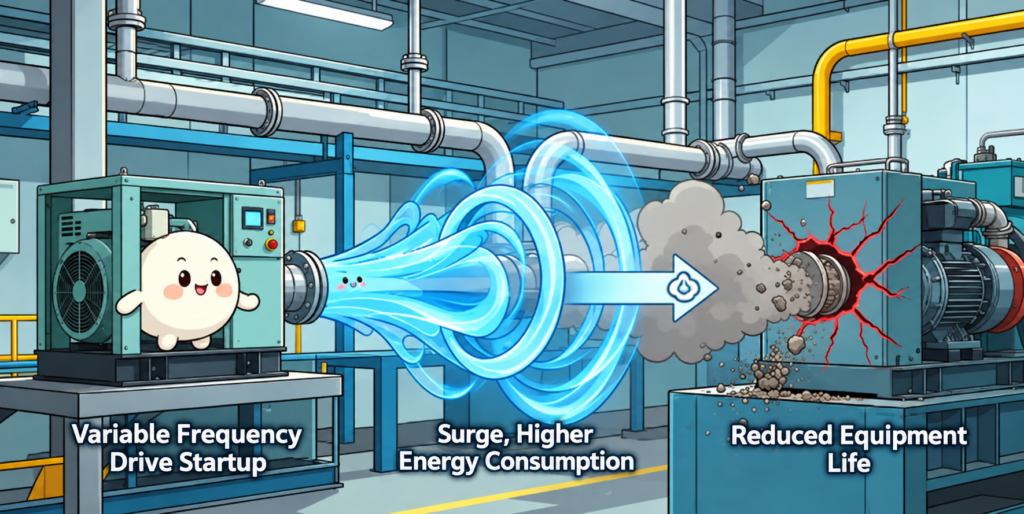
1. Higher Energy Consumption
A leaking system requires the compressor station to supply additional air simply to maintain system pressure.
Depending on compressor controls, storage capacity and production demand, excessive leakage may contribute to:
- longer compressor operating hours;
- additional compressor loading;
- unnecessary operation of backup capacity;
- higher electricity consumption;
- reduced overall system efficiency.
For facilities focused on energy performance, leak control should therefore be evaluated as part of the broader compressed air system energy-saving process.
The actual financial loss from a leak depends on factors such as leak size, operating pressure, compressor efficiency, annual operating hours and electricity price. For this reason, site-specific measurements provide a more reliable estimate than applying a single universal cost-per-cubic-meter figure.
2. Unstable System Pressure
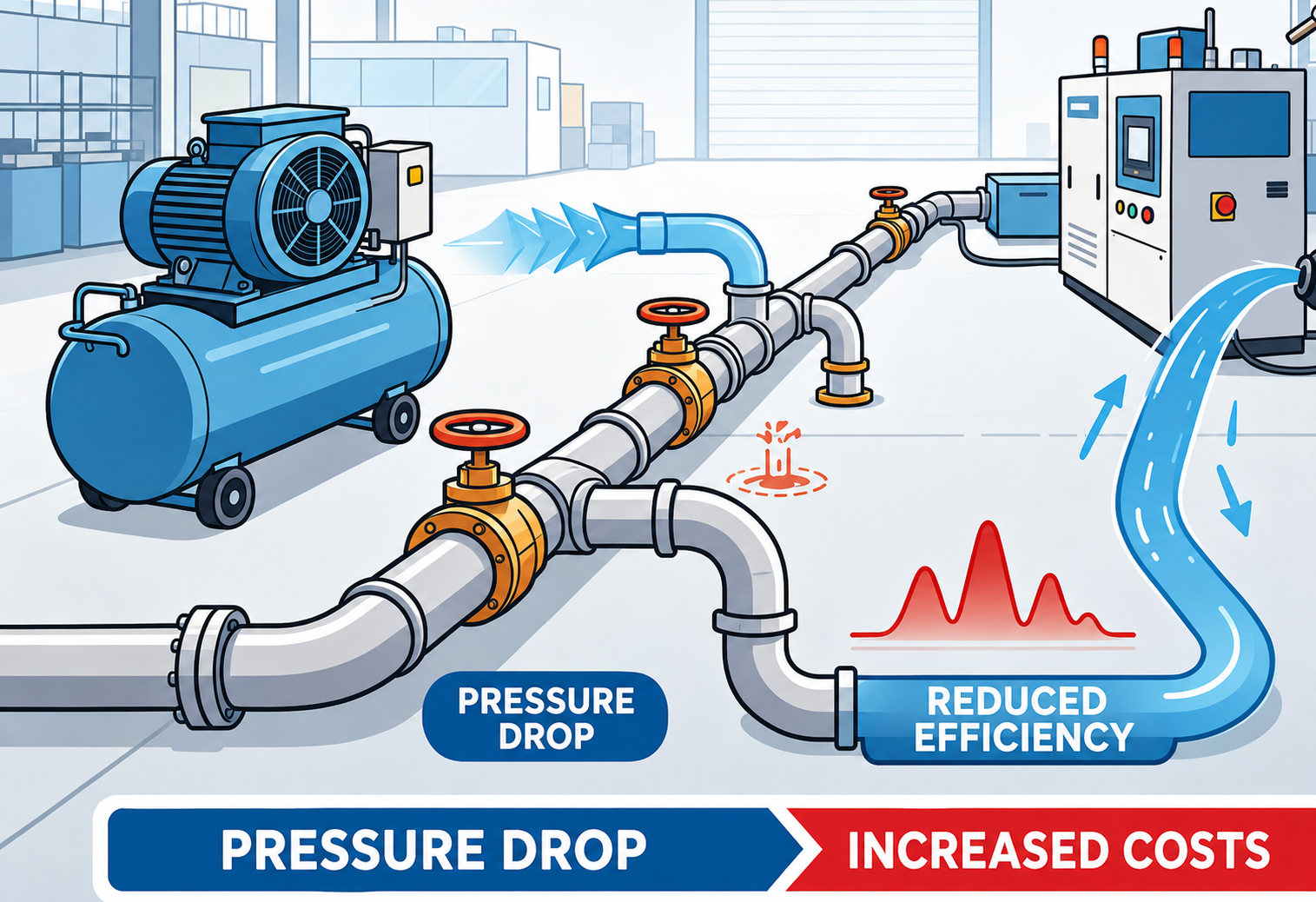
Leaks increase artificial demand on the compressed air network.
If compressor capacity, receiver volume or distribution piping cannot compensate adequately, pressure at the point of use may fall or fluctuate.
This can affect applications such as:
- pneumatic assembly tools;
- cylinders and actuators;
- automated production equipment;
- air-operated control devices;
- spraying and finishing equipment.
Before increasing compressor discharge pressure to compensate, facilities should determine whether the actual problem is leakage, inadequate piping, excessive local demand or another source of compressed air pressure drop.
Raising system pressure without correcting the underlying problem can increase energy consumption and may increase leakage through existing openings.
3. Additional Load on Compressors and Treatment Equipment
A leaking distribution system increases the volume of air that must be produced and treated.
That additional demand can affect not only the compressor but also downstream equipment such as:
- air receivers;
- filters;
- dryers;
- drains;
- distribution piping.
In systems where air quality is critical, efficient treatment remains essential. The five core components of a compressed air purification system should be selected and maintained according to the required flow, pressure and air-quality specification.
It is also important to distinguish leakage from contamination. An outward compressed-air leak does not normally draw dust or moisture into a pressurized line while the system remains above atmospheric pressure. Contamination problems should instead be investigated through the intake, compressor, condensate management and air-treatment system.
Where Do Compressed Air Leaks Commonly Occur?
Leaks can develop almost anywhere in a compressed air network, but some locations deserve particular attention:
- threaded pipe connections;
- quick couplings;
- flexible hoses;
- valves;
- flanges;
- filter housings;
- automatic and manual drains;
- pressure regulators;
- pneumatic cylinders;
- point-of-use equipment;
- damaged or corroded piping.
Frequently disconnected equipment and areas exposed to vibration are especially important inspection points because repeated movement can loosen connections and accelerate seal wear.
Three Practical Methods for Finding Compressed Air Leaks
A successful prevention program begins with reliable detection.
Different methods serve different purposes, so facilities may use more than one approach.
1. Soap-Solution Testing
Soap solution is one of the simplest ways to confirm a suspected leak.
Apply an approved leak-detection solution to areas such as:
- threaded fittings;
- valve connections;
- flanges;
- couplings;
- accessible joints.
Continuous bubble formation indicates escaping air.
Advantages:
- inexpensive;
- easy to use;
- useful for confirming a suspected leak;
- requires little specialized equipment.
Limitations:
- slow for large systems;
- requires physical access;
- unsuitable for many concealed locations;
- inefficient for plant-wide surveys.
Soap testing is therefore best used as a confirmation method rather than the sole strategy for a large industrial compressed air network.
2. Ultrasonic Leak Detection
Ultrasonic instruments are widely used for industrial compressed air surveys.
As compressed air escapes through a small opening, turbulent flow generates high-frequency acoustic energy. An ultrasonic detector can help the technician locate this signal even when a leak is difficult to hear directly.
A typical survey involves moving the detector systematically around:
- piping;
- fittings;
- valves;
- hoses;
- pneumatic equipment;
- drains;
- other potential leak points.
Once identified, each leak should be tagged or recorded for repair.
Ultrasonic inspection is particularly useful in large facilities because it allows technicians to survey many components without applying leak solution to every connection.
For a more detection-focused discussion, see our guide to compressed air leak detection.
3. System Leak-Rate or Pressure-Decay Assessment
A system-level test can help determine whether leakage has become significant.
One approach, where operating conditions and plant procedures allow it, is to isolate production demand and observe pressure decay over a defined period.
Another approach is to compare compressor output or load/unload behavior during non-production periods.
The correct calculation depends on:
- receiver and piping volume;
- starting and ending pressure;
- test duration;
- compressor control method;
- connected equipment;
- whether the system can be safely isolated.
A pressure-decay test can indicate that leakage exists, but it usually does not identify individual leak locations. Ultrasonic or local inspection is still required to find and repair them.
How to Repair Common Compressed Air Leak Points
Finding a leak is only useful if the repair is completed and verified.
Different leak types require different corrective actions.
Leaking Fittings and Connections
If a threaded connection is loose, depressurize and isolate the affected section before inspecting it.
Depending on the fitting design, repair may involve:
- correctly tightening the connection;
- replacing damaged threads;
- renewing the approved thread sealant;
- replacing worn seals or O-rings;
- replacing the complete fitting.
Do not repeatedly overtighten a damaged fitting. Excessive tightening can damage threads, deform sealing surfaces or create another failure point.
Seal materials should be compatible with the operating pressure, temperature, compressor lubricant and environmental conditions.
Damaged Hoses and Piping
A leaking hose should normally be replaced when deterioration, cracking or mechanical damage is evident.
For rigid piping, the correct repair depends on:
- pipe material;
- pipe diameter;
- pressure rating;
- extent of damage;
- applicable piping standard;
- manufacturer requirements.
Temporary clamps or repair devices should only be used when specifically rated and approved for the application.
Severely damaged or corroded pipe sections should generally be replaced rather than repeatedly patched.
After repair, restore pressure according to the applicable procedure and verify that the repaired connection remains leak-free.
Leaking Valves, Drains and Pneumatic Components
A considerable amount of compressed air can also be lost through end-use components.
Inspect:
- solenoid valves;
- control valves;
- cylinder seals;
- quick couplings;
- condensate drains;
- filter drain assemblies;
- pressure regulators.
A drain that remains partially open, for example, can continuously discharge compressed air even when the piping itself is leak-free.
Air Receiver Leaks Require Special Attention
An air receiver is a pressure vessel.
Suspected leakage from the vessel body, welds or pressure-retaining components should not be treated as an ordinary piping repair.
The receiver should be isolated and evaluated by qualified personnel in accordance with applicable local regulations, inspection requirements and manufacturer instructions.
Do not perform unauthorized welding on a pressure vessel.
For facilities reviewing the role and configuration of storage equipment, see when an air receiver tank is needed in a compressed air system.
Four Ways to Prevent Compressed Air Leaks from Returning
Repairing existing leaks is only the first step. Long-term control requires preventing new leaks from developing.
1. Use Properly Rated Components
Pipes, valves, couplings, hoses and seals should be suitable for:
- maximum working pressure;
- operating temperature;
- air quality;
- compressor lubricant;
- environmental exposure;
- required flow rate.
Avoid components with inadequate pressure ratings or uncertain compatibility.
The best fitting technology depends on the pipe material, operating conditions and installation requirements. Rather than assuming one connection type will always have the lowest leakage rate, select components according to manufacturer specifications and relevant piping standards.
2. Improve Installation Quality
Poor installation can create leak points before a system even begins operating.
Important practices include:
- supporting piping correctly;
- avoiding excessive mechanical stress;
- following the specified bend radius for tubing and hoses;
- aligning flanges before tightening;
- tightening fasteners evenly and to the specified torque;
- protecting piping from excessive vibration;
- using compatible sealing materials.
Where vibration is unavoidable, flexible connections or appropriate isolation methods may help protect downstream piping.
3. Establish a Routine Leak Inspection Program
Leak management should be continuous rather than a one-time maintenance project.
The appropriate inspection interval depends on the facility. A plant with extensive pneumatic equipment and frequent production changes may require more frequent surveys than a small, stable system.
A practical program can combine:
- operator observations during routine work;
- targeted checks after equipment changes;
- scheduled ultrasonic surveys;
- follow-up inspections after repairs;
- periodic system-level leakage assessments.
High-priority areas should include components that are frequently disconnected, exposed to vibration, aging, or historically prone to leakage.
4. Maintain a Leak Register
Each identified leak should be documented.
A useful leak register can include:
| Record | Information |
|---|---|
| Leak ID | Unique identification number |
| Location | Building, line and equipment |
| Component | Valve, hose, fitting, drain, etc. |
| Detection date | Date identified |
| Severity | Estimated or measured loss |
| Repair action | Work performed |
| Repair date | Completion date |
| Verification | Confirmed leak-free after repair |
| Responsible team | Maintenance owner |
This information makes it easier to identify recurring patterns.
For example, repeated leakage in one production area may indicate:
- excessive vibration;
- unsuitable fittings;
- poor installation;
- corrosion;
- repeated mechanical damage.
Correcting the root cause is usually more effective than repeatedly repairing the same type of leak.
Employee Awareness Is Part of Leak Prevention
Maintenance personnel cannot be everywhere at once.
Operators often notice early signs first, such as:
- unusual hissing;
- reduced pneumatic tool performance;
- unstable local pressure;
- a hose or fitting that repeatedly works loose;
- equipment consuming air while idle.
Employees should know how to report suspected leaks without attempting unauthorized repairs on pressurized equipment.
Facilities can also track leak reporting and repair completion as part of their energy-management or maintenance KPIs.
How to Build a Long-Term Compressed Air Leak Management Program
A sustainable program can follow a simple closed-loop process:
Detect → Record → Prioritize → Repair → Verify → Analyze → Prevent
Detect
Conduct routine visual, acoustic and ultrasonic inspections.
Record
Assign each leak an identification number and location.
Prioritize
Prioritize large leaks, safety-related defects and leaks affecting production pressure.
Repair
Use the correct component and approved repair method.
Verify
After repair, confirm that leakage has actually stopped.
Analyze
Review recurring leak locations and component failure patterns.
Prevent
Improve installation, component selection, vibration control and maintenance practices based on the findings.
This approach turns leak repair from a reactive maintenance activity into an ongoing efficiency program.
Do Not Confuse Leakage with Other Compressed Air Problems
Low pressure does not automatically mean the system has a leak.
Similar symptoms can result from:
- undersized piping;
- clogged filters;
- excessive filter pressure drop;
- inadequate compressor capacity;
- incorrectly sized dryers;
- malfunctioning valves;
- sudden production demand.
For this reason, leak investigation should be combined with pressure and flow measurements.
If oil contamination is also present, troubleshoot it separately using the appropriate compressed air oil contamination diagnostic process.
FAQ: Compressed Air Leak Prevention
What are the most common causes of compressed air leaks?
Common causes include worn seals, loose fittings, damaged hoses, leaking valves, defective drains, vibration, corrosion and poor installation.
What is the best way to find compressed air leaks?
Ultrasonic detection is useful for plant-wide surveys, while leak-detection solution is effective for confirming accessible leaks. System-level tests can help estimate whether overall leakage is significant.
Can compressed air leaks increase electricity consumption?
Yes. Air that escapes must be replaced by the compressor if the system is to maintain demand and pressure. The actual energy impact depends on compressor controls, operating pressure, leak size and production conditions.
Should I increase compressor pressure if production pressure is too low?
Not before identifying the cause. Leakage, restrictions, undersized piping or excessive demand may be responsible. Increasing compressor discharge pressure without correcting the root cause can increase energy use and leakage.
How often should a compressed air system be checked for leaks?
There is no single interval suitable for every facility. Inspection frequency should reflect system size, equipment age, operating hours, maintenance history and how frequently pneumatic equipment is changed.
Can an air receiver leak be repaired by welding?
Repairs to pressure-retaining sections of an air receiver should only be performed according to applicable pressure-vessel regulations and approved procedures by qualified personnel. Unauthorized welding should not be attempted.
Conclusion
Effective compressed air leak prevention is not simply about repairing a leaking fitting. It requires a structured approach to detection, repair, verification and long-term prevention.
A practical strategy is:
Find the leak → Identify the cause → Repair correctly → Verify the repair → Record the result → Prevent recurrence
When this process becomes part of routine maintenance, facilities can reduce unnecessary compressed air demand, improve pressure stability and operate compressors and downstream air-treatment equipment more efficiently.
For plants reviewing the performance of the entire compressed air treatment system, explore Lingyu’s compressed air treatment products or contact Lingyu to discuss your operating conditions and air-treatment requirements.