Large centralized compressed-air stations require drying equipment that can handle high airflow while maintaining a predictable pressure dew point and manageable system pressure loss.
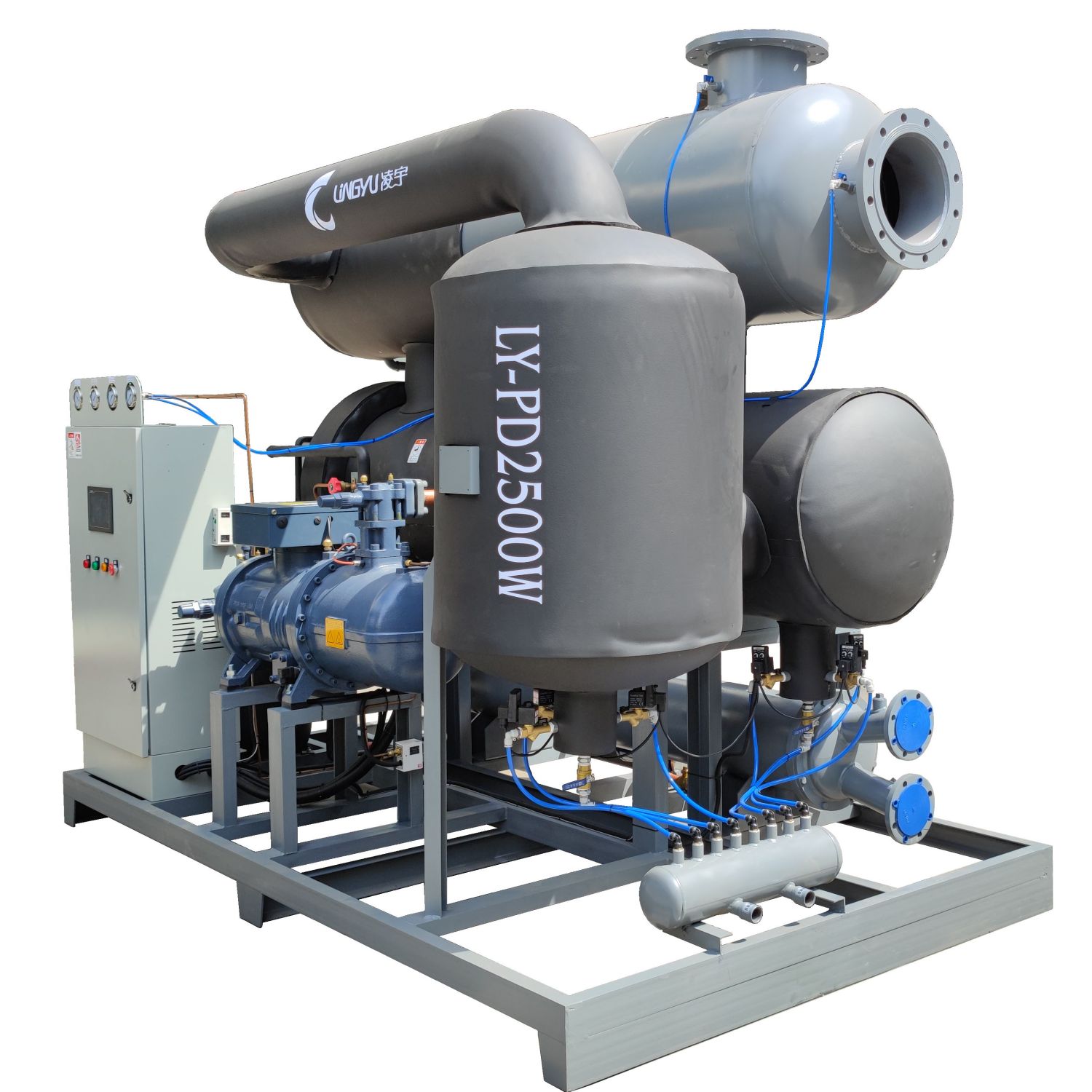
Lingyu’s 8830 CFM water-cooled high-temperature refrigerated air dryer belongs to this large-capacity application area. The broader WH Series Water-Cooled High-Inlet-Temperature Refrigerated Air Dryer family is designed for high-temperature compressed-air treatment, while a documented project using eight customized 250 m³/min WH Series refrigerated air dryers demonstrates the use of this architecture at capacities above the standard model range.
This guide focuses on the WH Series drying process, high-inlet-temperature capability, water-cooling requirements, pressure drop, large-capacity system integration, and maintenance priorities.
For users comparing other refrigerated-air-dryer configurations, Lingyu’s refrigerated air dryer range covers additional air-cooled and energy-saving designs.
How the WH Series Water-Cooled Dryer Works
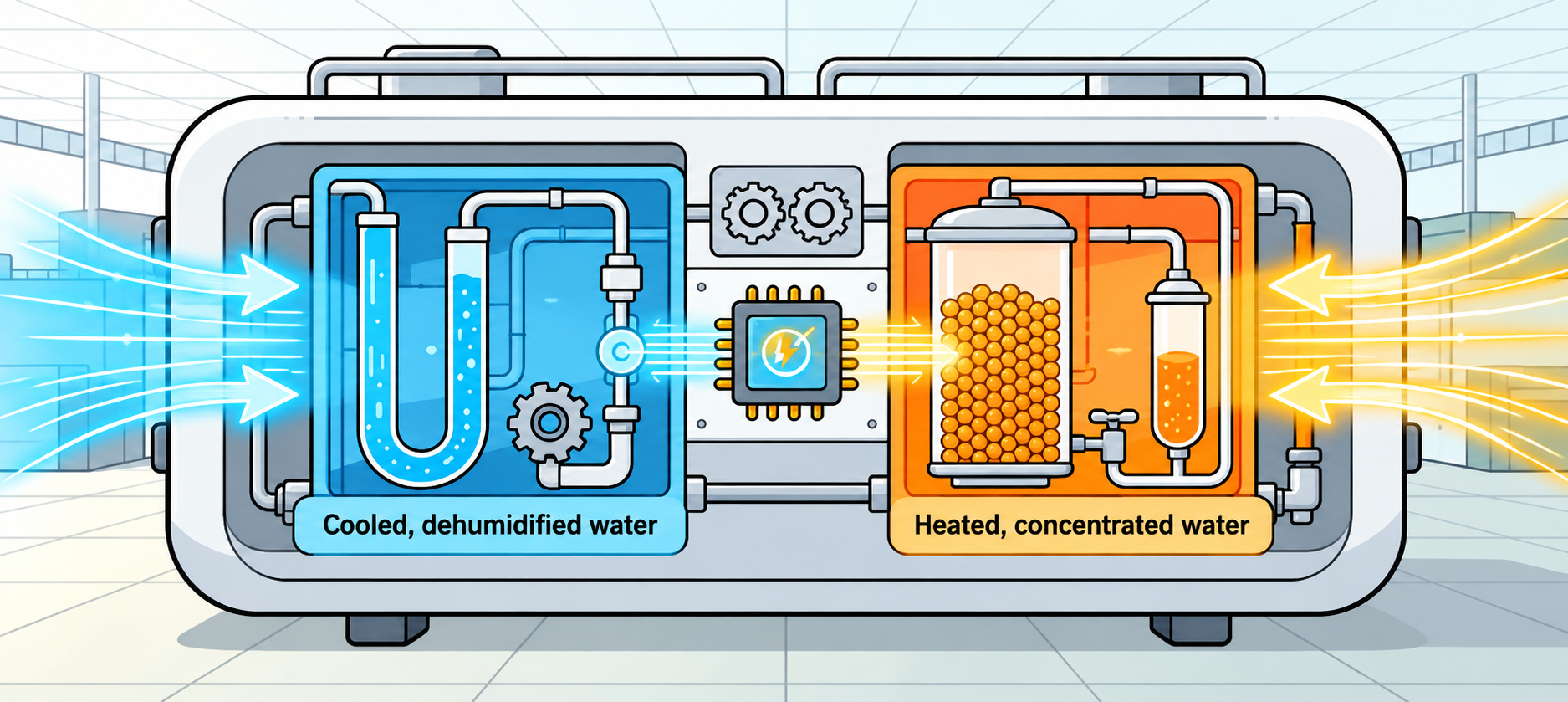
High-temperature compressed air containing moisture first enters the water-cooled pre-cooler and air-to-air heat exchanger. This initial cooling stage lowers the air temperature before it reaches the refrigeration evaporator.
The compressed air then passes through the air-to-refrigerant evaporator, where it is cooled until water vapor condenses. The WH Series operates with a 2–10°C pressure dew point.
Condensed moisture, together with some oil and impurities, is separated by the gas-liquid separation system and discharged through an automatic drain.
Finally, the dried low-temperature compressed air passes back through the air-to-air heat exchanger and is reheated toward ambient temperature before leaving the dryer.
This heat-recovery arrangement allows the outgoing dry air to help pre-cool incoming compressed air while reducing the risk of excessively cold air entering downstream piping.
Why the Pre-Cooler Matters for High Inlet Temperature
The WH Series is not simply a conventional refrigerated dryer with a water-cooled condenser. Its design specifically addresses high inlet-air temperature.
The rated inlet temperature is 50°C, while the maximum inlet temperature is ≤80°C.
Before the compressed air reaches the main refrigeration evaporator, the water-cooled pre-cooler removes part of the thermal load.
This is important because high-temperature compressed air carries both a higher sensible heat load and potentially a larger moisture load. Reducing the temperature before final refrigeration helps the evaporator operate within the intended system conditions.
Standard WH Series Operating Conditions
| Parameter | Specification |
|---|---|
| Rated inlet pressure | 0.7 MPa |
| Operating pressure range | 0.6–1.0 MPa |
| Rated inlet temperature | 50°C |
| Maximum inlet temperature | ≤80°C |
| Pressure dew point | 2–10°C |
| Rated ambient temperature | 32°C |
| Ambient operating range | 2–45°C |
| Pressure drop | ≤0.025 MPa |
| Cooling method | Water-cooled |
| Cooling-water pressure | 0.2–0.4 MPa |
| Cooling-water temperature | ≤32°C |
| Cooling-water operating range | 2–38°C |
| Standard refrigerant | R22 |
| Optional refrigerants | R407C / R410A upon request |
The 8830 CFM product is a larger custom-capacity configuration. Its exact cooling-water flow, power, connection sizes, dimensions, and refrigeration configuration should therefore be confirmed from its dedicated technical configuration rather than extrapolated from standard WH Series models.
Why Water Cooling Is Useful at Large Capacity
In an air-cooled refrigerated dryer, condenser heat is rejected to the surrounding ambient air. A water-cooled system instead transfers refrigeration-system heat into a cooling-water circuit.
For a large compressed-air station, this can reduce dependence on equipment-room airflow for condenser heat rejection.
This does not mean that the dryer is unaffected by ambient temperature or poor installation conditions. The WH Series still has an ambient operating range of 2–45°C.
The more precise advantage is that condenser performance depends on the cooling-water system rather than relying exclusively on large volumes of ambient ventilation air. This can be particularly useful in large indoor compressor rooms where rejecting condenser heat directly into the room would otherwise create additional ventilation demand.
Cooling Water Is a Primary Selection Parameter
For the WH Series, cooling-water conditions are part of the equipment specification:
Cooling-water temperature: ≤32°C
Cooling-water pressure: 0.2–0.4 MPa
The cooling-water system should therefore be evaluated before the dryer is selected.
Important factors include water temperature, available pressure, required flow, water quality, scaling tendency, filtration, and seasonal operating variation.
A large dryer cannot maintain stable refrigeration merely because a cooling-water connection exists. The water circuit must be capable of continuously removing the required condenser and pre-cooling heat load.
Cooling-Water Flow Must Be Confirmed for the 8830 CFM Configuration
The previously stated 600–750 L/min cooling-water flow should not be used as a confirmed specification for the 8830 CFM dryer because the available technical information does not provide a dedicated value for this model.
The confirmed WH Series cooling-water conditions are ≤32°C water temperature and 0.2–0.4 MPa water pressure.
For an 8830 CFM-class unit, cooling-water flow should be sized according to the dedicated technical configuration of the selected large-capacity WH dryer.
This avoids extrapolating an unsupported fixed flow value to a custom-capacity machine.
Pressure Drop Matters in a Large Compressed-Air Station
The standard WH Series pressure drop is:
≤0.025 MPa, approximately 0.25 bar.
In a large central compressor station, even modest pressure loss can affect total system energy consumption.
The dryer should therefore be evaluated together with the main compressed-air piping, filters, valves, air receivers, flow meters, distribution headers, and point-of-use pressure requirements.
The key system question is not only whether the dryer can process the required airflow, but whether the complete purification train can deliver the required downstream pressure.
Pressure Range and Custom Requirements
The standard WH operating pressure range is 0.6–1.0 MPa, with a rated inlet pressure of 0.7 MPa. Other working pressures are available upon request.
This is more precise than describing the dryer simply as supporting operating pressures “up to 10 bar.”
For exact information on the large-capacity configuration, users can review Lingyu’s 8830 CFM water-cooled high-temperature refrigerated dryer page.
Standard WH Capacity vs. 8830 CFM Custom Capacity
The standard WH Series includes the following larger-capacity models:
| Model | Airflow | Power | Air Connection |
|---|---|---|---|
| LY-D450WH | 50 m³/min | 8.7 kW | DN100 |
| LY-D600WH | 65 m³/min | 10.3 kW | DN125 |
| LY-D800WH | 85 m³/min | 13.8 kW | DN125 |
| LY-D1100WH | 110 m³/min | 17.0 kW | DN150 |
| LY-D1200WH | 120 m³/min | 19.2 kW | DN150 |
| LY-D1400WH | 140 m³/min | 20.4 kW | DN200 |
| LY-D1600WH | 160 m³/min | 23.9 kW | DN200 |
The standard range extends to 160 m³/min, above which special technical consultation is required.
At the same time, a documented petrochemical project uses 8 × 250 m³/min WH Series refrigerated air dryers. This supports positioning the 8830 CFM dryer as a custom large-capacity implementation of the WH architecture rather than treating it as one of the standard model-table entries.
High-Efficiency Moisture Separation
The WH Series includes an independently designed water-separation system.
After the compressed air is cooled in the evaporator, condensed water must be separated efficiently before the air leaves the dryer.
Cooling air below its dew point alone does not produce usable dry compressed air. The resulting liquid condensate must also be separated and discharged reliably.
Automatic Drain Maintenance
The WH Series drying process includes automatic condensate drainage.
For a large-capacity dryer, drain reliability is particularly important because the total condensate load can be substantial.
Maintenance should include regular checks of drain operation, drain blockage, water-separator condition, condensate piping, and discharge backpressure.
A refrigeration system may continue operating while a failed drain allows liquid to accumulate, so condensate drainage should be treated as a performance-critical component rather than a minor accessory.
Dual-Compressor Control and the Custom 8830 CFM Unit
Within the stated 5–180 m³/min range, WH Series dryers use a 1+1 dual-compressor configuration, with the second compressor starting or stopping according to system load.
This provides load matching and an energy-saving mechanism within that specified capacity range.
However, an 8830 CFM / approximately 250 m³/min custom dryer falls beyond the stated 5–180 m³/min range. The same 1+1 compressor configuration should therefore not automatically be assigned to the 8830 CFM model without dedicated product confirmation.
For this custom-capacity unit, compressor quantity and control logic should be treated as project-specific.
Control and Communication Options
The WH Series can be configured with PLC control, dry contacts, Modbus communication, and IoT connectivity according to project requirements.
These are more appropriate supported descriptions than stating that every 8830 CFM dryer necessarily includes a fully integrated digital control panel with automatic diagnostics.
For large centralized compressor stations, these communication options can support integration with a plant control or monitoring system.
Refrigerant Selection
The standard WH Series uses R22 as the listed refrigerant, while R407C and R410A are available upon request.
Refrigerant selection should be treated as an engineering configuration rather than assuming that refrigerants can be substituted directly without corresponding system changes.
For a large custom WH dryer, the refrigerant should be confirmed during technical configuration because the compressor, condenser, expansion device, and operating parameters must match the selected refrigerant.
Installation Requirements
The WH Series is designed for indoor installation on a level concrete floor, without a foundation, with at least 1.5 m clearance around the unit.
For a large custom-capacity machine, installation planning should also provide access for maintenance, heat-exchanger cleaning, compressor servicing, water-pipe connections, electrical panels, condensate drainage, and equipment removal if a major component eventually requires replacement.
Cooling-Water Quality and Heat Exchanger Maintenance
The specified cooling-water conditions define temperature and pressure but do not prescribe a universal chemical water-treatment program.
The practical maintenance objective is to preserve heat-transfer performance and prevent cooling-water passages from becoming restricted.
Operators should monitor cooling-water inlet and outlet conditions and inspect the water-side heat exchanger according to site water quality and operating experience.
Filtration Before and After the Dryer
A refrigerated dryer primarily controls moisture through cooling and condensation.
Particles and oil aerosols may require separate filtration according to the required downstream compressed-air quality.
Where additional filtration is required, Lingyu’s precision compressed air filters can form part of the complete purification train.
Filter configuration should be determined according to the complete system requirement rather than treated as a generic accessory.
Application Positioning for Large-Capacity WH Dryers
An 8830 CFM-class dryer is best positioned around large central compressed-air stations and high-flow industrial plants.
A documented petrochemical installation using eight 250 m³/min WH dryers provides a representative large-scale industrial reference and is more relevant to this equipment class than a broad list of small or unrelated applications.
For broader heavy-industry applications, users can review Lingyu’s mining and heavy industry compressed-air solutions.
What to Confirm Before Selecting an 8830 CFM Dryer
Before specifying a large-capacity WH dryer, confirm the actual peak airflow, normal airflow, inlet pressure, maximum inlet temperature, required pressure dew point, allowable pressure drop, cooling-water temperature, cooling-water pressure, available cooling-water flow, refrigerant requirement, electrical standard, control interface, installation dimensions, redundancy strategy, and upstream filtration.
For the 8830 CFM configuration in particular, exact power, cooling-water flow, connection sizes, dimensions, and refrigeration configuration should come from the dedicated project-specific technical data rather than being extrapolated from the standard WH model table.
For project-specific configuration, users can use Lingyu’s Contact Us page for technical confirmation.
Conclusion
The 8830 CFM water-cooled high-temperature refrigerated air dryer should be understood as a large custom-capacity implementation of Lingyu’s WH Series technology rather than as a standard model whose technical specifications can simply be copied from smaller units.
The WH Series supports a 50°C rated inlet temperature, ≤80°C maximum inlet temperature, 0.7 MPa rated inlet pressure, 0.6–1.0 MPa operating pressure, 2–10°C pressure dew point, ≤0.025 MPa pressure drop, cooling-water temperature ≤32°C, cooling-water pressure of 0.2–0.4 MPa, cooling-water operating range of 2–38°C, 32°C rated ambient temperature, and ambient operating range of 2–45°C.
The standard model table extends to 160 m³/min, while a documented project uses eight 250 m³/min WH Series units, demonstrating the use of the WH architecture at larger custom capacities.
For an 8830 CFM-class project, the most important engineering factors are not only nominal airflow but also high inlet-air temperature, cooling-water capacity, pressure drop, condensate removal, installation space, control integration, and exact project-specific technical configuration.