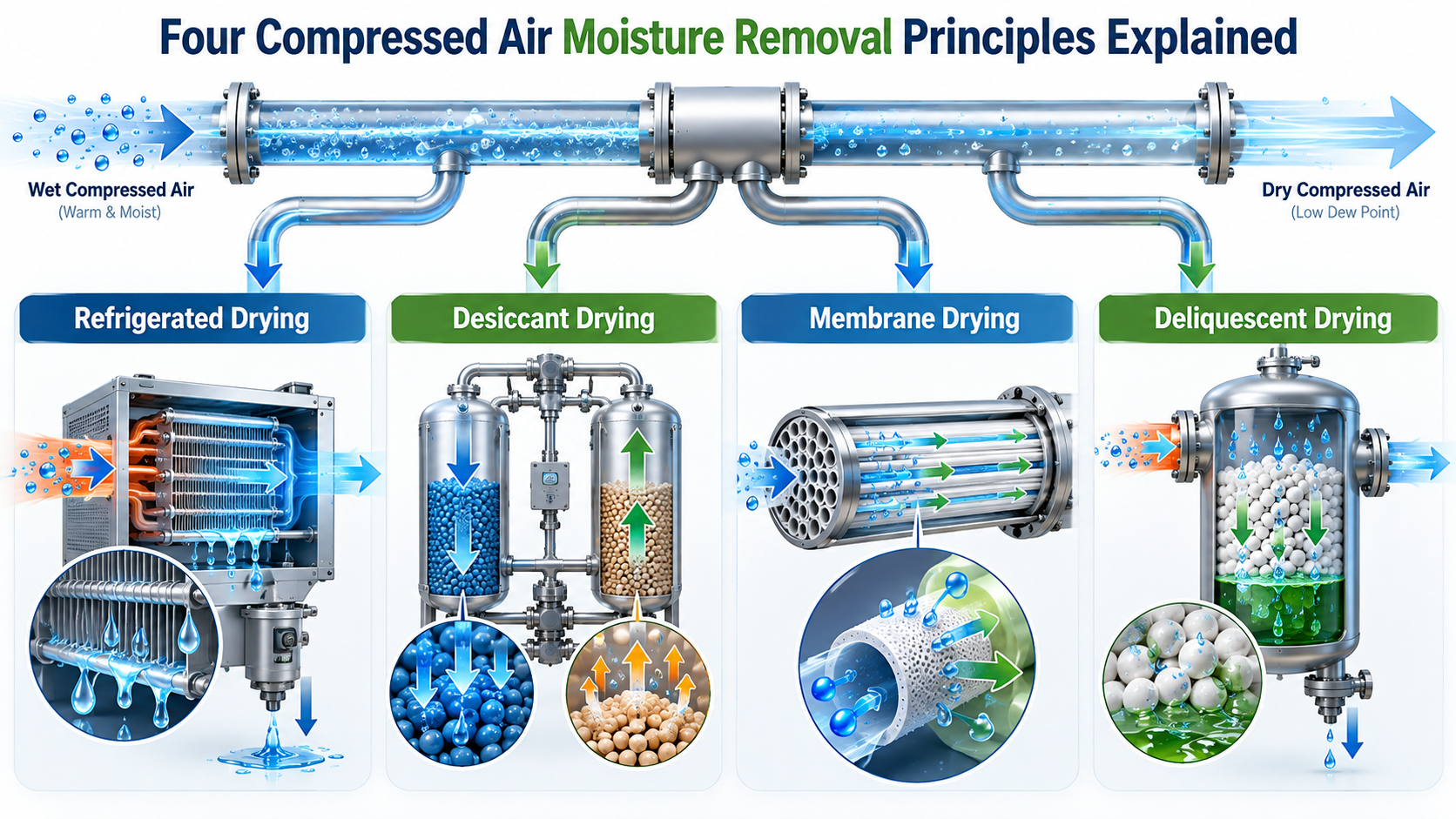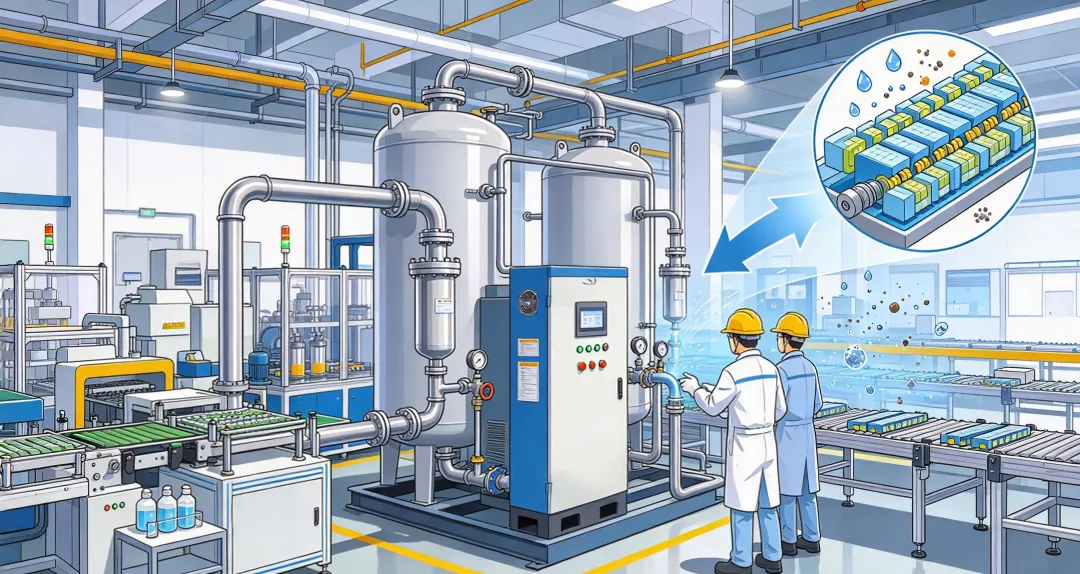
In industrial production, compressed air is often referred to as the “fourth utility.” However, moisture contained in compressed air can cause pipeline corrosion, pneumatic component failures, unstable processes, and product-quality problems.
An adsorption air dryer is designed to remove water vapor from compressed air using desiccant materials such as activated alumina and molecular sieve. This makes adsorption drying particularly suitable for applications that require a low pressure dew point and reliable moisture control.
1. How Does an Adsorption Air Dryer Work?
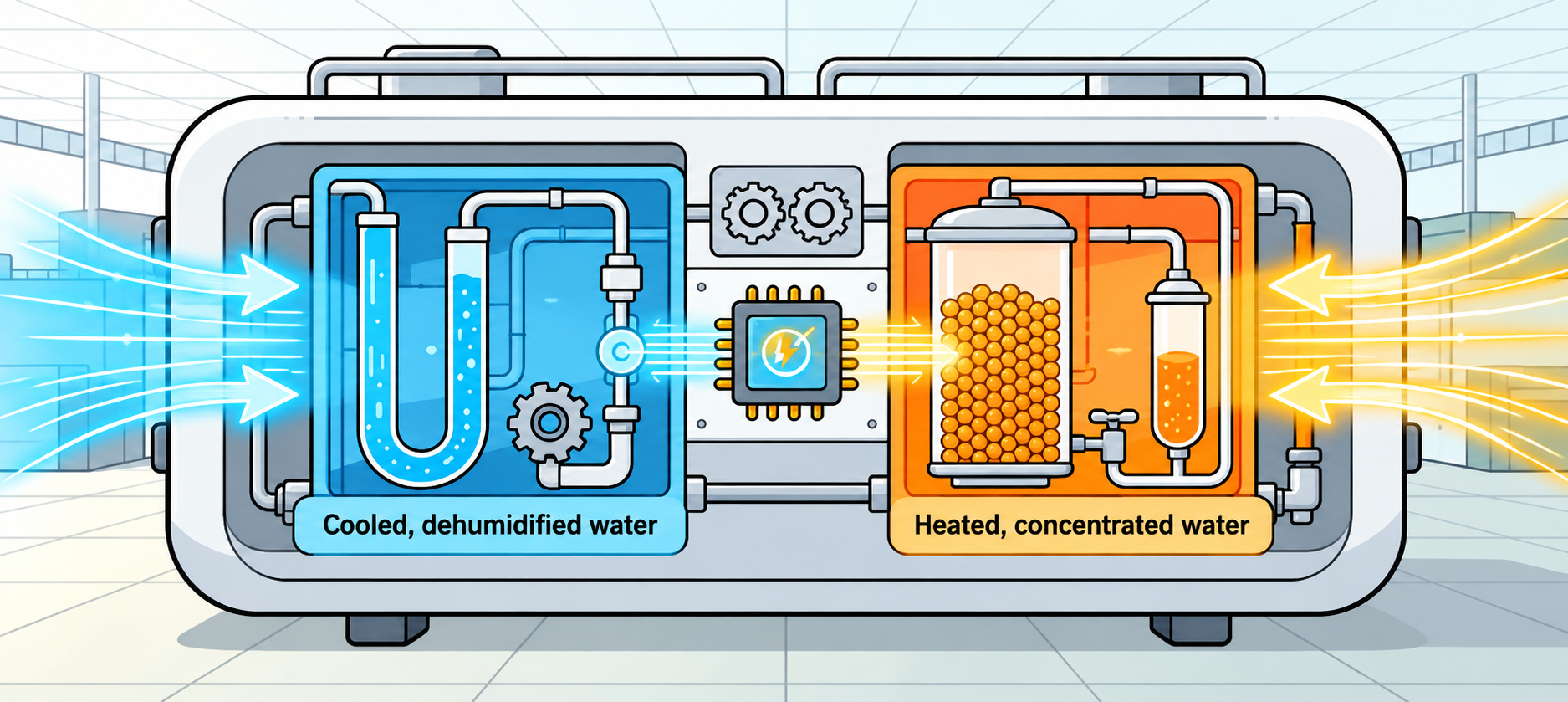
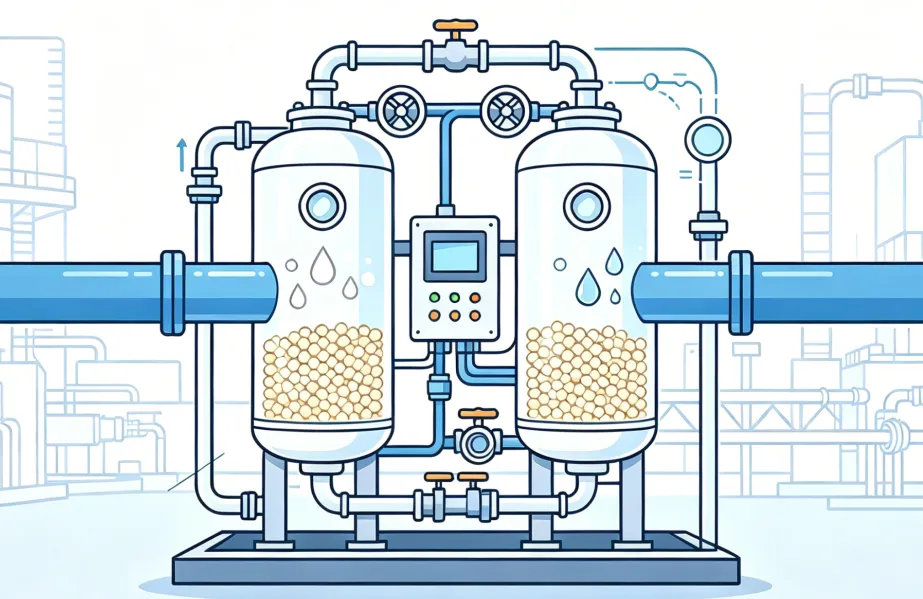
The operating principle of an adsorption air dryer is based on a continuous adsorption–regeneration cycle.
Inside the dryer, desiccant captures water vapor from the compressed air as it passes through the adsorption bed.
Once one adsorption chamber has completed its drying stage, the dryer switches operation so that the saturated desiccant can be regenerated while another chamber continues drying the compressed air.
Depending on the dryer design, regeneration may use:
- A portion of dry compressed air
- Heated regeneration
- Blower-assisted regeneration
- Recovered compressor discharge heat
The moisture released from the desiccant is discharged from the system, restoring its adsorption capacity and allowing the drying cycle to continue.
2. Common Adsorption Air Dryer Regeneration Methods
Different regeneration technologies have different energy-consumption characteristics and application requirements.
Heatless Regenerative Adsorption Air Dryers
Heatless dryers regenerate the desiccant using a portion of the dry compressed air produced by the system, without requiring an external regeneration heater.
Lingyu HH Series heatless regenerative adsorption dryers use pressure swing adsorption and have an average regeneration-air consumption of approximately 8–14% under specified operating conditions, with an outlet pressure dew point of ≤−40°C.
Their advantages include:
- Simple operating principle
- No regeneration heater
- Automatic adsorption and regeneration cycles
- Stable continuous drying
For a more detailed explanation, see the guide to heatless desiccant air dryers.
Heated Regenerative Adsorption Air Dryers
Heated regenerative dryers use heat during desorption, reducing the amount of dry compressed air required for regeneration compared with conventional heatless designs.
Lingyu HH Series heated regenerative adsorption dryers use thermal swing adsorption, with an average regeneration-air consumption of approximately 4–8% and an outlet pressure dew point of ≤−40°C under specified operating conditions.
These systems are suitable where lower purge-air consumption is important and a consistently low pressure dew point is required.
For more information, see the guide to heated regeneration adsorption air dryers.
Other Energy-Saving Regeneration Technologies
Adsorption dryers are not limited to conventional heatless and heated-purge designs.
Depending on operating conditions and available energy sources, other options include blower-heated and heat-of-compression systems.
For example, Lingyu’s HRB-E blower-heated dryer uses approximately 2–3% regeneration air, while the HRB-Z configuration is designed for approximately 0% product-air purge during regeneration.
Heat-of-compression dryers can also recover high-temperature compressor discharge heat for desiccant regeneration, reducing dependence on additional regeneration energy.
The appropriate technology should therefore be selected according to the complete compressed air system rather than dew point alone.
3. Proper Selection Determines Adsorption Dryer Performance
Choosing the correct adsorption air dryer requires several operating parameters to be considered together.
Compressed Air Flow Capacity
Dryer capacity should be selected according to the actual compressed air demand and inlet operating conditions.
Simply matching the dryer’s nominal flow rating to the compressor nameplate capacity is not always sufficient.
Evaluate:
- Actual compressed air flow
- Operating pressure
- Inlet temperature
- Required pressure dew point
- Applicable correction factors
For more detailed sizing guidance, see how to choose a desiccant air dryer and avoid common sizing mistakes.
Inlet Pressure and Temperature
Adsorption dryer performance depends on operating pressure and inlet temperature.
There is no universal minimum inlet pressure that applies to every model.
For example, several Lingyu conventional heatless and heated regenerative dryer series are designed for an operating pressure range of 0.6–1.0 MPa, with rated inlet temperatures of 10–30°C and a maximum inlet temperature of ≤40°C.
Other technologies, such as heat-of-compression dryers, operate under very different inlet-temperature conditions.
Always evaluate the actual operating conditions against the specifications of the selected dryer.
Required Pressure Dew Point
The target pressure dew point should be determined by the downstream process.
Do not specify a lower dew point than the application actually requires, because deeper drying can increase equipment and operating costs.
Lingyu adsorption dryer configurations commonly provide pressure dew point options around −20°C and −40°C, while specific models and configurations may have different performance ratings.
The selection principle should therefore be:
Required Process Air Quality → Required PDP → Suitable Dryer Technology
rather than automatically selecting the lowest available dew point.
4. Desiccant Condition and Inlet Air Quality
The service life of activated alumina and molecular sieve depends strongly on actual operating conditions.
Oil contamination, liquid-water carryover, excessive temperatures, poor regeneration, desiccant movement, and airflow channeling can all reduce adsorption performance.
For this reason, there is no universal rule that activated alumina must be replaced every 2–3 years or molecular sieve every 3–5 years.
Instead, desiccant condition should be evaluated according to dryer performance and actual operating conditions.
Signs that require investigation may include:
- Rising outlet pressure dew point
- Desiccant dust carryover
- Channeling or uneven airflow
- Abnormal pressure drop
- Reduced regeneration performance
- Visible desiccant deterioration
If desiccant performance has begun to decline, see what causes adsorption performance to deteriorate.
Maintaining appropriate upstream air treatment is also important.
Filters should be selected and serviced according to actual air-quality requirements, differential pressure, operating conditions, and manufacturer recommendations rather than a fixed universal replacement interval.
5. Build a Complete Compressed Air Treatment System
An adsorption air dryer should be considered part of an integrated compressed air treatment system rather than as a standalone component.
A typical system may include:
Air Compressor → Moisture Separation / Air Treatment → Pre-Filtration → Adsorption Drying → Final Filtration
Upstream treatment helps reduce liquid water, oil, and particulate contamination before compressed air enters the desiccant bed.
Downstream filtration can capture desiccant particles that may be released from the dryer.
The exact filtration arrangement should be selected according to required air quality and equipment configuration rather than applying one universal filter sequence to every installation.
Maintain Correct Regeneration Performance
Regeneration performance is equally important.
Insufficient or excessive regeneration airflow can both affect dryer performance and operating efficiency.
For practical troubleshooting, see how regeneration air flow should be adjusted in an adsorption air dryer.
Conclusion: Select the Adsorption Air Dryer as Part of the Complete System
An adsorption air dryer plays an important role in compressed air systems that require reliable moisture removal and a low pressure dew point.
Its performance depends not only on the desiccant itself, but also on:
Dryer Sizing → Inlet Conditions → Required Pressure Dew Point → Regeneration Method → Air Treatment → Maintenance
Heatless, heated-purge, blower-heated, and heat-of-compression dryers each have different operating and energy characteristics.
The correct solution should therefore be selected according to the actual process requirement and complete compressed air system.
Proper selection, appropriate upstream treatment, effective regeneration, and condition-based maintenance can help maintain stable pressure dew point, extend desiccant life, and reduce unnecessary operating costs.
For help selecting an adsorption dryer according to your flow, pressure, inlet temperature, pressure dew point, and regeneration requirements, contact Lingyu for technical support.