Proper adjustment of regeneration air flow is essential for maintaining the drying performance and energy efficiency of an adsorption air dryer.
Too little regeneration air may leave the desiccant insufficiently regenerated, while excessive purge air wastes valuable compressed air.
The correct setting depends on the dryer technology, specific model, operating conditions, moisture load, and required outlet pressure dew point.
This guide explains why regeneration air flow matters, how it should be adjusted, what operating conditions should be checked, and how regeneration can be optimized without sacrificing drying performance.
1. Why Is Regeneration Air Flow Important?
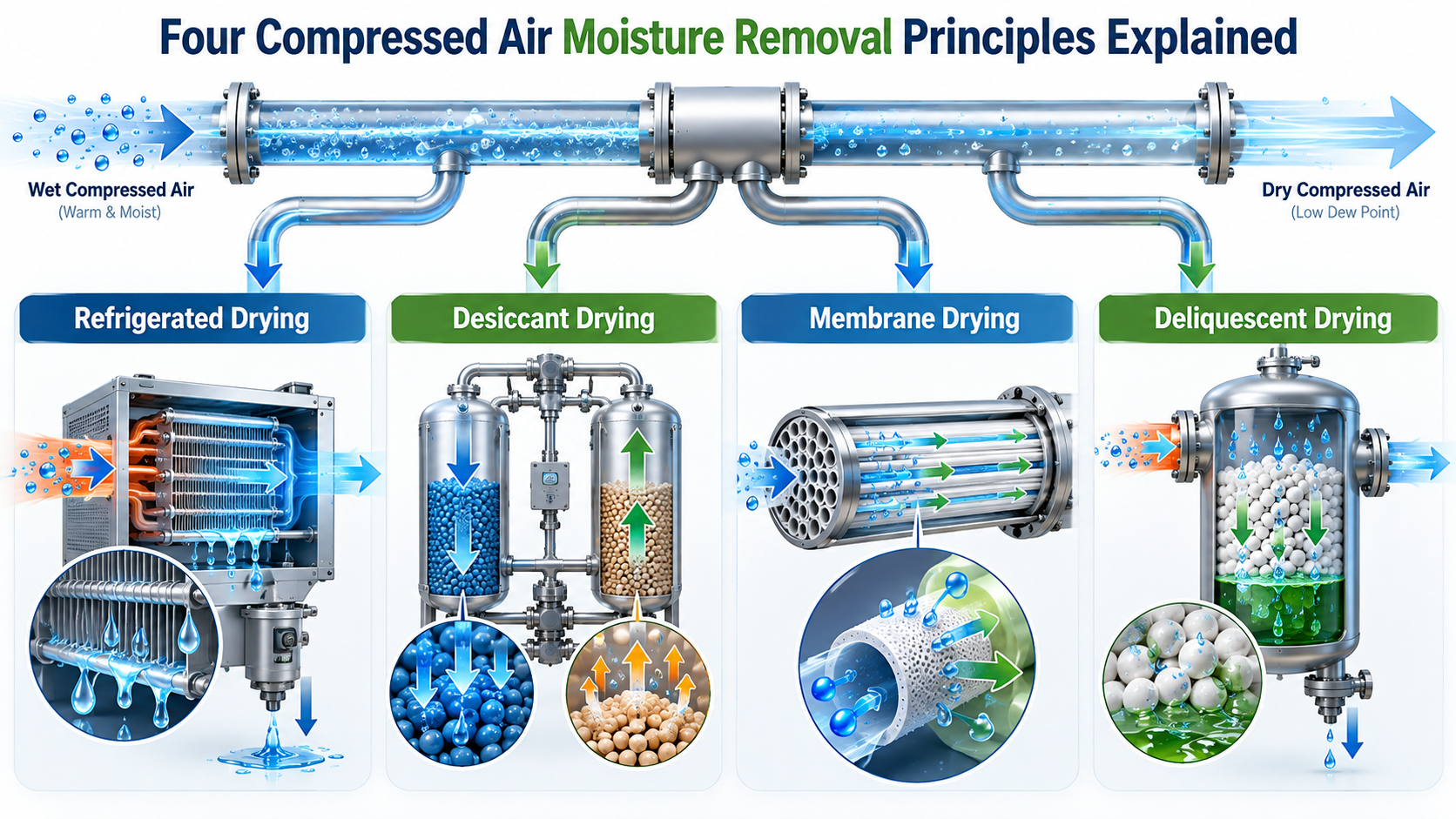
In a heatless regenerative adsorption dryer, part of the dry product air is depressurized and used to regenerate the saturated desiccant bed.
During regeneration, the dry purge air passes through the offline adsorption tower and carries away moisture released from the desiccant. The tower is then prepared for the next adsorption cycle.
Correct regeneration air flow is critical to:
- Maintaining the required pressure dew point
- Ensuring sufficient desiccant regeneration
- Avoiding unnecessary compressed air loss
- Supporting stable dryer operation
However, not all adsorption air dryers use the same regeneration method or purge-air percentage.
Heated, blower-heated, and heat-of-compression dryers use different regeneration strategies and therefore have different regeneration-air requirements.
For a broader explanation of these technologies, see adsorption air dryers in compressed air systems.
2. Methods for Adjusting Regeneration Air Flow
2.1 Follow the Dryer’s Specified Regeneration Setting
Regeneration air consumption should be set according to the specific dryer model and operating conditions rather than applying one universal percentage.
For example, Lingyu adsorption dryer configurations have different regeneration-air requirements:
| Dryer Configuration | Approximate Regeneration-Air Consumption |
|---|---|
| HH Series heatless regenerative dryer | 8–14% |
| HH Series heated regenerative dryer | 4–8% |
| M Series modular heatless dryer | 5–8% |
| HRB-E low-purge blower-heated dryer | 2–3% |
| HRB-Z zero-purge blower-heated dryer | Approx. 0% |
| HOC-E heat-of-compression dryer | ≤3% |
| HOC-Z zero-purge heat-of-compression dryer | 0% |
Actual values depend on the specific model and stated operating conditions.
The dryer specification should therefore always be the starting point when checking or adjusting regeneration air flow.
2.2 Adjust Manual Purge Flow Gradually
On dryers equipped with a manual purge-air regulating device, regeneration flow may be adjusted according to the manufacturer’s operating procedure.
The adjustment should be made gradually while monitoring:
- Outlet pressure dew point
- Regeneration pressure
- Operating pressure
- Tower switching
- Exhaust condition
- Overall dryer stability
Avoid making large adjustments based only on the sound of the regeneration exhaust.
If the outlet dew point remains poor despite apparently adequate purge flow, the problem may be caused by desiccant condition, inlet contamination, valve malfunction, channeling, or another system fault rather than insufficient regeneration air.
2.3 Use Intelligent or Dew-Point-Based Control Where Available
Some advanced adsorption dryer configurations use intelligent control to reduce unnecessary regeneration energy under variable-load conditions.
For example, optional dew-point-based control on some Lingyu blower-heated and heat-of-compression configurations can extend the adsorption cycle according to actual operating demand instead of relying only on a fixed cycle.
This can reduce unnecessary regeneration when the moisture load is lower.
However, this type of control should not be assumed to be standard on every adsorption dryer.
Control functions should always be confirmed for the specific dryer configuration.
3. Precautions When Adjusting Regeneration Air Flow
3.1 Avoid Excessive Purge-Air Adjustment
Increasing regeneration air beyond the required level does not automatically improve dryer performance.
Excessive purge air increases compressed air consumption and therefore increases the energy required to produce usable compressed air.
Conversely, reducing purge air too far may result in incomplete regeneration of the desiccant and gradual deterioration in outlet pressure dew point.
The objective is:
Use sufficient regeneration air to maintain the required dew point without unnecessary purge losses.
3.2 Consider Actual Inlet Operating Conditions
Regeneration requirements are closely related to the moisture load entering the dryer.
Important operating parameters include:
- Inlet temperature
- Inlet pressure
- Airflow
- Inlet moisture load
- Required outlet pressure dew point
Higher inlet temperature can increase the amount of water vapor carried by the compressed air, while changes in operating pressure and flow can also affect dryer capacity and regeneration requirements.
For this reason, a purge setting that performs correctly under one operating condition may not necessarily provide the same result if actual conditions move significantly away from the dryer’s rated design point.
3.3 Check the System Before Increasing Purge Flow
Poor dew point should not automatically be corrected by opening the regeneration-air valve further.
First inspect possible causes such as:
- Contaminated or deteriorated desiccant
- Liquid-water or oil carryover
- Restricted filters
- Abnormal tower switching
- Regeneration valve problems
- Restricted exhaust
- Uneven airflow or channeling
If drying performance continues to decline, see what is really behind the decline in desiccant air dryer adsorption performance.
4. How to Optimize Regeneration Air Flow
4.1 Match the Regeneration Method to the Energy-Saving Objective
The most effective regeneration strategy depends on the dryer technology.
Conventional heatless dryers use dry product air for regeneration, while other technologies reduce purge losses through heating, blower regeneration, or heat recovery.
For example, Lingyu’s HOC-Z zero-purge heat-of-compression dryer uses high-temperature compressor discharge heat for regeneration and is designed with 0% regeneration air consumption.
Similarly, the HRB-Z blower-heated configuration uses a closed-loop cooling process so that dry product air is not consumed during regeneration.
These technologies can be useful where minimizing compressed air loss is a major system objective.
4.2 Optimize Regeneration According to Actual Demand
Where suitable control functions are available, regeneration should respond to actual dryer load rather than using more energy than necessary.
Dew-point-based control can help extend adsorption cycles when conditions allow, reducing unnecessary regeneration under fluctuating loads.
However, energy optimization should never compromise the required outlet pressure dew point.
The priority should remain:
Required Air Quality → Stable Dryer Performance → Regeneration Optimization
4.3 Maintain Good Airflow Distribution
Regeneration efficiency also depends on how evenly air moves through the desiccant bed.
Uneven airflow, channeling, and adsorption dead zones can reduce effective desiccant utilization even when the nominal regeneration-air quantity appears correct.
Therefore, airflow-distribution problems should be diagnosed separately rather than compensated for simply by increasing purge flow.
For more detail, see how to prevent the channeling effect in a desiccant air dryer.
4.4 Maintain the Dryer According to Actual Operating Condition
Desiccant deterioration, valve wear, filter restriction, and contamination can gradually change regeneration performance.
Routine inspection should therefore consider:
- Pressure dew point trend
- Desiccant condition
- Filter differential pressure
- Valve operation
- Regeneration exhaust
- Dryer pressure drop
Maintenance intervals and adjustment limits should follow the specific dryer configuration and manufacturer recommendations rather than one universal schedule.
5. A Practical Regeneration Air Flow Adjustment Sequence
When regeneration performance needs to be checked, use a structured troubleshooting sequence:
Check Dryer Specification → Verify Operating Conditions → Monitor Pressure Dew Point → Inspect Regeneration System → Adjust Gradually → Recheck Performance
Step 1: Check the Dryer Specification
Confirm the regeneration method and specified regeneration-air requirement for the exact dryer model.
Do not apply the purge percentage of one dryer technology to another.
Step 2: Verify Actual Operating Conditions
Check inlet pressure, temperature, airflow, moisture load, and required outlet pressure dew point.
Determine whether the dryer is operating close to its rated conditions.
Step 3: Monitor Pressure Dew Point
Use outlet pressure dew point as an important indicator of drying performance.
A poor dew point indicates that further diagnosis is required, but it does not prove that regeneration air is insufficient.
Step 4: Inspect the Regeneration System
Check valves, exhaust paths, tower switching, desiccant condition, filters, and airflow distribution.
Correct system faults before compensating for them with additional purge air.
Step 5: Adjust Regeneration Air Gradually
Where manual adjustment is appropriate, follow the manufacturer’s procedure and make incremental changes.
Monitor dryer performance after each adjustment.
Step 6: Recheck Performance
Confirm that the required pressure dew point is maintained without unnecessary regeneration-air consumption.
The goal is not the highest possible purge flow.
The goal is the correct regeneration condition for the required drying performance.
Conclusion: Regeneration Air Flow Should Match the Dryer and Operating Conditions
Regeneration air flow adjustment is an important part of maintaining an adsorption air dryer, but there is no single purge-air percentage that applies to every dryer.
Heatless, heated-purge, blower-heated, and heat-of-compression dryers all use different regeneration strategies and therefore have different regeneration-air requirements.
The correct approach is:
Check the Dryer Specification → Verify Operating Conditions → Monitor Pressure Dew Point → Inspect the Regeneration System → Adjust Gradually → Recheck Performance
Increasing regeneration air should not be the automatic response to poor drying performance.
If the root cause is contamination, desiccant deterioration, valve malfunction, channeling, or incorrect operating conditions, additional purge air may only increase energy consumption without solving the problem.
For assistance with adsorption dryer regeneration performance or operating requirements, contact Lingyu for technical support.