Compressed air is far from being a “clean gas.” Air discharged from an air compressor can contain contaminants such as water vapor, condensed moisture, oil aerosols, dust, and solid particles.
If untreated compressed air is supplied directly to pneumatic equipment or sensitive processes, it can lead to corrosion, component wear, equipment failures, and product-quality problems.
A compressed air purification system transforms contaminated compressed air into a cleaner, drier, and more reliable utility through the coordinated operation of multiple treatment components.
This guide explains five important components of a compressed air purification system, including their functions, working principles, selection considerations, and maintenance requirements.
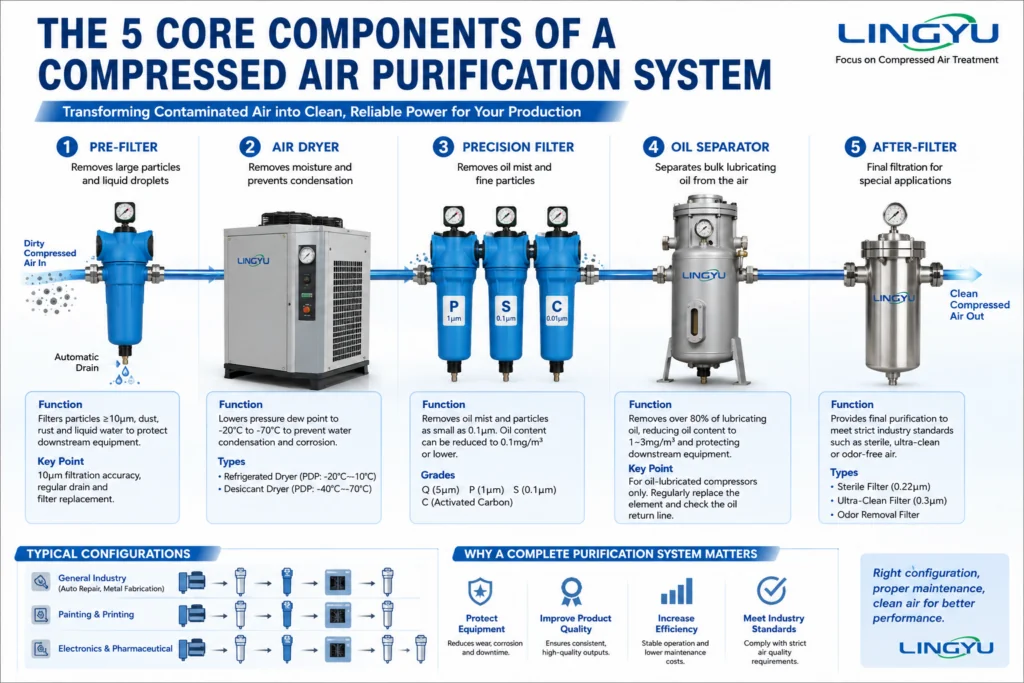
1. Pre-Filter
Primary Function: Protect Downstream Equipment
The pre-filter serves as an important first stage in a compressed air treatment system.
Its primary functions include:
- Removing solid particles from the compressed air
- Reducing liquid water and oil aerosols where applicable
- Protecting air dryers and downstream filters from excessive contamination
- Reducing the contaminant load on subsequent purification stages
The required filtration grade depends on compressor type, upstream separation, dryer configuration, and the final compressed air quality requirement.
How a Compressed Air Pre-Filter Works
Compressed air filters may use a combination of mechanical separation and coalescing filtration.
Depending on the filter design, particles are captured within the filter media while fine liquid droplets coalesce into larger droplets.
The collected liquid then moves toward the bottom of the filter housing and is discharged through a condensate drain.
The exact separation mechanism depends on the filter type and grade.
Pre-Filter Selection and Maintenance
Do not apply one universal filtration accuracy to every pre-filter.
Instead, select the filter according to:
- Contaminants that must be removed
- Compressor type
- Downstream equipment
- Required air quality
- Operating conditions
Lingyu’s precision compressed air filters include different filtration grades for different treatment stages.
Maintenance should be based on actual operating condition, condensate drainage, differential-pressure trend, and the filter manufacturer’s recommendations.
Avoid relying on universal rules such as replacing every filter element after a fixed number of months or replacing it whenever pressure drop reaches the same threshold in every compressed air system.
2. Air Dryer
Primary Function: Remove Moisture and Control Pressure Dew Point
Moisture is one of the most important contaminants in compressed air systems.
As compressed air cools, water vapor may condense into liquid water, potentially causing:
- Pipeline corrosion
- Rust inside pneumatic components
- Control and instrumentation problems
- Production-quality issues
The main function of an air dryer is to reduce the moisture content of compressed air to a pressure dew point appropriate for the downstream process and environmental conditions.
The correct pressure dew point should therefore be selected according to the actual application rather than applying a single value to all industrial systems.
Refrigerated Air Dryer
A refrigerated air dryer removes moisture by cooling compressed air.
The general process is:
Pre-Cooling → Refrigeration → Condensation → Moisture Separation → Reheating
Compressed air is first pre-cooled through heat exchange and then cooled further in the refrigeration section.
As its temperature decreases, water vapor condenses into liquid water. A separator removes the condensate, and the dry compressed air is reheated before leaving the dryer.
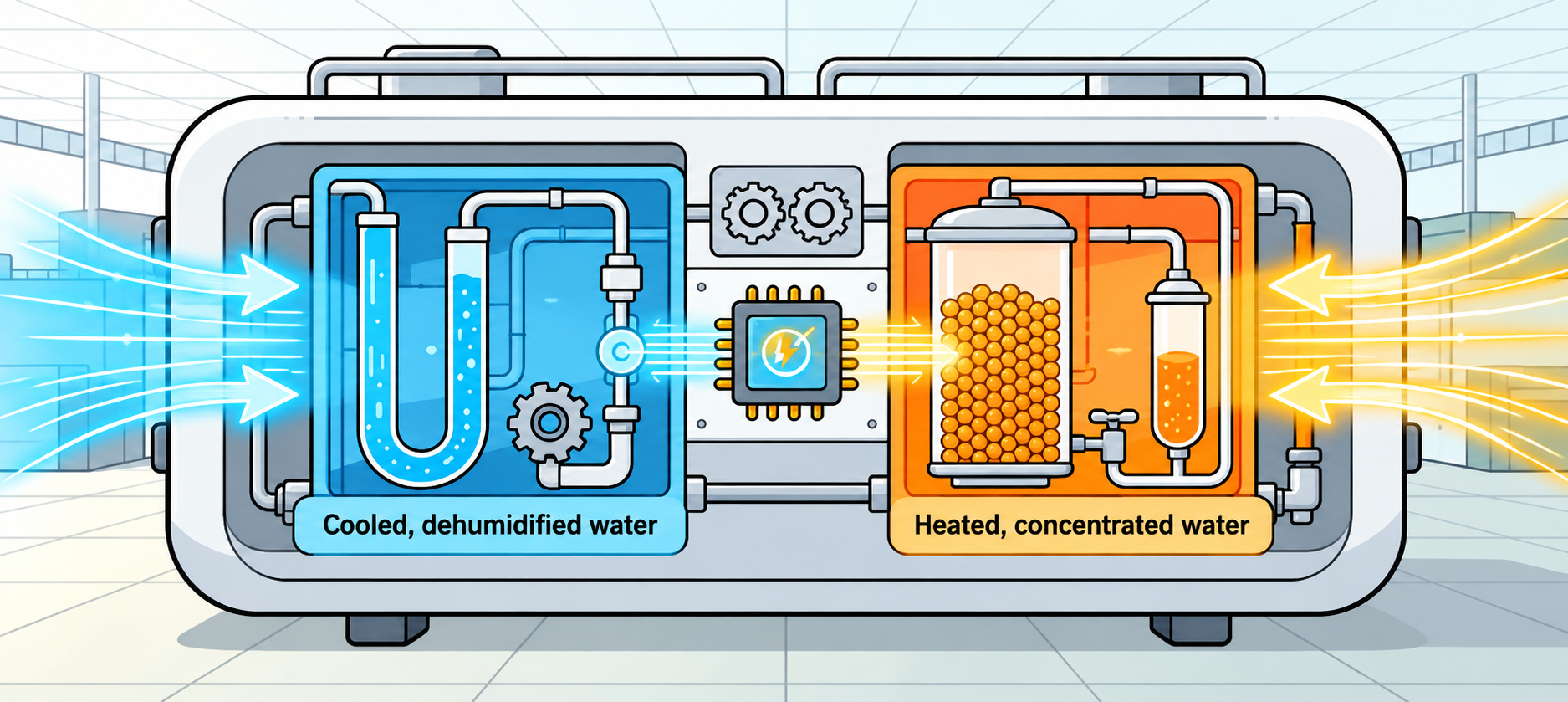
In Lingyu combined drying systems, for example, the refrigerated drying stage cools compressed air to a pressure dew point of approximately 2–10°C before the air enters the adsorption stage.
Refrigerated dryers are generally appropriate when a positive pressure dew point provides sufficient moisture protection.
Their advantages include relatively simple operation, low regeneration losses, and suitability for many general industrial applications.
Desiccant Air Dryer
A desiccant air dryer removes water vapor through adsorption.
Compressed air passes through a desiccant bed containing materials such as activated alumina or molecular sieve.
In twin-tower designs, one tower dries the compressed air while the other undergoes regeneration.
Depending on the dryer technology, regeneration may use:
- Dry compressed air purge
- Heated regeneration
- Blower-assisted regeneration
- Compressor discharge heat
Lingyu adsorption dryer configurations commonly provide outlet pressure dew points around −20°C or −40°C, while specifications vary by model and regeneration technology.
Desiccant dryers are therefore appropriate where the process requires a lower pressure dew point than a conventional refrigerated dryer can provide.
How to Select the Right Air Dryer
Choose the dryer according to:
Required Pressure Dew Point → Actual Airflow → Inlet Pressure → Inlet Temperature → Operating Conditions → Regeneration Method
The dryer should not simply be specified as 10–20% larger than the compressor by default.
Actual site conditions should be compared with the dryer’s rated conditions, and applicable correction factors or manufacturer sizing recommendations should be used where necessary.
For a broader comparison, see the complete guide to compressed air dryer types.
3. Precision Filter
Primary Function: Remove Fine Oil Aerosols and Particles
After bulk moisture removal and drying, additional filtration may still be required to remove fine particles and oil aerosols.
Precision filtration helps protect:
- Pneumatic components
- Painting and coating processes
- Instrumentation
- Sensitive production equipment
- Downstream adsorption dryers
- Point-of-use equipment
How a Precision Compressed Air Filter Works
Coalescing precision filters use specialized filter media to capture fine solid particles and bring very small liquid aerosols together into larger droplets.
These droplets migrate through the filter media and are collected for drainage.
Different filtration grades are used according to the required particle and oil-removal performance.
Lingyu Precision Filter Grades
| Filter Grade | Main Function | Particle Filtration | Residual Oil |
|---|---|---|---|
| AO | Pre-filtration | ≤1.0 μm | ≤3 ppm |
| AA | Oil and particulate removal | ≤0.1 μm | ≤0.1 ppm |
| AX | High-efficiency oil removal | ≤0.01 μm | ≤0.05 ppm |
| ACS | Activated-carbon oil removal | — | ≤0.003 ppm |
The required combination depends on the final compressed air quality requirement and system design.
It is not necessary to install every filtration grade in every compressed air system.
Precision Filter Maintenance
Filter condition should be monitored through:
- Differential-pressure indication
- Condensate drainage
- Air-quality performance
- Operating conditions
- Manufacturer recommendations
Lingyu precision filter designs include a differential-pressure indicator that helps show when filter-element replacement should be considered.
Fixed replacement intervals such as “every three months” or “every six months” should not be treated as universal requirements.
4. Moisture Separation and Condensate Management
Primary Function: Remove Bulk Condensate Before Sensitive Equipment
Liquid condensate should be removed efficiently before it reaches sensitive dryers, filters, pneumatic equipment, or production processes.
Depending on system design, moisture separation may take place through:
- Compressor aftercooling and separation
- Air receivers
- Air-water separators
- Refrigerated dryer separators
- Filter housings with automatic drains
This is different from the internal oil separator used inside an oil-injected compressor, which is primarily part of the compressor itself rather than a universal standalone compressed air purification component.
How Moisture Separation Works
When compressed air is cooled, water vapor condenses.
A suitable separator removes these liquid droplets from the airflow, after which condensate is discharged through an appropriate drain.
Effective condensate removal reduces the amount of liquid water entering downstream filters and adsorption dryers.
Condensate System Selection and Maintenance
The condensate-removal arrangement should be selected according to:
- Compressor type
- Airflow
- Operating pressure
- Condensate load
- Dryer configuration
- Drain requirements
Automatic drains should be checked regularly for blockage or malfunction because accumulated condensate can compromise treatment performance.
For oil-lubricated compressor systems, collected condensate may also require appropriate downstream oil-water treatment before disposal according to local requirements.
5. After-Filter
Primary Function: Final Treatment After the Air Dryer
An after-filter provides final filtration downstream of the dryer.
Its exact function depends on the dryer and process.
For adsorption dryers, an after-filter is commonly used to capture fine desiccant particles that may migrate from the adsorption bed.
In other applications, activated-carbon filtration may be added when further reduction of residual oil vapor is required.
The final filtration stage should therefore be selected according to actual air-quality requirements rather than assuming that every installation requires a sterile or HEPA-type filter.
High-Efficiency Particulate Filtration
High-efficiency particulate filtration can be used to capture fine particles and potential desiccant dust after adsorption drying.
The required filtration performance should be selected according to downstream air-quality requirements.
Activated Carbon Filtration
Activated-carbon filtration can be used when additional reduction of residual oil vapor is required.
Lingyu ACS activated-carbon filters, for example, are specified for residual oil levels of ≤0.003 ppm under the stated reference conditions.
After-Filter Selection and Maintenance
The correct after-filter depends on:
- Required particle cleanliness
- Required oil content
- Dryer type
- Process sensitivity
- Applicable industry requirements
Maintenance should follow actual filter condition, differential pressure, operating environment, and manufacturer instructions rather than a universal replacement or sterilization interval.
Typical Compressed Air Purification System Configurations
There is no single filtration sequence that is correct for every compressed air installation.
General-Purpose Compressed Air
A typical general-purpose system may follow a configuration such as:
Air Compressor → Air Receiver → Pre-Filtration → Refrigerated Air Dryer → Final Filtration
This type of arrangement may be suitable when a positive pressure dew point provides sufficient moisture protection.
Low-Dew-Point Compressed Air
Where a lower pressure dew point is required, the system may instead use:
Air Compressor → Air Receiver → Appropriate Pre-Filtration → Desiccant Air Dryer → After-Filter
The specific filtration grades and dryer configuration should be selected according to the required compressed air quality.
Combined Refrigerated and Adsorption Drying
For applications requiring deeper moisture removal while reducing the moisture load on the adsorption stage, a combined refrigerated and adsorption dryer can integrate both technologies.
In this type of system, the refrigerated stage first removes a large portion of the moisture before the compressed air enters the adsorption bed.
This reduces the moisture load on the adsorption system and can lower regeneration-air consumption.
The actual arrangement of filters, separators, dryers, and drains should always be adapted to the compressor and downstream air-quality requirement.
A Compressed Air Purification System Should Be Customized, Not Standardized
There is no universal compressed air purification configuration.
The correct system depends on several factors:
- Compressor type
- Actual airflow
- Operating pressure
- Inlet temperature
- Required pressure dew point
- Allowable oil content
- Required particle cleanliness
- Downstream application
The best approach is to define the required compressed air quality first and then select the necessary treatment stages.
A practical design sequence is:
Define Air Quality → Remove Bulk Condensate → Select Filtration → Select Drying Technology → Add Final Treatment Where Required
Avoid over-treatment, which can increase equipment cost, pressure drop, maintenance, and energy consumption.
At the same time, inadequate treatment can lead to equipment damage, process instability, and product defects.
A properly configured compressed air purification system coordinates moisture separation, drying, filtration, and condensate management so that each treatment stage supports the next.
For more detailed guidance on filter selection and maintenance, see the AO, AA, AX, and ACS compressed air filter guide.
For help matching a compressed air purification system to your required flow, pressure dew point, oil content, and particle cleanliness, contact Lingyu for technical support.