Industrial compressed-air systems can lose useful compressed air when conventional regenerative dryers consume dry product air during heating or cooling. In large compressor stations and continuous manufacturing facilities, reducing this regeneration-air loss can improve compressed-air utilization while maintaining the low pressure dew point required by downstream processes.
Lingyu’s HRB-Z Series Zero-Purge Blower-Heated Regenerative Desiccant Air Dryer uses ambient air, a blower, and an electric heater during thermal regeneration. During cooling, air circulates through an intercooler and the regeneration tower in a closed loop instead of consuming dry product air. Regeneration-air consumption is approximately 0%.
For users comparing different zero-purge configurations, Lingyu’s blower zero-purge adsorption dryer category covers the corresponding product family.
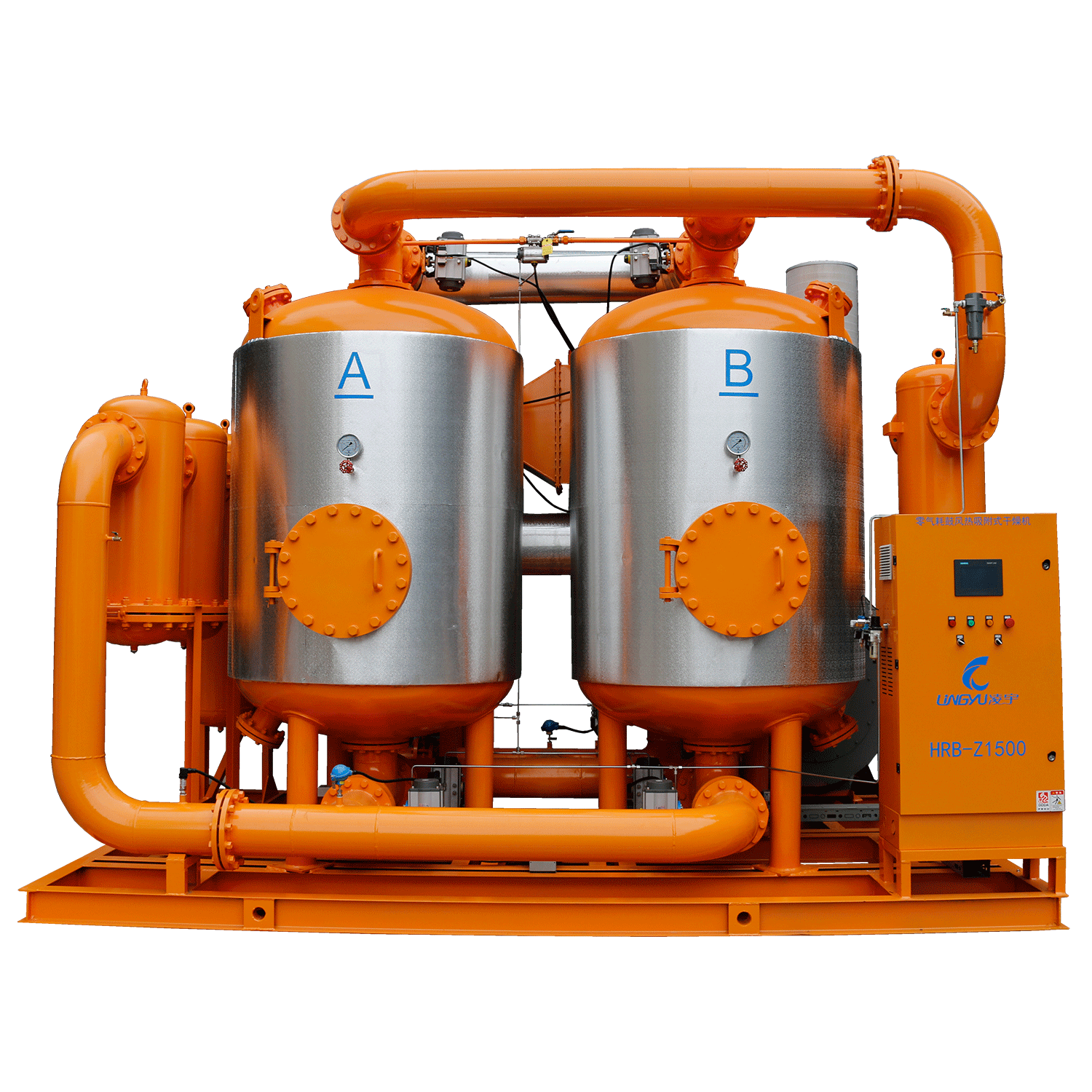
How HRB-Z Zero-Purge Regeneration Works
The HRB-Z combines blower-heated thermal regeneration with an intercooler-based closed-loop cooling process.
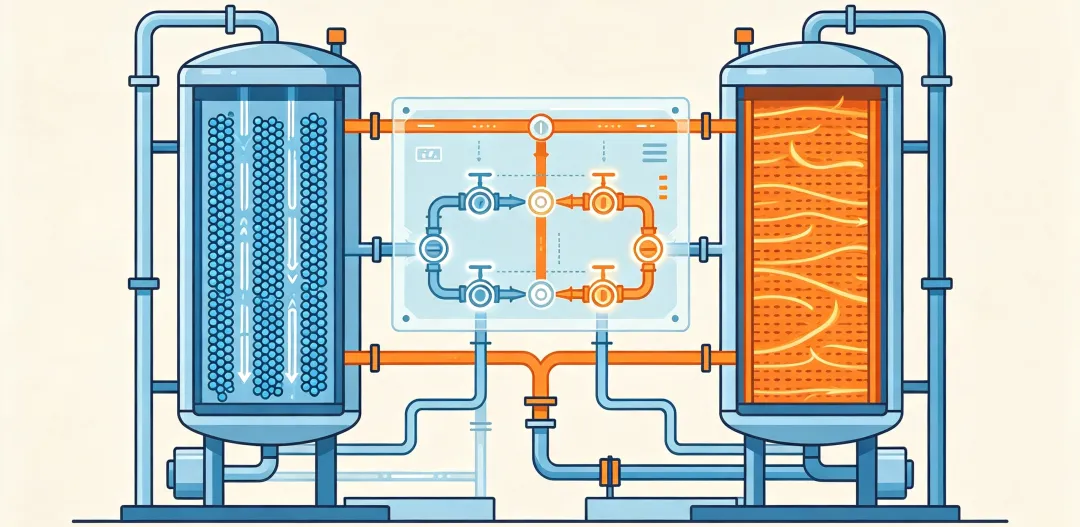
During normal operation, one adsorption tower dries the compressed air while the other tower proceeds through regeneration. After regeneration is completed, the towers switch functions to maintain continuous compressed-air treatment.
Heating and Desorption
During the heating stage, the blower draws ambient air into the system.
The air passes through an electric heater and then enters the regeneration tower. Thermal energy releases moisture previously adsorbed by the desiccant, and the moisture leaves the tower with the regeneration airflow.
Because ambient air provides the main regeneration flow, dry product air is not required for the heating and desorption process.
Closed-Loop Cooling
After thermal regeneration, the desiccant bed remains hot and must be cooled before it returns to adsorption service.
The HRB-Z does not use dry finished compressed air for this cooling stage. Instead, air continuously circulates between the intercooler and the regeneration tower.
Heat is removed as the circulating air passes through the cooler, and the cooled air returns to the desiccant bed. This closed-loop circulation allows the bed to cool without consuming dry product air.
Why HRB-Z Achieves Approximately 0% Regeneration-Air Consumption
The zero-purge characteristic of the HRB-Z comes primarily from the combination of ambient-air heating and closed-loop cooling.
Dry product air is not required during either the main heating stage or the closed-loop cooling stage. As a result:
Regeneration-air consumption: ≈0%
This is the main technical distinction between the HRB-Z and the HRB-E low-purge blower-heated dryer.
| Configuration | Heating | Cooling | Regeneration-Air Consumption |
|---|---|---|---|
| HRB-E Low-Purge | Ambient air + blower + heater | Dry product air | 2–3% |
| HRB-Z Zero-Purge | Ambient air + blower + heater | Closed-loop intercooler circuit | ≈0% |
The HRB-E uses approximately 2% of system airflow as dry product air during cooling, while total regeneration-air consumption is 2–3%. The HRB-Z replaces this cooling purge with the closed-loop intercooler arrangement.
HRB-Z Operating Conditions
The HRB-Z Series operates within the following standard conditions:
| Parameter | Specification |
|---|---|
| Applicable medium | Compressed air / non-corrosive air |
| Rated inlet pressure | 0.7 MPa |
| Operating pressure range | 0.6–1.0 MPa |
| Rated inlet temperature | 10–30°C |
| Maximum inlet temperature | ≤40°C |
| Inlet-air dew point | ≤25°C |
| Regeneration-air consumption | ≈0% |
| Outlet pressure dew point | −20°C / −40°C optional |
| Rated ambient temperature | 35°C |
| Ambient operating range | 2–40°C |
| Cooling-water temperature | ≤32°C |
| Cooling-water pressure | 0.2–0.6 MPa |
Other pressure ratings can be configured according to project requirements.
The actual inlet pressure, temperature, moisture load, outlet dew-point requirement, and cooling conditions should all be considered during dryer sizing.
HRB-Z Model Range
The HRB-Z Series covers a standard airflow range from 13.5 to 260 m³/min.
| Model | Airflow | Air Connection | Installed Power | Dimensions |
|---|---|---|---|---|
| HRB-ZW/A100 | 13.5 m³/min | DN65 | 12.1 kW | 1955 × 1040 × 2350 mm |
| HRB-ZW/A180 | 25.0 m³/min | DN80 | 19.5 kW | 2148 × 1197 × 2437 mm |
| HRB-ZW/A400 | 45.0 m³/min | DN100 | 36.5 kW | 2477 × 1500 × 2825 mm |
| HRB-ZW/A700 | 75.0 m³/min | DN125 | 57.5 kW | 3030 × 1940 × 2888 mm |
| HRB-ZW/A1200 | 120 m³/min | DN150 | 77.5 kW | 3570 × 2319 × 3130 mm |
| HRB-ZW/A1600 | 165 m³/min | DN200 | 143 kW | 3590 × 2800 × 3380 mm |
| HRB-ZW/A2600 | 260 m³/min | DN250 | 257.5 kW | 4800 × 3000 × 3450 mm |
For capacities above 260 m³/min or applications involving special materials, pressure ratings, temperatures, or other operating requirements, the equipment can be configured for the specific project.
HRB-ZW/A1600 Capacity
The HRB-ZW/A1600 has an airflow capacity of 165 m³/min, with a DN200 connection, installed power of 143 kW, and dimensions of 3590 × 2800 × 3380 mm.
The correct standard capacity for this model is therefore 165 m³/min rather than 160 m³/min.
HRB-ZW and HRB-ZA Cooling Configurations
The HRB-Z Series is available with two cooling configurations:
HRB-ZW — water-cooled
HRB-ZA — air-cooled
The cooling method should be selected according to site utilities, ambient conditions, installation requirements, and system design.
HRB-ZW Water-Cooled Configuration
For the water-cooled version:
Cooling-water temperature: ≤32°C
Cooling-water pressure: 0.2–0.6 MPa
These requirements apply specifically to the water-cooled configuration.
HRB-ZA Air-Cooled Configuration
The HRB-ZA provides an air-cooled alternative where cooling-water availability or site conditions make air cooling more suitable.
The final cooling configuration should be selected according to the conditions of the compressed-air station.
Closed-Loop Cooling and Zero-Purge Operation
The intercooler is a key part of the HRB-Z zero-purge process rather than simply an auxiliary cooling component.
After hot-air regeneration, the desiccant must be cooled before it can efficiently adsorb moisture again.
In the HRB-Z, air repeatedly circulates through the regeneration tower and intercooler. Heat is removed from the circulating air, allowing the desiccant bed to cool without sacrificing dry compressed air.
This cooling architecture is the main engineering mechanism behind the approximately 0% regeneration-air consumption.
Energy-Saving Control
The HRB-Z uses Lingyu’s EBZ200-2 multi-core control system.
Compared with conventional fixed-cycle operation, the control strategy can reduce overall energy consumption by more than 10% under the applicable operating and comparison conditions.
Actual energy performance depends on airflow, operating load, regeneration demand, ambient conditions, cooling conditions, and operating schedule. The >10% figure therefore reflects performance under the corresponding operating conditions rather than a fixed saving for every installation.
Optional Dew-Point-Based Control
For compressed-air systems with fluctuating demand, optional dew-point-based control can further optimize the adsorption and regeneration cycle.
Instead of switching strictly according to a fixed time cycle, the system can extend the adsorption period according to actual moisture demand.
Under suitable fluctuating-load conditions, this operating strategy can reduce overall energy consumption by more than 30% compared with fixed-cycle operation.
Actual savings depend on the operating profile, so the >30% value should be evaluated in relation to the application and load conditions.
High-Performance Desiccant
The HRB-Z uses customized high-performance desiccant with a 20% additional filling allowance.
The additional filling capacity supports adsorption performance and long-term operation.
Desiccant service condition depends on factors such as inlet contamination, liquid-water carryover, moisture loading, operating temperature, regeneration quality, airflow distribution, desiccant dusting, and total operating hours.
For this reason, desiccant condition should be evaluated through routine inspection and operating performance rather than relying on one universal replacement interval.
Blower, Valves, and Cooler
Reliable zero-purge regeneration depends on coordinated operation of the blower, heater, pneumatic valves, and cooling system.
High-Pressure Blower
The high-pressure blower provides the airflow required for thermal regeneration and closed-loop cooling.
Stable blower performance helps maintain the regeneration airflow required through the desiccant bed.
High-Performance Pneumatic Valves
Pneumatic valves switch the airflow paths as the two adsorption towers alternate between drying and regeneration.
Reliable switching is important for maintaining pressure stability and ensuring that heating, cooling, adsorption, and tower-changeover stages operate correctly.
High-Efficiency Cooler
The HRB-Z uses a high-efficiency cooler designed with HTFS thermal-design software.
During closed-loop cooling, the cooler removes heat from the circulating air before the air returns to the regeneration tower.
Cooling performance therefore directly affects the ability of the system to complete the zero-purge cooling process.
Airflow Distribution
The HRB-Z incorporates 304 stainless-steel control-air piping and a specially designed flow distributor.
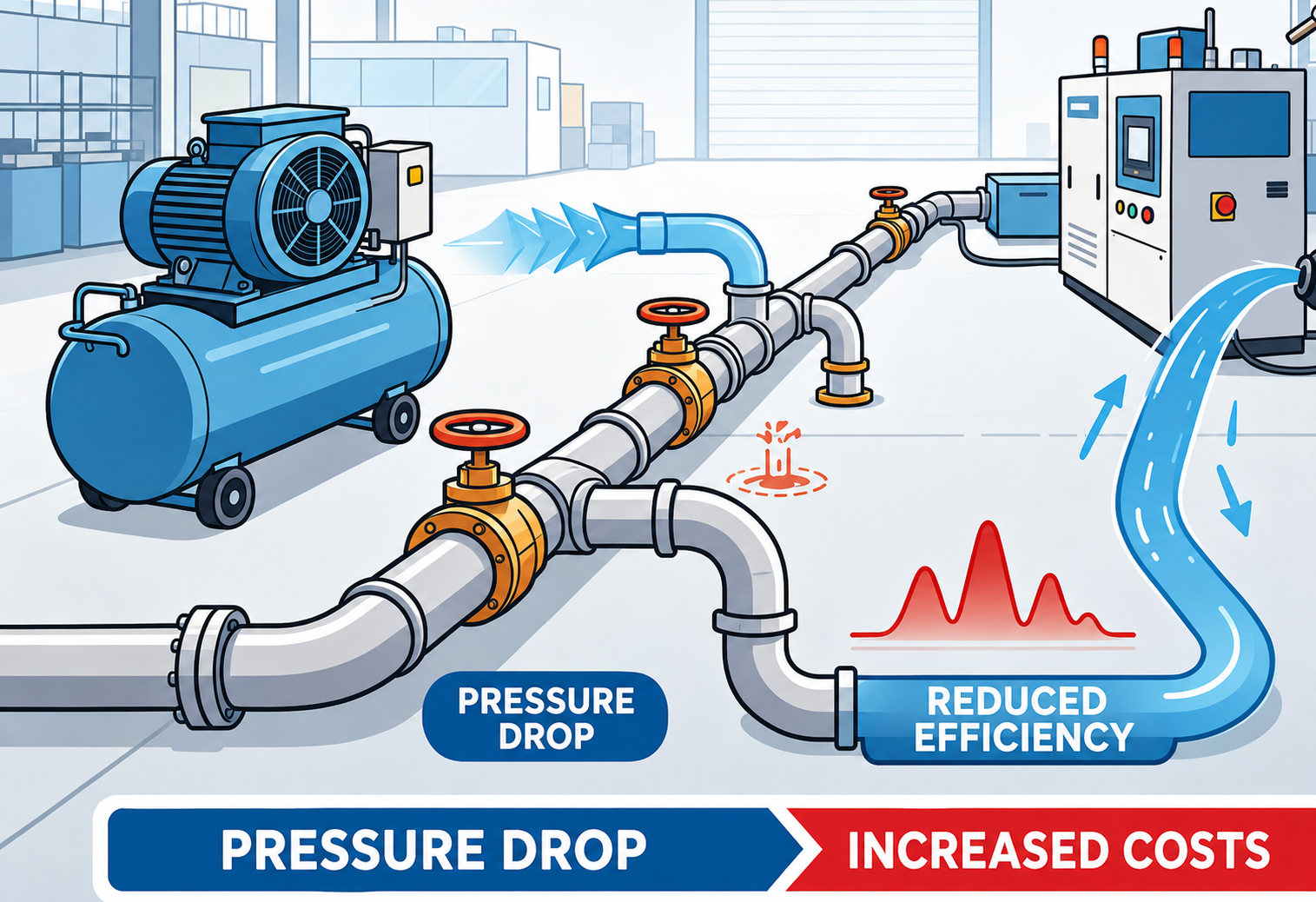
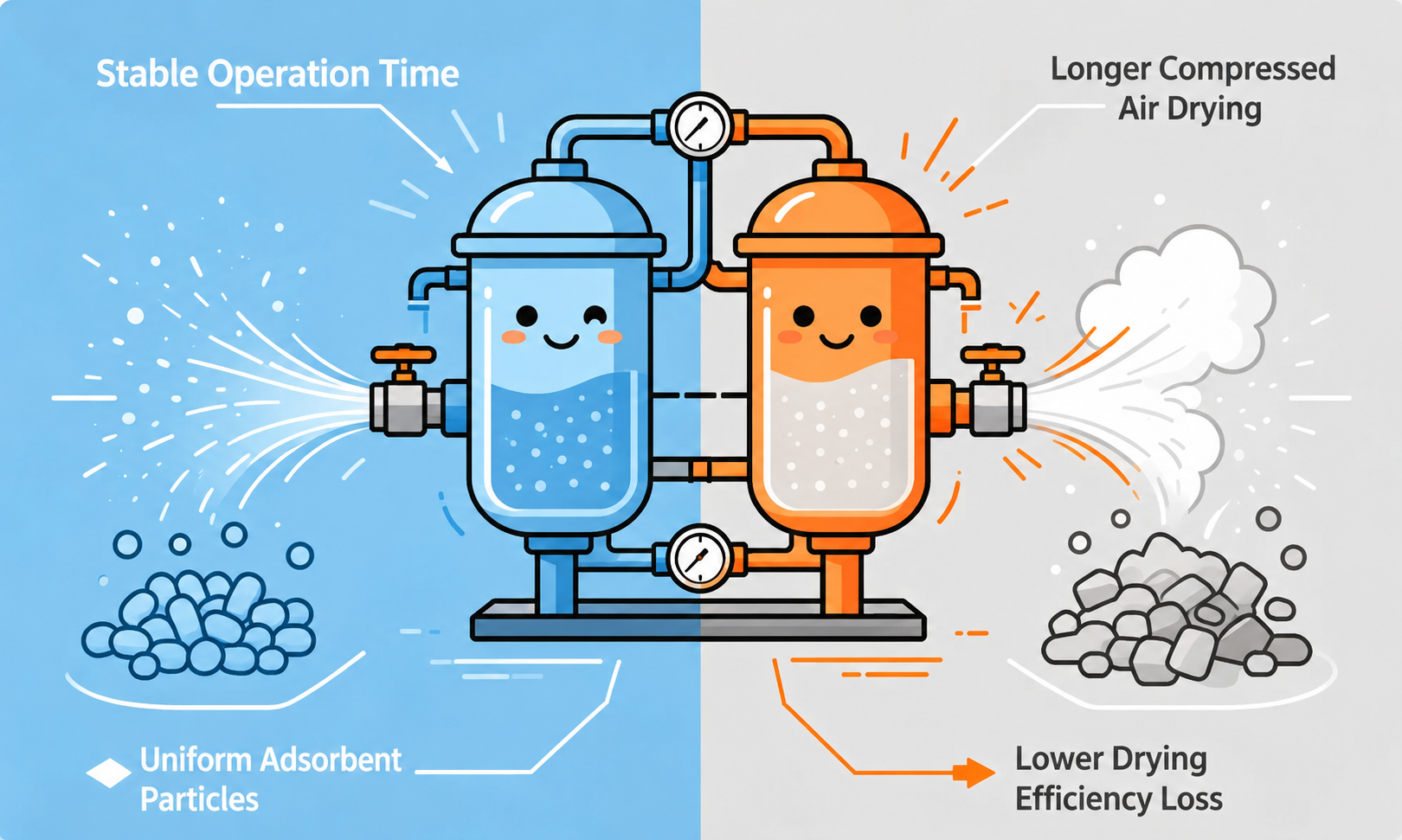
Effective airflow distribution improves utilization of the desiccant bed while helping maintain low compressed-air pressure drop.
Uneven airflow can create localized desiccant loading, uneven adsorption, and less effective regeneration. For high-capacity adsorption dryers, flow distribution and vessel internals are therefore important parts of the overall drying process.
Monitoring and Control
The HRB-Z provides centralized monitoring of important operating conditions.
7-Inch MCGS Touchscreen
The dryer is equipped with a 7-inch MCGS touchscreen programmable controller.
Operating parameters available for monitoring include:
- Compressed-air outlet temperature
- Heating temperature
- Regeneration exhaust temperature
- Tower A/B pressure
- Blower pressure
- Optional pressure dew point
These parameters allow operators to monitor both adsorption and regeneration conditions through a central interface.
Communication Options
RS-485 communication is standard.
IoT connectivity and other communication solutions are also available according to customer requirements.
For centralized compressor stations, these communication functions can support integration of dryer operating data into plant supervisory and control systems.
Pressure Dew Point Selection
The HRB-Z Series offers −20°C and −40°C outlet pressure dew point configurations.
The appropriate pressure dew point should be selected according to the moisture sensitivity of downstream equipment and processes.
A lower dew point is not automatically necessary for every application. Required air quality, inlet moisture load, capacity, regeneration requirements, and process conditions should be evaluated together.
Why Inlet Air Conditions Matter
Adsorption-dryer sizing should not be based on nominal airflow alone.
The HRB-Z has:
Rated inlet pressure: 0.7 MPa
Operating pressure range: 0.6–1.0 MPa
Rated inlet temperature: 10–30°C
Maximum inlet temperature: ≤40°C
Inlet-air dew point: ≤25°C
Higher inlet temperature or moisture loading increases the amount of water that the adsorption system must handle.
Airflow, pressure, inlet temperature, inlet dew point, outlet pressure dew point, and load variation should therefore be considered together during equipment selection.
Filtration and Desiccant Protection
Zero-purge regeneration reduces compressed-air consumption during regeneration, but it does not replace filtration.
Oil aerosols, liquid water, and particles can affect desiccant performance, valve reliability, airflow distribution, and downstream compressed-air quality.
Where additional contamination control is required, Lingyu’s precision compressed air filters can be integrated into the compressed-air treatment system.
Filter grade and arrangement should be selected according to compressor type, inlet contamination, and required downstream air quality.
Industrial Applications
With airflow capacities extending to 260 m³/min and installed power reaching 257.5 kW, the HRB-Z Series is suitable for centralized industrial compressed-air systems and continuous manufacturing facilities.
One large zero-air-loss blower-heated project uses 10 × 65 m³/min regenerative adsorption dryers. The project requirements include:
Pressure dew point: ≤−40°C
Regeneration-air consumption: 0%
The system also incorporates optimized airflow distribution, dew-point/time-based control, touchscreen controls, and centralized-system integration.
These characteristics support the use of zero-purge blower-heated adsorption dryers in industrial plants where compressed-air efficiency, stable low-dew-point performance, and continuous operation are important.
For electronics-related production environments, users can review Lingyu’s semiconductor and PCB manufacturing application.
HRB-Z vs. HRB-E
Both HRB-Z and HRB-E use a blower and heater during thermal regeneration, but they use different cooling methods.
HRB-E Low-Purge Blower-Heated Dryer
The HRB-E uses ambient air supplied by a blower and heated during regeneration.
During cooling, approximately 2% of system airflow is used as dry product air.
Overall regeneration-air consumption is 2–3%.
HRB-Z Zero-Purge Blower-Heated Dryer
The HRB-Z also uses ambient air, a blower, and an electric heater during regeneration.
During cooling, however, air circulates through the intercooler and regeneration tower in a closed loop.
Dry product air is not used for cooling, and regeneration-air consumption is approximately 0%.
The cooling architecture is therefore the main technical distinction between the two systems.
HRB-Z vs. HOC-Z
HRB-Z and HOC-Z can both operate without a conventional dry-air regeneration purge, but their regeneration heat sources are fundamentally different.
HRB-Z
HRB-Z uses an electric heater, blower, and ambient air for thermal regeneration.
HOC-Z
HOC-Z uses heat contained in high-temperature compressor discharge air.
Because the heat source and regeneration architecture are different, these systems should be evaluated separately when selecting an adsorption dryer.
How to Select an HRB-Z Zero-Purge Dryer
Selecting the correct dryer requires evaluation of the entire compressed-air operating profile rather than nominal flow alone.
Airflow and Operating Pressure
Confirm the required airflow and actual operating pressure.
The standard airflow range is 13.5–260 m³/min, the rated inlet pressure is 0.7 MPa, and the operating pressure range is 0.6–1.0 MPa.
Inlet Temperature and Moisture Load
Confirm both inlet temperature and inlet-air dew point.
The rated inlet temperature is 10–30°C, the maximum inlet temperature is ≤40°C, and the inlet-air dew point is ≤25°C.
Required Outlet Pressure Dew Point
Select either the −20°C or −40°C configuration according to downstream process requirements.
Minimum, Normal, and Maximum Load
Compressed-air demand often varies over time.
Minimum, normal, and maximum airflow should therefore be considered during selection. Applications with substantial load variation may also benefit from dew-point-based control.
Cooling Method
Determine whether the installation requires an HRB-ZW water-cooled configuration or an HRB-ZA air-cooled configuration.
For the water-cooled version, confirm cooling-water temperature of ≤32°C and pressure of 0.2–0.6 MPa.
Electrical Power and Installation Space
Installed power ranges from 12.1 kW for the HRB-ZW/A100 to 257.5 kW for the HRB-ZW/A2600.
Installation space should also be evaluated against the dimensions of the selected model.
Filtration Requirements
Define upstream and downstream filtration according to compressor type, contamination level, and required compressed-air quality.
Protecting the desiccant from liquid water, oil aerosols, and excessive particulate contamination is important for stable operation.
Control and Communication Requirements
Confirm requirements for the 7-inch MCGS touchscreen, RS-485 communication, optional IoT connectivity, pressure dew point monitoring, dew-point-based control, and plant supervisory-system integration.
Redundancy Strategy
For critical continuous-production systems, redundancy should be evaluated as part of the compressed-air station design.
The complete HRB-Z range can be reviewed on Lingyu’s blower zero-purge adsorption dryer page.
For capacities above 260 m³/min or special pressure, temperature, material, cooling, control, or installation requirements, the dryer configuration should be selected according to the specific project conditions.
Conclusion
The HRB-Z Series Zero-Purge Blower-Heated Regenerative Desiccant Air Dryer combines ambient-air thermal regeneration with closed-loop cooling to achieve approximately 0% regeneration-air consumption.
During heating, ambient air is drawn in by the blower, heated by the electric heater, and passed through the regeneration tower to remove moisture from the desiccant. During cooling, air circulates through the intercooler and regeneration tower in a closed loop without consuming dry finished compressed air.
Standard operating conditions include a rated inlet pressure of 0.7 MPa, an operating pressure range of 0.6–1.0 MPa, a rated inlet temperature of 10–30°C, a maximum inlet temperature of ≤40°C, an inlet-air dew point of ≤25°C, and −20°C / −40°C outlet pressure dew point options.
The standard airflow range extends from 13.5 to 260 m³/min, with water-cooled HRB-ZW and air-cooled HRB-ZA configurations available for different site conditions.
The EBZ200-2 control system, optional dew-point-based energy control, 20% additional desiccant filling allowance, 304 stainless-steel control-air piping, high-performance pneumatic valves, high-efficiency cooler, 7-inch MCGS touchscreen, RS-485 communication, and optional IoT connectivity provide the monitoring and control functions required for large industrial compressed-air installations.