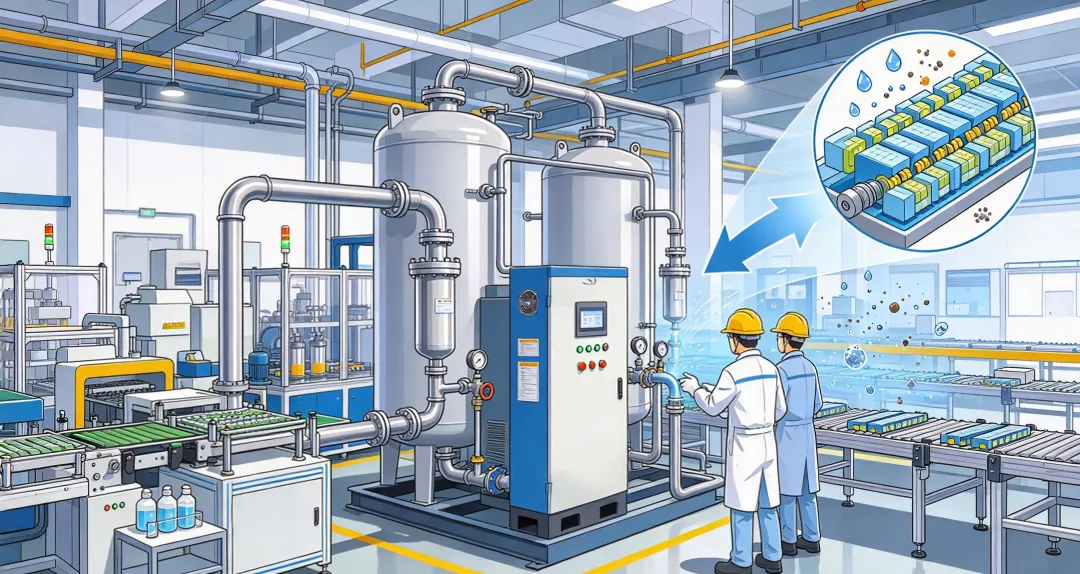
A desiccant air dryer does far more than simply alternate compressed air between two vessels.
Continuous drying depends on the coordinated control of adsorption, regeneration, airflow distribution, depressurization, repressurization, valve sequencing, and—in heated regeneration systems—heating and cooling.
The operating principle is often summarized as:
One tower dries while the other regenerates.
Although this description is correct, actual dryer performance depends on how effectively the complete adsorption-regeneration cycle is controlled.
This article explains how a twin-tower regenerative dryer maintains a continuous supply of dry compressed air and examines the engineering factors that influence pressure dew point, energy consumption, reliability, and desiccant life.
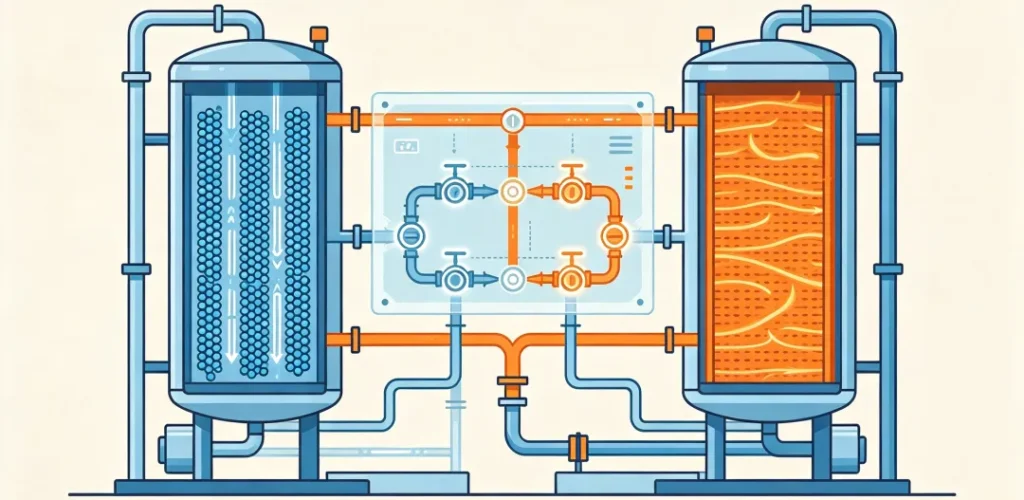
1. How the Twin-Tower Adsorption and Regeneration Cycle Works
A twin-tower dryer contains two adsorption vessels filled with desiccant.
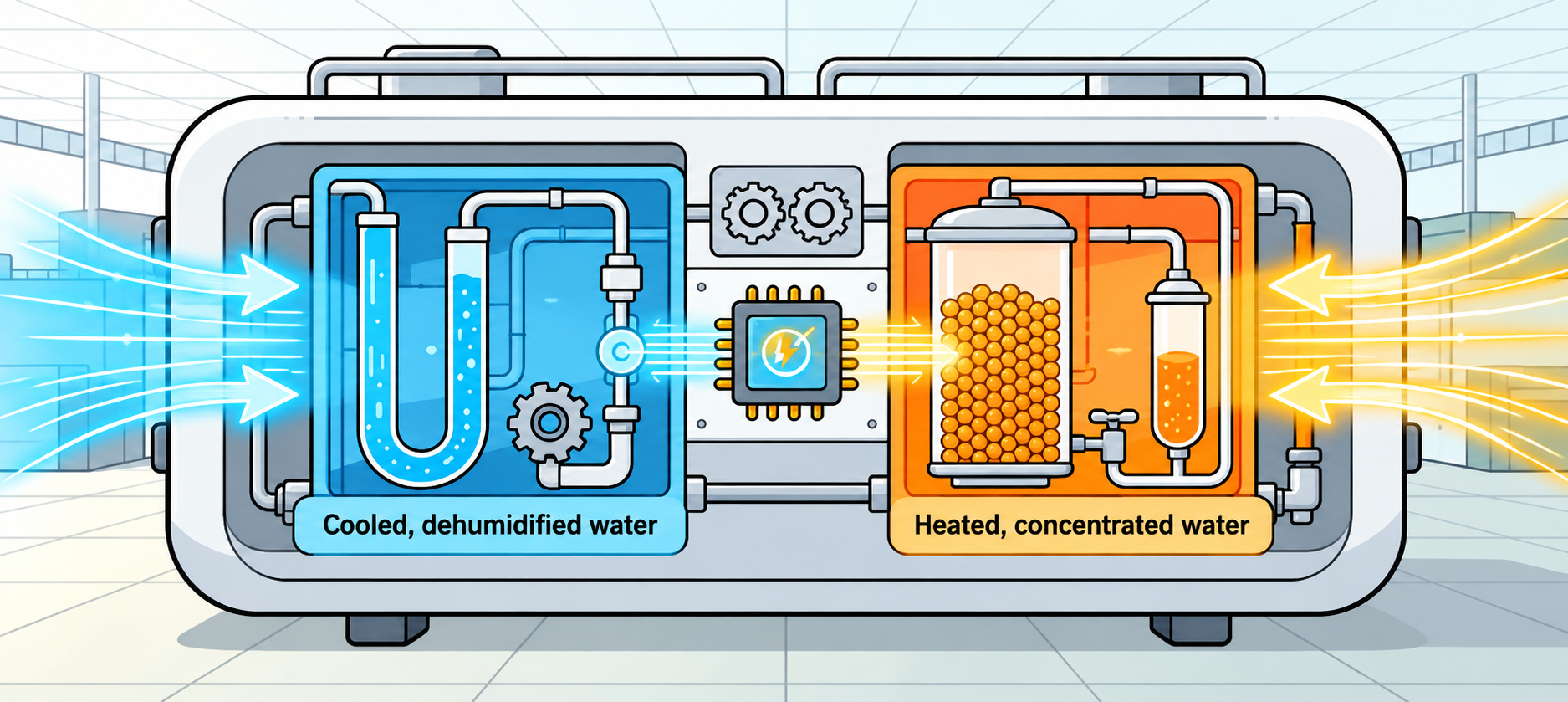
While one tower removes water vapor from the compressed air, the second tower restores the adsorption capacity of its desiccant through regeneration.
When regeneration is complete and the appropriate switching conditions are reached, the two towers exchange functions.
| Cycle Stage | Main Process | Key Factors to Monitor | Possible Problems |
|---|---|---|---|
| Adsorption | Water vapor is adsorbed by the desiccant while dry air flows downstream | Inlet temperature, pressure, flow distribution, outlet pressure dew point | Channeling, contamination, desiccant deterioration |
| Depressurization & Regeneration | The off-line tower is depressurized and moisture is removed from the desiccant | Regeneration airflow, temperature where applicable, exhaust condition, cycle duration | Insufficient regeneration, restricted exhaust, valve leakage |
| Cooling | Used where heated desiccant must be cooled before returning to adsorption | Cooling airflow, temperature, duration | Incomplete cooling, temporary dew-point deterioration |
| Repressurization | Pressure in the regenerated vessel is restored before switching | Tower pressure, equalization sequence, valve response | Pressure shock, unstable switching |
| Tower Switching | Valves redirect compressed air so the regenerated tower begins adsorption | Controller sequence, pneumatic valves, actuators, pressure balance | Valve sticking, incorrect timing, abnormal tower switching |
The exact sequence varies according to the regeneration technology.
Heatless dryers use pressure-swing regeneration and generally do not require a separate thermal cooling stage. Heated regeneration systems, by contrast, normally need to cool the desiccant after heated desorption before the tower returns to adsorption.
The key objective remains the same:
One tower must be ready to take over adsorption before the operating tower reaches the end of its effective adsorption cycle.
This preparation allows a twin-tower system to maintain a continuous supply of dry compressed air.
2. Airflow Distribution Is Critical to Desiccant Utilization
Even if a dryer contains sufficient desiccant, poor airflow distribution can prevent the entire adsorption bed from being used effectively.
Compressed air should pass through the desiccant bed as uniformly as possible.
Well-designed flow distributors and internal structures help prevent excessive flow concentration in individual areas of the bed.
Poor airflow distribution may cause a phenomenon known as channeling.
When channeling occurs, compressed air preferentially follows lower-resistance paths through the desiccant instead of flowing uniformly through the entire bed.
This can cause:
- Premature moisture breakthrough
- Unstable outlet pressure dew point
- Reduced effective adsorption capacity
- Shortened adsorption cycles
- Increased regeneration demand
- Uneven desiccant loading
- Accelerated desiccant deterioration
For a more detailed explanation, see how to prevent channeling in a desiccant air dryer.
Airflow distribution therefore affects not only dew-point performance but also the effective utilization and service life of the desiccant.
3. Desiccant Selection Also Affects Dryer Performance
Different desiccant materials provide different adsorption characteristics, mechanical strength, and moisture-removal performance.
Depending on the dryer design and required pressure dew point, an adsorption bed may use activated alumina, molecular sieve, or a combination of desiccant materials.
Some Lingyu regenerative dryer configurations use activated alumina together with high-performance molecular sieve.
The correct desiccant arrangement depends on factors such as:
- Required pressure dew point
- Inlet moisture load
- Regeneration method
- Operating temperature
- Airflow
- Mechanical durability requirements
The purpose is not simply to maximize the amount of desiccant inside the vessel.
The objective is to achieve stable adsorption performance while maintaining good airflow distribution and minimizing attrition and dust generation.
Desiccant condition is also important throughout the operating life of the dryer. Excessive mechanical degradation can generate dust and contribute to downstream contamination or pressure loss.
For related maintenance guidance, see how to prevent desiccant dust carryover in an adsorption air dryer.
4. Reliable Valves Make Continuous Tower Switching Possible
Switching valves and pneumatic actuators are among the most important mechanical components in a twin-tower adsorption system.
During every cycle, they must repeatedly open and close in the correct sequence to control:
- Wet-air inlet
- Dry-air outlet
- Regeneration airflow
- Exhaust
- Pressure equalization
- Tower repressurization
The valve system must therefore provide reliable sealing, fast and repeatable response, stable actuation, long cycle life, and correct coordination with the controller.
Internal valve leakage can be particularly harmful.
If a valve does not seal correctly, compressed air may enter the regenerating tower at the wrong time, regeneration air may be lost, or the pressure relationship between Tower A and Tower B may become unstable.
This can affect both energy consumption and pressure dew point.
Why Pressure Equalization Matters
The towers should not simply exchange functions under uncontrolled differential pressure.
Before switching, the regenerated vessel should be repressurized according to the designed control sequence.
Pressure equalization helps reduce sudden pressure changes and mechanical shock during the transition.
Lingyu heatless and heated-purge regenerative dryers use automatic repressurization before valve switching to help stabilize vessel pressure and reduce pressure fluctuations.
If tower switching becomes irregular, see how to troubleshoot abnormal switching in a desiccant air dryer.
5. Regeneration Is What Makes Continuous Adsorption Possible
The adsorption tower cannot remove moisture indefinitely.
As the desiccant captures water vapor, its remaining adsorption capacity gradually decreases.
Regeneration restores that capacity so the tower can be used again.
Different dryer technologies accomplish this in different ways.
| Regeneration Technology | Main Regeneration Method | Typical Lingyu Configuration | Main Characteristic |
| Heatless | Dry compressed air expanded to low pressure | Approx. 8–14% purge air on HH heatless models | Simple regeneration system |
| Heated Purge | External heating plus dry purge air | Approx. 4–8% purge air depending on series | Lower compressed-air demand than heatless |
| Low-Purge Blower-Heated | Heated ambient air plus limited dry-air cooling purge | Approx. 2–3% regeneration air on HRB-E | Significantly reduces compressed-air loss |
| Zero-Purge Blower-Heated | Heated ambient air with closed-loop cooling | Approx. 0% regeneration air on HRB-Z configuration | Eliminates dry-product-air regeneration loss under specified conditions |
| Heat of Compression | Uses compressor discharge heat | Low-purge and zero-purge configurations available | Recovers available compression heat |
Actual performance depends on the model, pressure, inlet temperature, required pressure dew point, operating conditions, and configuration.
Heatless Regeneration
A heatless regenerative dryer operates according to pressure-swing adsorption.
A portion of the dry compressed air is expanded to a lower pressure and passed through the regenerating tower.
The purge air provides the low water-vapor partial pressure needed for desorption and carries the released moisture out of the dryer.
The design is mechanically straightforward because no external regeneration heater is required.
Its main trade-off is compressed-air consumption.
Lingyu HH Series heatless dryers, for example, are specified with average purge-air consumption of 8–14% under their rated operating conditions.
Heated-Purge Regeneration
A heated regeneration system introduces external heat to assist moisture desorption.
Because thermal energy helps release moisture from the desiccant, less dry compressed air is generally required than with heatless regeneration.
Lingyu heated-purge configurations are available with purge consumption of approximately 4–8%, depending on the series and operating conditions.
Unlike heatless regeneration, heated regeneration also requires the desiccant bed to be cooled before returning to adsorption.
This means regeneration quality depends not only on heating but also on adequate cooling.
Blower-Heated Regeneration
A blower-heated adsorption dryer uses a blower to draw ambient air through a heater and then passes the heated air through the regeneration tower.
This reduces dependence on dry compressed air for regeneration.
Lingyu’s HRB-E low-purge blower-heated design uses only a small amount of dry product air during cooling, with specified regeneration-air consumption of approximately 2–3%.
Zero-purge blower-heated configurations use a closed-loop cooling process and are designed to avoid consuming dry product air during regeneration under specified operating conditions.
These technologies are particularly attractive for higher-flow, continuous compressed-air systems where purge-air losses can represent a substantial operating expense.
Heat-of-Compression Regeneration
Heat-of-compression systems use thermal energy already present in high-temperature compressor discharge air.
Instead of producing regeneration heat entirely from an electric heater, the dryer recovers compressor heat to desorb moisture from the desiccant.
Lingyu offers both low-purge and zero-purge HOC configurations.
In suitable systems, this approach can significantly reduce regeneration energy consumption.
However, HOC dryer performance depends strongly on compressor discharge temperature, compressor type, load profile, and overall system integration.
6. Regeneration Airflow Must Be Correctly Controlled
More regeneration air does not automatically mean better dryer performance.
Too little regeneration airflow can leave excessive moisture in the desiccant, while unnecessary purge airflow wastes compressed air and increases operating cost.
The correct setting depends on the specific dryer design and regeneration technology.
Important variables include:
- Inlet pressure
- Inlet temperature
- Airflow
- Required pressure dew point
- Regeneration temperature
- Cycle duration
- Cooling method
- Desiccant condition
For additional guidance, see how to adjust regeneration airflow in an adsorption dryer.
7. Dew Point Demand Control Can Reduce Unnecessary Regeneration
Traditional dryers may operate using fixed adsorption and regeneration cycles.
This approach is simple and predictable, but compressed-air demand is often not constant.
When the plant operates at partial load, the desiccant bed may still have considerable unused adsorption capacity when a fixed timer initiates the next switching cycle.
Dew point demand control can help address this problem.
Instead of switching solely according to elapsed time, the control system uses actual dew-point conditions to determine when the adsorption cycle should be extended or regeneration should occur.
Depending on the dryer design, this may reduce:
- Unnecessary purge-air consumption
- Heater operating time
- Blower operating time
- Switching frequency
- Overall regeneration energy
Some Lingyu energy-saving regenerative dryer configurations use dew-point-based control to extend adsorption cycles according to actual operating demand.
The result is a dryer that responds more closely to the real moisture load rather than continuously operating according to a worst-case fixed cycle.
8. Preventive Maintenance Helps Maintain Stable Alternating Operation
Continuous drying depends on more than the condition of the desiccant itself.
The complete dryer system should be monitored.
Important components include:
- Desiccant
- Switching valves
- Pneumatic actuators
- Solenoid valves
- Check valves
- Silencers
- Filters
- Pressure sensors
- Temperature sensors
- Dew-point instrumentation
- Controller and PLC
- Pneumatic control tubing
Monitor Pressure Dew Point
A gradual deterioration in outlet pressure dew point may indicate:
- Insufficient regeneration
- Excessive inlet temperature
- Desiccant contamination
- Desiccant deterioration
- Valve leakage
- Incorrect regeneration airflow
- Inadequate cooling in heated systems
Dew-point trends are generally more useful than reacting only after the dryer can no longer meet the required specification.
Monitor Pressure Drop
Increasing pressure loss through the dryer may indicate:
- Desiccant dust accumulation
- Contamination
- Upstream filter blockage
- Airflow restriction
- Valve problems
- Internal mechanical deterioration
Alarm limits should be based on the specific dryer design and equipment requirements rather than applying one universal differential-pressure value.
If pressure loss continues to increase, see what to do when adsorption dryer pressure drop is too high.
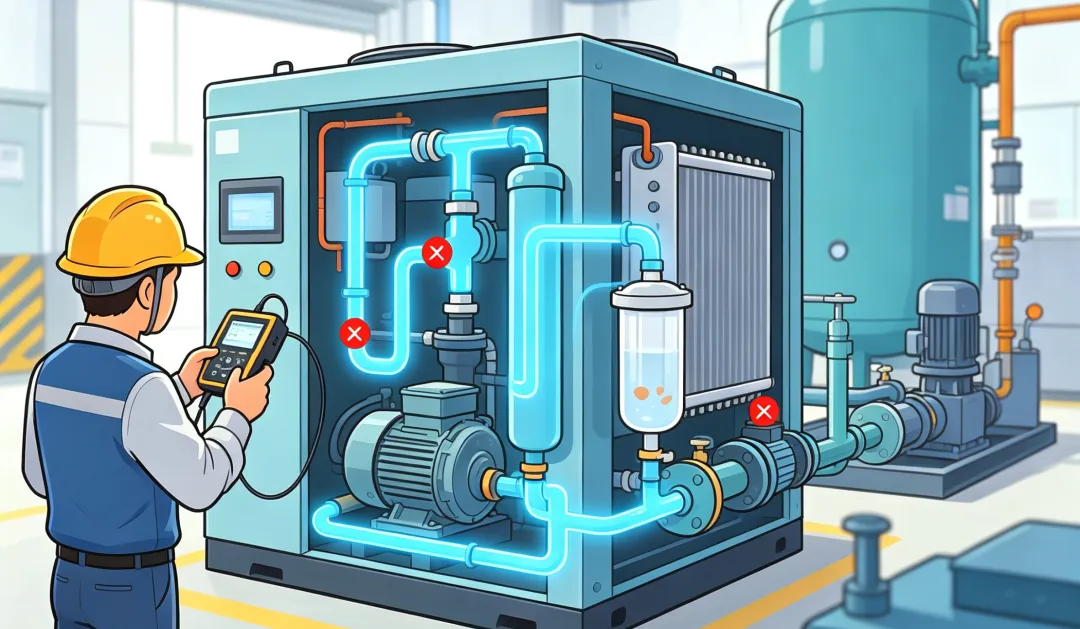
9. Common Twin-Tower Dryer Problems
| Problem | Possible Causes | Recommended Checks |
| Unstable pressure dew point | Poor airflow distribution, inadequate regeneration, degraded or contaminated desiccant, valve leakage | Check airflow distribution, desiccant condition, regeneration conditions, and valves |
| Increasing pressure drop | Desiccant dust, filter blockage, contamination, restricted valves or piping | Inspect filters, desiccant bed, valves, and airflow path |
| Incomplete regeneration | Insufficient regeneration airflow, inadequate heating where applicable, restricted exhaust, incorrect cycle control | Verify regeneration airflow, exhaust system, heater, and control sequence |
| Abnormal tower switching | Solenoid or actuator problem, pneumatic control fault, valve sticking, incorrect control sequence | Check controller outputs, solenoids, actuators, valves, and pressure equalization |
| Excessive energy consumption | Excessive purge air, unnecessary fixed-cycle regeneration, leakage, unsuitable regeneration technology | Check regeneration settings, leakage, and control strategy |
Troubleshooting should treat the dryer as a complete compressed-air treatment system rather than viewing the two adsorption towers in isolation.
A pressure dew-point problem can originate upstream or downstream of the desiccant bed.
10. Proper Upstream Air Treatment Protects the Adsorption Bed
Liquid water, compressor oil, aerosols, and solid contaminants should be controlled before compressed air reaches the desiccant.
Depending on system requirements, upstream treatment may include:
- Condensate separation
- Pre-filtration
- Oil and particulate removal
- High-efficiency filtration
- Additional oil-vapor treatment where required
Contamination can reduce adsorption performance, increase pressure drop, promote desiccant deterioration, and shorten service life.
The appropriate filtration configuration should therefore be selected according to the compressor type, dryer requirements, and downstream compressed-air quality specification.
Lingyu’s precision filter range includes AO, AA, AX, and ACS filtration grades for different particle and oil-removal requirements.
For systems requiring dedicated upstream filtration, see Lingyu’s precision compressed air filter.
11. Size the Dryer for Actual Operating Conditions
Continuous drying also depends on correct equipment selection.
Dryer capacity should be evaluated according to:
- Maximum actual airflow
- Inlet pressure
- Inlet temperature
- Required pressure dew point
- Ambient conditions
- Load profile
- Regeneration technology
A dryer selected only according to compressor nameplate capacity may not provide the required performance under real operating conditions.
For a more detailed selection method, see how to choose a desiccant air dryer and avoid common sizing mistakes.
Conclusion: Continuous Drying Depends on the Complete Cycle
A twin-tower desiccant air dryer achieves continuous drying not simply because Tower A and Tower B alternate.
Continuous operation depends on the coordinated management of:
Adsorption → Regeneration → Cooling where required → Repressurization → Switching
Uniform airflow allows the desiccant bed to be used effectively. Proper regeneration restores adsorption capacity. Heated systems must be adequately cooled before returning to service. Repressurization and pressure equalization prepare the regenerated tower for a stable transition, while reliable valves and controls allow the two towers to exchange functions without interrupting the supply of dry compressed air.
The regeneration method also has a major influence on energy efficiency. Heatless, heated-purge, blower-heated, and heat-of-compression dryers achieve the same fundamental objective in different ways, with very different compressed-air and energy requirements.
For industrial users, the important question is therefore not simply:
“How do the two towers alternate?”
A better question is:
“How effectively does the dryer control adsorption, regeneration, pressure, airflow, and energy use throughout the complete operating cycle?”
For help selecting the appropriate regeneration technology or configuring a twin-tower drying system for your actual operating conditions, contact Lingyu for technical support.