In a compressed-air treatment system, a desiccant air dryer removes water vapor and maintains the pressure dew point required by downstream processes.
When adsorption performance begins to decline, the first visible symptom is often a rising or unstable outlet pressure dew point.
Other signs may include:
- Reduced drying performance
- Shorter effective adsorption cycles
- Increasing pressure drop
- More frequent regeneration
- Abnormal tower switching
- Repeated dew-point problems even after operating parameters are adjusted
A common reaction is to assume that the desiccant has simply reached the end of its service life.
However, desiccant deterioration is only one possible cause.
Poor inlet-air quality, excessive moisture loading, incomplete regeneration, abnormal airflow distribution, valve leakage, incorrect operating conditions, and undersized equipment can all reduce adsorption performance.
The most effective troubleshooting approach is therefore to diagnose the complete drying system before replacing the desiccant.
1. Desiccant Deterioration: Look Beyond Simple “Aging”
Desiccant is continuously exposed to compressed airflow, pressure cycling, adsorption, regeneration, and mechanical movement.
Over time, these conditions can affect both its physical condition and adsorption performance.
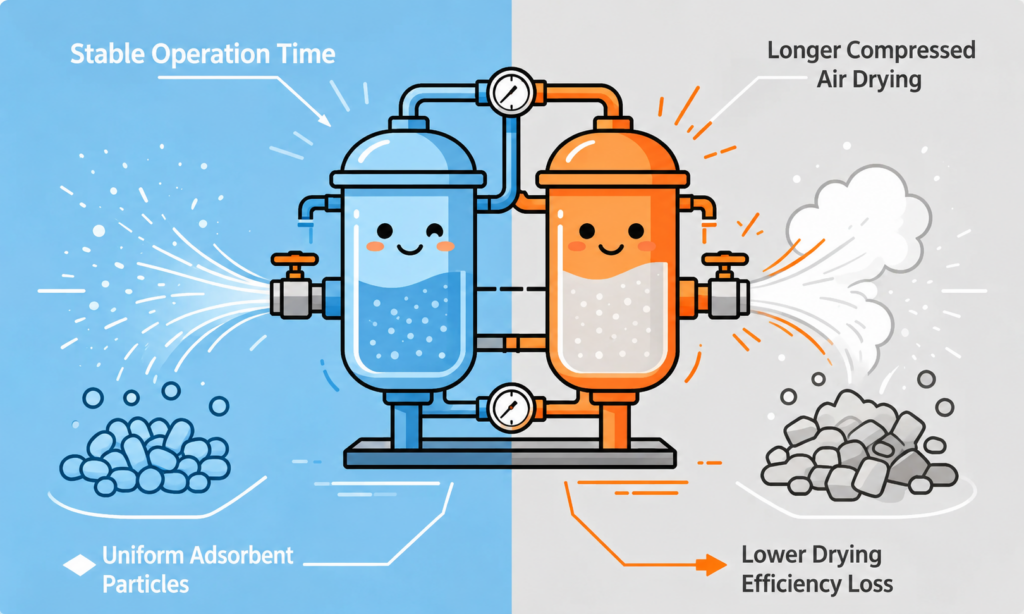
Desiccant Dusting and Mechanical Breakdown
Repeated pressure changes and airflow can cause desiccant particles to rub against each other and gradually generate fine dust.
Excessive dusting or attrition can contribute to:
- Higher pressure drop
- Restricted airflow
- Uneven air distribution
- Reduced usable adsorption capacity
- Downstream particulate contamination
Lingyu regenerative dryer designs use high-performance desiccants selected for adsorption capacity and abrasion resistance, while some designs also incorporate airflow-distribution measures to minimize desiccant attrition and dusting.
If excessive dust is found, the important question is not only:
“Should the desiccant be replaced?”
It is also:
“What caused the excessive mechanical degradation?”
Possible contributing factors include:
- Excessive pressure fluctuations
- Abnormal repressurization
- Uneven airflow
- Poor desiccant loading
- Frequent abnormal switching
For more detail, see how to prevent desiccant dust carryover in an adsorption air dryer.
Check the Desiccant Before Replacing It
Inspect the adsorption material for:
- Excessive dust
- Broken particles
- Agglomeration
- Discoloration
- Oil contamination
- Abnormal settling
- Signs of excessive moisture exposure
Desiccant that can no longer provide the required adsorption performance should be replaced according to the equipment manufacturer’s maintenance procedure.
However, replacing the desiccant without correcting the underlying operating problem may cause the new material to deteriorate again.
For additional maintenance guidance, see the air dryer desiccant replacement guide.
2. Poor Inlet Air Quality Can Rapidly Reduce Adsorption Performance
The adsorption tower should primarily handle water vapor under the conditions for which the dryer was designed.
Excessive liquid water, oil, and solid contamination upstream of the adsorption bed can place unnecessary stress on the desiccant.
Oil Contamination
Oil aerosols and oil vapor entering from the compressor system can contaminate the adsorption bed and reduce effective moisture adsorption.
This may contribute to:
- Higher outlet pressure dew point
- Reduced usable adsorption capacity
- Increased pressure loss
- Shorter desiccant service life
- More frequent maintenance
If oil contamination is found in the dryer, replacing the desiccant alone is not enough.
The upstream source must also be investigated.
Check:
- Compressor oil carryover
- Coalescing filter performance
- Filter differential pressure
- Filter element condition
- Drain operation
- Upstream piping contamination
For related troubleshooting, see how to solve excessive oil content in a compressed air system.
Liquid Water Carryover
A regenerative adsorption dryer should not be expected to handle uncontrolled quantities of liquid condensate.
When upstream cooling, separation, drainage, or filtration is inadequate, excessive liquid water may reach the adsorption bed.
This increases moisture loading and can contribute to:
- Rapid desiccant saturation
- Unstable pressure dew point
- Agglomeration
- Airflow restriction
- Higher pressure drop
- Uneven bed performance
In a combined drying system, compressed air can first pass through a refrigerated stage, where a significant portion of condensable moisture is removed before the air passes through oil-removal filtration and enters the adsorption stage.
Depending on the system design, inspect:
- Aftercooler
- Moisture separator
- Automatic drains
- Refrigerated dryer
- Coalescing filters
- Low points in the piping system
The dryer inlet should remain within the specified operating conditions.
3. Operating Outside the Rated Conditions Can Overload the Adsorption Bed
Even good desiccant cannot compensate indefinitely for incorrect inlet conditions.
Temperature, pressure, airflow, and inlet moisture load all influence dryer performance.
Excessive Inlet Temperature
Higher compressed-air temperature generally increases the moisture load entering the adsorption dryer and can reduce effective adsorption performance.
The important reference is not one universal temperature limit.
It is the specified inlet-temperature range of the selected dryer model.
For example, several Lingyu heatless and heated-purge regenerative dryer series specify a rated inlet temperature of 10–30°C and a maximum inlet temperature of ≤40°C.
Other dryer technologies, such as heat-of-compression systems, are designed around completely different inlet-temperature conditions.
Always compare the actual operating temperature with the specification for the specific dryer.
If inlet temperature exceeds the design range, inspect the upstream:
- Aftercooler
- Cooling-water system where applicable
- Moisture separator
- Condensate drain
- Ventilation conditions
Low Operating Pressure
Operating pressure also affects the amount of air that must pass through the adsorption bed.
If pressure falls substantially below the dryer’s rated condition, the volumetric flow through the vessel may increase for the same mass flow.
This can reduce effective contact time and place additional load on the dryer.
Several Lingyu regenerative dryer series use a rated inlet pressure of 0.7 MPa, with a standard operating range of 0.6–1.0 MPa, although other pressure configurations are available.
Actual pressure should therefore be checked against the technical requirements for the installed model.
Excessive Airflow
A dryer continuously operating above its effective treatment capacity may experience premature moisture breakthrough.
Possible symptoms include:
- Rising dew point under peak production
- Normal performance at low load but poor performance at high load
- Short effective adsorption periods
- Increased regeneration frequency
- Higher pressure loss
Measure the actual airflow rather than relying only on compressor nameplate capacity.
If operating conditions have changed since installation, the dryer capacity should be reassessed.
4. Incomplete Regeneration Can Look Like “Bad Desiccant”
A desiccant bed cannot continue adsorbing moisture unless the previously adsorbed water is effectively removed during regeneration.
This makes regeneration performance one of the first areas to inspect when outlet pressure dew point begins to rise.
Insufficient Regeneration Airflow
Too little regeneration airflow may prevent adequate moisture removal from the desiccant.
Depending on dryer technology, check:
- Regeneration valve position
- Purge-air flow
- Regeneration pressure
- Exhaust condition
- Cycle duration
- Control sequence
The correct airflow is specific to the dryer technology and model.
More purge air is not automatically better either, because excessive purge wastes compressed air without necessarily improving drying performance.
For a dedicated explanation, see how to adjust regeneration airflow in an adsorption dryer.
Inadequate Heating or Cooling in Heated Regeneration Systems
For heated-purge and blower-heated dryers, regeneration also depends on sufficient thermal energy.
Possible causes of poor regeneration include:
- Heater malfunction
- Temperature-sensor fault
- Incorrect temperature control
- Insufficient regeneration airflow
- Incorrect cycle timing
- Inadequate cooling after heated regeneration
The cooling stage is particularly important.
Heated desorption alone does not complete the regeneration process. The desiccant must also cool sufficiently before returning to adsorption service.
A dryer may therefore reach the required regeneration temperature and still produce poor dew-point performance if the cooling stage is incomplete.
Restricted Regeneration Exhaust
Regeneration moisture must also be discharged from the system effectively.
A restricted exhaust path or silencer can interfere with depressurization and regeneration.
Inspect:
- Exhaust silencer
- Exhaust valve
- Exhaust piping
- Internal contamination
- Icing where operating conditions make it possible
Service or replace restricted components according to the equipment maintenance procedure.
5. Valve Leakage and Switching Problems Can Disrupt Both Towers
A twin-tower dryer relies on precise valve sequencing.
If an inlet, exhaust, check, or regeneration valve leaks internally or fails to reach the correct position, airflow may not follow the intended adsorption-regeneration path.
Possible consequences include:
- Pressure imbalance between Tower A and Tower B
- Regeneration air loss
- Wet air entering the wrong vessel
- Incomplete depressurization
- Incomplete repressurization
- Unstable outlet dew point
Lingyu regenerative dryer designs use pneumatic valves and actuators for tower switching, while automatic repressurization before switching helps equalize vessel pressure and reduce pressure fluctuations.
When valve-related problems are suspected, inspect:
- Solenoid valves
- Pneumatic actuators
- Switching valves
- Check valves
- Control-air pressure
- Pneumatic tubing
- Controller outputs
- Valve-position feedback where equipped
- Repressurization sequence
If the two towers are not alternating correctly, see how to troubleshoot abnormal switching in a desiccant air dryer.
6. Uneven Airflow Can Leave Part of the Desiccant Bed Unused
A tower can contain enough desiccant and still perform poorly if compressed air does not flow evenly through the adsorption bed.
Air naturally follows lower-resistance paths.
If the bed has voids, settling, poor distribution, or internal flow problems, part of the compressed air may bypass much of the available adsorption material.
This is known as channeling.
Channeling can cause:
- Premature moisture breakthrough
- Unstable pressure dew point
- Localized desiccant saturation
- Reduced effective adsorption capacity
- Increased regeneration demand
- Uneven desiccant degradation
Internal airflow distribution and desiccant filling are therefore important parts of adsorption-bed design. Uneven airflow, adsorption dead zones, channeling, tunneling, attrition, and dusting can all reduce effective bed utilization.
If a bed-distribution problem is suspected, inspect:
- Desiccant filling condition
- Bed settling
- Internal flow distributor
- Support structure
- Inlet airflow distribution
- Evidence of localized dusting or void formation
For a deeper explanation, see how to prevent channeling in a desiccant air dryer.
7. Increasing Pressure Drop May Be a Symptom, Not the Root Cause
Pressure drop should be evaluated together with dew-point performance.
An increasing differential pressure may indicate:
- Desiccant dust accumulation
- Contaminated desiccant
- Filter blockage
- Airflow restriction
- Valve restriction
- Internal contamination
Do not apply one universal pressure-drop alarm value to every dryer.
Alarm and maintenance limits should follow the specification of the particular product.
Some energy-saving dryer designs incorporate differential-pressure monitoring and protection as part of the control system.
If pressure loss is becoming excessive, see what to do when adsorption dryer pressure drop is too high.
8. Incorrect Dryer Sizing Can Create a Permanent Performance Problem
Sometimes the dryer is not damaged.
It is simply too small for the actual operating conditions.
If production airflow, inlet temperature, or moisture loading has increased since the dryer was selected, the adsorption bed may continuously operate close to or beyond its effective capacity.
Possible symptoms include:
- Dew-point deterioration mainly during peak production
- Frequent regeneration
- Short adsorption cycles
- Rapid desiccant loading
- Stable performance only when plant demand is reduced
Reassess the dryer based on:
- Maximum actual airflow
- Inlet pressure
- Inlet temperature
- Required pressure dew point
- Actual load profile
- Regeneration technology
- Upstream air quality
Do not select or reassess the dryer from compressor nameplate flow alone.
For a detailed sizing method, see how to choose a desiccant air dryer and avoid common sizing mistakes.
9. Upstream Pretreatment Is Part of the Dryer System
A desiccant dryer should not be considered an isolated piece of equipment.
Its performance depends heavily on what happens before compressed air reaches the adsorption vessels.
A compressed-air treatment system may include:
Aftercooling → Condensate Separation → Air Receiver → Refrigerated Drying Where Appropriate → Pre-Filtration → Oil-Removal Filtration → Adsorption Drying → Final Particulate Filtration
The exact configuration depends on the required air quality and dryer design.
Lingyu’s precision filtration range includes AO, AA, AX, and ACS grades for different particle- and oil-removal requirements.
For system-specific filtration selection, see the compressed air filter selection and maintenance guide.
Where the moisture load is particularly high, a refrigerated + adsorption drying configuration can also reduce the moisture entering the adsorption bed.
By removing a significant portion of moisture before the adsorption stage, this arrangement can reduce the adsorption-system moisture load, lower regeneration-air demand, and help extend desiccant service life.
Recommended Troubleshooting Sequence
When adsorption performance begins to decline, do not start by replacing the desiccant.
Use this sequence instead:
Inlet Conditions → Regeneration System → Desiccant Condition → Valve Operation → Airflow Distribution → Pressure Drop → Dryer Sizing
First, check inlet temperature, pressure, airflow, liquid water, and oil contamination.
Then verify regeneration airflow, heating where applicable, cooling, exhaust, and cycle control.
Inspect the desiccant for dusting, contamination, settling, or excessive moisture loading.
Check valves, actuators, solenoids, and tower switching.
Investigate channeling and airflow distribution.
Review filter condition and dryer differential pressure.
Finally, confirm that the dryer is correctly sized for current production conditions.
This sequence helps distinguish genuine desiccant failure from the system problems that may be causing the desiccant to fail.
Conclusion: Do Not Replace the Desiccant Until You Find the Cause
A decline in adsorption performance does not automatically mean that the desiccant has simply reached the end of its service life.
The real cause may be:
- Desiccant dusting or deterioration
- Oil contamination
- Liquid-water carryover
- Excessive inlet temperature
- Incorrect operating pressure
- Excessive airflow
- Incomplete regeneration
- Restricted exhaust
- Valve leakage
- Abnormal tower switching
- Channeling
- Increasing pressure drop
- Incorrect dryer sizing
Replacing the adsorption material without identifying the root cause may only provide temporary improvement.
The better approach is to diagnose the entire system:
Inlet Air → Regeneration → Desiccant → Valves → Airflow → Pressure Drop → Sizing
By correcting the underlying cause, operators can restore stable pressure dew-point performance, reduce unnecessary maintenance, protect the desiccant bed, and improve the long-term reliability of the compressed-air treatment system.
If repeated dew-point problems continue after these checks, contact Lingyu for technical support and system evaluation.