Compressed air pressure is only useful if enough of it actually reaches the point of use.
A compressor may discharge air at the required pressure, yet pneumatic tools, production machines, and process equipment can still receive insufficient pressure because of losses across piping, filters, dryers, valves, fittings, and other components.
This difference is known as compressed air pressure drop.
Some pressure loss is unavoidable whenever air flows through a compressed-air system. The goal is therefore not to eliminate pressure drop completely, but to prevent unnecessary losses that increase compressor energy consumption and reduce production stability.
This article explains what causes compressed air pressure loss, how to identify where it occurs, and how to reduce it without simply increasing compressor discharge pressure.
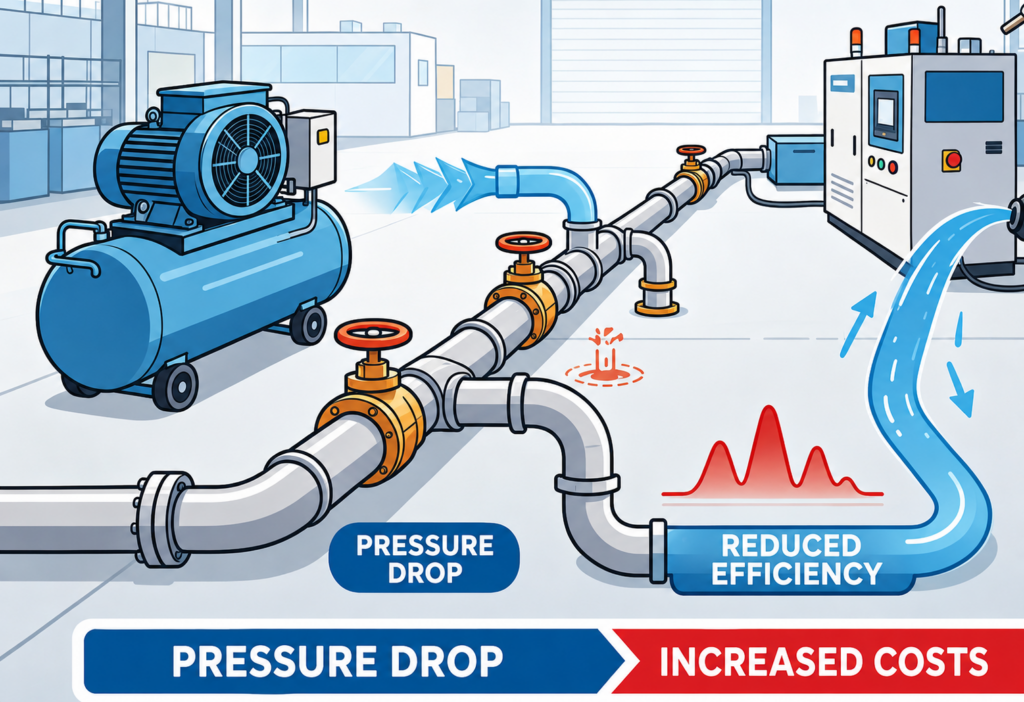
1. What Is Compressed Air Pressure Drop?
Pressure drop is the reduction in compressed-air pressure as air travels through the system.
For example, if the compressor room supplies air at 7.5 bar while a production machine receives 6.8 bar during normal operation, the pressure difference between those two measurement points is 0.7 bar.
However, pressure drop should always be defined between specific locations.
A useful way to evaluate the system is:
Compressor discharge → treatment equipment → main header → branch line → point of use
This makes it possible to determine where pressure is actually being lost.
Pressure losses may occur across:
- Compressed-air piping
- Filters
- Air dryers
- Separators
- Valves and fittings
- Hoses and quick couplings
- Local regulators
- Treatment equipment
- Undersized branch lines
The total system pressure drop is the combined effect of these individual restrictions.
2. Friction Losses in Compressed Air Piping
As compressed air travels through a pipe, friction between the moving air and the internal pipe surface creates resistance.
Pressure loss generally increases with:
- Longer pipe runs
- Smaller internal diameter
- Higher airflow
- Higher air velocity
- Rough internal surfaces
- Corrosion or deposits
- More fittings and directional changes
Undersized piping is particularly important.
If a pipe is too small for the required airflow, air velocity rises and friction losses increase.
This means a plant may have enough compressor capacity but still experience low pressure at distant production equipment because the distribution system cannot move the required air efficiently.
Fittings Also Add Resistance
Every component that changes airflow direction or restricts the flow path can add local pressure loss.
Examples include:
- Elbows
- Tees
- Valves
- Reducers
- Couplings
- Quick-connect fittings
One fitting may create only a small loss, but many restrictions in series can produce a substantial total pressure drop.
Compressed-air piping should therefore be evaluated as a complete network rather than by looking only at straight pipe length.
3. Compressed Air Leaks Can Increase Pressure Loss Indirectly
A compressed-air leak is primarily a loss of flow, but it can also contribute to pressure problems.
Leaks increase the amount of compressed air the system must produce and distribute.
As total airflow through the piping increases, velocity and friction losses may also rise.
The result can be:
Higher compressor demand + greater distribution pressure drop
This becomes particularly noticeable in systems where the piping is already close to its practical flow capacity.
Common leak locations include:
- Pipe joints
- Hoses
- Couplings
- Quick connectors
- Valves
- Seals
- Pneumatic equipment
A structured leak-management program can therefore improve both energy efficiency and pressure stability.
For a dedicated troubleshooting approach, see how to identify and reduce hidden compressed air leaks.
4. Filters Can Become a Major Pressure-Drop Source
Compressed-air filters protect downstream equipment by removing particles, oil aerosols, and other contaminants.
However, filtration also creates resistance to airflow.
As a filter element becomes loaded with contamination, differential pressure across the element may increase.
This creates an important maintenance trade-off:
The filter must maintain the required air quality without creating unnecessary resistance.
Operators should therefore monitor filter differential pressure and inspect elements according to actual operating conditions and manufacturer recommendations.
Avoid using one universal replacement interval or differential-pressure threshold for every compressed-air filter.
Different filter grades and equipment configurations have different operating requirements.
Lingyu’s precision filter range includes AO, AA, AX, and ACS filtration grades for different particle and oil-removal requirements.
For more information on selecting the appropriate filtration configuration, see the compressed air filter selection and maintenance guide.
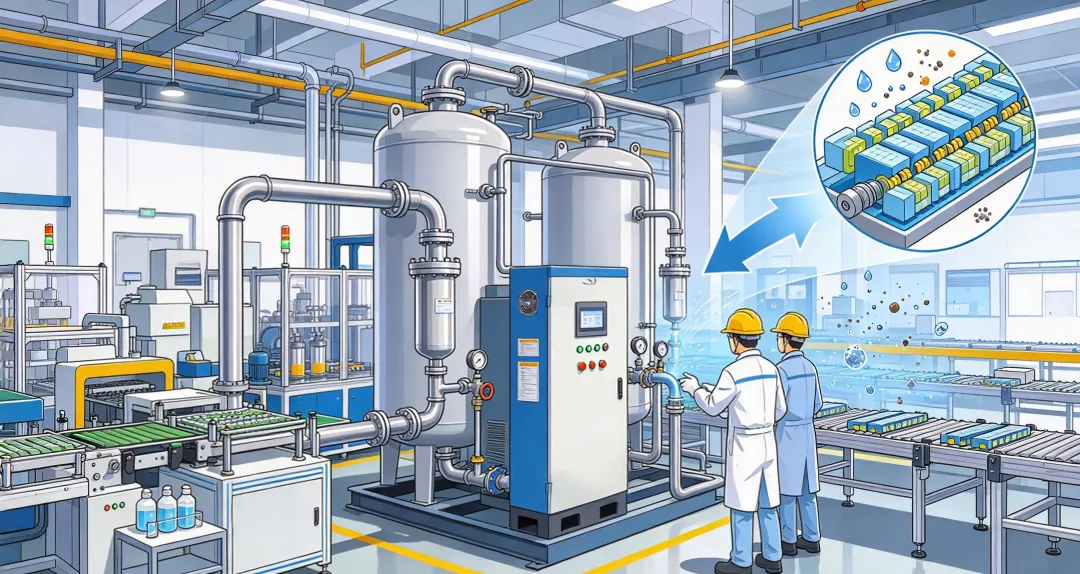
5. Air Dryers Also Contribute to System Pressure Drop
Every compressed-air dryer introduces some airflow resistance.
The amount depends on dryer technology, internal airflow path, heat exchangers, valves, vessel design, airflow, contamination level, and operating condition.
An appropriately selected and maintained dryer should keep this resistance within its intended design range.
Excessive dryer pressure loss may indicate:
- Incorrect equipment sizing
- Excessive airflow
- Internal contamination
- Restricted filters
- Desiccant dust accumulation
- Valve restriction
- Heat-exchanger fouling
- Other airflow obstructions
Some Lingyu regenerative dryer designs incorporate inlet-to-outlet differential-pressure monitoring so that abnormal pressure loss can be identified against a preset equipment limit.
For adsorption equipment specifically, see what to do when adsorption dryer pressure drop is too high.
6. Excessive Air Demand Can Look Like a Pressure-Drop Problem
Not every low-pressure event is caused by pipe friction or a clogged component.
Pressure may also fall when air demand exceeds the amount the system can supply at that moment.
This can occur because of:
- Peak production demand
- Large intermittent air users
- Multiple machines starting together
- Insufficient compressor capacity
- Insufficient storage
- Poor compressor sequencing
- Excessive leakage
- Undersized distribution piping
This distinction is important.
If the entire plant pressure drops during peak production, replacing one filter or increasing one pipe size may not solve the real problem.
The issue may instead be a mismatch between supply, storage, distribution capacity, and demand.
7. Why Increasing Compressor Pressure Is Often the Wrong First Response
When point-of-use pressure falls, one of the fastest responses is to increase compressor discharge pressure.
This may temporarily restore production pressure, but it does not remove the restriction that caused the problem.
Instead, the plant may end up operating the entire compressed-air system at a higher pressure simply to overcome avoidable losses.
Higher system pressure can increase:
- Compressor energy demand
- Air leakage
- Artificial demand
- Mechanical loading
- Overall operating cost
A better troubleshooting approach is:
Measure the pressure loss → locate the restriction → remove the unnecessary loss
Only after the system has been optimized should the required compressor discharge pressure be determined.
8. Pressure Drop Can Directly Affect Production
Compressed air is often part of the production process itself.
If pressure at the point of use falls below the required level, pneumatic equipment may no longer operate as intended.
Possible effects include:
- Reduced actuator force
- Slower cylinder movement
- Lower pneumatic tool output
- Longer machine cycles
- Unstable clamping
- Irregular spray performance
- Inconsistent process control
Pressure drop is therefore not only an energy-efficiency issue.
It can also become a production-stability issue.
Point-of-Use Pressure Matters More Than Compressor Pressure
The pressure shown at the compressor discharge tells you what the compressor produces.
It does not tell you what the machine actually receives.
For production equipment, the more meaningful measurement is the dynamic pressure at the point of use while the equipment is operating.
A system may appear acceptable when little or no air is flowing but suffer a significant pressure drop when production demand increases.
9. How to Reduce Pressure Drop in Compressed Air Piping
Distribution-system improvements can reduce unnecessary resistance.
Important design principles include:
- Selecting adequate pipe diameter
- Limiting unnecessary pipe length
- Reducing excessive bends and fittings
- Avoiding severe diameter transitions
- Using suitable low-resistance components
- Considering a ring-main layout where appropriate
Pipe Diameter Is Usually More Important Than Compressor Pressure
When piping is severely undersized, raising compressor pressure is often an inefficient workaround.
A better long-term solution may be to increase distribution capacity.
Increasing the appropriate pipe capacity reduces airflow velocity and friction loss throughout the affected section.
Consider a Ring-Main System
In larger plants, a ring-main arrangement can allow air to approach a demand point from more than one direction.
Depending on the system layout, this may improve pressure stability and reduce local flow velocity compared with supplying all users through one long dead-end pipe.
However, actual piping design should be based on measured airflow and pressure requirements rather than applying one layout universally.
10. Maintain Air-Treatment Equipment by Differential Pressure
Maintenance should not rely only on fixed time intervals.
A filter may become heavily contaminated earlier than expected in one plant while remaining relatively clean for much longer in another.
Important factors include:
- Compressor condition
- Ambient contamination
- Oil carryover
- Condensate loading
- Airflow
- Operating hours
Monitoring differential pressure across filters and dryers provides useful information about the actual airflow resistance developing inside the equipment.
The trend is often more useful than a single isolated reading.
A gradual rise may indicate contamination, while a sudden change may indicate a blockage, valve problem, or abnormal operating condition.
Where the process requires different levels of filtration, Lingyu’s precision compressed air filter can be evaluated according to the required air-quality and pressure-drop specifications.
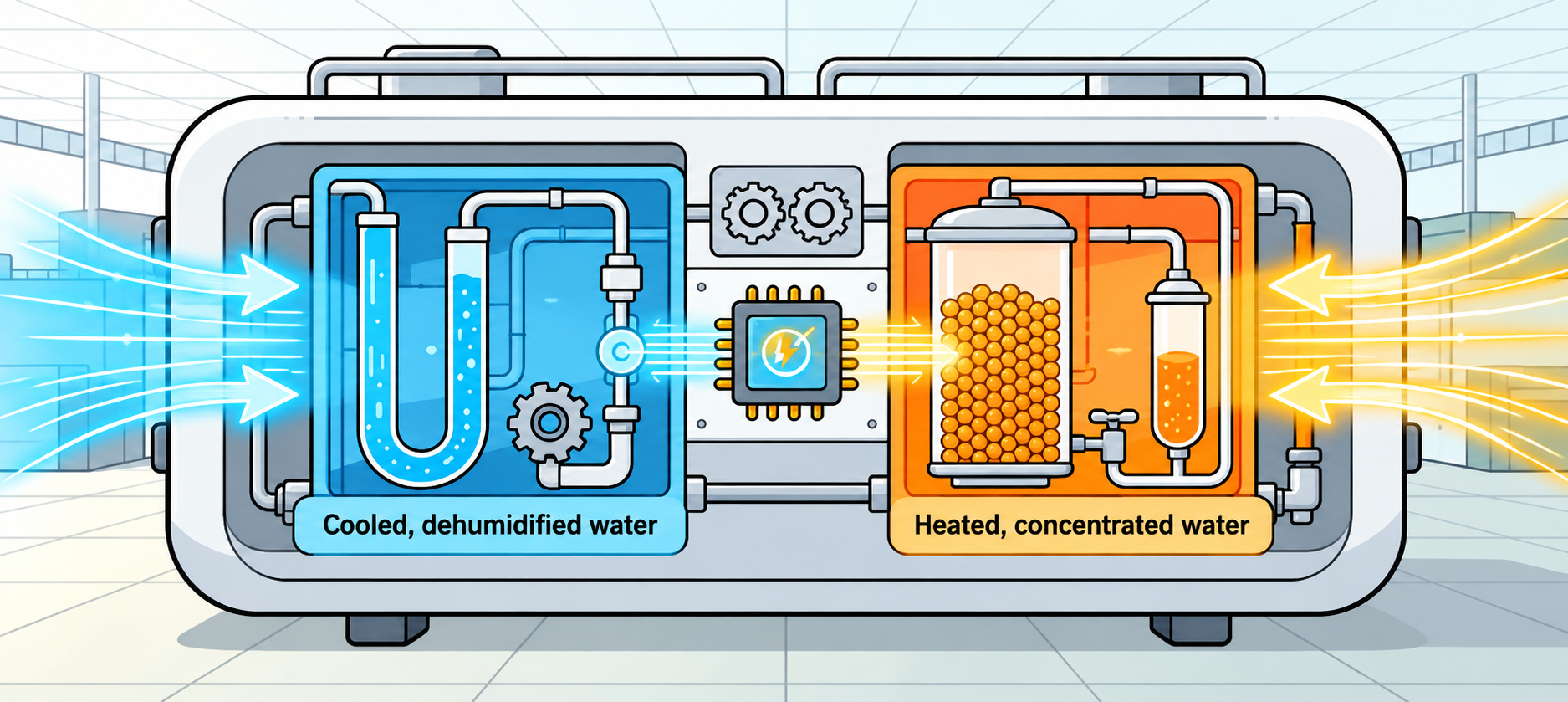
11. Low-Pressure-Drop Drying Equipment Can Reduce System Losses
Pressure drop should also be considered when selecting new air-treatment equipment.
Two dryers may provide the required outlet air quality while creating different amounts of airflow resistance.
For plants with high airflow or long annual operating hours, even relatively small differences in pressure loss may affect total compressed-air energy consumption.
Lingyu provides a dedicated low-pressure-differential refrigerated dryer for applications where reducing dryer pressure loss is an important selection consideration.
For more detail on this technology, see the low-pressure-differential refrigerated dryer guide.
12. Improve Pressure Stability by Reducing Leakage and Artificial Demand
Pressure optimization should address both supply and demand.
A system with major leakage may require more compressor capacity and higher airflow through the distribution network than production actually needs.
Likewise, unnecessarily high plant pressure can cause some unregulated air users to consume more air.
This is sometimes referred to as artificial demand.
Reducing leakage and avoiding unnecessary pressure can lower total airflow demand.
Lower flow can then help reduce friction losses elsewhere in the system.
This creates a positive cycle:
Lower demand → lower airflow → lower pressure loss → lower required compressor pressure
13. Use Storage Where Air Demand Is Highly Intermittent
Some production machines require a large amount of air for only a short period.
Examples can include certain actuators, blasting operations, or high-flow pneumatic processes.
If these loads draw directly from the main header without adequate storage or distribution capacity, local or system-wide pressure may fall rapidly.
Appropriately located air receivers can help buffer short-duration demand.
However, storage does not compensate for permanently insufficient compressor capacity or severely undersized piping.
It should be considered as one part of the overall system design.
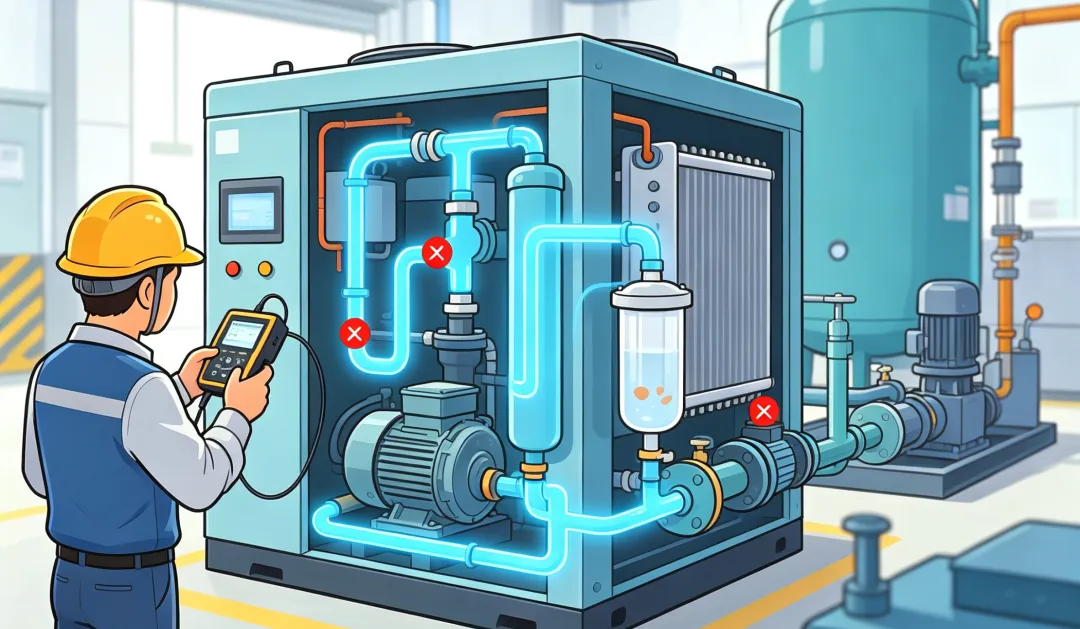
14. Measure Pressure Drop Instead of Guessing
One of the most effective diagnostic methods is to measure pressure at several points simultaneously or with synchronized data logging.
Useful measurement locations include:
Compressor discharge → aftercooler/separator → filters → dryer → main header → branch line → point of use
This divides the compressed-air system into measurable sections.
For example:
- If most of the pressure loss occurs across a filter, investigate the filter.
- If the compressor room remains stable but the production area loses pressure, investigate the distribution network.
- If system pressure falls everywhere during peak demand, investigate compressor capacity, leakage, storage, and control.
- If pressure loss across the dryer increases over time, inspect the dryer and its associated filtration.
This approach prevents unnecessary equipment replacement because the location of the restriction is identified before corrective action begins.
15. Evaluate Pressure Drop Under Real Operating Load
Pressure should not be measured only during low-production or no-flow conditions.
Friction-related pressure losses increase as airflow increases.
A system may therefore show:
Small pressure drop at low demand
but:
Large pressure drop during peak production
For meaningful analysis, record at least:
- Compressor-room pressure
- Main-header pressure
- Point-of-use pressure
- Airflow
- Production load
- Relevant filter or dryer differential pressure
Matching the pressure trend with plant demand makes it easier to identify whether the restriction is constant or flow-dependent.
16. Pressure Drop Should Be Managed as a Complete System Issue
Optimizing one component while ignoring the rest of the system may produce limited results.
A more effective strategy considers the complete air path:
Generation → Treatment → Storage → Distribution → Point of Use
Potential improvements may include:
- Correct pipe sizing
- Lower-resistance treatment equipment
- Filter maintenance
- Dryer maintenance
- Leak repair
- Appropriate receiver capacity
- Better compressor sequencing
- Separation of different pressure requirements
- Pressure and flow monitoring
- Optimized operating pressure
The objective is to deliver the required air quality, airflow, and pressure to production with the least practical energy input.
A Practical Pressure-Drop Troubleshooting Sequence
When a plant experiences low or unstable compressed-air pressure, diagnose it in this order:
Measure → Localize → Identify the Restriction → Check Demand → Correct the Cause → Recheck Under Load
First, measure pressure at the compressor room and point of use.
Then divide the system into sections and identify where the largest loss occurs.
Check filters, dryers, valves, piping, and local fittings.
If no severe restriction is found, compare compressor supply with actual demand and leakage.
After corrective work, repeat the measurements during normal and peak production.
This prevents a common mistake:
Raising compressor pressure before identifying why pressure is being lost.
Conclusion: The Important Pressure Is the Pressure That Reaches Production
Compressed-air pressure drop is not simply a piping problem.
It can originate from piping friction, excessive airflow, filters, dryers, fittings, leakage, inadequate storage, insufficient system capacity, or poor equipment selection.
The correct response is not automatically to increase compressor discharge pressure.
A more efficient approach is to identify exactly where the pressure loss occurs and reduce unnecessary resistance throughout the compressed-air system.
The most useful question is therefore not:
“How much pressure is the compressor producing?”
It is:
“How much usable pressure reaches the point of use under actual production demand?”
By measuring pressure across the complete system, maintaining treatment equipment, repairing leaks, improving piping capacity, and selecting equipment with appropriate airflow resistance, industrial facilities can improve pressure stability while reducing unnecessary compressor energy consumption.
For system-specific support, contact Lingyu with your airflow, compressor-room pressure, point-of-use pressure, dryer and filtration configuration, and actual operating conditions.