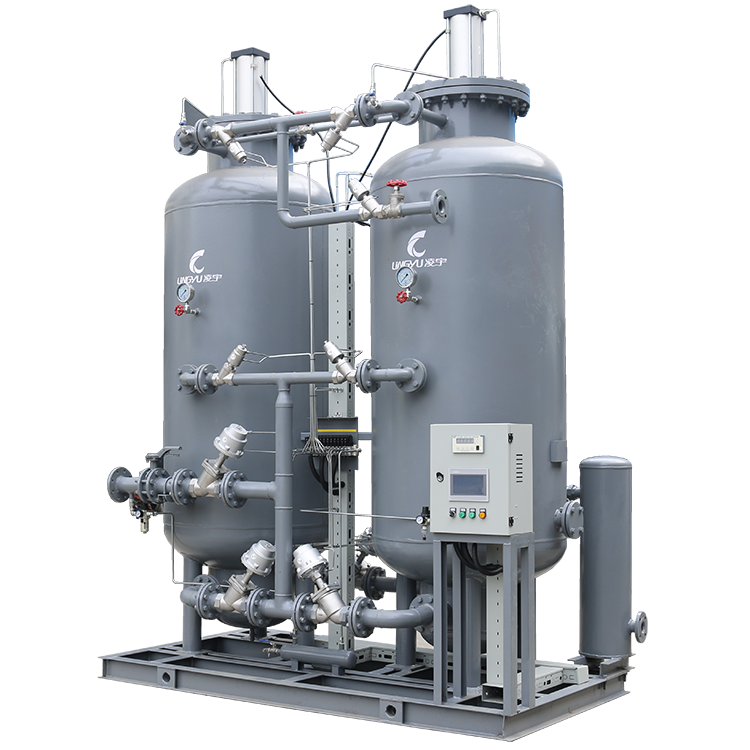
The LYZD-A Series PSA nitrogen generator is designed for on-site nitrogen production using compressed air as the feed gas. Rather than relying on delivered nitrogen cylinders or bulk liquid nitrogen, a PSA system separates nitrogen directly from compressed air and continuously supplies product gas according to the required capacity and purity.
For users evaluating the LYZD-A Series, nominal nitrogen purity alone is not enough. Feed-air pressure, nitrogen production capacity, effective air consumption, control functions, system configuration, and required product purity all influence final equipment selection.
For product-level information, users can also review Lingyu’s PSA nitrogen generator range.
How the LYZD-A PSA Nitrogen Generator Works
The LYZD-A Series uses Pressure Swing Adsorption (PSA) technology with two adsorption towers operating alternately.
Each tower is filled with Carbon Molecular Sieve (CMS). When compressed air enters an adsorption tower, oxygen molecules are preferentially adsorbed by the CMS, while nitrogen passes through the adsorption bed and is collected as product gas.
While Tower A is producing nitrogen, Tower B undergoes depressurization and regeneration. Oxygen previously adsorbed by the CMS is released and discharged to the atmosphere with the assistance of a small amount of nitrogen purge gas.
Once Tower A reaches its predetermined adsorption capacity and Tower B has completed regeneration, the control system switches their functions. Tower B begins adsorption while Tower A regenerates.
This alternating process allows continuous nitrogen production under automatic PLC control.
Standard Operating Conditions
The standard operating conditions for the PSA nitrogen generator are:
| Parameter | Specification |
|---|---|
| Inlet air temperature | ≤40°C |
| Inlet air pressure | 0.5–0.8 MPa |
| Nitrogen purity | 95%–99.999% |
| Nitrogen dew point | ≤−40°C |
| Ambient temperature | ≤40°C |
| Switching cycle | 45–60 seconds |
| Power supply | 220 V / 50 Hz |
| Noise level | ≤75 dB |
These parameters are important because PSA performance depends strongly on the condition of the compressed-air supply. The system supports a configurable purity range rather than operating at one universal fixed purity.
Why Nitrogen Purity Must Be Defined Before Capacity Selection
Nitrogen purity and production capacity cannot be evaluated independently.
Higher nitrogen purity generally requires the adsorption system to retain more oxygen before the gas reaches the product outlet. As a result, the relationship between feed-air consumption and usable nitrogen output changes with the required purity.
Available technical configurations include 99.0%, 99.5%, 99.9%, 99.99%, and 99.999% nitrogen purity, with the final configuration determined by project requirements.
Specifying only “high-purity nitrogen” is therefore insufficient. The actual purity requirement should be defined before system sizing.
Selecting a substantially higher purity than the process actually requires can unnecessarily increase compressed-air consumption and overall system cost.
LYZD-A Series Capacity and Effective Air Consumption
Under the stated reference conditions, the LYZD-A Series covers nitrogen production capacities from 20 to 600 m³/h.
| Model | Nitrogen Production | Effective Air Consumption | Dimensions |
|---|---|---|---|
| LYZD-A20 | 20 m³/h | 0.66 m³/min | 1500×850×500 mm |
| LYZD-A50 | 50 m³/h | 1.67 m³/min | 1900×1000×600 mm |
| LYZD-A100 | 100 m³/h | 3.33 m³/min | 2230×1700×800 mm |
| LYZD-A200 | 200 m³/h | 6.67 m³/min | 2750×1750×900 mm |
| LYZD-A300 | 300 m³/h | 10.0 m³/min | 2807×2100×1050 mm |
| LYZD-A400 | 400 m³/h | 13.33 m³/min | 2890×2200×1200 mm |
| LYZD-A500 | 500 m³/h | 16.67 m³/min | 2900×2500×1350 mm |
| LYZD-A600 | 600 m³/h | 20.00 m³/min | 2900×2500×1400 mm |
These capacity data are based on design conditions of 0.8 MPa(g) adsorption pressure, 20°C ambient temperature, and 80% relative humidity of the feed air. Actual system sizing should therefore account for site conditions rather than applying the table without correction.
Control Features of the LYZD-A PSA System
The LYZD-A Series incorporates several control and monitoring functions intended to stabilize nitrogen production and reduce manual intervention.
Fully Automatic Operation
Automatic start, stop, and adsorption-cycle switching allow the system to operate continuously without manual tower switching.
PLC-Controlled Pneumatic Valves
The PLC controls pneumatic valves according to the required sequence, coordinating adsorption, depressurization, regeneration, pressure equalization, and tower switching.
Real-Time Nitrogen Monitoring
Nitrogen purity and flow rate are monitored online.
A PSA generator must not only produce nitrogen but also verify that the product gas meets the specified operating requirement.
Off-Spec Nitrogen Protection
If nitrogen purity falls below the set value, the system activates an alarm.
If the off-spec condition continues beyond a preset period, the system can automatically shut down for protection, helping prevent uncontrolled delivery of nitrogen that does not meet the specified purity.
Digital Touchscreen Monitoring
The touchscreen displays key operating information such as system pressure, nitrogen purity, nitrogen flow, and operating status.
Automatic CMS Compaction and Why It Matters
Carbon Molecular Sieve is the central adsorption material in a PSA nitrogen generator.
During long-term cyclic operation, repeated pressurization and depressurization can cause movement inside the CMS bed. Maintaining suitable packing density is therefore important for stable adsorption performance.
The LYZD-A design includes an automatic CMS compaction system intended to maintain proper packing density and reduce CMS pulverization associated with bed movement.
This is more useful for maintenance planning than assigning a universal fixed service life to the CMS.
Actual CMS condition can be influenced by feed-air quality, oil contamination, moisture entering the adsorption towers, operating pressure, switching frequency, bed movement, and actual operating hours.
CMS condition should therefore be evaluated according to operating performance and system condition rather than replacement based only on a fixed calendar interval.
Energy Efficiency: Look at Effective Air Consumption
For PSA nitrogen generation, energy efficiency should not be evaluated only by the electrical power consumed directly by the nitrogen generator.
A major energy input comes from producing the compressed feed air, making effective air consumption an important system-selection parameter.
For the 98% reference condition, representative figures include:
| Nitrogen Production | Effective Air Consumption |
|---|---|
| 20 m³/h | ≈0.66 m³/min |
| 100 m³/h | ≈3.33 m³/min |
| 300 m³/h | ≈10.0 m³/min |
| 600 m³/h | ≈20.0 m³/min |
These figures demonstrate why the nitrogen generator and compressor system should be evaluated together rather than as independent pieces of equipment.
The LYZD-A system also uses an optimized unequal-pressure equalization process, which improves nitrogen recovery efficiency and provides an approximately 5% indirect reduction in overall energy consumption under the intended design conditions.
Feed-Air Treatment Is Part of the Nitrogen System
A PSA nitrogen generator does not normally operate directly from untreated compressor discharge air.
A complete configuration can include an air compressor, air receiver, refrigerated air dryer, buffer tank, nitrogen generator, nitrogen buffer tank, pressure-control components, nitrogen/oxygen analysis equipment, and upstream filtration.
This matters because moisture, liquid water, oil aerosols, and particles entering the CMS bed can affect adsorption performance and system reliability.
Appropriate compressed-air filtration should therefore be considered part of the complete nitrogen-generation system rather than an unrelated accessory.
How to Size an LYZD-A Nitrogen Generator
A suitable model should not be selected from nitrogen flow alone. Required nitrogen flow, purity, feed-air pressure, feed-air temperature, and nitrogen dew point should be evaluated together.
Required Nitrogen Flow
Determine normal nitrogen consumption and maximum simultaneous demand.
A process requiring 80 m³/h continuously may require a different configuration from one that normally uses 40 m³/h but occasionally peaks near 80 m³/h.
Required Nitrogen Purity
Define the actual purity required by the process.
The difference between 99%, 99.9%, 99.99%, and 99.999% is significant from a PSA system-design perspective.
Feed-Air Pressure
The standard inlet-pressure range is 0.5–0.8 MPa.
Available compressor pressure should therefore be confirmed before equipment sizing.
Feed-Air Temperature
The specified inlet-air temperature is ≤40°C.
Proper upstream cooling and compressed-air treatment should be maintained so that the PSA generator receives air within its required operating conditions.
Nitrogen Dew Point
The standard nitrogen dew-point specification is ≤−40°C.
If the process requires a different moisture specification, this should be defined before the complete system is configured.
Where the LYZD-A Series Can Be Used
The correct PSA nitrogen-generator application should be determined by required purity, flow, dew point, pressure, and process purpose rather than assigning every system to the same generic industry list.
For example, users evaluating nitrogen for modified-atmosphere or other process applications can review Lingyu’s food and beverage application page, while pharmaceutical users can review the pharmaceutical and biopharmaceutical application section.
The purpose of LYZD-A equipment selection should remain focused on the actual nitrogen specification and process requirement rather than relying only on the industry name.
What If the Required Purity Is 99.999%?
This requirement should be handled carefully because PSA nitrogen production and further nitrogen purification are not always the same system configuration.
PSA nitrogen-generator configurations can reach different purity levels. A separate carbon-based deoxygenation purification system can also upgrade approximately 99.9% PSA nitrogen to ≥99.999% nitrogen.
That purification process reduces residual oxygen through carbon-based deoxygenation and then removes CO₂, moisture, and particulates.
Projects with stringent purity requirements should therefore not assume that every PSA configuration reaches the target through the same equipment arrangement.
The complete nitrogen system should be selected according to:
Required purity + flow + dew point + oxygen specification + feed-air condition
Information to Prepare Before Requesting a System
Before selecting an LYZD-A configuration, prepare the required nitrogen flow, required nitrogen purity, nitrogen pressure, required dew point, operating hours, available compressed-air pressure, feed-air temperature, ambient conditions, and expected demand fluctuations.
These parameters allow the nitrogen generator, air-treatment equipment, compressor capacity, buffer storage, and monitoring system to be evaluated as one complete system.
For special purity, capacity, or operating requirements, a customized technical configuration can then be evaluated.
Conclusion
The LYZD-A PSA Nitrogen Generator uses twin adsorption towers filled with Carbon Molecular Sieve to continuously separate nitrogen from compressed air through alternating adsorption and regeneration cycles.
Its key characteristics include 95%–99.999% configurable nitrogen purity, ≤−40°C nitrogen dew point, 0.5–0.8 MPa inlet pressure, ≤40°C inlet-air temperature, 45–60-second switching cycle, 220 V/50 Hz power supply, ≤75 dB noise level, automatic PLC control, online purity and flow monitoring, off-spec protection, automatic CMS compaction, and a standard capacity range of 20–600 m³/h.
For correct selection, users should focus on the relationship between required purity, nitrogen demand, effective compressed-air consumption, feed-air quality, and operating conditions rather than selecting a generator solely by nominal nitrogen capacity.