In large industrial compressed-air systems, desiccant regeneration can represent a significant part of the dryer’s operating cost. The HOC-E Series Low-Purge Heat-of-Compression Regenerative Desiccant Air Dryer addresses this issue by recovering thermal energy already available in the high-temperature compressed air discharged from the air compressor.
Instead of relying primarily on an external regeneration heater, the HOC-E uses compressor discharge heat to regenerate the desiccant. No compressed air is consumed during the heating and regeneration stage, while only a small quantity of dry product air is required during cooling.
Key characteristics include ≤3% regeneration-air consumption, a 110–180°C allowable inlet-temperature range, −20°C / −40°C pressure dew point configurations, and defined cooling-water requirements.
For users comparing the wider family of heat-of-compression technologies, Lingyu’s heat-of-compression dryer range provides the relevant product category.
How the HOC-E Heat-of-Compression Dryer Works
The HOC-E uses the thermal energy contained in high-temperature compressed air discharged from the air compressor.
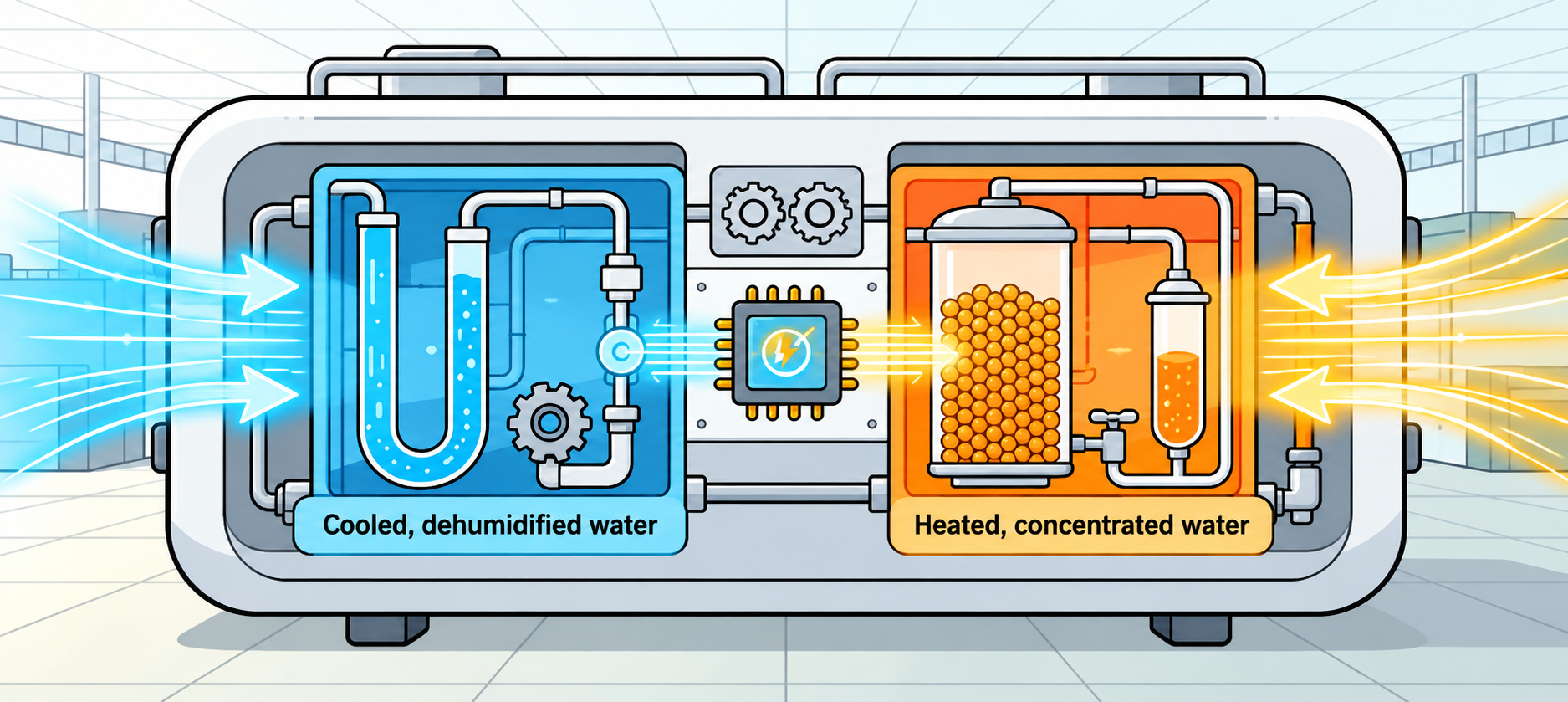
After one adsorption vessel completes its drying cycle, the high-temperature compressed air is directed through the desiccant bed. The heat carried by the compressed air raises the desiccant temperature and causes the adsorbed moisture to desorb. This allows regeneration to take place without consuming dry compressed air during the heating stage.
The key distinction appears during cooling.
After thermal regeneration is complete, the desiccant must be cooled before it can return to efficient adsorption. In the HOC-E configuration, a small amount of dry product air is used during this cooling stage.
This arrangement reduces compressed-air losses while maintaining effective regeneration.
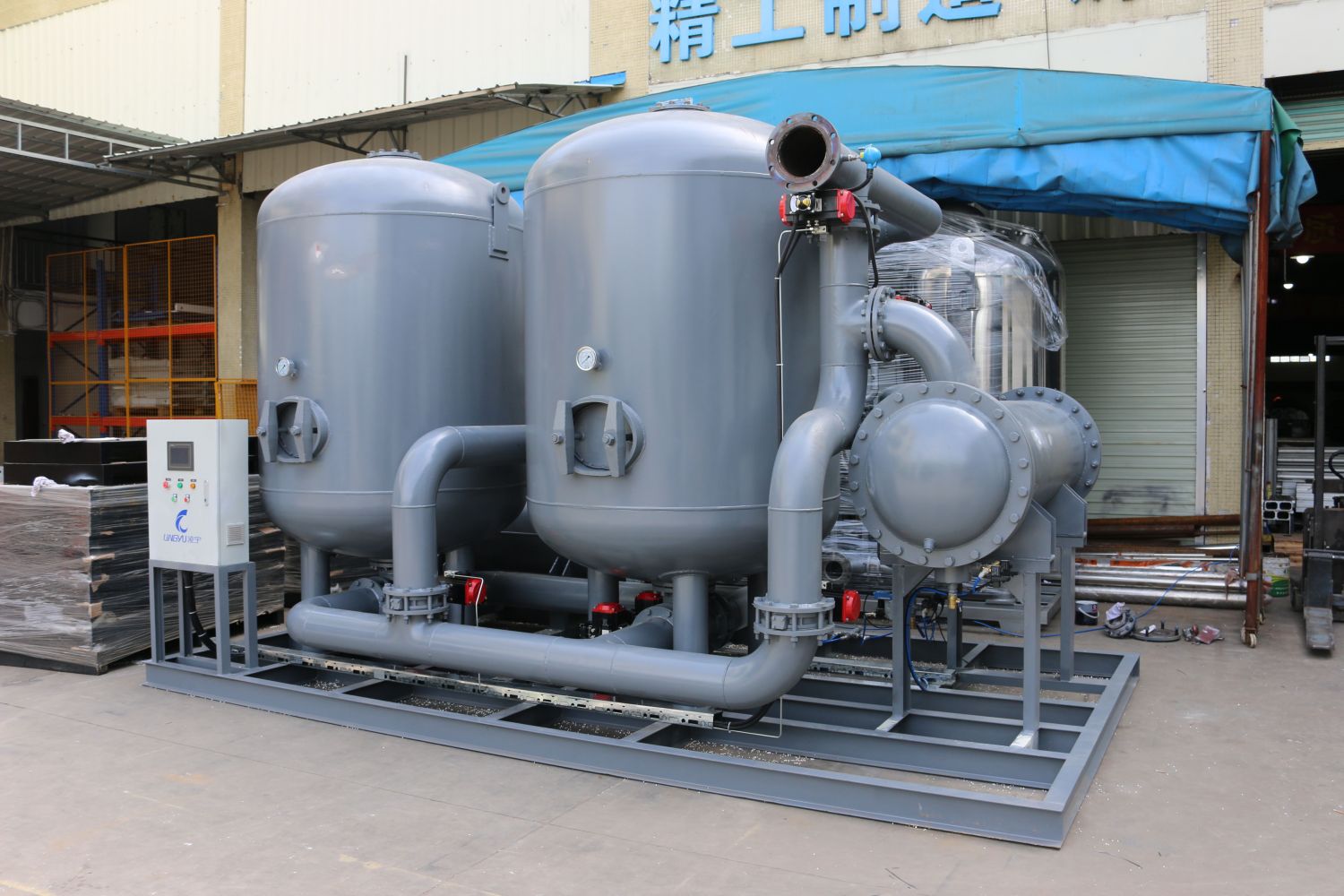
HOC-E Is Low-Purge, Not Zero-Purge
The HOC-E is a low-purge heat-of-compression dryer, not a zero-purge model.
Its regeneration-air consumption is:
≤3%
The correct operating description is therefore:
No compressed-air consumption during heating/regeneration + small dry-air consumption during cooling.
It should not be described as a completely zero-gas-consumption dryer.
The HOC-Z Series is the separate zero-purge configuration. It uses cooled compressed air to cool the regenerated desiccant bed and does not consume dry product air during either heating/regeneration or cooling.
The distinction is important:
HOC-E = low purge. HOC-Z = zero purge.
Why Compressor Waste Heat Matters
A conventional heated adsorption dryer requires an external heat source to provide the energy needed for desiccant regeneration.
The HOC-E instead uses heat that already exists in the compressor discharge air. Rather than first rejecting all of the compression heat and then using electrical energy to heat another regeneration airflow, the HOC-E captures part of the compressor’s thermal energy and puts it directly into the regeneration process.
This makes the system particularly relevant where sufficiently hot compressor discharge air is continuously available.
Its core energy-saving principle is therefore waste-heat utilization, rather than simply a generic claim of low power consumption.
Standard Operating Conditions
The HOC-E Series operates under the following conditions:
| Parameter | Specification |
|---|---|
| Applicable medium | Compressed air / non-corrosive air |
| Rated inlet pressure | 0.7 MPa |
| Operating pressure range | 0.6–1.0 MPa |
| Rated inlet temperature | 120°C |
| Allowable inlet-temperature range | 110–180°C |
| Regeneration-air consumption | ≤3% |
| Outlet pressure dew point | −20°C / −40°C optional |
| Cooling-water temperature | ≤32°C |
| Cooling-water pressure | 0.2–0.6 MPa |
The inlet-temperature requirement is particularly important because the HOC-E depends on thermal energy in the compressor discharge air for regeneration.
Why High Inlet Temperature Is Required
For many dryers, high inlet temperature is mainly considered a thermal load that must be reduced. For an HOC-E dryer, high-temperature compressed air has another function: it is the regeneration heat source.
The rated inlet temperature is 120°C, with an allowable range of 110–180°C.
If the compressor discharge temperature is too low, the available regeneration energy may not match the design requirement. HOC-E selection therefore needs to consider compressor type, compressor discharge temperature, load profile, available heat throughout the operating cycle, cooling arrangement, and required pressure dew point.
The dryer should be engineered together with the compressor system rather than selected as an isolated downstream component.
Why Cooling Is Still Necessary
Heating removes moisture from the desiccant, but desorption alone does not mean the bed is immediately ready for full adsorption capacity.
The desiccant must also return to a suitable adsorption temperature.
The HOC-E therefore includes a cooling stage after thermal regeneration. This is the stage where a small amount of dry product air is consumed, which is why the overall regeneration-air specification is ≤3% rather than 0%.
Cooling-Water Requirements
The HOC-E requires cooling water under the following conditions:
Cooling-water temperature: ≤32°C
Cooling-water pressure: 0.2–0.6 MPa
Cooling-water availability should therefore be checked before equipment selection.
Insufficient cooling can affect the desiccant’s ability to return to an effective adsorption temperature after regeneration. The project should consider cooling-water inlet temperature, available pressure, required flow rate, water quality, seasonal temperature changes, and reliability of the cooling-water supply.
Cooling water is not merely an installation accessory; it is part of the HOC-E regeneration cycle.
Cooling-Water Flow Depends on Dryer Capacity
Cooling-water flow requirements increase with dryer capacity. Representative values include:
| Model | Airflow | Cooling-Water Flow | Cooling-Water Connection |
|---|---|---|---|
| HOC-E100 | 13.5 m³/min | 5.5 T/h | G1½” |
| HOC-E200 | 28.5 m³/min | 11.5 T/h | G2″ |
| HOC-E300 | 37.0 m³/min | 15.0 T/h | G2″ |
| HOC-E500 | 55.0 m³/min | 22.5 T/h | DN65 |
| HOC-E800 | 85.0 m³/min | 35.0 T/h | DN80 |
| HOC-E1000 | 110 m³/min | 45.0 T/h | DN100 |
| HOC-E1400 | 140 m³/min | 57.5 T/h | DN125 |
| HOC-E1800 | 180 m³/min | 74.0 T/h | DN125 |
| HOC-E2100 | 210 m³/min | 86.0 T/h | DN125 |
| HOC-E2600 | 260 m³/min | 106.5 T/h | DN150 |
The HOC-E range extends from 13.5 to 260 m³/min, positioning it primarily for medium- and large-scale industrial compressed-air systems rather than small laboratory installations.
HOC-E Model Range
Representative compressed-air connection and dimensional data include:
| Model | Airflow | Compressed-Air Connection | Dimensions |
|---|---|---|---|
| HOC-E100 | 13.5 m³/min | DN65 | 2050×1350×2550 mm |
| HOC-E150 | 21.5 m³/min | DN65 | 2100×1350×2550 mm |
| HOC-E300 | 37.0 m³/min | DN100 | 2400×1600×2750 mm |
| HOC-E500 | 55.0 m³/min | DN125 | 2800×1950×2950 mm |
| HOC-E800 | 85.0 m³/min | DN125 | 3370×2300×3050 mm |
| HOC-E1000 | 110 m³/min | DN150 | 3800×2700×3350 mm |
| HOC-E1400 | 140 m³/min | DN200 | 4100×2800×3550 mm |
| HOC-E1800 | 180 m³/min | DN200 | 4500×3100×3650 mm |
| HOC-E2100 | 210 m³/min | DN200 | 4800×3150×3750 mm |
| HOC-E2600 | 260 m³/min | DN250 | 5000×3250×3800 mm |
For airflows above 260 m³/min, or special material, pressure, or temperature requirements, separate technical confirmation is required.
For product-specific details, users can review the HOC-E compression heated regeneration adsorption air dryer page.
Pressure Dew Point Options
The HOC-E is available with −20°C / −40°C outlet pressure dew point configurations.
These two targets should not be treated as interchangeable. The correct pressure dew point depends on the downstream process.
Selection should therefore start with the required dew point rather than simply requesting the lowest available value. Over-specifying dew point can increase system complexity without delivering meaningful process benefit.
EBZ200-2 Energy-Saving Control
The HOC-E incorporates Lingyu’s EBZ200-2 multi-core control system.
Compared with conventional fixed-cycle operation, this control strategy can reduce overall energy consumption by more than 10%.
This is particularly relevant for heat-of-compression systems because dryer performance depends on coordinating adsorption timing, regeneration heat availability, cooling, vessel switching, and operating load.
The control system therefore plays an important role in using available heat effectively rather than simply following a fixed cycle regardless of operating conditions.
Optional Dew-Point-Based Control
The HOC-E can also use optional dew-point-based energy-saving control.
Under fluctuating-load conditions, the system can extend the adsorption cycle according to actual operating demand. Under suitable fluctuating-load conditions, this strategy can reduce overall energy consumption by more than 30%.
The >30% figure applies to the optional control strategy under appropriate variable-load conditions and should not be interpreted as a guaranteed saving for every HOC-E installation. Its value depends on actual load variation and operating profile.
Siemens Touchscreen and System Monitoring
The HOC-E uses a Siemens touchscreen programmable controller.
The system monitors parameters including air outlet temperature, heating temperature, regeneration exhaust temperature, Tower A/B pressure, blower pressure, and optional pressure dew point.
RS-485 communication is supported as standard, with optional IoT or other communication solutions available according to project requirements.
For large centralized compressor stations, these functions support integration of dryer operation into broader equipment monitoring.
Airflow Distribution and Desiccant Utilization
The HOC-E uses a specially designed flow distributor intended to improve desiccant utilization while minimizing compressed-air pressure drop.
It also uses customized high-performance desiccant with an additional filling allowance to support stable adsorption performance.
Uniform airflow through the desiccant affects moisture adsorption, regeneration uniformity, pressure drop, and long-term operating stability.
Core Components and Maintenance Priorities
The HOC-E uses high-performance pneumatic valves and a high-efficiency cooler designed using HTFS thermal design software among its main components.
Maintenance should focus on the complete heat-recovery and regeneration process. Important operating checks include compressor discharge temperature, tower switching, cooling-water flow, cooling-water temperature, regeneration temperatures, pneumatic valve condition, tower pressures, dew-point trend, condensate management, and upstream filter condition.
A problem in the compressor or cooling-water system can affect dryer performance even if the adsorption vessels themselves are in good condition.
Why Upstream Filtration Still Matters
Heat-of-compression regeneration does not eliminate the need to control contaminants entering the adsorption system.
Oil aerosols, particles, and unwanted condensate can affect the desiccant and internal components.
Where additional contaminant removal is required, suitable precision compressed air filters should be integrated according to the complete air-quality specification.
Filtration should be treated as part of dryer protection and complete air-treatment integration rather than as a generic accessory.
Where HOC-E Makes the Most Sense
The technical characteristics of the HOC-E point toward medium- and large-scale industrial compressed-air stations with access to sufficiently hot compressor discharge air and reliable cooling water.
The HOC-E is particularly relevant where a plant has medium-to-large continuous airflow, high compressor discharge temperature, a requirement for −20°C or −40°C pressure dew point, available cooling water, a strong interest in reducing purge-air losses, centralized equipment monitoring, and long operating hours.
These system conditions provide a more meaningful basis for evaluating the HOC-E than a generic list of unrelated applications.
HOC-E vs. HOC-Z
The core difference between the two heat-of-compression configurations is their cooling method and resulting regeneration-air consumption.
HOC-E: No compressed-air consumption during heating/regeneration, but ≤3% regeneration air overall because a small amount of dry product air is used during cooling.
HOC-Z: No dry product-air consumption during either heating or cooling, giving 0% regeneration-air consumption.
The HOC-E should therefore not be described as a zero-gas-consumption dryer.
Information to Provide Before HOC-E Selection
Before requesting an HOC-E configuration, provide the required airflow, compressor type, compressor discharge temperature, operating pressure, required pressure dew point, normal and peak load, operating hours, cooling-water temperature, cooling-water pressure, available cooling-water flow, upstream air quality, and control-integration requirements.
For capacities above 260 m³/min or special pressure, material, or temperature conditions, users can use Lingyu’s contact page for technical configuration support.
Conclusion
The HOC-E Series Low-Purge Heat-of-Compression Regenerative Desiccant Air Dryer uses thermal energy already contained in high-temperature compressor discharge air to regenerate the desiccant.
Its main technical characteristics include a 120°C rated inlet temperature, 110–180°C allowable inlet-temperature range, ≤3% regeneration-air consumption, −20°C / −40°C pressure dew point configurations, 0.7 MPa rated inlet pressure, 0.6–1.0 MPa operating pressure, cooling-water temperature ≤32°C, and cooling-water pressure of 0.2–0.6 MPa.
The key advantage of the HOC-E is not zero purge. It is substantially reduced purge-air consumption combined with waste-heat regeneration.
For plants with sufficiently hot compressor discharge air, reliable cooling water, and medium-to-large continuous air demand, that combination can reduce regeneration losses while maintaining stable low-dew-point compressed air.