Industrial compressed-air stations that produce high-temperature compressor discharge air can recover part of that thermal energy instead of discarding it and then supplying separate energy for desiccant regeneration.
The HOC-Z Series Zero-Purge Heat-of-Compression Regenerative Desiccant Air Dryer is designed around this principle. It uses the thermal energy contained in high-temperature compressed air discharged from the air compressor to regenerate the desiccant and uses cooled compressed air during the cooling stage.
Because dry product air is not consumed during either heating/regeneration or cooling, regeneration-air consumption is 0%. This guide focuses on HOC-Z waste-heat regeneration, zero-purge cooling, 110–180°C inlet conditions, load control, dew-point monitoring, valve reliability, condensate management, and model selection.
For users comparing HOC-E and HOC-Z configurations, Lingyu’s heat-of-compression dryer range provides the broader product family.
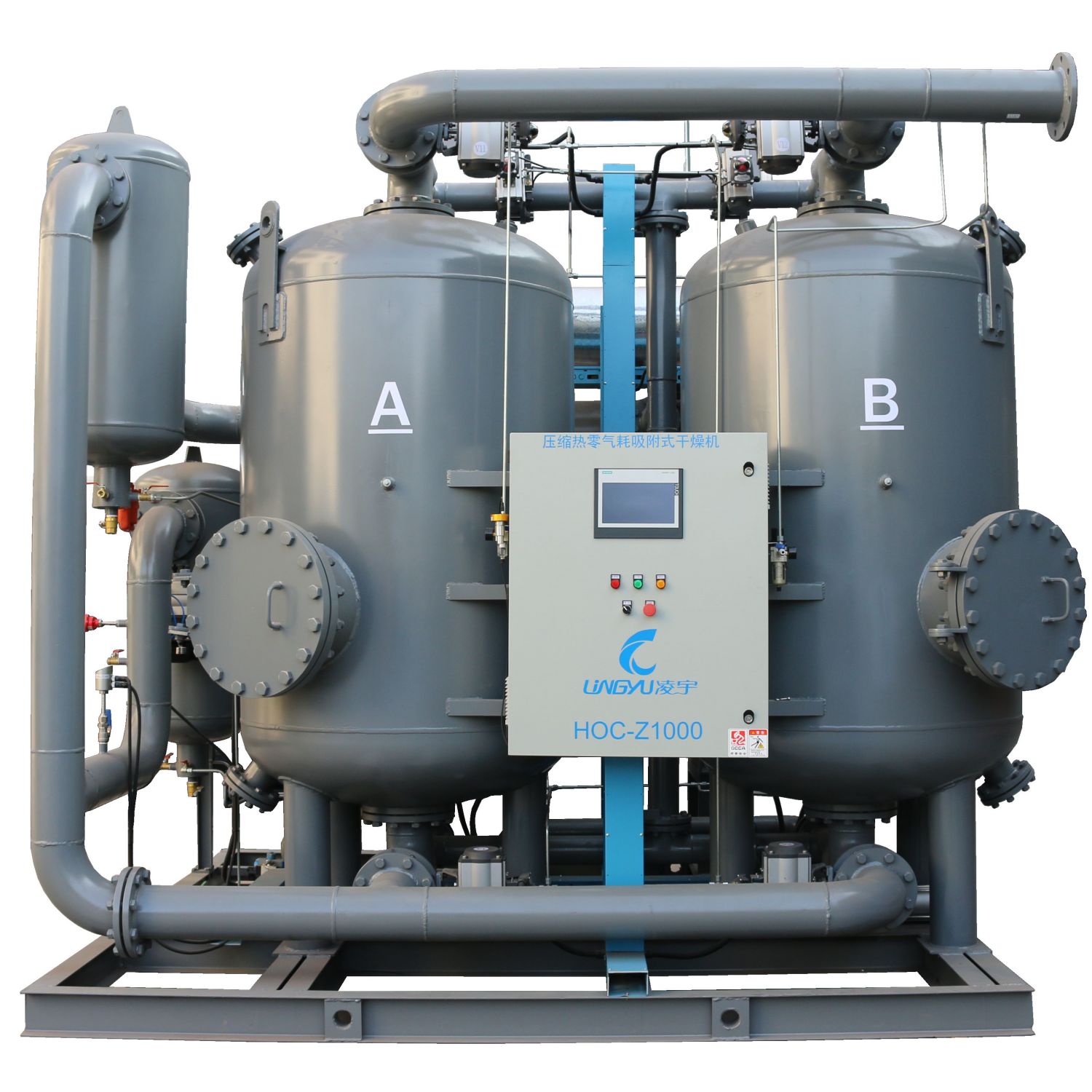
How the HOC-Z Regeneration Process Works
The HOC-Z does not depend on ambient air drawn through a separate blower for regeneration. Instead, it uses the thermal energy already contained in high-temperature compressed air leaving the air compressor.
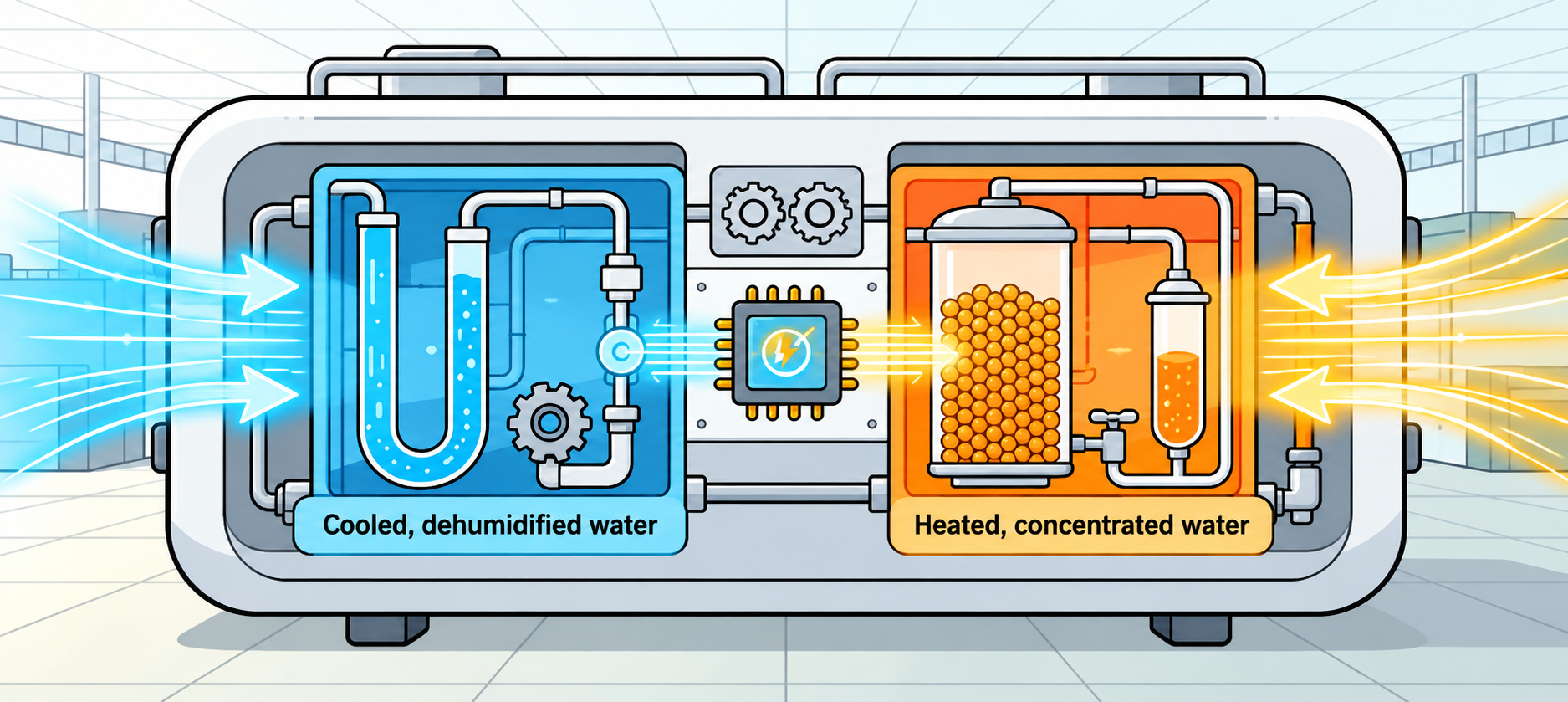
After an adsorption cycle, hot compressed air is directed through the desiccant bed. Its thermal energy raises the desiccant temperature and releases moisture previously adsorbed during drying. This allows thermal regeneration to take place without consuming dry product air.
During cooling, compressed air that has passed through the cooler is used to cool the regenerated desiccant bed.
Because neither heating/regeneration nor cooling requires dry finished-air purge, regeneration-air loss is eliminated in the HOC-Z design.
Why HOC-Z Is a Zero-Purge Dryer
The key distinction between HOC-Z and HOC-E is the cooling process.
For HOC-Z:
Heating/regeneration: no dry product air consumed
Cooling: no dry product air consumed
Overall regeneration-air consumption: 0%
By comparison, the HOC-E Series uses a small quantity of dry product air during cooling and has a regeneration-air consumption specification of ≤3%.
HOC-Z should therefore be classified as a true zero-purge heat-of-compression regenerative desiccant dryer, while HOC-E remains a low-purge configuration.
Compressor Discharge Heat Is the Regeneration Energy Source
The main energy principle of HOC-Z is heat recovery.
Air compression naturally produces heat. Instead of allowing all of this thermal energy to be rejected downstream, the HOC-Z uses high-temperature compressor discharge air to heat and regenerate the desiccant.
Its regeneration principle is therefore fundamentally different from a blower-heated dryer, which uses an external blower and heater.
HOC-Z is most relevant when the compressor system can continuously provide sufficiently hot discharge air within the dryer’s designed operating range.
Standard HOC-Z Operating Conditions
| Parameter | Specification |
|---|---|
| Applicable medium | Compressed air / non-corrosive air |
| Rated inlet pressure | 0.7 MPa |
| Operating pressure range | 0.6–1.0 MPa |
| Rated inlet temperature | 120°C |
| Allowable inlet-temperature range | 110–180°C |
| Regeneration-air consumption | 0% |
| Outlet pressure dew point | −20°C / −40°C optional |
| Cooling-water temperature | ≤32°C |
| Cooling-water pressure | 0.2–0.6 MPa |
Other pressure ratings are available upon request.
The important temperature condition is specifically the high-temperature compressor discharge air entering the HOC regeneration system, not simply a high ambient temperature around the dryer.
Why the 110–180°C Inlet Range Matters
The HOC-Z has a 120°C rated inlet temperature and an allowable inlet-temperature range of 110–180°C.
This temperature is not merely a condition that the dryer must tolerate. It is part of the regeneration-energy source.
If compressor discharge temperature is insufficient, the thermal energy available for desiccant regeneration may also be insufficient. HOC-Z selection should therefore evaluate the compressor and dryer as an integrated system.
Important inputs include compressor type, discharge temperature, load profile, airflow, operating pressure, and required pressure dew point.
Cooling Is Still Essential to Regeneration
Heating the desiccant releases moisture, but a hot desiccant bed is not immediately ready for optimum moisture adsorption.
After thermal desorption, the adsorption bed must be cooled.
The HOC-Z uses compressed air that has been cooled by the system cooler to reduce the regenerated desiccant temperature. This cooling air is not dry product air sacrificed as purge, allowing the HOC-Z to maintain its 0% regeneration-air consumption design.
Cooling-Water Conditions
The HOC-Z requires:
Cooling-water temperature: ≤32°C
Cooling-water pressure: 0.2–0.6 MPa
Cooling-water performance should be verified during system design because the cooling system affects the dryer’s ability to return regenerated desiccant to an effective adsorption temperature.
Cooling water should therefore be treated as a core operating requirement rather than simply an auxiliary utility.
HOC-Z Model Parameters
The HOC-Z range extends from 13.5 to 260 m³/min.
| Model | Airflow | Inlet Temperature | Cooling-Water Flow | Water Connection | Air Connection | Dimensions |
|---|---|---|---|---|---|---|
| HOC-Z100 | 13.5 m³/min | 110–180°C | 10 t/h | G1½” | DN65 | 2350 × 1650 × 2800 mm |
| HOC-Z150 | 21.5 m³/min | 110–180°C | 16 t/h | G1½” | DN65 | 2350 × 1700 × 2820 mm |
| HOC-Z300 | 37.0 m³/min | 110–180°C | 27 t/h | G2″ | DN100 | 2950 × 1980 × 3050 mm |
| HOC-Z600 | 65.0 m³/min | 110–180°C | 47.5 t/h | DN65 | DN125 | 3300 × 2450 × 3200 mm |
| HOC-Z1000 | 110 m³/min | 110–180°C | 66 t/h | DN100 | DN150 | 4200 × 2800 × 3300 mm |
| HOC-Z2600 | 260 m³/min | 110–180°C | 156 t/h | DN125 | DN250 | 5100 × 3200 × 3850 mm |
For capacities above 260 m³/min, or for special specifications, materials, pressures, or operating temperatures, separate technical confirmation is required.
Dew-Point Monitoring and Control
The HOC-Z includes a dew-point meter that can be configured to display either atmospheric dew point or pressure dew point.
This allows operators to monitor moisture performance directly and helps maintain stable dew-point control.
The available outlet pressure dew point configurations are:
−20°C / −40°C optional
The appropriate dew point should be selected according to the actual process requirement rather than automatically specifying the lowest available value.
Siemens Touchscreen and RS-485 Integration
The HOC-Z is equipped with a Siemens touchscreen controller and an RS-485 communication interface. A communication protocol is available for integration into centralized control systems.
These functions are particularly useful in large compressor stations where the HOC dryer may need to coordinate with compressors, cooling systems, and plant supervisory controls.
Automatic Flow Distribution for Variable Load
One of the distinctive HOC-Z features is automatic flow-distribution control.
The system adjusts the opening of the flow-diverting valve according to actual airflow and heating temperature and can accommodate 30–110% load variations.
This is important because compressor stations rarely remain at one fixed operating load. Automatic flow distribution allows the system to manage the distribution of high-temperature compressed air as demand changes.
Why Load Variation Matters
At reduced compressed-air load, both the available heat flow and regeneration requirement can change. A fixed-flow arrangement may not respond efficiently to these changes.
The HOC-Z uses automatic flow distribution to coordinate airflow and heating temperature across its specified load range.
For facilities with variable production demand, this provides a defined load-management function rather than relying only on a fixed operating cycle.
High-Reliability Pneumatic Valve System
The HOC-Z uses a high-reliability pneumatic valve arrangement.
The solenoid valves controlling the pneumatic valves use a dual-coil design, while the high-temperature-resistant double-eccentric butterfly valves incorporate valve-position feedback switches.
During an abnormal shutdown or power failure, the valves can maintain their operating positions. This arrangement can support short-duration maintenance without interrupting compressed-air supply.
For a large centralized compressed-air system, valve reliability is particularly important because switching behavior directly affects regeneration, airflow routing, and continuity of supply.
Intelligent Condensate Drainage
The HOC-Z incorporates intelligent condensate management.
A liquid-level sensor monitors condensate accumulation. When the liquid reaches the alarm level, the system can automatically initiate forced drainage and contaminant discharge.
The condensate receiver water level is dynamically displayed on the touchscreen. Manual forced drainage, timed forced drainage, and automatic level-based drainage modes are also available.
These functions make condensate management an integrated part of dryer monitoring and maintenance.
Partial-Flow and Full-Flow Operation
The HOC-Z supports seamless transition between partial-flow and full-flow operating modes.
During cooling, the cooling air can also provide a degree of desorption, allowing the regeneration heating temperature to be reduced appropriately. This can improve operational safety while also reducing energy demand.
This operating flexibility differentiates HOC-Z from a simple fixed-cycle heat-recovery dryer.
Differential-Pressure Monitoring and Protection
The HOC-Z provides inlet-to-outlet differential-pressure display and alarm functions.
If differential pressure exceeds the preset limit, the dryer can enter an emergency operating condition with both towers operating in parallel to help maintain compressed-air supply.
This provides an additional protection mechanism for large centralized systems where interruption of compressed-air supply can affect production.
Filtration Still Matters
Zero-purge regeneration does not eliminate the need for appropriate upstream and downstream compressed-air treatment.
Oil, particles, and liquid contamination can affect adsorption performance and internal components.
Where required by the process air-quality specification, Lingyu’s precision compressed air filters can be integrated into the complete purification system.
Specific filter grades should be selected according to compressor type and downstream air-quality requirements.
HOC-Z Application Positioning
With a capacity range beginning at 13.5 m³/min and extending to 260 m³/min, and cooling-water demand reaching 156 t/h for the HOC-Z2600, HOC-Z is naturally positioned for industrial compressor stations and large continuous compressed-air systems.
Small point-of-use applications such as laboratory analyzers, dental compressors, car-wash systems, bus doors, ozone generators, and FTIR instruments are not appropriate positioning for this equipment range and have therefore been removed.
For plant-level application context, users can review Lingyu’s power and utilities compressed-air solutions.
Zero-Air-Loss Project References
A large industrial project used six 110 m³/min zero-air-loss heat-of-compression and blower-heated regenerative adsorption dryers.
The stated project performance included pressure dew point ≤−40°C and 0% regeneration-air consumption, together with multi-point temperature and pressure monitoring, local/remote control, and time-based/dew-point-based operating modes.
A separate project used six 150 m³/min zero-air-loss HOC dryers.
These configurations demonstrate the application of zero-air-loss HOC technology in large industrial compressed-air stations.
HOC-Z vs. HOC-E
The two configurations use compressor discharge heat but differ in how the regenerated desiccant bed is cooled.
| Configuration | Heating / Regeneration | Cooling | Regeneration-Air Consumption |
|---|---|---|---|
| HOC-E | Compressor discharge heat | Small amount of dry product air | ≤3% |
| HOC-Z | Compressor discharge heat | Cooled compressed air | 0% |
HOC-E is therefore a low-purge heat-of-compression dryer, while HOC-Z is the zero-purge / zero-air-loss configuration.
What to Confirm Before Selecting an HOC-Z Dryer
Before selecting an HOC-Z configuration, confirm the airflow, compressor type, compressor discharge temperature, inlet pressure, required pressure dew point, minimum/normal/maximum load, cooling-water temperature, cooling-water pressure, required cooling-water flow, compressed-air connection, available installation space, control integration, and required redundancy.
For product-specific information, users can review Lingyu’s HOC-Z zero-gas-consumption heat-of-compression dryer page.
For capacities above 260 m³/min or special pressure, material, or temperature requirements, users can use Lingyu’s Contact Us page for project-specific technical configuration.
Conclusion
The HOC-Z Series is a Zero-Purge Heat-of-Compression Regenerative Desiccant Air Dryer, not a blower-heated regeneration dryer.
Its regeneration process uses thermal energy contained in high-temperature compressor discharge air, while its cooling process uses compressed air that has been cooled by the system cooler. Because neither stage consumes dry product air, regeneration-air consumption is 0%.
The standard operating conditions include 0.7 MPa rated inlet pressure, 0.6–1.0 MPa operating pressure, 120°C rated inlet temperature, 110–180°C allowable inlet-temperature range, −20°C / −40°C outlet pressure dew point options, cooling water ≤32°C at 0.2–0.6 MPa, and capacities from 13.5 to 260 m³/min.
For large industrial compressed-air stations, the main HOC-Z selection factors are available compressor discharge heat, variable-load behavior, cooling-water capacity, zero-purge cooling, dew-point requirements, valve reliability, condensate management, and control-system integration.