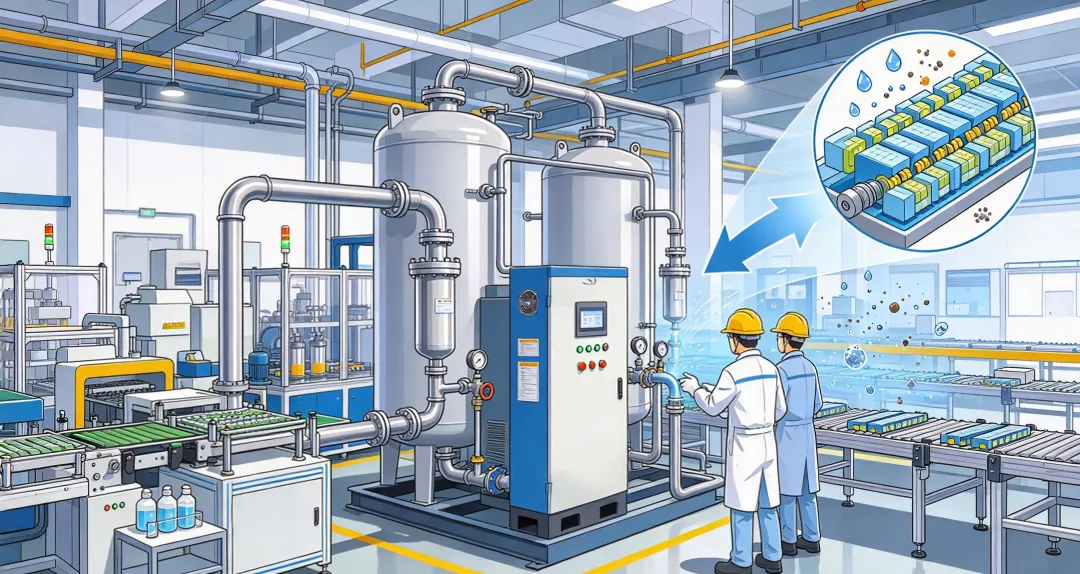
Nitrogen is one of the most abundant gases in Earth’s atmosphere, accounting for approximately 78% of atmospheric air. Because it is relatively unreactive under many normal industrial conditions and does not support combustion, nitrogen is widely used to create controlled atmospheres, reduce oxygen exposure, protect materials, and support manufacturing processes.
Understanding how nitrogen is used also helps manufacturers determine what gas quality, purity, flow rate, pressure, and supply method are appropriate for a specific process.
Why Nitrogen Is Important in Industrial Processes
One of nitrogen’s most valuable characteristics is its ability to displace oxygen from a process environment.
This makes nitrogen useful where manufacturers need to reduce oxidation, limit combustion risk, protect oxygen-sensitive products, purge vessels or pipelines, or maintain a controlled atmosphere.
However, nitrogen should not simply be described as “safe” because it is non-flammable. High concentrations can displace breathable oxygen, particularly in enclosed spaces, so ventilation, oxygen monitoring, and appropriate operating procedures may be necessary.
Similarly, nitrogen purity and moisture content depend on how the gas is produced and treated. Industrial users should specify the gas according to the actual process requirement rather than assuming that all nitrogen supplies have the same quality.
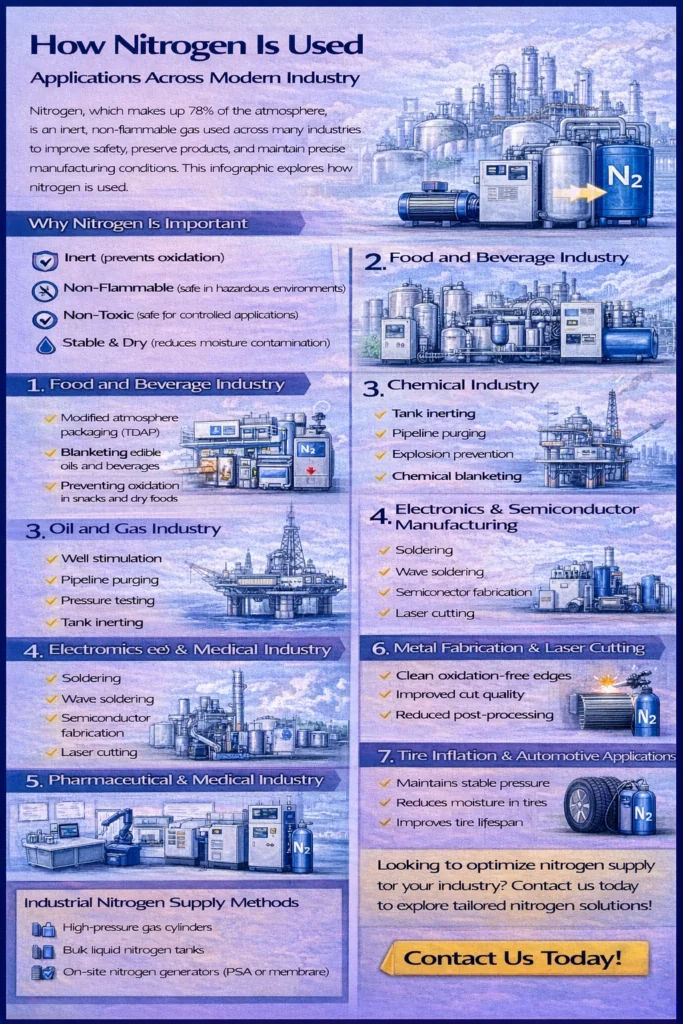
How Nitrogen Is Used in the Food and Beverage Industry
Food manufacturers use nitrogen primarily to control oxygen exposure during packaging, storage, and selected production processes.
In modified-atmosphere packaging and nitrogen flushing, nitrogen can reduce the amount of oxygen surrounding a food product. This may help control oxidation and support the preservation of flavor, appearance, or texture where appropriate.
Nitrogen may also be used for blanketing edible oils, beverages, storage tanks, and other oxygen-sensitive products.
The required nitrogen purity depends on factors such as the product, packaging system, residual oxygen target, production speed, and storage conditions rather than one universal “food industry” purity.
Lingyu provides more application-specific information through its food and beverage solutions.
How Nitrogen Is Used in Chemical and Petrochemical Processing
Nitrogen has an important role in chemical manufacturing because many processes require control of the oxygen concentration inside tanks, vessels, pipelines, and production equipment.
It can be used for tank blanketing, purging, inerting, transfer operations, and maintaining controlled atmospheres around oxygen-sensitive or flammable materials.
For example, a vessel may be purged with nitrogen before a process starts, or a nitrogen blanket may be maintained above a stored liquid to reduce contact with atmospheric oxygen.
The correct nitrogen specification depends on the chemical being handled, allowable oxygen concentration, process pressure, required flow, and plant safety requirements.
More information is available in Lingyu’s petrochemical and chemical processing solutions.
How Nitrogen Is Used in Oil, Gas, and Marine Operations
Nitrogen is also widely applied in oil, gas, offshore, and marine environments where controlled gas conditions are required.
Depending on the operation, nitrogen may be used for pipeline purging, tank inerting, pressure-related operations, vessel blanketing, or selected maintenance and commissioning procedures.
Because these applications can involve large gas volumes and demanding operating environments, flow rate, pressure, storage, installation conditions, and applicable project requirements can be just as important as nitrogen purity.
Readers working in this sector can refer to Lingyu’s oil, gas, offshore and marine applications.
How Nitrogen Is Used in Electronics and Semiconductor Manufacturing
Electronics production often requires careful control of oxygen and contamination during sensitive manufacturing processes.
Nitrogen may be used in soldering, selected assembly processes, component protection, and semiconductor or PCB manufacturing where reducing oxidation can improve process consistency.
The required gas specification can vary significantly. Some operations may be satisfied with industrial nitrogen, while other processes can require much tighter control of oxygen, moisture, or contamination.
For more specialized applications, see Lingyu’s semiconductor and PCB manufacturing solutions.
How Nitrogen Is Used in Pharmaceutical Manufacturing
Nitrogen can be used in pharmaceutical and biopharmaceutical production to reduce oxygen exposure during selected manufacturing, storage, transfer, and packaging processes.
Typical uses can include vessel blanketing, process inerting, packaging, and supporting controlled atmospheres for oxygen-sensitive materials.
It is important, however, not to equate high nitrogen purity with pharmaceutical compliance automatically. Gas quality may also involve moisture, particles, oil, microbiological considerations where applicable, filtration, monitoring, qualification, and process-specific requirements.
Lingyu’s pharmaceutical and biopharmaceutical applications provide a more appropriate next step for readers interested in this sector.
How Nitrogen Is Used in Metal Fabrication and Laser Cutting
In laser cutting, nitrogen can be used as an assist gas where minimizing oxidation at the cut surface is important.
This is especially relevant when processing materials such as stainless steel or aluminum where manufacturers want a cleaner, brighter cut edge.
For laser applications, purity alone does not determine cutting performance. Nitrogen flow, point-of-use pressure, material thickness, laser power, nozzle configuration, and production demand all need to be considered.
More detailed information can be found in Lingyu’s metal fabrication and laser cutting solutions.
What About Nitrogen in Medical and Laboratory Applications?
Nitrogen is also used in laboratories and selected medical or analytical environments, but these applications should be separated from the general industrial nitrogen-generator discussion.
Gas requirements for analytical instruments, sample preparation, healthcare systems, or cryogenic liquid-nitrogen storage can differ substantially from standard industrial PSA applications.
For this reason, the exact equipment and gas-quality requirements should be determined from the application or instrument specification rather than assuming that one industrial nitrogen system is suitable for every medical or laboratory use.
How Industrial Nitrogen Is Supplied
Industrial users generally obtain nitrogen through stored compressed gas, bulk liquid nitrogen, or on-site generation.
The best method depends on consumption, required purity, pressure, operating pattern, site infrastructure, and supply logistics.
Facilities with regular nitrogen demand may evaluate a PSA nitrogen generator as an alternative to relying entirely on externally delivered gas.
On-site systems can reduce dependence on deliveries, but they still require compressed air, electricity, air treatment, maintenance, storage, and appropriate controls. For this reason, on-site generation should not automatically be described as the cheapest solution for every user.
How PSA Nitrogen Generation Works
Lingyu’s nitrogen generation equipment uses Pressure Swing Adsorption, or PSA.
The system contains two adsorption towers filled with Carbon Molecular Sieve. Oxygen is preferentially adsorbed from the compressed-air stream while nitrogen passes through as product gas. The two towers alternate between adsorption and regeneration under automatic PLC control to maintain continuous nitrogen production.
Lingyu’s catalog specifies a nitrogen purity range of approximately 95%–99.999%, with standard product configurations including 99%, 99.5%, 99.9%, and 99.99%.
For a more detailed technical explanation, see how PSA nitrogen generation works.
Why Nitrogen Purity Varies by Application
One of the most important points for industrial buyers is that higher purity is not automatically better.
Different processes tolerate different residual oxygen levels. A process used primarily for blanketing may have different requirements from semiconductor production or a specialized manufacturing process.
Specifying unnecessarily high purity can affect generator capacity, nitrogen recovery, compressed-air consumption, and overall operating cost.
Nitrogen system selection should therefore consider purity together with flow, pressure, dew point, peak demand, and air consumption.
Lingyu’s PSA system also provides real-time monitoring of nitrogen purity and flow, with off-specification alarm and protection functions.
What About Very High-Purity Nitrogen?
Some applications may require nitrogen beyond the standard purity produced directly by a PSA generator.
Lingyu’s catalog includes a carbon-based deoxygenation purification system designed to further purify approximately 99.9% PSA nitrogen to ≥99.999%. The catalog specifies residual oxygen at very low ppm levels, along with further removal of CO₂ and moisture.
This type of additional purification should be considered only when the process genuinely requires such gas quality.
It should not be presented as necessary for every industrial nitrogen application.
Benefits of On-Site Nitrogen Generation
For suitable applications, on-site generation can provide more direct control over nitrogen availability and reduce dependence on cylinder or bulk-gas delivery schedules.
It can also reduce some gas-handling and logistics requirements and allow the system to be sized around actual process demand.
However, the economic result depends on nitrogen consumption, required purity, compressor energy, operating hours, maintenance, air treatment, and local delivered-gas pricing.
For that reason, claims such as “significant cost savings” or “rapid ROI” are best supported by site-specific calculations rather than treated as universal benefits. For a more detailed financial comparison, see the nitrogen generator cost and ROI guide.
Conclusion
Understanding how nitrogen is used shows why the gas is important across food processing, chemical production, oil and gas operations, electronics manufacturing, pharmaceutical production, metal fabrication, and many other industrial sectors.
The common principle is not simply the use of “high-purity nitrogen.” Each process has its own requirement for oxygen concentration, nitrogen purity, flow, pressure, moisture, and supply reliability.
For facilities considering on-site generation, the most effective approach is to define those process requirements first and then select the nitrogen production and air-treatment system accordingly.