If you’re considering investing in an on-site nitrogen generation system, one of the first questions you’ll ask is: How much does a nitrogen generator cost?
The answer depends on several factors, including nitrogen purity, flow rate, operating pressure, technology, and overall system configuration.
This guide explains the key factors that affect nitrogen generator cost, compares different nitrogen supply methods, and shows how businesses can evaluate the long-term economics of PSA nitrogen generation.
What Is the Average Nitrogen Generator Cost?
The cost of a nitrogen generator can vary significantly depending on the application and system size.
Small systems and large industrial installations have very different equipment, compressed air, treatment, storage, and control requirements.
For this reason, it is usually more accurate to request a quotation based on the required:
- Nitrogen purity
- Nitrogen flow rate
- Outlet pressure
- Operating hours
- Compressed air conditions
- System configuration
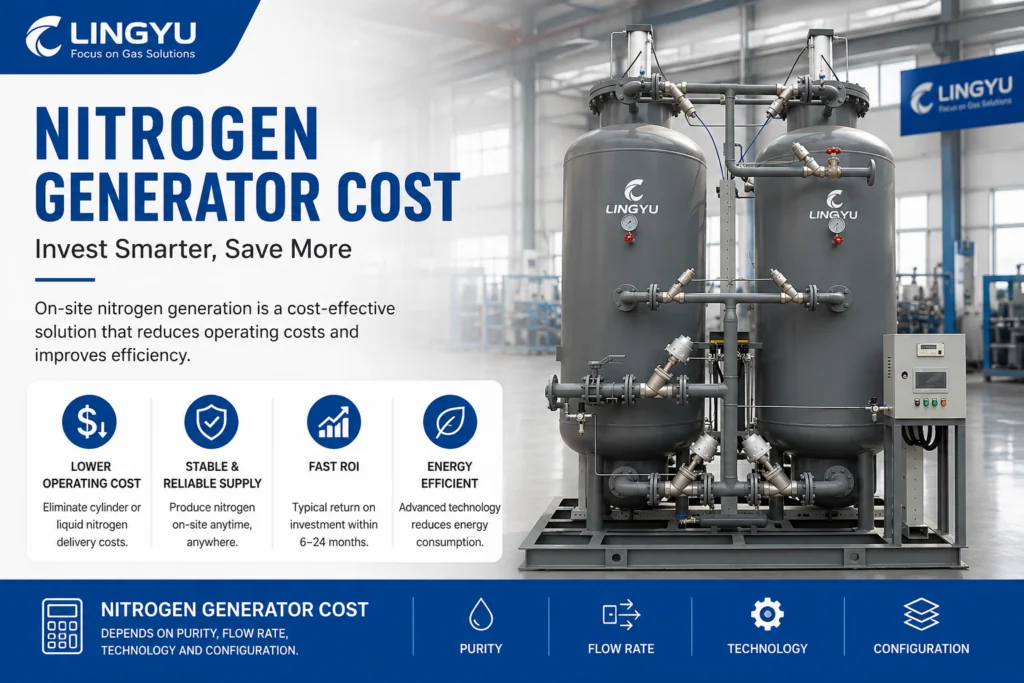
While the initial investment in on-site nitrogen generation may be higher than using cylinders, facilities with stable and continuous nitrogen demand may reduce recurring gas delivery, rental, transportation, and handling costs over time.
The actual return on investment should therefore be calculated using site-specific nitrogen consumption, electricity costs, operating hours, maintenance expenses, and current delivered-gas costs rather than relying on a universal payback period.
Factors That Affect Nitrogen Generator Cost
1. Nitrogen Purity
Nitrogen purity is one of the most important factors affecting equipment selection and operating cost.
Lingyu PSA nitrogen generators cover nitrogen purity requirements from 95% to 99.999%, depending on system configuration and operating conditions.
Higher purity generally requires more demanding separation performance and may increase compressed air consumption or equipment requirements.
Choosing the purity that your process actually requires can therefore help avoid unnecessary investment and operating costs.
2. Nitrogen Flow Rate
Flow rate is another major pricing factor.
Systems producing higher volumes of nitrogen require larger adsorption vessels, more carbon molecular sieve, larger valves and piping, and greater compressed air capacity.
The generator should therefore be sized according to actual nitrogen demand rather than simply selecting the largest available model.
If you are still determining the correct combination of purity and capacity, see the PSA nitrogen generator selection guide.
3. Nitrogen Generation Technology
Different nitrogen generation technologies have different investment and operating characteristics.
PSA (Pressure Swing Adsorption) systems use carbon molecular sieve to separate oxygen from compressed air and are widely used for industrial on-site nitrogen production.
Membrane nitrogen generators are suitable for applications where their achievable purity and operating characteristics match the process requirements.
Cryogenic nitrogen production is generally associated with much larger-scale gas production and a different investment model.
For industrial buyers, the correct choice depends on required purity, flow rate, pressure, operating profile, and total lifecycle cost.
4. Air Compressor and Supporting Equipment
A complete PSA nitrogen generation system may include:
- Air compressor
- Air dryer
- Precision filters
- Air receiver tank
- Nitrogen generator
- Nitrogen storage tank
- Control and monitoring equipment
The condition and capacity of the existing compressed air system can significantly affect total project cost.
If sufficient clean and dry compressed air is already available, additional investment may be lower.
If a dedicated compressor and air-treatment system are required, these components should be included when comparing quotations.
Hidden Costs Beyond Equipment Price
When evaluating nitrogen generator cost, it is important to consider the total cost of ownership, not just the purchase price.
Operating expenses may include:
- Electricity consumption
- Preventive maintenance
- Filter replacement
- Compressor servicing
- Spare parts
- Installation and commissioning
- Adsorbent replacement over the equipment lifecycle
For PSA systems, compressed air is a major operating input.
This means compressor efficiency, operating pressure, air-treatment pressure drop, and generator air consumption can all influence the long-term cost of producing nitrogen.
A lower equipment price does not necessarily mean a lower lifetime nitrogen cost.
Nitrogen Generator vs. Nitrogen Cylinders: Which Costs Less?
Many companies initially choose bottled nitrogen because it requires relatively little on-site equipment investment.
However, cylinder supply may involve recurring costs such as:
- Gas refill charges
- Transportation fees
- Cylinder rental
- Delivery scheduling
- Inventory management
- Cylinder handling and storage
An on-site nitrogen generator produces nitrogen from compressed air as required, reducing dependence on repeated cylinder deliveries and providing a more continuous supply for facilities with regular nitrogen demand.
Whether it is more economical depends on:
- Actual nitrogen consumption
- Electricity prices
- Operating hours
- Existing nitrogen supply costs
- Maintenance requirements
- Total system investment
For facilities with stable nitrogen demand, these factors should be compared through a site-specific ROI calculation rather than a generic industry payback estimate.
How to Reduce Nitrogen Generator Cost
Businesses can improve the economics of an on-site nitrogen system by following several basic principles:
Select the Nitrogen Purity Actually Required
Higher purity is not automatically better from an economic perspective.
Specify the nitrogen purity required by the process rather than selecting a higher purity level without a technical need.
Size the Generator for Actual Flow Demand
Oversizing can increase initial equipment cost and may result in unnecessary system capacity.
Generator sizing should be based on real nitrogen demand and the expected operating profile.
Avoid Unnecessary Operating Pressure
The required nitrogen outlet pressure should be determined by the downstream process.
Avoid specifying higher pressure than the application actually requires.
Optimize the Compressed Air System
Because PSA nitrogen generation depends on compressed air, compressor efficiency and air-treatment performance affect nitrogen production cost.
Use an efficient, properly sized compressed air system and maintain appropriate filtration and drying.
Evaluate Lifecycle Cost
Compare both capital expenditure and long-term operating expenses.
A lower purchase price does not necessarily provide the lowest total cost over the life of the equipment.
Match the System to Actual Operating Conditions
Purity, flow, pressure, operating hours, compressed air conditions, and control requirements should be evaluated together.
Correct sizing is particularly important because both excessive purity and excessive capacity can increase unnecessary investment and energy consumption.
Why Choose Lingyu Nitrogen Generators?
Lingyu provides PSA nitrogen generation systems for a range of industrial applications.
Lingyu PSA nitrogen generator systems use two adsorption towers filled with carbon molecular sieve. The towers alternate between adsorption and regeneration under automatic PLC control to provide a continuous nitrogen supply.
Depending on configuration, Lingyu PSA nitrogen generators support nitrogen purity from 95% to 99.999%.
Key design features include:
- Automatic PLC-controlled operation
- Real-time nitrogen purity and flow monitoring
- Off-spec nitrogen alarm and protection
- Digital touchscreen monitoring
- Automatic carbon molecular sieve compaction
- Continuous nitrogen production
- Optimized pressure-equalization control
Lingyu’s optimized pressure-equalization process is designed to improve nitrogen recovery efficiency and can indirectly reduce overall energy consumption by approximately 5% under the stated design conditions.
You can also explore Lingyu’s nitrogen generator range for available configurations.
Frequently Asked Questions
How Much Does an Industrial Nitrogen Generator Cost?
There is no single standard price for an industrial nitrogen generator.
Final cost depends mainly on:
- Nitrogen purity
- Flow rate
- Operating pressure
- Compressed air requirements
- System configuration
- Controls
- Storage
- Installation requirements
A quotation based on actual operating conditions provides a more reliable cost estimate than a broad generic price range.
Is a Nitrogen Generator Worth the Investment?
For facilities with regular nitrogen demand, on-site generation can reduce recurring costs associated with cylinders or delivered nitrogen.
However, actual ROI depends on current nitrogen costs, electricity prices, nitrogen consumption, operating hours, maintenance costs, and total system investment.
A site-specific lifecycle cost comparison provides a more reliable basis for evaluating the investment than a universal payback claim.
What Is the Biggest Factor Affecting Nitrogen Generator Cost?
Several factors work together to determine system cost.
The main factors are:
Nitrogen purity + required flow rate + operating pressure + compressed air requirements + overall system configuration
The importance of each factor depends on the application.
Does Higher Nitrogen Purity Increase Cost?
In general, higher PSA nitrogen purity requires more demanding separation performance and may increase compressed air consumption or equipment requirements.
For this reason, specifying the correct process purity is important for controlling both initial and operating costs.
Get a Customized Nitrogen Generator Cost Estimate
Every production facility has different nitrogen requirements.
To recommend an appropriate system, the key parameters should include:
Nitrogen Purity → Flow Rate → Outlet Pressure → Operating Hours → Compressed Air Conditions
Lingyu’s engineering team can use these operating requirements to recommend a suitable PSA nitrogen generation configuration and provide a project-specific quotation.
Contact Lingyu for a customized nitrogen generator cost estimate and on-site nitrogen generation solution.