In industries such as laser cutting, electronics manufacturing, pharmaceutical production, food processing, and precision manufacturing, compressed air is an indispensable utility.
As a core component of the drying process, an adsorption air dryer plays an important role in maintaining a stable supply of clean, dry compressed air.
However, one common operating problem is desiccant dust carryover, also known as desiccant dusting or powder carryover.
Fine desiccant particles may be carried into the exhaust system or downstream compressed air line, leading to frequent after-filter blockage, increased pressure drop, contamination of downstream equipment, and deterioration in dryer performance.
Desiccant dust carryover is often associated with desiccant attrition, contamination, abnormal airflow distribution, or mechanical impact inside the adsorption vessel.
Identifying the root cause is therefore essential before replacing the desiccant or making operating adjustments.
1. What Causes Desiccant Dust Carryover?
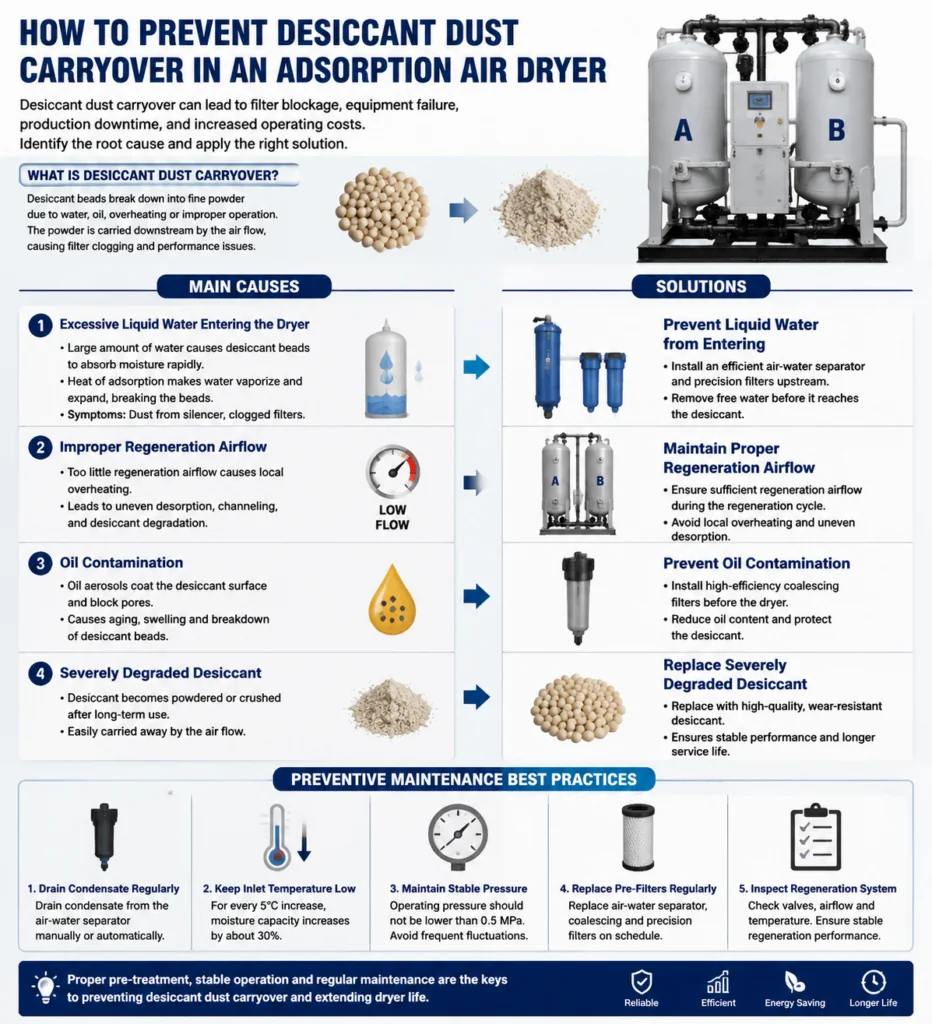
Desiccant dust carryover occurs when desiccant particles experience excessive attrition, fracture, or deterioration.
Fine particles generated inside the adsorption bed can then be carried away by the compressed air or regeneration exhaust.
The most common causes include the following.
1.1 Liquid Water Entering the Desiccant Tower
Adsorption dryers are designed primarily to remove water vapor, not large quantities of liquid water.
If upstream condensate separation, drainage, or filtration is ineffective, liquid water may enter the adsorption vessel and place an excessive moisture load on the desiccant.
Long-term exposure to liquid water can reduce adsorption performance, contribute to desiccant deterioration, and increase the possibility of dust generation.
Typical symptoms may include:
- Increased desiccant dust in the exhaust system
- Downstream particulate filters becoming clogged more frequently
- Deteriorating pressure dew point
- Caking or visible deterioration of the desiccant
- Severe desiccant degradation that may require partial or complete replacement
Effective upstream moisture separation is therefore essential for protecting the adsorption bed.
1.2 Mechanical Impact and Pressure Fluctuations
Desiccant particles can also deteriorate when they are repeatedly subjected to excessive movement or mechanical impact inside the vessel.
One important source of stress is abnormal pressure change during tower switching.
In a properly controlled twin-tower dryer, the regenerated tower should normally be repressurized and pressure-equalized before switching into adsorption service.
This helps reduce sudden pressure fluctuations and minimizes impact on the desiccant bed.
If switching, repressurization, or valve operation is abnormal, repeated pressure shocks may accelerate desiccant attrition and dust formation.
If the dryer also shows unstable tower switching, see how to troubleshoot abnormal switching in a desiccant air dryer.
1.3 Improper Regeneration Airflow
Regeneration airflow must be sufficient to remove moisture from the desiccant according to the dryer design.
If regeneration airflow is inadequate, the desiccant may not be completely regenerated, resulting in declining adsorption performance.
Regeneration performance can also be affected by uneven airflow distribution.
When air follows preferential paths through the adsorption bed, some areas may receive insufficient regeneration while others experience greater airflow.
This condition is closely related to channeling, which can reduce effective desiccant utilization and contribute to uneven bed conditions.
For more information, see how to prevent channeling in a desiccant air dryer.
Regeneration airflow should therefore remain within the range specified for the particular dryer rather than being reduced simply to save compressed air.
1.4 Oil Contamination
Oil contamination is another important factor affecting desiccant condition.
Oil-lubricated compressors may introduce oil aerosols into the compressed air system.
If upstream oil-removal filtration is inadequate, oil can reach the adsorption bed and gradually reduce desiccant performance.
Contaminated desiccant may exhibit:
- Reduced adsorption capacity
- Uneven regeneration
- Caking or surface contamination
- Increasing pressure dew point
- Accelerated deterioration
Appropriate upstream oil-removal filtration should therefore be maintained according to the compressed air quality requirement and dryer specification.
If excessive oil is present throughout the compressed air system, see how to solve excessive oil content in a compressed air system.
2. Corrective Actions for Desiccant Dust Carryover
Once the likely cause has been identified, corrective action should focus on eliminating the source of desiccant damage rather than simply replacing the after-filter repeatedly.
2.1 Prevent Liquid Water from Entering the Dryer
Check the complete upstream moisture-removal system, including:
- Air-water separation
- Condensate drains
- Air receiver drainage
- Upstream filters
- Aftercooling or refrigerated pretreatment where applicable
Liquid condensate should be removed before compressed air enters the adsorption vessel.
For applications with a high moisture load, a combined refrigerated and adsorption drying configuration may also be considered.
The refrigerated stage removes a large portion of the moisture before the compressed air reaches the adsorption bed, reducing the moisture load on the desiccant.
2.2 Maintain Proper Regeneration Airflow
Do not reduce regeneration airflow below the setting required for the specific dryer.
Different adsorption dryer technologies use very different regeneration-air quantities.
Heatless, heated-purge, blower-heated, and heat-of-compression dryers should therefore not be adjusted according to one universal purge percentage.
If regeneration performance is in doubt, monitor:
- Outlet pressure dew point
- Regeneration airflow
- Exhaust condition
- Tower pressure
- Switching sequence
- Regeneration temperature where applicable
For detailed guidance, see how regeneration air flow should be adjusted in an adsorption air dryer.
2.3 Prevent Oil Contamination
Use an appropriate upstream filtration arrangement to control oil aerosols and other contaminants before they reach the adsorption bed.
Filter selection should be based on actual air-quality requirements rather than one universal filtration sequence.
Filter differential pressure, condensate drainage, and element condition should also be checked regularly because a poorly maintained filtration system can compromise downstream dryer performance.
2.4 Replace Severely Degraded Desiccant
If a substantial portion of the desiccant has already broken down into fine particles, simply correcting operating conditions will not restore the damaged media.
The affected desiccant should be inspected and replaced when necessary.
When selecting replacement media, important characteristics include:
- Appropriate adsorption performance
- Good abrasion resistance
- Adequate mechanical strength
- Compatibility with the dryer design
Lingyu adsorption dryers use desiccants selected for adsorption performance and abrasion resistance to help maintain stable pressure dew point while minimizing dusting.
3. Preventive Maintenance Best Practices
Routine inspection helps identify conditions that can lead to desiccant dusting before they result in significant downstream contamination.
3.1 Keep Condensate Drainage Working Properly
Check separators, filter drains, air receivers, and other condensate-removal devices.
A blocked or failed drain can allow accumulated liquid water to move downstream and eventually enter the adsorption dryer.
Automatic drains should therefore be inspected for proper operation rather than assumed to be maintenance-free.
3.2 Control Inlet Air Temperature
Higher compressed air inlet temperatures generally increase the water-vapor load entering an adsorption dryer.
Operate the dryer within the inlet-temperature range specified for the particular model.
For example, several conventional Lingyu heatless and heated regenerative dryer configurations have a rated inlet temperature of 10–30°C, with a maximum inlet temperature of ≤40°C.
Do not apply one temperature limit universally to every adsorption dryer because heat-of-compression and other regeneration technologies operate under very different inlet conditions.
3.3 Maintain the Correct Operating Pressure
Operating pressure affects dryer capacity, airflow velocity, regeneration conditions, and overall adsorption performance.
Rather than applying a universal minimum such as 0.5 MPa to every dryer, follow the operating range specified for the selected model.
Several Lingyu conventional adsorption dryer configurations, for example, are designed for an operating range of 0.6–1.0 MPa.
Stable pressure and proper tower repressurization also help reduce unnecessary mechanical impact on the desiccant.
3.4 Monitor Filters by Condition
Upstream and downstream filter elements should not be replaced according to an arbitrary universal interval.
Instead, monitor:
- Differential pressure
- Condensate drainage
- Filter condition
- Air-quality performance
- Manufacturer recommendations
A rising pressure drop can indicate filter loading caused by contamination or desiccant dust.
If abnormal restriction develops around the dryer system, see what to do when the pressure drop of an adsorption dryer is too high.
3.5 Inspect the Regeneration and Switching Systems
Regularly check:
- Regeneration valves
- Exhaust valves and silencers
- Regeneration airflow
- Heater operation where applicable
- Tower repressurization
- Switching sequence
- Pressure dew point
Abnormal switching or regeneration can place additional stress on the adsorption bed and reduce drying performance.
3.6 Maintain Good Airflow Distribution
Airflow distribution should also be considered when diagnosing repeated desiccant dusting.
Uneven airflow can contribute to channeling, inconsistent regeneration, localized mechanical stress, and poor utilization of the adsorption bed.
Lingyu’s modular adsorption air dryer uses a straight-through adsorption chamber, inlet buffer structure, and controlled desiccant filling arrangement to help reduce uneven airflow, channeling, desiccant attrition, and dusting.
4. A Practical Troubleshooting Sequence for Desiccant Dusting
When desiccant dust carryover becomes excessive, avoid immediately replacing filters or increasing regeneration airflow.
Use a structured diagnostic sequence instead:
Liquid Water → Oil Contamination → Regeneration → Tower Switching → Airflow Distribution → Desiccant Condition
Step 1: Check for Liquid Water
Inspect upstream separation, drainage, filters, receivers, and pretreatment equipment.
Confirm that liquid condensate is not entering the adsorption tower.
Step 2: Check for Oil Contamination
Inspect upstream oil-removal filtration and the condition of the desiccant.
Determine whether oil aerosols or other contaminants are reaching the adsorption bed.
Step 3: Verify Regeneration
Check regeneration airflow, exhaust behavior, regeneration temperature where applicable, and outlet pressure dew point.
Confirm that the desiccant is being regenerated according to the dryer design.
Step 4: Verify Tower Switching and Repressurization
Observe the switching sequence and tower pressures.
Abnormal switching or insufficient repressurization may expose the desiccant bed to unnecessary pressure shocks.
Step 5: Check Airflow Distribution
Look for indications of channeling or uneven airflow through the adsorption bed.
Do not compensate for poor airflow distribution simply by increasing regeneration-air quantity.
Step 6: Inspect Desiccant Condition
If operating conditions and upstream treatment have been corrected but excessive dusting continues, inspect the desiccant for:
- Attrition
- Fracture
- Caking
- Contamination
- Moisture saturation
- General deterioration
Replace damaged media when necessary.
Conclusion: Find the Root Cause Before Replacing the Desiccant
Desiccant dust carryover is usually a symptom of an underlying problem rather than an isolated maintenance issue.
The main areas to investigate are:
Liquid Water → Oil Contamination → Regeneration → Tower Switching → Airflow Distribution → Desiccant Condition
Effective condensate removal and filtration help protect the desiccant from contamination.
Proper regeneration maintains adsorption performance, while controlled repressurization and airflow distribution help reduce mechanical stress and attrition inside the bed.
If excessive dusting continues after the operating conditions and upstream treatment have been corrected, the desiccant itself should be inspected for deterioration and replaced when necessary.
A systematic diagnosis is more effective than repeatedly replacing downstream filters or increasing regeneration airflow without identifying the root cause.
For help evaluating adsorption dryer operating conditions or selecting a suitable drying configuration, contact Lingyu for technical support.