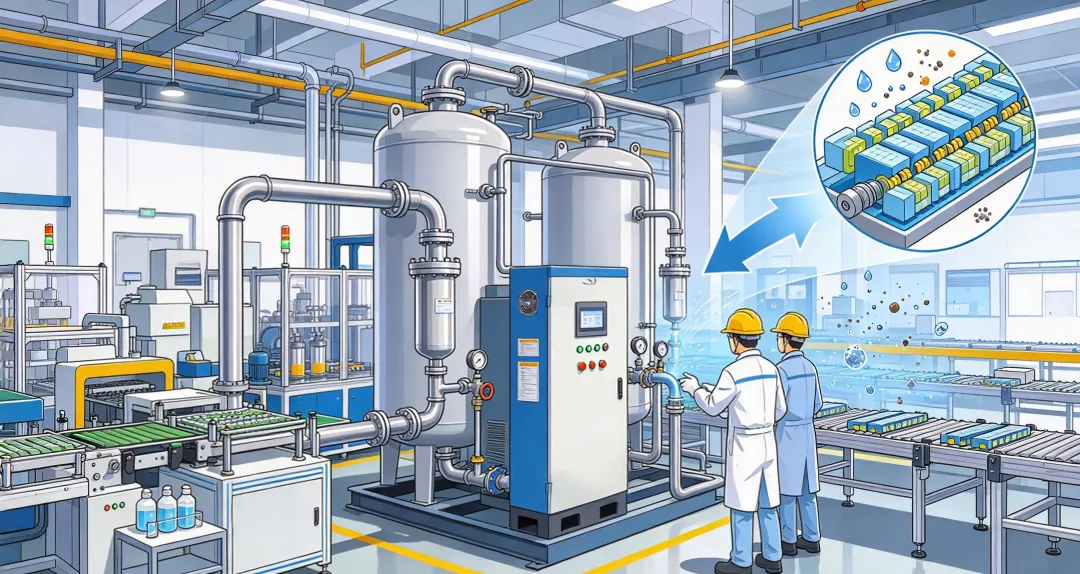
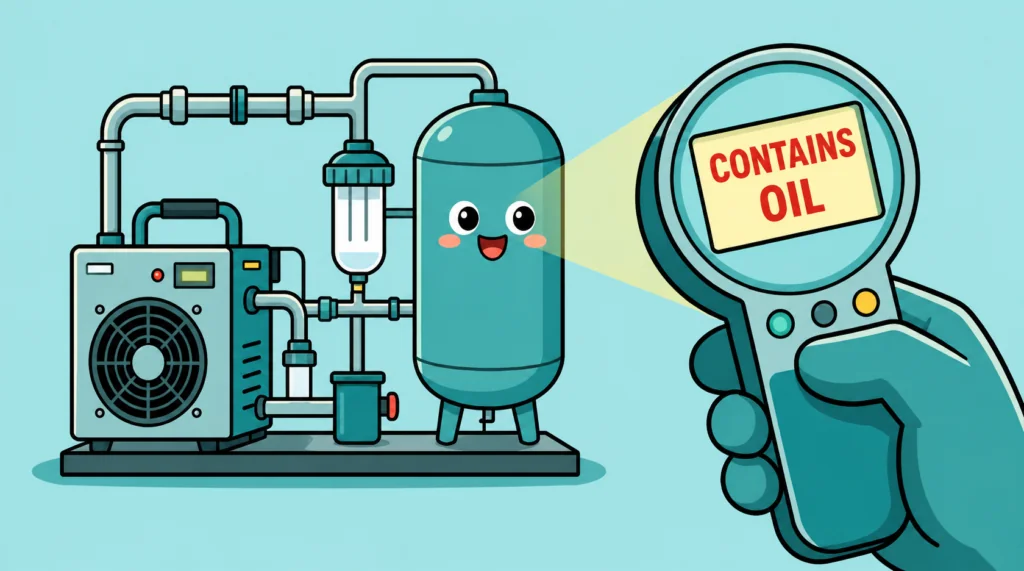
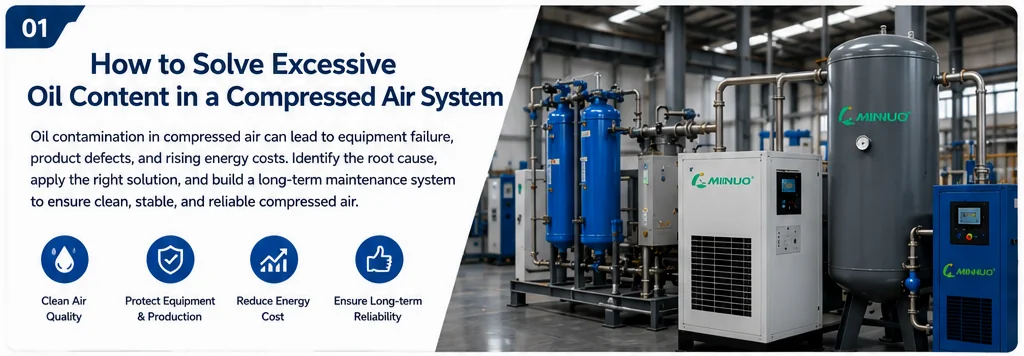
Excessive oil contamination in a compressed air system can affect air dryers, filters, pneumatic equipment, piping, and sensitive production processes. The most important first step is not to add more filtration immediately, but to determine where the oil is actually entering the system.
Oil contamination may originate from the compressor, the air-treatment system, condensate-management problems, or contamination already accumulated inside the distribution piping. Accurate troubleshooting therefore requires a systematic inspection of the complete compressed air system.
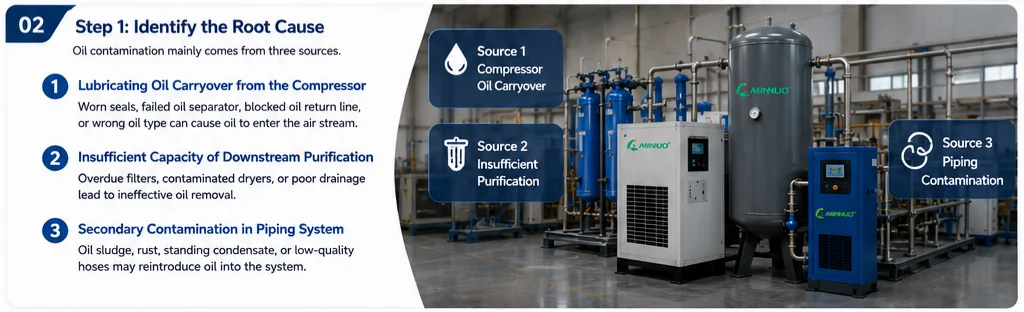
1. Identify the Root Cause First: Determine Where the Oil Is Coming From
When dealing with excessive oil contamination, one of the biggest troubleshooting mistakes is taking corrective action before identifying the source.
The main areas to investigate are:
Compressor → Air Treatment → Condensate System → Dryer → Distribution Piping
1.1 Lubricating Oil Carryover from the Air Compressor
For oil-lubricated compressors, the compressor itself is one of the first areas to inspect.
Oil may enter the downstream compressed air system if the compressor’s internal oil-separation or oil-return system is not operating correctly.
Worn or Damaged Sealing Components
Worn seals or other internal sealing problems can contribute to abnormal oil carryover.
If oil contamination increases rapidly, inspect the compressor according to the manufacturer’s service procedure rather than assuming the downstream filters are the only problem.
Oil Separator Failure
The compressor’s internal oil separator plays an important role in separating lubricating oil from the compressed air before discharge.
If the separator element becomes damaged, heavily contaminated, or otherwise unable to perform correctly, oil carryover can increase substantially.
Check the separator element for:
- Damage
- Excessive contamination
- Abnormal differential pressure
- Installation problems
- Condition relative to the compressor manufacturer’s service requirements
Blocked Oil Return Line
Separated lubricant normally returns to the compressor’s lubrication circuit through the oil-return system.
If the return line becomes restricted, oil may accumulate and increase carryover into the downstream compressed air system.
Inspect the oil return line and related components for blockage or malfunction.
Incorrect or Degraded Compressor Oil
Using unsuitable compressor lubricant or operating with severely degraded oil may affect compressor performance and oil separation.
Always use lubricant that meets the compressor manufacturer’s requirements. Investigate abnormal operating temperature, oil degradation, or contamination when oil carryover increases.
1.2 Insufficient Performance of Downstream Purification Equipment
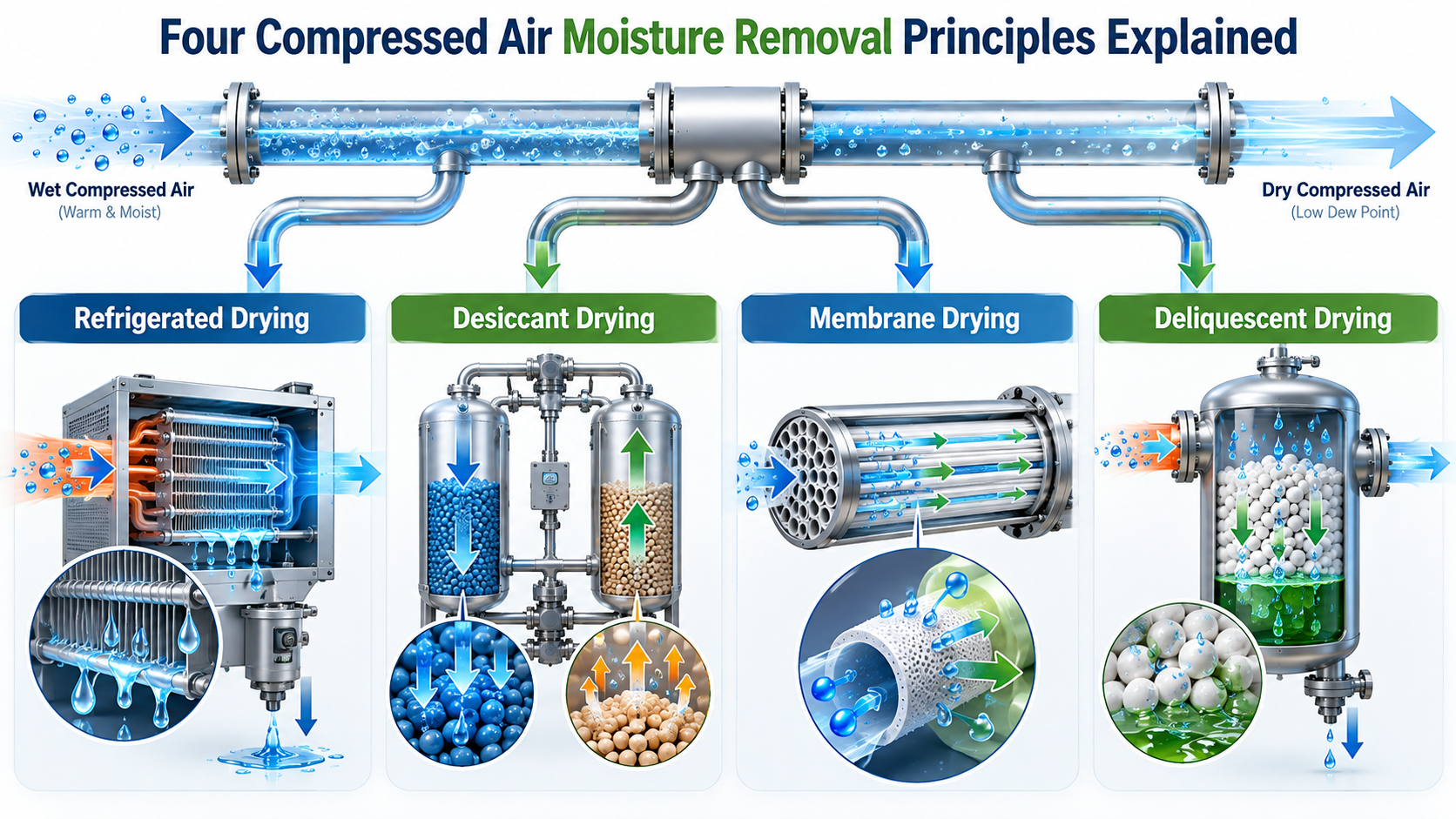
Compressed air leaving the compressor may pass through several treatment stages, including:
- Moisture separators
- Refrigerated air dryers
- Desiccant dryers
- Oil-removal filters
- Precision filters
- Activated-carbon filters where required
If one of these stages is incorrectly selected, overloaded, contaminated, or poorly maintained, residual oil may increase.
For a broader explanation of how these treatment stages work together, see the five core components of a compressed air purification system.
Loaded or Damaged Precision Filters
Oil-removal and coalescing filters should be checked according to their actual condition rather than a universal replacement interval.
Inspect:
- Differential pressure
- Filter element condition
- Condensate drainage
- Airflow
- Installation direction
- Oil contamination level
Lingyu’s compressed air filtration range includes several grades for different treatment requirements:
| Filter Grade | Main Function | Particle Filtration | Residual Oil |
|---|---|---|---|
| AO | Pre-filtration | ≤1.0 μm | ≤3 ppm |
| AA | Oil and particulate removal | ≤0.1 μm | ≤0.1 ppm |
| AX | High-efficiency oil removal | ≤0.01 μm | ≤0.05 ppm |
| ACS | Activated-carbon oil removal | — | ≤0.003 ppm |
The appropriate combination depends on the actual compressed air quality requirement.
For more detailed filter-selection information, see the AO, AA, AX, and ACS compressed air filter guide.
Oil-Contaminated Desiccant Dryer
Oil contamination can reduce the adsorption performance of activated alumina or molecular sieve inside a desiccant dryer.
Possible symptoms include:
- Rising pressure dew point
- Desiccant caking
- Uneven adsorption
- Increased pressure drop
- Desiccant deterioration
If the adsorbent has become heavily contaminated, correct the upstream oil-removal problem first. The desiccant should then be inspected and replaced if necessary.
Poor Condensate Drainage
Oil and water often accumulate together as condensate in compressed air treatment equipment.
If an automatic drain, separator, receiver, or refrigerated dryer drain is blocked, contaminated condensate may remain inside the system and reduce treatment performance.
Check all condensate drains and separators for proper operation.
1.3 Secondary Contamination from the Piping System
Oil contamination can continue even after the original compressor or filtration problem has been corrected.
Oil deposits may remain inside downstream piping and gradually be carried back into the airflow.
Possible sources include:
- Oil deposits in older piping
- Condensate accumulation at low points
- Contaminated receivers
- Dead legs with poor drainage
- Flexible hoses deteriorated after long-term exposure to oil
- Previous system-wide oil carryover events
If oil content remains high after the upstream source has been corrected, inspect the downstream piping and point-of-use equipment for residual contamination.
2. Corrective Actions According to the Severity of the Problem
Corrective action should match the actual severity and source of contamination rather than relying on one universal oil-content threshold.
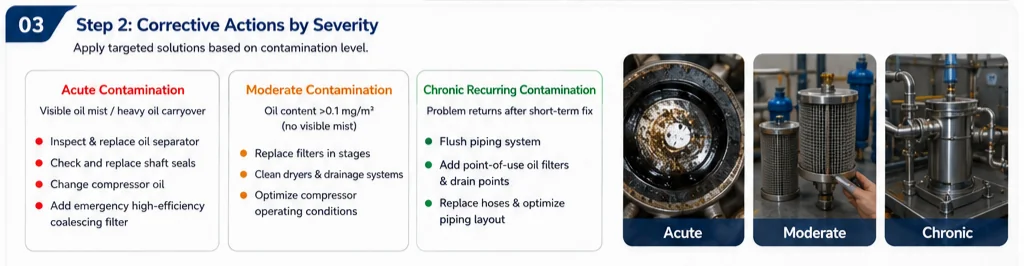
2.1 Severe or Visible Oil Carryover
If visible oil is present in downstream piping, filters, receivers, or production equipment, inspect the compressor and treatment system immediately.
Inspect the Compressor Oil Separator
Check the separator element and oil-return system.
Replace damaged or failed components according to the compressor manufacturer’s requirements.
Inspect Sealing and Oil-Return Components
Check seals, return lines, valves, and related components for abnormal leakage or blockage.
Check Compressor Oil Condition
If the oil is degraded, contaminated, or unsuitable for the compressor, replace it according to the manufacturer’s procedure.
Protect Downstream Equipment
If severe oil carryover has occurred, inspect downstream:
- Air receivers
- Filters
- Dryers
- Piping
- Critical production equipment
Do this before returning the system to normal operation.
Simply installing an additional filter without correcting the compressor-side failure will not provide a reliable long-term solution.
2.2 Moderate Oil Contamination
If no visible liquid oil is present but measured oil content is higher than the process requirement, focus on the purification chain.
Check Filter Performance
Inspect each filter stage and verify that its filtration grade is appropriate for the required air quality.
Filter elements should be replaced according to:
- Actual condition
- Differential pressure
- Contamination level
- Manufacturer recommendations
Do not apply one fixed number of operating hours to every system.
Check Dryers and Condensate Systems
Inspect:
- Refrigerated dryer condensate separation
- Automatic drains
- Air receivers
- Desiccant dryer inlet condition
- Upstream oil-removal filters
Oil contamination that reaches the adsorption bed can create longer-term dryer performance problems.
Verify Compressor Operating Conditions
Abnormal compressor temperature, oil condition, separator performance, or operating state can all contribute to increased oil carryover.
Operate the compressor within its specified conditions and investigate abnormal discharge temperature or oil consumption.
2.3 Chronic or Recurring Oil Contamination
If oil contamination repeatedly returns after the primary source has been repaired, inspect the distribution system for secondary contamination.
Clean or Replace Contaminated Piping Where Necessary
Sections containing severe oil deposits may require cleaning or replacement.
Any cleaning procedure should be compatible with:
- Piping material
- Downstream process
- Site safety requirements
Add Point-of-Use Filtration Where Required
Critical applications may require additional final filtration close to the point of use.
However, point-of-use filters should complement—not replace—proper central air treatment.
Inspect Flexible Hoses
Replace hoses that have deteriorated, swollen, or become internally contaminated.
Improve Drainage and Piping Layout
Inspect:
- Low points
- Dead legs
- Receivers
- Drain locations
- Sections where condensate can accumulate
Improved condensate management can help prevent contaminated liquid from being reintroduced into the airflow.
3. Long-Term Prevention and System Management
Temporary repairs alone may not prevent oil contamination from returning.
Long-term control depends on coordinated maintenance of the compressor, air-treatment equipment, condensate system, and distribution network.
3.1 Maintain Compressor and Filter Records
Keep maintenance records for:
- Compressor lubricant
- Oil separator elements
- Oil-return components
- Precision filters
- Activated-carbon filters where installed
- Condensate drains
Service decisions should follow actual equipment condition and manufacturer recommendations rather than being based solely on elapsed calendar time.
3.2 Monitor the System at More Than One Location
Oil testing only at the compressor outlet may not reveal where contamination is entering the system.
When troubleshooting, consider checking air quality at several points:
Compressor Outlet → After Air Treatment → Main Header → Critical Point of Use
This helps distinguish compressor oil carryover from downstream piping contamination.
3.3 Maintain Condensate Drainage
Inspect condensate drainage throughout the system.
Blocked drains can allow oil-water mixtures to accumulate in:
- Air receivers
- Filters
- Refrigerated dryers
- Separators
- Distribution piping
Drain performance should therefore be part of routine compressed air system inspection.
3.4 Match Filtration to the Required Air Quality
Do not automatically install every available filtration stage.
Define the required:
- Oil content
- Particle cleanliness
- Pressure dew point
Then select the appropriate purification equipment.
Over-treatment can increase pressure drop and maintenance cost, while under-treatment may expose dryers and production equipment to contamination.
4. Practical Troubleshooting Sequence
A systematic troubleshooting sequence helps avoid unnecessary filter replacement and makes it easier to locate the actual contamination source.
Identify the Source → Inspect the Compressor → Check Filtration and Drainage → Inspect Dryers → Check the Distribution System → Verify Air Quality Again
If Oil Is Detected Immediately After the Compressor
Focus first on:
Oil Separator → Oil Return System → Seals → Compressor Oil → Operating Conditions
If Compressor Discharge Air Is Acceptable but Downstream Oil Is High
Focus on:
Filtration → Condensate Drainage → Dryers → Receivers → Distribution Piping
If Oil Returns After the Original Fault Has Been Repaired
Investigate:
Residual Piping Contamination → Low Points → Dead Legs → Receivers → Flexible Hoses → Point-of-Use Equipment
This approach helps distinguish a current oil-carryover problem from contamination remaining after a previous system failure.
Conclusion
Excessive oil content in a compressed air system may originate from several locations:
Compressor Oil Carryover → Air-Treatment Failure → Condensate Problems → Desiccant Contamination → Piping Contamination
The most effective troubleshooting sequence is:
Identify the Source → Inspect the Compressor → Check Filtration and Drainage → Inspect Dryers → Check the Distribution System → Verify Air Quality Again
Avoid replacing filters repeatedly without correcting the source of the oil.
Likewise, do not assume that every oil problem comes from the compressor if contaminated piping or treatment equipment has already been exposed to a previous carryover event.
By identifying the source systematically and maintaining the compressor, filtration system, dryers, drains, and piping according to actual operating conditions, oil contamination can be controlled more effectively and downstream equipment can be better protected.
For help evaluating compressed air treatment requirements or selecting appropriate oil-removal filtration, contact Lingyu.