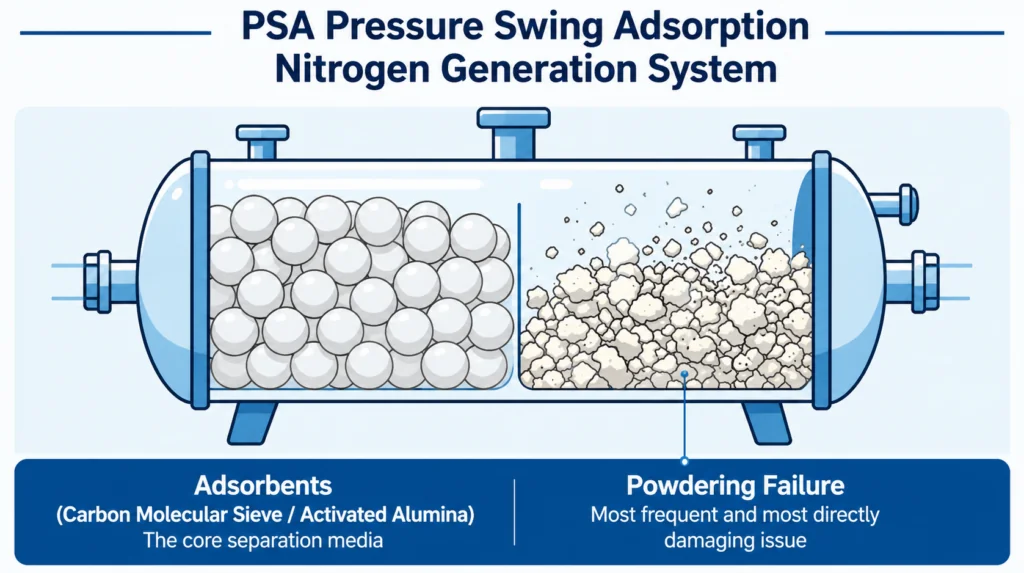
In a PSA (Pressure Swing Adsorption) nitrogen generation system, Carbon Molecular Sieve (CMS) serves as the core separation medium. CMS selectively adsorbs oxygen from compressed air while allowing nitrogen to pass through the adsorption bed.
Adsorbent powdering is a serious operating problem. In mild cases, excessive CMS dust may contribute to unstable nitrogen purity and reduced production performance. In severe cases, dust accumulation can contaminate pipelines, interfere with valve operation, affect downstream instruments, and eventually require replacement of the adsorbent bed.
Understanding the causes of CMS powdering is therefore essential for maintaining stable PSA nitrogen generator performance.
How to Quickly Identify CMS Powdering
Before opening the adsorption tower, technicians can often identify possible powdering through several operating symptoms.
1. Dust in the Nitrogen Outlet
Possible signs include:
- Black CMS powder appearing downstream of the adsorption system
- Dust accumulating inside filter housings or piping
- Abnormal dust discharge during operation
Visible powder is a strong indication that the CMS bed, retaining components, or internal structure should be inspected.
2. Significant Performance Decline
Possible symptoms include:
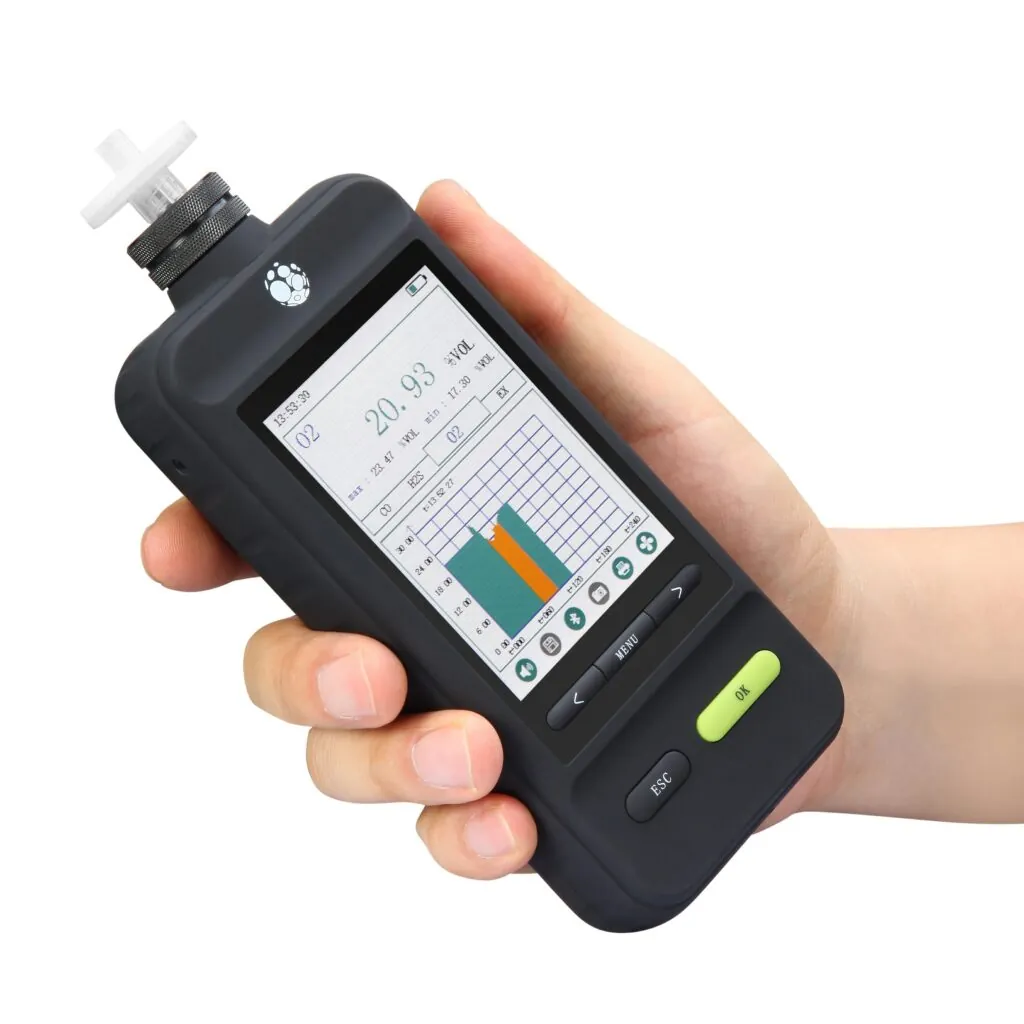
- Nitrogen purity remaining below the required specification
- Nitrogen flow or production capacity declining
- Pressurization behavior becoming abnormal
- Compressed-air consumption increasing relative to nitrogen output
- Operating adjustments providing little improvement
However, these symptoms do not prove CMS powdering by themselves. Low nitrogen purity can also result from valve leakage, inadequate compressed-air quality, incorrect operating conditions, or other system faults.
For broader diagnosis, see the common reasons a PSA nitrogen generator may produce impure nitrogen.
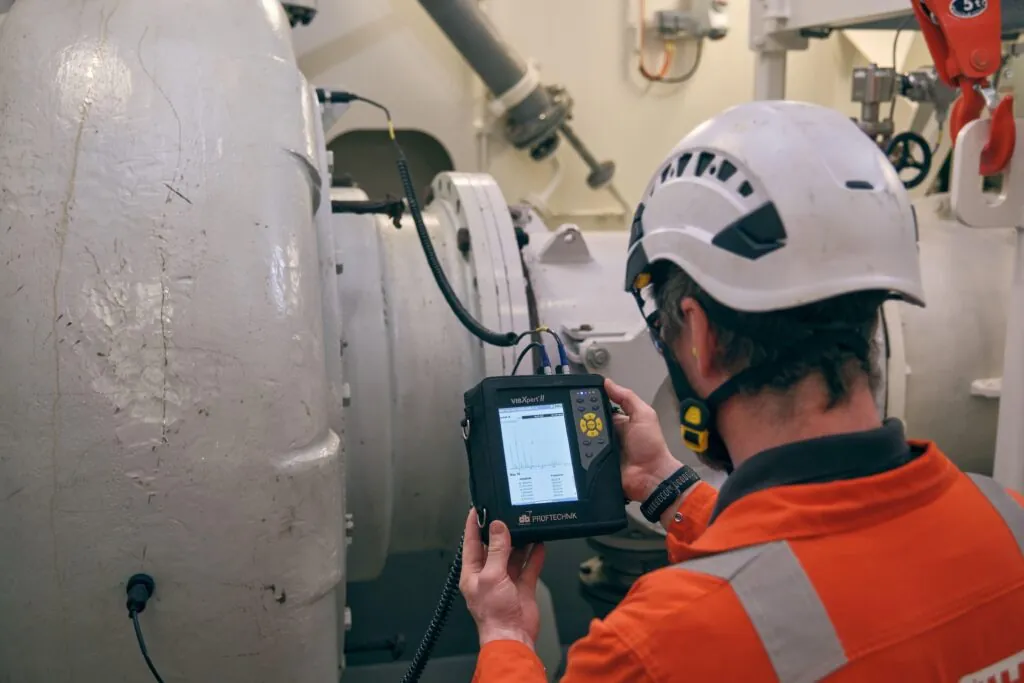
3. Abnormal Noise and Vibration
Unusual noise or vibration around the adsorption vessels may indicate excessive movement within the adsorbent bed or abnormal valve operation.
Check for:
- Unusual impact or movement sounds
- Increased equipment vibration
- Abnormal pneumatic valve operation
If several of these symptoms appear together, a systematic inspection of the PSA system is recommended.
Five-Step Troubleshooting Procedure
A structured approach helps identify the root cause while avoiding unnecessary adsorbent replacement.
Step 1: Inspect the Compressed Air Supply
The first priority is to determine whether the compressed air entering the PSA nitrogen generator contains excessive moisture, oil, or particulate contamination.
Contaminants can reduce CMS adsorption performance, promote caking or deterioration, and affect the valves and internal components of the generator.
Check:
- The performance of the compressed-air dryer and upstream filtration system
- Filter differential pressure and filter condition
- Condensate drainage from air receivers, filters, and dryers
- Whether liquid water is entering the PSA nitrogen generator
- Whether abnormal oil contamination is present in the compressed-air supply
Replace damaged or excessively loaded filter elements as required.
If the compressed-air quality is poor, replacing the CMS without correcting the upstream problem may result in recurring failure.
The air-treatment problem should therefore be corrected before the adsorption bed is repaired or replaced.
Step 2: Check Bed Compression and Adsorbent Settlement
Insufficient bed restraint can allow CMS particles to move during repeated adsorption, depressurization, equalization, and switching cycles.
Continuous movement and particle-to-particle impact can accelerate mechanical attrition and powder generation.
After safely shutting down, isolating, and completely depressurizing the system according to the manufacturer’s procedure:
- Check for obvious CMS settlement or voids where inspection access is provided
- Inspect the bed-compaction or retaining system
- Check internal support and retaining components for damage or displacement
- Verify that the adsorbent remains properly packed according to the equipment design
Lingyu PSA nitrogen generators use an automatic CMS compaction system designed to maintain proper packing density and help reduce CMS pulverization caused by bed movement.
Loss of proper bed compression or packing density can increase CMS movement and mechanical wear. The underlying restraint or compaction problem should be corrected before the system is returned to service.
Step 3: Inspect Gas Distribution and Retaining Components
Abnormal airflow distribution can create uneven loading within the CMS bed.
Damaged or blocked distributors, screens, or retaining components may cause localized airflow paths and mechanical stress on the adsorbent.
Inspect:
- Accessible gas-distribution components
- Support and retaining screens for damage or blockage
- Whether CMS particles have migrated beyond the adsorbent bed
- Internal components for accumulated powder
- Evidence of uneven bed condition
If internal distribution or retaining components are damaged, they should be repaired or replaced before new CMS is installed.
Simply adding fresh adsorbent without correcting the internal problem may result in repeated powdering.
Step 4: Verify Operating Parameters and Valve Performance
A PSA nitrogen generator depends on repeated pressure changes between two adsorption towers.
In Lingyu PSA systems, the two towers alternate between adsorption and regeneration under automatic PLC control. Correct pneumatic-valve sequencing and pressure equalization are therefore important for maintaining stable operation.
Improper switching, valve leakage, or abnormal pressure changes can place additional mechanical stress on the CMS bed.
Verify:
- Inlet pressure
- Adsorption and regeneration pressure behavior
- Switching sequence
- Pressure equalization
- Pneumatic valve operation
- Internal valve leakage
- Nitrogen purity and flow trend
For the referenced Lingyu PSA configuration, the specified inlet pressure is 0.5–0.8 MPa, while the switching cycle is 45–60 seconds.
These values are model-specific and should not be treated as universal settings for every PSA nitrogen generator.
Do not apply generic equalization times, differential-pressure limits, or switching-cycle values unless they are specified for the particular machine.
Abnormal switching or valve operation can disturb the pressure cycle and increase mechanical stress inside the adsorption vessels.
Before modifying PLC parameters, compare the actual operating sequence with the manufacturer’s specified settings.
For an explanation of the adsorption and regeneration cycle, see how a PSA nitrogen generator works with Carbon Molecular Sieve.
Step 5: Evaluate CMS Condition
Even high-quality CMS can deteriorate when exposed to unfavorable operating conditions.
Important factors include:
- Repeated mechanical movement
- Poor bed compression
- Oil contamination
- Excessive moisture exposure
- Abnormal pressure cycling
- Long-term operation
There is no universal CMS service life that applies to every PSA nitrogen generator. Actual life depends heavily on compressed-air quality, operating conditions, packing stability, cycling, and maintenance.
Where safe inspection procedures allow, collect representative samples and inspect the CMS condition.
Normal condition may include:
- Relatively consistent particle condition
- Limited visible dust
- No obvious oil or liquid-water contamination
Possible failure indicators include:
- Excessive powder
- Broken particles
- Caking
- Oil contamination
- Moisture contamination
- Significant loss of bed volume or packing density
If CMS degradation is severe, replacement may be necessary.
The cause of the deterioration should always be corrected first; otherwise, the replacement material may experience the same failure.
On-Site Corrective Actions
Once serious CMS powdering is confirmed, corrective work should follow the PSA nitrogen generator manufacturer’s maintenance and safety procedures.
1. Shutdown and Depressurization
Before opening an adsorption vessel:
- Stop the equipment
- Isolate the relevant energy sources
- Fully depressurize the system
- Verify that no residual pressure remains
- Follow the manufacturer’s vessel-opening procedure
Never open an adsorption vessel while it is pressurized.
2. Remove Degraded Adsorbent
Where complete replacement is required:
- Remove the degraded CMS according to the maintenance procedure
- Remove accumulated dust from accessible internal areas
- Inspect associated piping and valves for CMS contamination
- Check downstream components that may have been exposed to powder
3. Repair Internal Components
Before refilling the vessel, inspect and repair as necessary:
- Support screens
- Retaining components
- Gas distributors
- Bed-compaction system
- Internal piping and valves
The new adsorbent should not be installed until the mechanical cause of abnormal bed movement has been resolved.
4. Reload New CMS
Use CMS that meets the requirements of the specific PSA nitrogen generator.
Follow the manufacturer’s specified filling and compaction procedure to achieve the required packing density and prevent excessive bed movement.
Avoid applying generic filling methods to all PSA systems because vessel and compaction designs can differ.
5. Verify Operating Parameters
After maintenance:
- Confirm the specified inlet pressure
- Verify valve sequencing and pressure equalization
- Check nitrogen purity
- Check nitrogen flow
- Observe pressure behavior
- Check for abnormal noise or dust discharge
Do not arbitrarily change switching or equalization parameters unless required by the manufacturer’s procedure.
6. Protect Downstream Equipment
If significant powder carryover has occurred, inspect:
- Downstream filters
- Nitrogen piping
- Purity analyzers
- Flowmeters
- Regulators and valves
- Sensitive end-use equipment
Contaminated filter elements should be replaced when necessary.

Long-Term Prevention Strategies
The most effective approach is preventing CMS powdering before serious damage occurs.
Maintain Compressed-Air Quality
Keep dryers, filters, separators, and condensate drains operating correctly.
Liquid water, oil contamination, and excessive particulate matter should be prevented from reaching the PSA nitrogen generator.
Monitor Bed Packing and Compaction
Proper packing density helps limit adsorbent movement during pressure cycling.
Lingyu PSA systems incorporate automatic CMS compaction to help maintain packing density and reduce pulverization caused by bed movement.
Monitor Valve and Pressure-Cycle Performance
Check:
- Pneumatic valve operation
- Switching sequence
- Pressure equalization
- Inlet pressure
- Nitrogen purity
- Nitrogen flow
Lingyu systems use PLC-controlled pneumatic valves together with an optimized pressure-equalization process to support stable alternating adsorption and regeneration.
Maintain Filters and Drains by Condition
Avoid relying on universal daily, weekly, monthly, or annual maintenance intervals.
Inspection and replacement frequency should reflect:
- Actual operating hours
- Differential-pressure trends
- Condensate load
- Compressed-air quality
- Environmental conditions
- Manufacturer recommendations
Select the PSA System for Actual Operating Conditions
A generator that is incorrectly sized or operated outside its specified conditions can create unnecessary stress throughout the system.
Purity, flow, inlet pressure, compressed-air quality, and operating environment should therefore be considered during equipment selection.
For more guidance, see the PSA nitrogen generator selection guide.
Practical CMS Powdering Troubleshooting Sequence
CMS powdering is usually not an isolated adsorbent problem.
A practical diagnostic sequence is:
Compressed-Air Quality → Bed Packing and Compaction → Internal Distribution Components → Valve and Pressure Cycling → CMS Condition
A systematic diagnosis should begin upstream before the adsorption vessels are opened.
Correct the air-quality problem first, then inspect bed packing and internal components, verify valve operation and pressure cycling, and finally evaluate the condition of the CMS itself.
Replacing the adsorbent without identifying the root cause may provide only a temporary solution.
Conclusion
CMS powdering in a PSA nitrogen generator can be associated with several factors:
Compressed-Air Quality → Bed Packing and Compaction → Internal Distribution Components → Valve and Pressure Cycling → CMS Condition
The most effective approach is to identify and correct the underlying cause rather than treating CMS replacement as the first solution.
By maintaining clean and dry compressed air, stable CMS packing, reliable valve operation, and correct PSA operating conditions, operators can reduce the risk of CMS powdering while protecting nitrogen purity, equipment reliability, and downstream production.
To discuss PSA nitrogen generator configuration, CMS condition, or compressed-air treatment requirements, contact Lingyu.