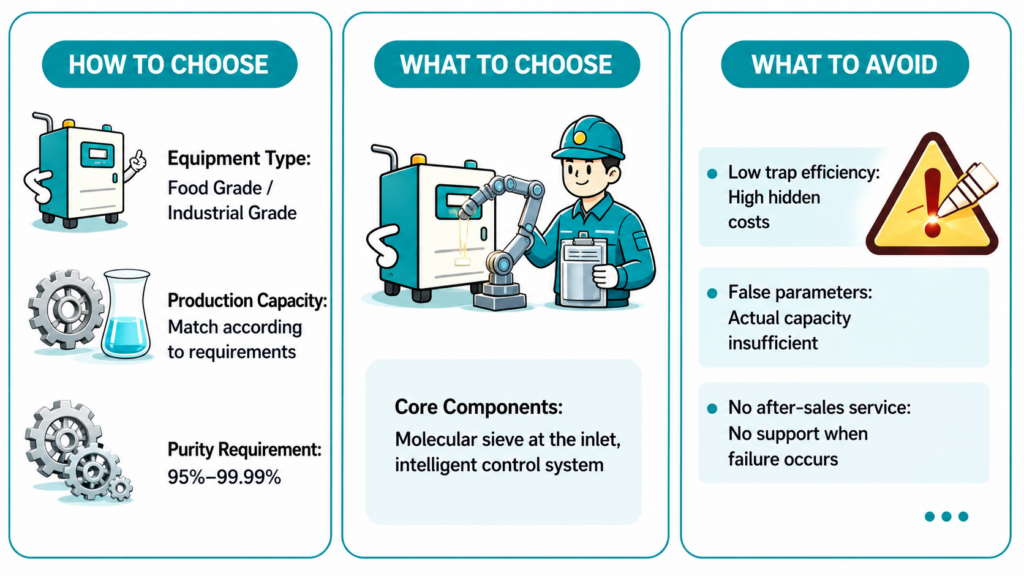
Combining an air compressor with a PSA nitrogen generator is widely used across modern manufacturing plants. However, incorrect system selection can lead to recurring operational problems such as:
- Unstable nitrogen purity
- Insufficient nitrogen flow
- Excessive compressed-air consumption
- Carbon Molecular Sieve deterioration
- Frequent valve or filtration problems
- Higher-than-expected maintenance and operating costs
At first glance, a PSA (Pressure Swing Adsorption) nitrogen generator appears straightforward: compressed air passes through Carbon Molecular Sieve (CMS), which preferentially adsorbs oxygen while nitrogen passes through as product gas.
In real industrial applications, however, small mistakes in purity, flow, pressure, pretreatment, or control configuration can significantly affect long-term performance.
This guide explains the practical selection factors that determine whether a PSA nitrogen generator can provide stable and efficient operation over many years.
Step 1: Define Your Actual Nitrogen Requirements
The first and most important step is understanding the actual process requirement.
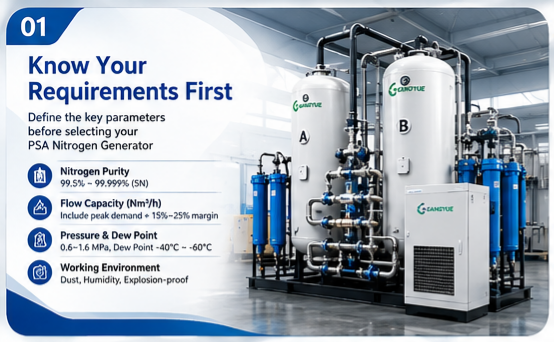
Before selecting a PSA nitrogen generator, clearly define four parameters: purity, flow, pressure/dew point, and operating environment.
1. Determine the Required Nitrogen Purity
Higher purity is not always better.
PSA nitrogen generation becomes more demanding as the required nitrogen purity increases. Specifying a purity level substantially higher than the process actually requires can increase compressed-air consumption and system cost.
Lingyu PSA nitrogen generators are available across a nitrogen purity range of approximately 95% to 99.999%, depending on the configuration.
Purity should therefore be selected according to the process requirement rather than simply choosing the highest available specification.
For example, general purging or storage applications may require substantially less purity than highly moisture- or oxygen-sensitive manufacturing processes.
The basic selection principle is:
Required Process Purity → Select a Generator Capable of Reliably Meeting That Requirement
Avoid unnecessary over-specification while leaving sufficient allowance for the actual process requirement.
2. Calculate Actual Nitrogen Consumption
Nitrogen flow capacity is normally expressed in m³/h or Nm³/h, depending on the manufacturer’s stated reference conditions.
Do not select a generator based only on average consumption.
Consider:
- Normal operating demand
- Peak demand
- Number of simultaneous users
- Production schedule
- Future expansion
- Storage or buffer capacity
A fixed universal oversizing percentage should not be applied to every installation.
Instead, determine the actual peak nitrogen requirement and establish appropriate reserve capacity based on the plant’s load profile.
Oversizing too aggressively can increase capital cost, while undersizing can cause pressure and flow instability during peak demand.
3. Define Required Pressure and Dew Point
Pressure and dew point are frequently overlooked during nitrogen generator selection.
Lingyu PSA nitrogen generator specifications list an inlet compressed-air pressure range of approximately 0.5–0.8 MPa.
The required nitrogen delivery pressure, however, should be determined by downstream equipment and piping requirements.
If the process requires nitrogen at a higher pressure than the PSA generator can economically provide, a nitrogen booster or another pressure solution may be required.
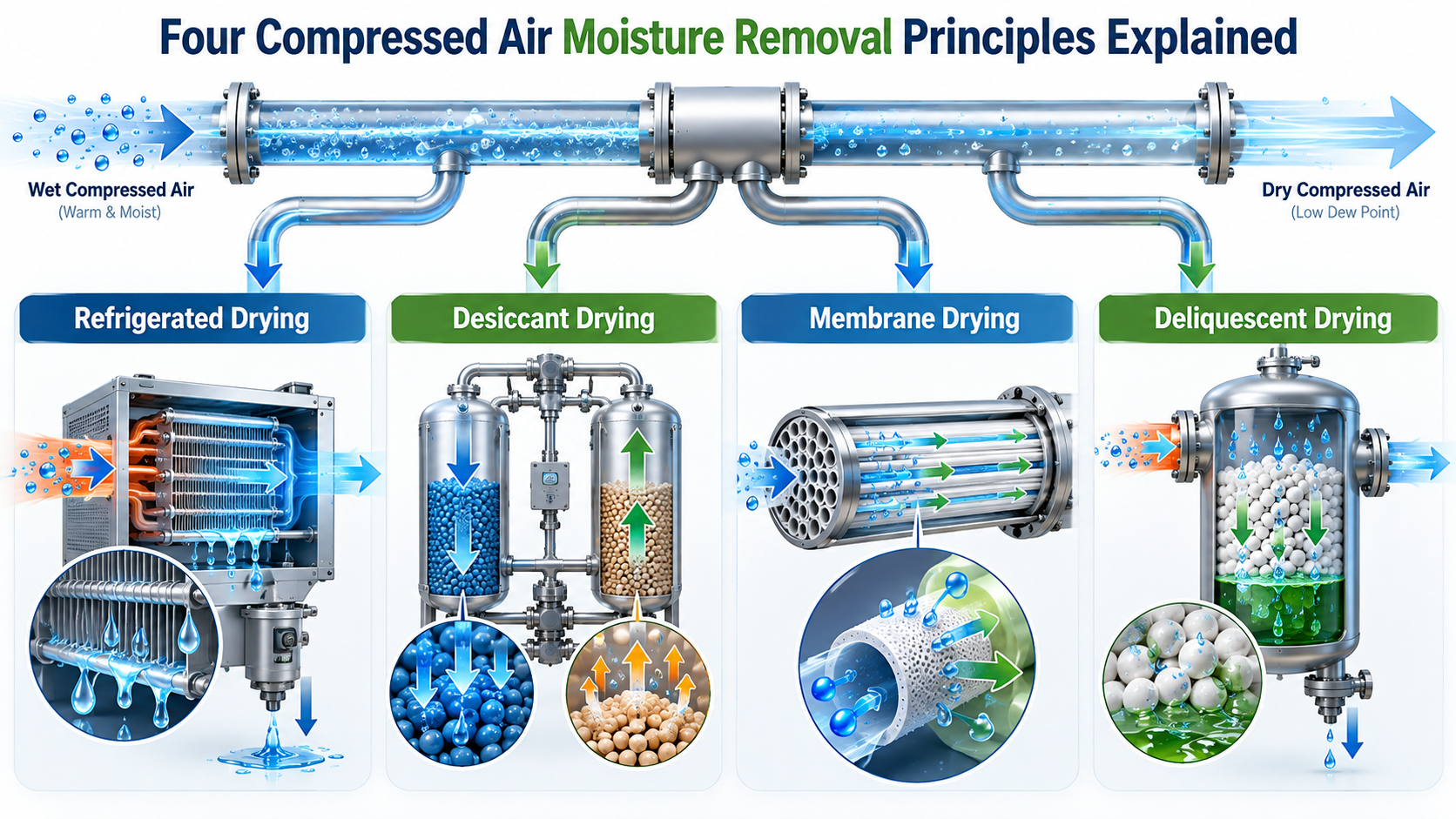
Dew point must also be considered.
Lingyu PSA nitrogen generators are specified with a nitrogen dew point of ≤−40°C under the stated operating conditions.
If a particular process requires substantially drier nitrogen, define that requirement before system selection so that the necessary air treatment or post-treatment configuration can be evaluated.
4. Consider the Operating Environment
The installation environment can affect equipment reliability.
Consider:
- Ambient temperature
- Ventilation
- Dust level
- Humidity
- Corrosive atmosphere
- Indoor or outdoor installation
- Hazardous-area requirements
- Available electrical supply
Lingyu PSA nitrogen generator specifications list an inlet air temperature of ≤40°C and an ambient temperature of ≤40°C for the referenced configuration.
If the system will operate in unusual environmental or hazardous conditions, confirm the electrical, piping, instrumentation, and enclosure requirements specifically for that site.
Step 2: Understand the Five Core Technical Parameters
Marketing descriptions can look similar between suppliers, but long-term performance is strongly influenced by the CMS system, compressed-air consumption, purity monitoring, mechanical structure, and controls.
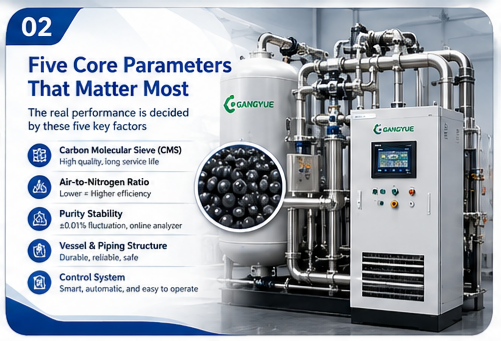
1. Carbon Molecular Sieve: The Heart of a PSA Nitrogen Generator
Carbon Molecular Sieve is the key adsorbent inside a PSA nitrogen generator.
Its function is to preferentially adsorb oxygen from compressed air while allowing nitrogen to pass through the adsorption bed.
During operation, two towers alternate between adsorption and regeneration so that nitrogen can be supplied continuously.
When evaluating the CMS system, important factors include:
- Adsorbent quality
- Filling quantity
- Packing density
- Resistance to movement and powdering
- Vessel filling method
Lingyu PSA nitrogen generators use an automatic CMS compaction system designed to maintain packing density and help reduce CMS pulverization caused by bed movement.
Do not rely on a universal statement such as “CMS always lasts 8–10 years.” Actual service life depends on compressed-air quality, operating conditions, cycling, contamination, and system design.
2. Compressed-Air Consumption
Compressed air is one of the most important operating inputs for a PSA nitrogen generator.
As nitrogen purity increases, the amount of compressed air required to produce a given quantity of product nitrogen may also increase.
Instead of relying on generic industry air-to-nitrogen ratios, compare the supplier’s actual compressed-air consumption data at the required purity and operating conditions.
When comparing systems, evaluate:
Required Nitrogen Flow + Required Purity + Effective Air Consumption
rather than nitrogen output alone.
This provides a more meaningful basis for comparing the operating efficiency of different PSA configurations.
3. Purity Stability and Monitoring
Nominal purity is only useful if the system can maintain the required specification during actual operation.
A suitable industrial PSA nitrogen generator should provide a method for monitoring product-gas quality.
Lingyu PSA nitrogen systems include:
- Real-time nitrogen purity monitoring
- Real-time flow monitoring
- Off-spec nitrogen alarm
- Protective shutdown if the off-spec condition persists
- Digital touchscreen display of key operating parameters
These functions help prevent prolonged delivery of nitrogen that does not meet the required specification.
Do not apply one universal purity-fluctuation limit such as ±0.01% to every application unless that tolerance is specifically required by the process.
4. Adsorption Vessels, Valves, and Piping
The mechanical structure of the PSA system affects switching reliability and long-term operation.
Important components include:
- Adsorption vessels
- Pneumatic switching valves
- Check valves
- Interconnecting piping
- Flow-distribution components
- Pressure-equalization system
Valve reliability is particularly important because PSA operation depends on continuous alternating adsorption and regeneration cycles.
Lingyu PSA systems use PLC-controlled pneumatic valves and an optimized pressure-equalization process between towers.
Mechanical design should therefore be evaluated as part of the complete system rather than focusing only on the CMS specification.
5. Control and Monitoring System
Automatic control is essential for continuous PSA operation.
Lingyu PSA nitrogen generator configurations include:
- Automatic start and stop
- Automatic adsorption/regeneration cycle switching
- PLC-controlled pneumatic valves
- Real-time purity monitoring
- Flow monitoring
- Off-spec alarm and protection
- Digital touchscreen monitoring
The referenced PSA configuration has a switching cycle of approximately 45–60 seconds.
An optimized unequal-pressure equalization process is designed to improve nitrogen recovery and can indirectly reduce overall energy consumption by approximately 5% under the stated design approach.
This should be understood as a feature-specific performance claim rather than a universal energy-saving figure for every PSA installation.
Step 3: Select the PSA Nitrogen Generator According to the Application
Different processes require different combinations of nitrogen purity, flow, pressure, dew point, and filtration.
There is no universal PSA nitrogen generator configuration.
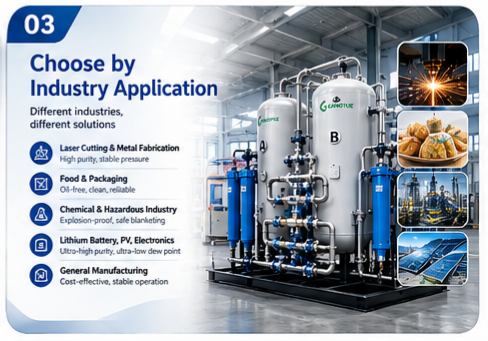
1. Laser Cutting and Metal Fabrication
Important considerations may include:
- Required nitrogen purity
- High instantaneous flow
- Stable delivery pressure
- Buffer capacity
- Booster requirements where higher nitrogen pressure is needed
- Compressed-air quality
The correct purity and pressure should be based on the cutting process, material, thickness, and equipment specification rather than applying one universal value to every laser-cutting application.
2. Food and Packaging
Typical considerations include:
- Required nitrogen purity
- Oil and particle control
- Stable gas supply
- Applicable food-contact or process requirements
The compressed-air treatment system upstream of the PSA generator should be configured according to the required gas quality.
3. Chemical and Process Industries
For applications such as blanketing, purging, or inerting, selection should consider:
- Required oxygen concentration
- Nitrogen flow
- Operating pressure
- Hazardous-area classification
- Materials compatibility
- Safety requirements
Explosion-proof specifications should always follow the actual site classification rather than applying one generic Ex rating to every chemical installation.
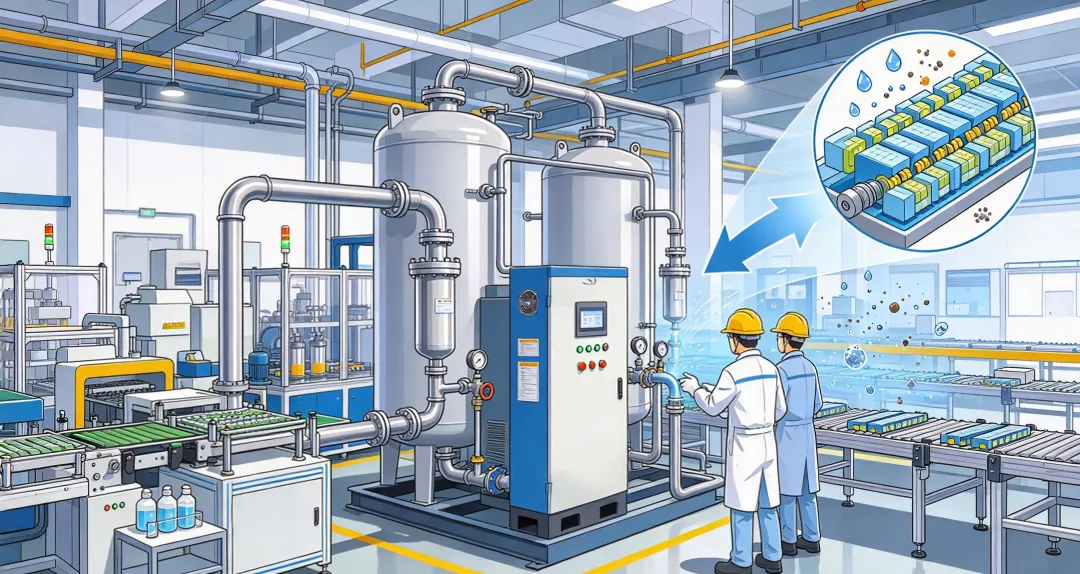
4. Battery, Solar, Pharmaceutical, and Electronics Applications
Moisture- and oxygen-sensitive processes may require higher nitrogen purity and tighter gas-quality control.
Before specifying the generator, define:
- Nitrogen purity
- Dew point
- Particle cleanliness
- Oil content
- Delivery pressure
- Required flow
If the process requirement is more stringent than the standard PSA generator outlet specification, additional purification or drying stages may be required.
5. General Manufacturing
For general purging, inerting, storage protection, or similar industrial uses, avoid unnecessary overconfiguration.
A standard PSA system may be sufficient if it meets the required purity, flow, pressure, and dew point.
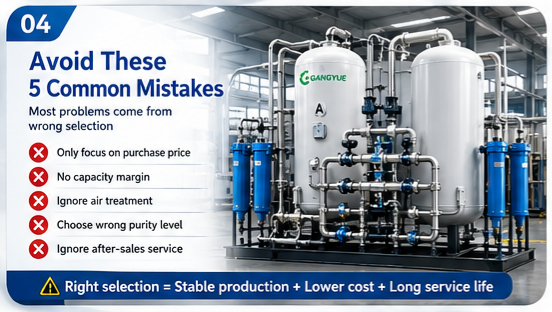
Step 4: Avoid the Five Most Common PSA Nitrogen Generator Selection Mistakes
1. Focusing Only on Purchase Price
A PSA nitrogen generator is a long-term operating system, so purchase price is only one part of the total cost.
Consider:
- Compressed-air energy
- Filter maintenance
- Valve maintenance
- CMS condition
- Spare parts
- Downtime
- Supporting air-treatment equipment
A lower initial price does not necessarily mean a lower lifecycle cost.