Compressed air is an essential utility across modern manufacturing, but untreated compressed air can carry water vapor, liquid condensate, oil contamination, and solid particles. As compressed air moves through a plant and its temperature changes, moisture can condense inside piping, receivers, valves, pneumatic equipment, and process systems.
An industrial air dryer is therefore a key part of a compressed-air treatment system. Its primary purpose is to reduce moisture so that the compressed air can meet the pressure-dew-point requirements of downstream equipment and processes.
However, there is no single industrial dryer technology that is ideal for every application. Refrigerated dryers, regenerative desiccant dryers, blower-heated dryers, Heat of Compression systems, and combined dryers operate differently and provide different dew-point, energy, and installation characteristics.
Lingyu’s compressed-air drying portfolio includes refrigerated dryers, adsorption dryers, and combined dryers, with multiple product families within these groups.
What Is an Industrial Air Dryer?
An industrial air dryer is equipment used to reduce the moisture content of compressed air before that air reaches downstream machinery or production processes.
The appropriate dryer depends primarily on the required pressure dew point (PDP).
For many general industrial applications, refrigerated drying may provide sufficient moisture control. For processes requiring substantially drier compressed air, an adsorption or desiccant dryer may be necessary.
The purpose is not simply to make the air “cleaner.” A dryer specifically addresses moisture. Other contaminants—including oil aerosols, particles, and desiccant dust—may require separators and filters as part of the complete compressed-air purification system.
A dryer alone should therefore not automatically be described as producing oil-free or particle-free compressed air.
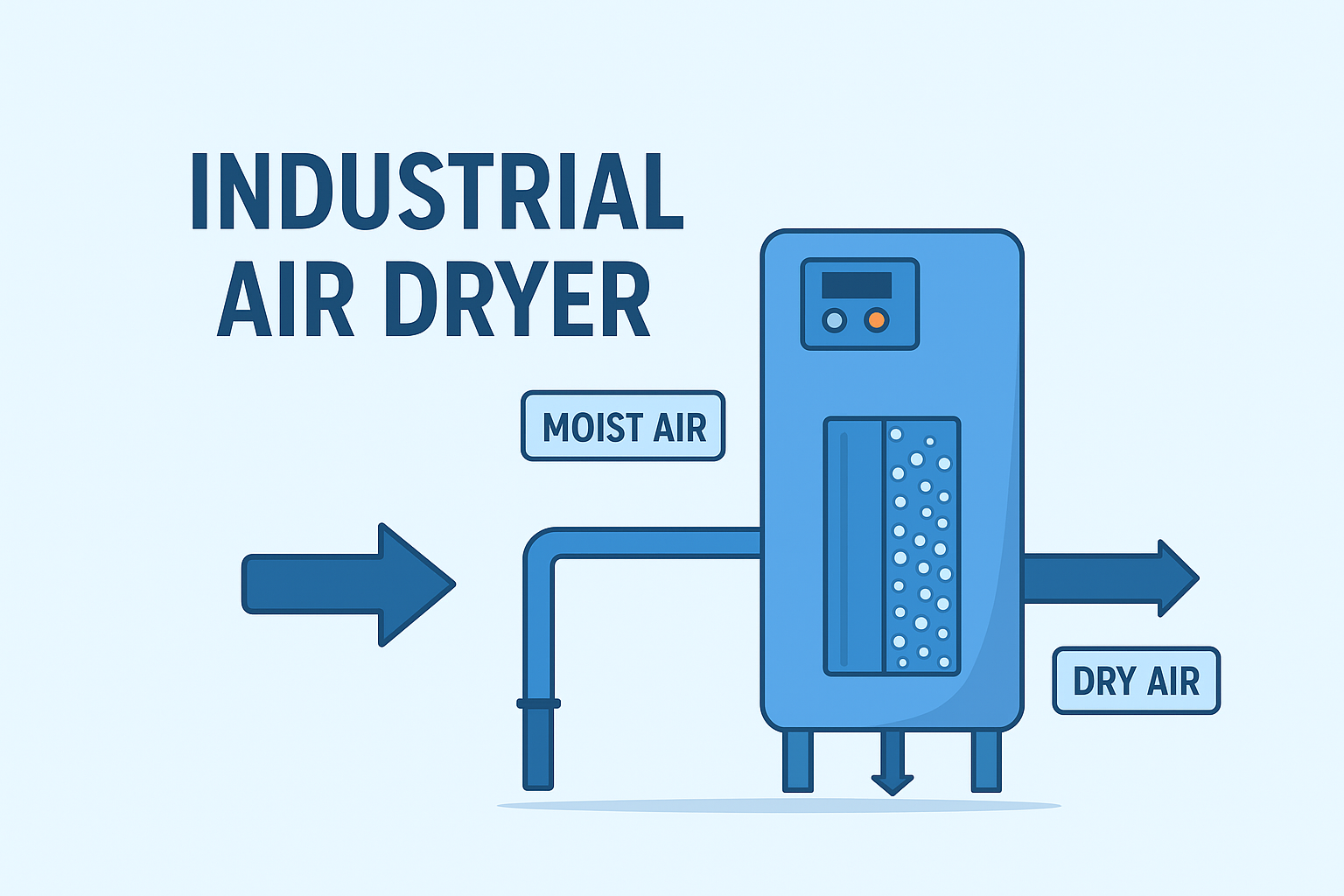
Why Moisture Appears in Compressed-Air Systems
Atmospheric air naturally contains water vapor.
When air is compressed, the amount of moisture contained in each cubic meter of compressed air effectively increases. As the compressed air later cools, it can reach saturation and excess water vapor condenses into liquid.
This condensate can contribute to corrosion, unreliable pneumatic operation, process problems, and product-quality issues.
The role of the dryer is to reduce the moisture content before the air reaches moisture-sensitive parts of the system.
How Does an Industrial Air Dryer Work?
There is no universal drying mechanism.
Industrial compressed-air dryers generally use two major moisture-removal principles.
Refrigeration drying removes water by cooling the compressed air, condensing moisture, mechanically separating the liquid, and draining it.
Adsorption drying passes compressed air through a desiccant bed that adsorbs residual water vapor. The saturated desiccant is then regenerated so it can be reused.
Combined drying uses both principles. Refrigeration removes a large portion of the incoming moisture before the compressed air enters the adsorption stage. In Lingyu’s combined-dryer process, the refrigeration section first reduces the PDP to approximately 2–10°C, followed by oil-removal filtration and deeper adsorption drying.
Refrigerated Industrial Air Dryers
A refrigerated air dryer removes moisture by cooling compressed air.
The typical process is:
Pre-cooling → evaporator cooling → condensation → gas-liquid separation → drainage → reheating
As the compressed air is cooled, water vapor condenses into liquid. A separator removes the condensate, and an automatic drain discharges it from the dryer.
Lingyu’s refrigerated dryer portfolio includes AH air-cooled, WH water-cooled, and several energy-saving refrigerated configurations.
For a detailed explanation of the refrigeration process, see how a refrigerated air dryer works.
Air-Cooled Refrigerated Dryers
An air-cooled refrigerated dryer rejects refrigeration-system heat to ambient air.
This configuration is particularly practical where a separate cooling-water supply is not available or desired.
Lingyu’s AH Series is specified for a 2–10°C PDP, making it relevant for many general manufacturing and plant-air applications.
Facilities specifically considering this configuration can explore the air-cooled refrigerated dryer range.
Water-Cooled Refrigerated Dryers
A water-cooled refrigerated dryer uses cooling water to reject heat from the refrigeration circuit.
This configuration can be appropriate in plants with suitable centralized cooling-water infrastructure or where condenser heat rejection through ambient air is less desirable.
Lingyu’s WH Series provides a 2–10°C PDP and is designed as a water-cooled high-inlet-temperature refrigerated dryer. Its rated inlet temperature is 50°C, with a maximum inlet temperature of ≤80°C.
The corresponding systems are available in Lingyu’s water-cooled refrigerated dryer range.
Desiccant or Adsorption Industrial Air Dryers
When the required pressure dew point is substantially lower than the normal refrigerated-dryer range, adsorption drying becomes more relevant.
A desiccant dryer passes compressed air through an adsorption bed. Water vapor attaches to the desiccant surface and is removed from the air.
Most regenerative industrial adsorption dryers use alternating vessels so that one tower dries the compressed air while the other is regenerated.
Lingyu’s adsorption-dryer families include heatless, heated-purge, modular, blower-assisted, and Heat of Compression technologies.
Heatless Regenerative Dryers
A heatless dryer regenerates the offline desiccant bed using a portion of already dried compressed air.
The basic system is comparatively simple because no regeneration heater is required, but purge-air consumption must be considered in lifecycle cost.
For Lingyu’s conventional CH and HH heatless series, average purge-air consumption is specified at 8–14%.
The CH Series is specified for −50°C to −20°C PDP, while the HH Series is specified at ≤−40°C PDP.
Users considering this regeneration method can review the heatless desiccant dryer range.
Heated-Purge Regenerative Dryers
A heated-purge dryer adds external thermal energy to the regeneration cycle.
Because heat assists desorption, less dry compressed air is generally required for regeneration than in the corresponding conventional heatless design.
Lingyu’s CH and HH heated-purge configurations specify average purge-air consumption of 4–8%.
Facilities evaluating this technology can use the externally heated desiccant dryer range.
Blower-Heated Industrial Air Dryers
A blower-heated regenerative dryer draws ambient air through a blower and heater for regeneration rather than relying primarily on compressed product air.
Lingyu’s HRB-E low-purge configuration specifies 2–3% regeneration-air consumption, while the HRB-Z zero-purge configuration uses closed-loop cooling and specifies approximately 0% compressed regeneration-air consumption.
Zero purge does not mean zero energy consumption. The blower, heater, cooling system, and controls still require energy.
For systems where compressed-air loss is an important economic consideration, see the blower-heated and zero-purge adsorption dryer range.
Heat of Compression Industrial Dryers
Heat of Compression, or HOC, dryers use thermal energy contained in high-temperature compressor discharge air as the primary regeneration heat source.
This can significantly reduce compressed-air regeneration loss when the dryer and compressor system are appropriately matched.
Lingyu’s HOC-Z Series is specified for 0% regeneration-air consumption, with −20°C / −40°C PDP options and an allowable inlet-temperature range of 110–180°C.
Plants evaluating this technology should consider compressor discharge temperature, operating profile, cooling requirements, pressure drop, and system integration rather than judging the dryer only from nominal airflow.
The Heat of Compression dryer range provides the corresponding product-family entry point.
Combined Refrigerated and Adsorption Dryers
A combined dryer uses refrigeration as a first drying stage and adsorption as a second, deeper drying stage.
In Lingyu’s design, wet compressed air is first pre-cooled and then refrigerated to approximately 2–10°C PDP. Much of the moisture condenses and is separated before the air reaches the adsorption system.
This reduces the moisture load placed on the adsorption bed and can reduce regeneration-air demand and extend desiccant service life compared with sending the entire incoming moisture load directly to adsorption.
Combined drying is therefore another industrial option where a low final PDP is required but the inlet moisture load is relatively high.
Refrigerated vs. Desiccant Dryer: Which Is Better?
Neither technology is universally better.
The first question should be: What pressure dew point does the process actually require?
A standard refrigerated dryer is appropriate for many applications where approximately 2–10°C PDP is sufficient.
An adsorption dryer becomes more relevant where substantially lower dew points are necessary.
A plant should not select a −40°C adsorption dryer when a refrigerated dryer fully satisfies the process requirement simply because the lower number sounds better. Likewise, a refrigerated dryer should not be selected for a process that genuinely requires −40°C PDP.
For a broader technology overview, see Lingyu’s compressed air dryer types guide.
Industrial Dryer Dew Point Comparison
| Dryer Technology | Lingyu Reference PDP |
|---|---|
| AH / WH refrigerated | 2–10°C |
| CH heatless | −50°C to −20°C |
| HH heatless | ≤−40°C |
| CH heated purge | −50°C to −20°C |
| HH heated purge | ≤−40°C |
| M modular heatless | ≤−20°C standard, −40°C optional |
| HRB-E / HRB-Z blower heated | −20°C / −40°C optional |
| HOC-E / HOC-Z | −20°C / −40°C optional |
| DC / DH combined | ≤−40°C |
These values illustrate why one generic dew-point specification should not be applied to all industrial desiccant dryers. The appropriate PDP depends on the actual dryer family and process requirement.
Does an Industrial Air Dryer Remove Oil and Particles?
Not necessarily.
Moisture, oil, and particles are separate compressed-air contaminants.
Some refrigeration stages can condense and separate part of the oil and impurities together with water, but this should not be treated as a substitute for properly selected filtration.
Lingyu’s combined-dryer process makes this distinction clear: after the refrigeration stage, compressed air passes through an oil-removal filter before entering adsorption, and a particulate filter is used downstream to remove residual particles and desiccant dust.
Where oil and particle specifications matter, a precision compressed-air filter or another appropriate filtration stage should be selected as part of the complete treatment system.
Why Industrial Air Dryers Matter
The value of a dryer comes from controlling the moisture level required by the process.
Properly selected drying can help reduce condensate-related corrosion, protect pneumatic equipment, improve process stability, and reduce moisture-related quality problems.
The dryer itself should not automatically be treated as a device that increases compressor efficiency. Depending on the technology, a dryer introduces electrical consumption, purge-air consumption, pressure drop, or auxiliary energy.
System efficiency therefore depends on selecting the appropriate drying level and regeneration method rather than simply installing the most sophisticated dryer available.
Pressure Drop and Lifecycle Energy Cost
Dryer operating cost is not determined solely by electrical power.
Pressure drop across the dryer, filters, and treatment system can require the compressor to operate at a higher discharge pressure to maintain the required downstream pressure.
Regenerative dryers may additionally consume compressed purge air, heater power, blower power, or cooling energy.
A useful lifecycle comparison should therefore consider:
Electrical power + purge-air loss + pressure drop + cooling energy + maintenance
rather than dryer purchase price alone.
Where Are Industrial Air Dryers Used?
Almost every industry using compressed air can require some form of moisture control, but the correct dryer varies from process to process.
General Manufacturing and Automotive
Manufacturing plants use compressed air for automation, pneumatic tools, cylinders, actuators, assembly, and production equipment.
For many general pneumatic loads, refrigerated drying may be sufficient. More moisture-sensitive processes may require adsorption drying.
For sector-specific requirements, see Lingyu’s automotive and general manufacturing application.
Food and Beverage
Compressed air may be used in packaging, conveying, pneumatic equipment, and process-control functions.
The required air quality depends on whether compressed air is indirect utility air or has more sensitive process interaction.
A refrigerated or desiccant dryer may be appropriate depending on the required PDP, but the dryer alone should not be described as producing oil-free food-grade air.
See Lingyu’s food and beverage compressed-air application.
Electronics and Precision Manufacturing
Electronics processes can include both ordinary pneumatic loads and highly moisture-sensitive production requirements.
Some may be satisfied by refrigerated drying; others may require −20°C or −40°C PDP.
The correct decision should follow the actual equipment and process specification rather than assuming that an entire industry uses one dryer type.
Pharmaceutical and Chemical Processing
Pharmaceutical, chemical, and petrochemical plants can contain general utility air as well as low-dew-point process and instrument-air systems.
That makes dryer selection particularly application-specific.
Lingyu provides dedicated pharmaceutical and biopharmaceutical application and petrochemical and chemical processing application pages.
How to Select an Industrial Air Dryer
An industrial dryer should be selected from the actual operating conditions rather than nominal compressor capacity alone.
Important variables include required PDP, maximum actual airflow, inlet pressure, inlet temperature, ambient conditions, contamination level, pressure drop, regeneration-air consumption, cooling requirements, annual operating hours, compressor compatibility, and maintenance capability.
A refrigerated dryer can be the most economical solution if a 2–10°C PDP is sufficient.
A heatless dryer may be attractive when simplicity is important and purge-air cost is acceptable. Heated-purge and blower systems reduce purge demand by adding thermal and mechanical regeneration equipment. HOC technology can reduce purge loss further when suitable compression heat is available, while combined drying can reduce the adsorption stage’s incoming moisture load.
Maintenance Depends on Dryer Technology
Maintenance requirements vary substantially by dryer type.
A refrigerated dryer requires attention to heat exchangers, refrigeration compressors, condensers, separators, automatic drains, controls, and refrigerant-system performance.
An adsorption dryer adds desiccant beds, switching valves, purge systems, silencers, heaters, blowers, cooling systems, or HOC-specific components depending on the regeneration method.
Maintenance requirements should therefore follow the actual dryer configuration and measured performance rather than a generic assumption that industrial air dryers require little maintenance.
Conclusion
An industrial air dryer is a compressed-air treatment system designed primarily to control moisture and deliver a pressure dew point appropriate for downstream equipment and processes.
Refrigerated dryers remove moisture through cooling, condensation, separation, and drainage. Desiccant dryers adsorb residual water vapor and regenerate the adsorption bed using dry purge air, external heat, blower air, or compressor heat. Combined dryers use refrigeration to remove the bulk moisture load before deeper adsorption drying.
Lingyu’s product range includes AH and WH refrigerated dryers, energy-saving refrigerated configurations, conventional heatless and heated-purge adsorption dryers, modular heatless dryers, blower-heated systems, HOC dryers, and DC/DH combined systems.
The correct industrial dryer should therefore be selected according to required pressure dew point, airflow, inlet temperature and pressure, site utilities, purge-air consumption, energy use, pressure drop, contamination-control requirements, and lifecycle cost.
The goal is not to choose the dryer with the lowest possible dew point. It is to produce compressed air that is dry enough for the process, reliably and economically.