The hidden cost of excessive compressed air pressure—and how to reduce it without compromising production
When a production line reports insufficient compressed air pressure, the quickest response is often to increase the compressor setpoint.
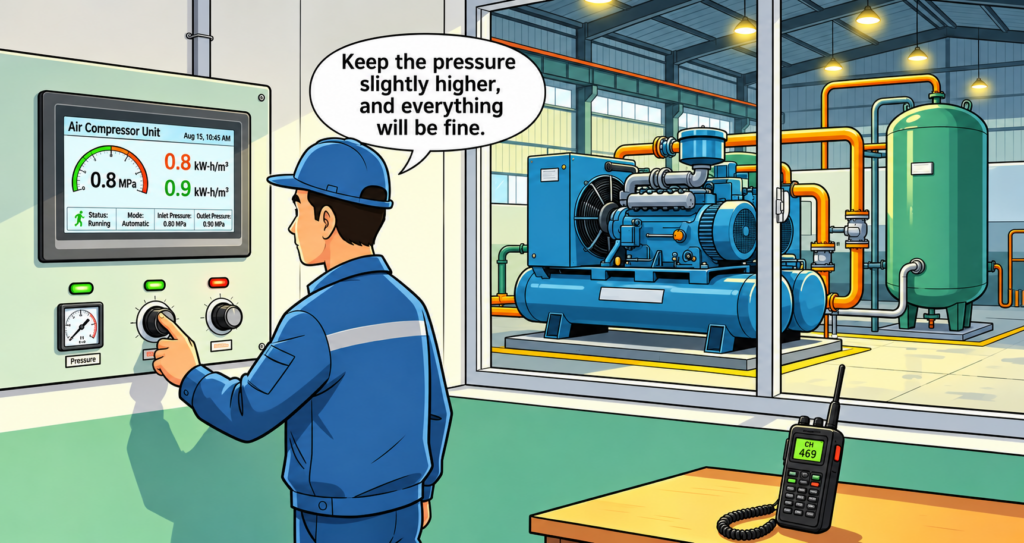
An operator may raise the pressure from 0.8 MPa to 0.9 MPa, expecting pneumatic tools, solenoid valves, and production equipment to operate more reliably.
At first, the adjustment may appear successful. The pressure gauge looks stable, equipment alarms disappear, and production continues.
However, higher compressed air pressure is not always a more reliable or economical solution.
Every unnecessary increase in discharge pressure requires additional compression work. It may also increase air leakage, unregulated air consumption, and the cost of operating a multi-compressor station.
A commonly cited engineering estimate suggests that increasing compressor discharge pressure by 0.1 MPa (approximately 1 bar or 14.5 psi) may increase energy consumption by roughly 6–8% under typical operating conditions.
This is a rule of thumb rather than a universal performance guarantee. Actual results depend on the compressor, operating pressure, load profile, control system, and air demand.
The important question is not simply how much pressure a compressor can produce.
It is how much pressure the factory actually needs—and how much electricity is being spent producing pressure that provides no useful benefit.
1. Does Higher Compressed Air Pressure Really Improve Reliability?
The idea behind increasing pressure is understandable.
Higher pressure can sometimes improve the response of pneumatic actuators, support air tools during demanding operations, or temporarily prevent low-pressure alarms when demand increases.
But that apparent improvement may hide the real problem.
Consider a factory operating with a compressor discharge pressure of 0.8 MPa.
When a production machine occasionally experiences low pressure, the operator increases the compressor setting to 0.9 MPa.
Instead of investigating the cause of the pressure loss, the entire compressed air system now operates at a higher pressure.
Over time, this can become the normal operating condition.
If another pressure complaint occurs, operators may increase the setting again.
Eventually, the plant may be maintaining a discharge pressure significantly higher than its actual production requirements.
Why higher pressure is not the same as better system performance
A compressor room gauge measures pressure at a specific location.
It does not necessarily represent the pressure available at the most demanding or most distant production machine.
Pressure can be lost through:
Air dryers and compressed air filters.
Undersized distribution pipes.
Long flexible hoses and quick-connect fittings.
Partially closed valves.
Air leaks and poor piping connections.
Sudden high-flow demand from production equipment.
Increasing compressor discharge pressure may compensate for these losses, but it does not eliminate them.
A stable compressor room pressure does not guarantee an efficient compressed air distribution system.
2. How Much Energy Does an Extra 0.1 MPa of Compressor Pressure Use?
Compressing air requires electrical energy.
As discharge pressure increases, the compressor generally has to perform more work to deliver compressed air.
For many industrial compressed air systems, a common engineering guideline is:
An increase of 0.1 MPa in compressor discharge pressure may correspond to approximately 6–8% higher energy consumption.
The estimate is useful for identifying potential savings, but should not be treated as a fixed relationship.
Actual energy consumption depends on factors such as:
Compressor type and compression stages.
Compressor performance and efficiency curves.
Operating pressure range.
Inlet air temperature and pressure.
Actual load factor.
Variable-speed or fixed-speed control.
Load/unload operation.
Air leakage and unregulated consumption.
The number of compressors operating together.
For accurate savings calculations, the compressor performance data and measured electrical input should take priority over a generic percentage.
Why compressor nameplate efficiency does not tell the whole story
Compressor efficiency is often evaluated using specific input power.
This is generally expressed as:
Specific Input Power = Electrical Input Power ÷ Delivered Airflow
Common units include kW/(m³/min), with airflow referenced to the applicable test conditions.
A lower specific input power indicates less electrical input is required for a given amount of delivered air.
China’s GB 19153-2019 standard, Minimum Allowable Values of Energy Efficiency and Energy Efficiency Grades for Displacement Air Compressors, uses specific input power within its equipment efficiency assessment framework.
However, a compressor that achieves a favorable efficiency grade under standardized test conditions does not automatically make the entire compressed air station equally efficient under real operating conditions.
If the system operates at excessive pressure, experiences significant pressure drops, or repeatedly loads and unloads compressors, actual station efficiency may be substantially different from the equipment’s rated efficiency.
A high-efficiency compressor is only one part of a high-efficiency compressed air system.
Example: What could a 0.15 MPa pressure reduction save?
Consider a hypothetical industrial air compressor with the following operating data:
| Parameter | Assumed value |
|---|---|
| Average measured electrical input | 75 kW |
| Annual operating hours | 6,000 hours |
| Electricity tariff | $0.10/kWh |
| Baseline annual electricity consumption | 450,000 kWh |
| Baseline annual electricity cost | $45,000 |
The baseline annual electricity cost is:
75 kW × 6,000 hours × $0.10/kWh = $45,000
Now assume that an engineering assessment confirms the plant can reduce compressor discharge pressure by 0.15 MPa while maintaining adequate pressure at every critical point of use.
Using the simplified 6–8% energy change per 0.1 MPa, the estimated energy reduction is approximately 9–12%.
<escape></escape>
| Illustrative result | Estimated range |
|---|---|
| Energy reduction | 9–12% |
| Annual electricity savings | 40,500–54,000 kWh |
| Annual electricity cost savings | $4,050–$5,400 |
These figures are illustrative estimates, not verified project savings.
They assume the engineering rule of thumb remains approximately applicable across the proposed pressure reduction.
In practice, system demand, leakage, compressor control, and part-load performance can cause actual savings to differ.
For a real project, use measured average input power or actual annual energy consumption—not motor nameplate power multiplied by operating hours.
The most reliable way to understand the electricity cost of a compressed air station is to meter it directly.
3. The Hidden Costs of Excessive Compressed Air Pressure
Additional compression work is only the first cost.
Excess pressure can also increase air losses and make poor compressor control more expensive.
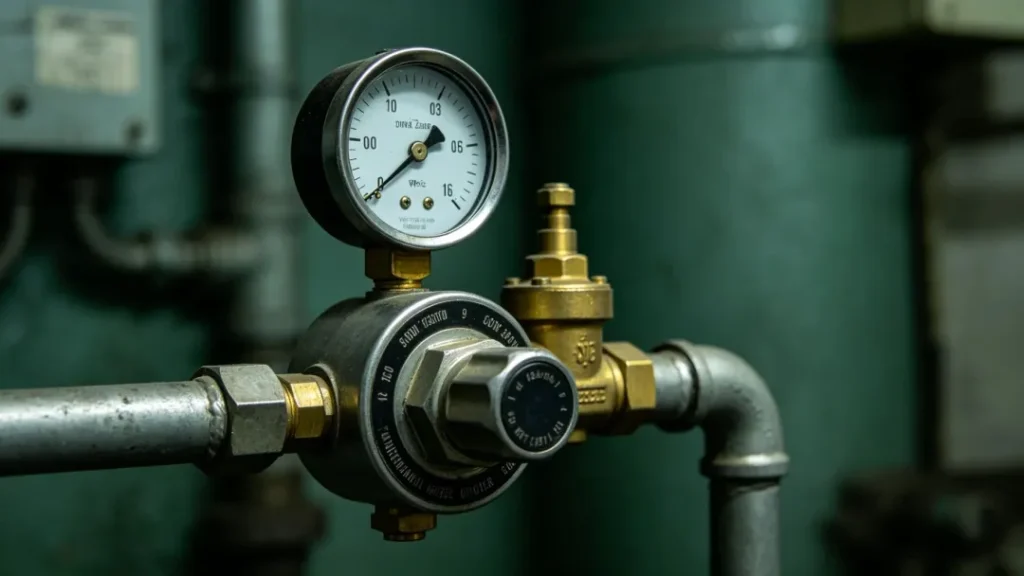
3.1. Higher pressure can increase air leakage and artificial demand
Most industrial compressed air systems develop leaks over time.
Common leakage points include:
Pipe joints and threaded connections.
Flexible hoses.
Quick-connect couplings.
Valve seals and fittings.
Drain assemblies.
Aging pneumatic components.
When the pressure upstream of a leak increases, the amount of escaping air will generally increase for the same opening, subject to the flow conditions.
A system operating at 0.9 MPa may therefore lose more air through existing leaks than the same system operating at 0.7 MPa.
The compressor must replace this escaping air, even though it contributes nothing to production.
Higher pressure can also increase consumption by unregulated air users, such as open blowing and poorly controlled pneumatic applications.
This additional demand is often called artificial demand.
Reducing unnecessary system pressure can help control both leakage-related losses and artificial demand, although the amount saved depends on the system.
For further guidance on locating and managing leaks, read Lingyu’s compressed air leak detection guide.
3.2. Poor compressor sequencing increases operating losses
Compressed air stations frequently operate more than one compressor.
If every compressor uses independent pressure settings without coordinated sequencing, the station may experience:
Repeated loading and unloading.
Unnecessary operation of multiple compressors.
Wide pressure fluctuations.
Excessive compressor cycling.
Poor part-load efficiency.
A compressor in an unloaded state may produce little useful air while still consuming electricity.
The exact unloaded power depends on compressor design and control configuration.
Therefore, effective compressor station management requires more than maintaining sufficient pressure.
It requires matching compressed air supply with actual demand while avoiding unnecessary operation of additional compressors.
Storage capacity, pressure bands, and coordinated compressor controls can all influence system efficiency.
4. Why You Should Measure Pressure Before Lowering the Setpoint
If excessive compressor pressure wastes energy, why not simply lower the setpoint immediately?
Because an uncontrolled pressure reduction could create new production problems.
Critical pneumatic equipment may require a minimum inlet pressure to operate safely and reliably. Some machines also experience short-term peaks in compressed air demand.
Pressure optimization should begin with measurement, not guesswork.
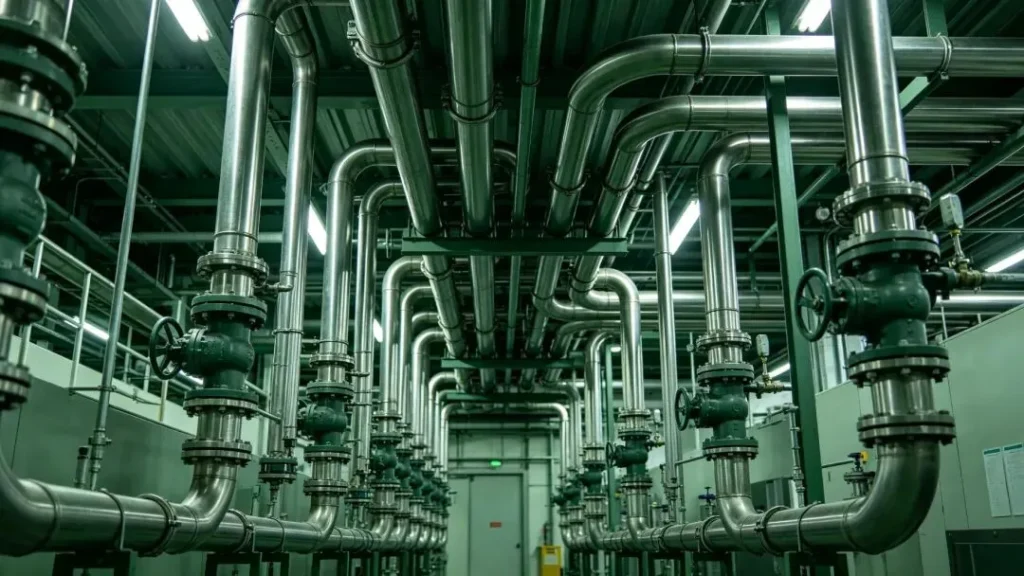
Step 1: Build a complete compressed air pressure profile
Measure pressure from the compressor outlet to the most critical or distant point of use.
A practical pressure profile includes:
Compressor discharge → Air treatment outlet → Main distribution header → Critical point-of-use inlet
For example:
| Measurement point | Illustrative pressure |
|---|---|
| Compressor station discharge | 0.85 MPa |
| Critical point-of-use inlet | 0.65 MPa |
| Total pressure difference | 0.20 MPa |
If the compressor discharge is 0.85 MPa but the most distant machine receives only 0.65 MPa, investigate the 0.20 MPa difference before increasing the compressor setpoint.
Possible causes include an undersized pipe, excessive filter differential pressure, air dryer pressure loss, restrictive fittings, or peak airflow demand.
The individual pressure losses should be measured under representative production loads.
A related Lingyu article explains the engineering causes in more detail: Compressed Air Pressure Drop Explained.
Step 2: Reduce leakage and inappropriate compressed air use
Before lowering the operating pressure, inspect the distribution network for leaks.
An ultrasonic leak detector can help maintenance teams locate leaks that are difficult to hear in a noisy plant.
Document each leak and prioritize those with the greatest estimated air loss.
Also review applications such as open blowing and cooling.
Where technically suitable, a low-pressure blower or another dedicated device may perform the task more efficiently than compressed air.
Lowering unnecessary air demand can make it easier to maintain stable pressure with fewer compressors.
For preventive measures, refer to Lingyu’s compressed air leak prevention guide.
Step 3: Confirm the actual pressure requirement of each critical machine
Different pneumatic applications have different pressure requirements.
Check equipment manuals and process specifications rather than applying one unnecessarily high pressure setting throughout the facility.
For each critical user, identify:
Minimum allowable inlet pressure.
Normal operating pressure.
Maximum permitted pressure.
Peak airflow demand.
Pressure fluctuations during production.
Relevant process and safety requirements.
Particular attention should be given to the small number of machines that require higher pressure than most other users.
If these applications are responsible for the plant’s elevated pressure setting, consider whether local pressure boosting or a separate supply arrangement would be more suitable.
The entire factory should not necessarily operate at higher pressure to satisfy a few specialized machines.
Step 4: Optimize air treatment pressure drop and storage
Compressed air treatment equipment can contribute to pressure loss between the compressor and the distribution network.
Inspect:
Refrigerated and desiccant air dryers.
Precision filters.
Air receivers.
Condensate separators.
Valves, fittings, and connecting pipes.
A clogged filter or poorly selected air treatment component may create unnecessary pressure drop.
Correcting these restrictions can improve downstream pressure without increasing the compressor discharge setpoint.
For systems in which pressure drop through the dryer is a significant concern, Lingyu offers low-pressure-differential refrigerated air dryers designed to reduce flow resistance under the specified operating conditions.
Air receiver storage should also be evaluated.
Appropriate storage and control can help manage short-duration demand peaks, reducing the need to maintain excessive average pressure solely for occasional high-flow events.
Step 5: Reduce compressor pressure gradually and monitor performance
Once the system has been assessed, pressure can be optimized through controlled adjustments.
Do not reduce the setpoint in one large step without confirming the operating margin.
Instead, implement a staged reduction under a documented engineering procedure.
After each adjustment, monitor:
Compressor discharge and header pressures.
Pressure at critical points of use.
Production equipment alarms.
Compressor input power.
Loading and unloading frequency.
Compressor operating combinations.
Airflow demand.
Production quality and process stability.
If production remains stable and the critical machines still receive adequate pressure, the next adjustment can be evaluated.
If the pressure at a critical user falls below its requirement, investigate the restriction or operating condition before proceeding.
The goal is not to make every machine operate at a lower pressure. It is to reduce the pressure the compressors must produce while still meeting every process requirement.
5. Why System-Wide Optimization Delivers More Than Setpoint Changes
Pressure reduction is often one part of a broader compressed air energy-saving program.
A well-designed improvement project may also involve:
Variable-speed compressor operation.
Coordinated compressor sequencing.
Additional air receiver capacity.
Automatic condensate drainage.
Reduced filtration and dryer pressure loss.
Compressed air leak repair.
Heat recovery.
Real-time monitoring and energy management.
An example is the compressed air station improvement initiative reported by CRRC Yangtze Group in China.
According to CRRC’s 2024 ESG Report, the group worked with Qishuyan Institute to develop a Level-1 energy-efficient compressed air station.
The report states annual savings of approximately 1.22 million kWh of electricity, together with reductions equivalent to 150 tonnes of standard coal and 720 tonnes of carbon emissions.
These results were associated with a comprehensive energy-efficiency improvement initiative rather than a simple compressor pressure adjustment.
The example illustrates an important principle:
The largest opportunities often come from optimizing generation, treatment, distribution, control, and end-use demand together.
For operators planning an efficiency project, savings should be evaluated against measured energy consumption rather than inferred from pressure changes alone.
Lingyu’s compressed air system energy-saving acceptance guide explains how to approach savings verification and avoid overstating project results.
6. Five-Point Compressed Air Pressure Optimization Checklist
Before changing an air compressor pressure setting, complete the following checks.
| Check | Recommended action | Why it matters |
|---|---|---|
| 1. Measure the full pressure profile | Record pressure at compressor discharge, treatment outlet, header, and critical users | Identifies where pressure is lost |
| 2. Detect and repair leaks | Use appropriate leak detection methods and prioritize large leaks | Reduces wasted compressed air |
| 3. Verify end-use pressure requirements | Review equipment specifications and identify exceptional high-pressure users | Avoids overpressurizing the entire plant |
| 4. Review compressor controls and storage | Evaluate loading, unloading, sequencing, pressure bands, and receiver capacity | Helps maintain stable pressure efficiently |
| 5. Lower pressure in stages | Track electrical power, airflow, critical pressures, and production performance after each adjustment | Confirms safe operation and measurable savings |
This checklist is intended for engineering assessment and planned maintenance, not uncontrolled adjustment during critical production.
7. How to Verify the Actual Savings from Lower Compressor Pressure
A pressure reduction does not automatically establish an energy saving.
The change should be evaluated through a reliable comparison of baseline and post-adjustment performance.
Establish the baseline
Before modifications, record:
Electricity consumption in kWh.
Average compressor input power in kW.
Delivered airflow.
Compressor discharge and header pressures.
Critical point-of-use pressures.
Production operating hours and load.
Compressor load profiles.
Measure after the adjustment
Repeat the measurements under comparable production conditions.
Where operating demand changes significantly, the analysis should normalize for production volume, airflow demand, or other relevant variables.
The most useful result is not merely a lower discharge pressure reading.
It is a measured reduction in electricity consumption or specific energy use while maintaining the required production performance.
Use actual measured values for savings calculations
A basic calculation is:
Annual Energy Savings (kWh) = Adjusted Baseline Energy − Post-Improvement Energy
Annual Cost Savings = Annual Energy Savings × Applicable Electricity Tariff
For complex compressor stations, additional normalization may be needed to account for seasonal changes, varying production, or changes in compressed air demand.
The 6–8% per 0.1 MPa guideline may help estimate potential opportunities during planning.
However, project acceptance should be based on credible measured results, not a rule-of-thumb percentage.
Conclusion: The Most Expensive Pressure Is the Pressure Your Factory Does Not Need
The hidden cost of compressed air is often not the pressure required by production.
It is the extra pressure added as a precaution without verifying whether it is necessary.
Excess compressor discharge pressure can increase compression energy, leakage, and unregulated compressed air consumption.
But simply lowering the pressure setting is not a complete solution.
An effective optimization program starts by answering three questions:
What minimum inlet pressure do the most critical machines actually require?
How much pressure is being lost between the compressor station and those machines?
How do electricity consumption, airflow, and production performance change when pressure is reduced?
The most efficient compressed air station is not necessarily the one with the lowest pressure setting.
It is the one that supplies only the pressure and airflow the production process needs, with the lowest practical energy consumption and reliable operation.
Improve Compressed Air Efficiency with Lingyu
Lingyu provides industrial compressed air treatment solutions designed to support stable air quality and more efficient operation.
From low-pressure-drop refrigerated air dryers to precision filtration and integrated air treatment equipment, the right system configuration can help reduce avoidable pressure losses.
Explore Lingyu’s compressed air treatment products or contact our technical team to discuss system pressure drop, dryer selection, filtration, and opportunities for more efficient compressed air treatment.