A practical guide to diagnosing vibration, fan noise, refrigeration compressor sounds and installation-related noise in industrial compressed air dryers.
A refrigerated air dryer normally produces some operating noise from its refrigeration compressor, condenser fan and internal refrigerant flow. However, unusually loud humming, rattling, grinding, whistling or knocking may indicate a mechanical, electrical, airflow or refrigeration system problem.
Excessive refrigerated air dryer noise is rarely caused by a single factor. It can result from mechanical vibration, restricted airflow, worn components, abnormal refrigeration conditions or resonance between the dryer and its surrounding structure.
Effective noise reduction starts with a simple principle:
Identify the source first, then address the underlying cause.
Adding sound insulation without determining why the dryer has become noisy may conceal an emerging fault, restrict cooling airflow or create additional maintenance problems.
This guide explains how to recognize common refrigerated air dryer noises, identify likely causes and select appropriate corrective actions.
1. How to Identify the Source of Refrigerated Air Dryer Noise
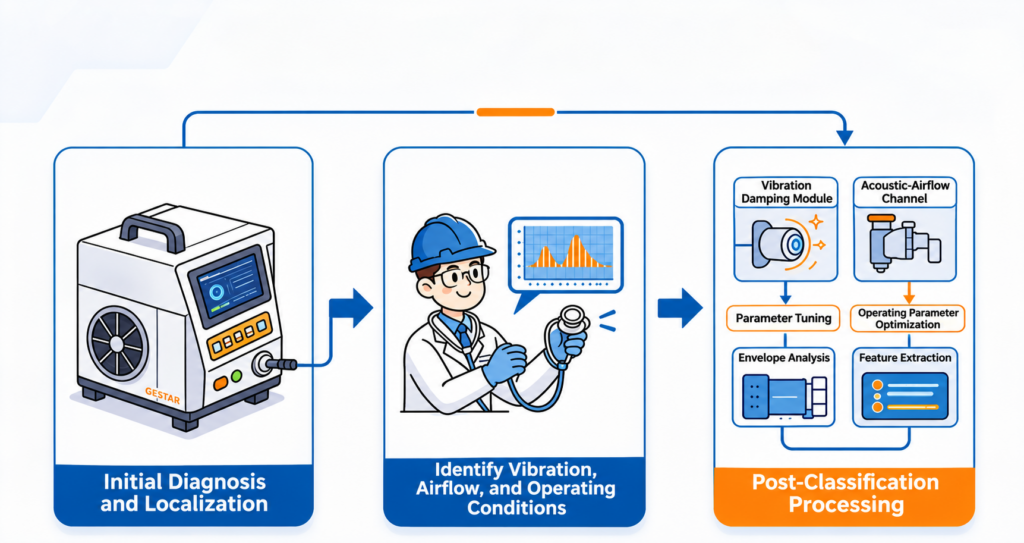
Before attempting repairs, determine when the noise occurs, what it sounds like and which part of the dryer appears to be producing it.
1.1. Identify the noise by its sound and operating pattern
Different noises can provide useful diagnostic clues.
| Noise type | Possible sources | What to investigate |
|---|---|---|
| Low-frequency humming or booming | Refrigeration compressor, mounting base, cabinet resonance | Mounting bolts, vibration isolators and structural contact |
| Metallic rattling | Loose panels, brackets, piping or fasteners | Cabinet fittings, pipe supports and internal clearances |
| Grinding or scraping | Condenser fan, fan motor bearings or blade interference | Fan condition, bearing wear and contact with guards |
| Continuous rushing or whistling | Cooling airflow, compressed air piping or a restricted flow passage | Ventilation openings, piping and flow restrictions |
| Intermittent hissing or gurgling | Refrigerant movement, expansion device or condensate drainage | Refrigeration operating conditions and drain operation |
| Abnormal knocking or banging | Compressor internal fault, severe vibration or possible liquid-related operation | Immediate safety assessment and professional diagnosis |
| Repeated clicking or buzzing | Contactors, relays, fan motors or repeated start attempts | Electrical supply, controls and protective devices |
These sound patterns are preliminary indicators, not definitive fault diagnoses.
For example, refrigerant movement can produce audible flow noise during otherwise normal operation. Conversely, unusually loud metallic knocking may indicate a serious mechanical or refrigeration problem.
1.2. Determine when the noise occurs
Observe whether the noise appears:
Immediately when the dryer starts.
Only while the refrigeration compressor is running.
When the condenser fan begins operating.
During high compressed air demand.
At the moment the condensate drain opens.
After the dryer has been operating for an extended period.
During frequent starts and stops.
This information helps separate normal operating sounds from abnormal conditions.
A fan-related noise may appear only when the condenser fan is energized. A cabinet resonance may become more noticeable at a particular operating speed or load. A brief sound associated with a drain cycle may originate from condensate discharge rather than the refrigeration circuit.
1.3. Check operating conditions before inspecting components
Review the dryer display, controller alarms and operating records.
Important parameters may include:
Compressed air inlet temperature.
Compressed air inlet pressure.
Airflow and system load.
Ambient temperature.
Ventilation conditions.
Refrigeration system operating status.
Pressure dew point, if monitored.
Compressor and fan cycling frequency.
A dryer operating outside its specified temperature, pressure or airflow range may experience additional thermal and mechanical stress.
For a broader understanding of dryer operation and routine care, see Lingyu’s refrigerated compressed air dryer maintenance guide.
Safety precautions before troubleshooting
Operators should observe equipment from designated safe locations without removing guards or reaching into moving components.
Do not touch internal piping, fan blades, compressor housings or electrical components while the equipment is operating.
Before opening panels, tightening internal fasteners, cleaning rotating components or performing maintenance:
Follow the manufacturer’s shutdown procedure.
Isolate electrical power and apply the required lockout/tagout controls.
Isolate and safely release compressed air pressure where necessary.
Allow hot or cold components to reach safe handling temperatures.
Verify that hazardous energy has been controlled before starting work.
Maintenance on the sealed refrigeration circuit or electrical system should be performed only by appropriately qualified personnel.
2. Mechanical Vibration and Loose Components
Mechanical vibration is among the most common causes of excessive refrigerated air dryer noise.
It may appear as low-frequency humming, intermittent rattling or repeated impact sounds.
The underlying problem is often related to equipment mounting, component wear or vibration transmitted through the cabinet and connected piping.
2.1. Inspect the base and mounting structure
A refrigerated air dryer should be installed on a stable, level surface that meets the manufacturer’s requirements.
Over time, vibration can loosen mounting fasteners or cause movement between the equipment frame and its support structure.
After the dryer has been safely isolated, qualified maintenance personnel should inspect:
Anchor bolts and base mounting points.
Refrigeration compressor mounting brackets.
Cabinet supports and access panels.
Rubber mounting elements and vibration isolators.
Signs of cracked brackets or deteriorated supports.
Loose fasteners should be tightened according to the manufacturer’s specifications.
If vibration is being transmitted through a rigid floor or mounting structure, suitable anti-vibration mounts may reduce the transmission of vibration.
However, the isolators must be selected for the equipment’s weight, operating characteristics and installation requirements.
2.2. Check piping supports and mechanical contact
Piping can amplify relatively small vibrations.
If a refrigerant line or compressed air pipe contacts a cabinet panel, another pipe or a rigid support, the resulting vibration may produce rattling or resonant noise.
Inspect the piping layout for:
Loose clamps or supports.
Pipes touching adjacent metal surfaces.
Worn vibration-resistant supports.
Excessive movement at connections.
Contact between tubing and cabinet panels.
Correcting improper contact and securing piping with compatible supports can reduce noise transmission.
Refrigerant tubing must not be bent or repositioned casually. Any adjustment involving the refrigeration circuit requires the appropriate technical assessment.
2.3. Examine fan blades and motor bearings
A damaged or unbalanced condenser fan can cause both mechanical noise and vibration.
Possible causes include:
Dust accumulation on fan blades.
Bent or damaged blades.
Blade contact with the fan guard.
Loose fan mounting hardware.
Worn motor bearings.
Fan motor deterioration.
After safe isolation, inspect and clean accessible components according to the maintenance manual.
If the fan uses serviceable bearings, follow the manufacturer’s lubrication instructions. Many fan motors use sealed bearings that are not intended for routine greasing.
A severely worn bearing or damaged fan should be repaired or replaced with a compatible component.
Do not attempt to rebalance damaged blades through improvised modifications.
3. Condenser Fan Noise and Airflow Restrictions
Fan-related noise often appears as continuous rushing air, high-pitched whistling or mechanical vibration.
The source may be the fan itself, but restrictions around the condenser can also contribute to abnormal operation.
3.1. Maintain adequate ventilation clearance
Air-cooled refrigerated dryers depend on sufficient airflow to reject heat from the refrigeration system.
If the condenser inlet or discharge is obstructed, cooling performance can deteriorate.
Common installation problems include:
Insufficient clearance around ventilation openings.
Dust accumulation on condenser fins.
Hot discharge air recirculating into the intake.
Objects stored near the dryer.
Installation in a poorly ventilated equipment room.
Maintain the clearances specified by the dryer manufacturer.
Do not cover ventilation openings or install sound barriers that restrict the required cooling airflow.
3.2. Clean the condenser and airflow passages
Dust, lint and debris can accumulate on the condenser and fan assembly.
This buildup can reduce heat-transfer performance and may cause unstable operation, increased fan noise or additional refrigeration system stress.
Routine maintenance should include:
Inspecting the condenser surface.
Removing dust using an approved cleaning method.
Checking that ventilation openings remain unobstructed.
Verifying that the fan operates normally.
Examining the fan guard and mounting hardware.
Use cleaning methods that do not damage condenser fins, electrical components or the fan assembly.
The dryer must be shut down and safely isolated before cleaning components that could expose personnel to moving parts or electrical hazards.
3.3. Consider quieter fan solutions only when technically compatible
For some older dryers, replacing a worn fan motor or damaged fan assembly may noticeably reduce noise.
However, replacing the original fan with a slower or smaller-capacity model is not automatically a safe noise-reduction solution.
Insufficient condenser airflow can increase condensing temperature and pressure, reducing cooling performance and potentially damaging the refrigeration system.
Any alternative fan must meet the manufacturer’s requirements for airflow, static pressure, electrical characteristics, speed control and operating environment.
4. Refrigeration Compressor and Refrigerant Flow Noise
The refrigeration system is another major source of operating noise.
A typical refrigerated air dryer uses a refrigeration compressor, condenser, expansion or metering device, evaporator and associated piping.
Some compressor vibration and refrigerant flow noise are normal. The challenge is distinguishing expected operating sounds from those associated with abnormal mechanical or thermodynamic conditions.
For a more detailed explanation of the circuit, see Lingyu’s air dryer refrigeration system guide.
4.1. Diagnose abnormal refrigeration compressor noise
A refrigeration compressor may produce an unusually loud hum, rattle, knocking sound or other abnormal mechanical noise when its operating condition deteriorates.
Possible causes include:
Loose compressor mounting.
Internal bearing or mechanical wear.
Abnormal lubrication conditions.
Excessive operating load.
Electrical supply or start-related problems.
Liquid refrigerant entering the compressor under abnormal conditions.
A sudden increase in knocking, severe vibration or other unusual compressor sounds should be treated seriously.
If these symptoms occur together with protective trips or abnormal operating temperatures, stop the dryer according to the manufacturer’s procedure and arrange a professional inspection.
Do not repeatedly restart a compressor that may be experiencing a serious mechanical or refrigeration fault.
One condition requiring particular attention is liquid refrigerant entering the compressor. This can lead to damaging operation under certain conditions.
Lingyu explains the relevant warning signs in its article on refrigerated air dryer compressor liquid slugging.
4.2. Understand refrigerant flow and expansion device sounds
Refrigerant passes through a metering device, such as a capillary tube or expansion valve, before entering the low-pressure side of the refrigeration system.
During this process, hissing, flowing or occasional gurgling sounds may be audible.
Such sounds do not necessarily indicate a fault.
However, noise that becomes significantly louder, occurs with abnormal cooling performance or is accompanied by repeated protective shutdowns should be investigated.
Potential contributing factors include:
Unstable refrigerant flow.
Improper expansion device operation.
Incorrect sensor or sensing bulb installation, where applicable.
Abnormal refrigeration operating conditions.
Refrigerant charge problems.
Mechanical contact or vibration in refrigerant tubing.
The correct diagnosis requires measurements and comparison with the manufacturer’s service data.
Do not adjust refrigerant charge or expansion valve settings based on sound alone.
4.3. Avoid unapproved modifications to the refrigeration circuit
Adding a buffer tube, silencer or other component to a refrigerant line may appear to be a straightforward noise-control measure.
However, changing the refrigeration circuit can affect pressure losses, refrigerant distribution, oil return and overall system reliability.
Such modifications should only be considered when specifically approved by the equipment manufacturer or qualified refrigeration engineering personnel.
If the noise is associated with refrigerant flow, the first step is to confirm whether the dryer is operating within its specified refrigeration conditions.
4.4. Investigate repeated starting and electrical-related sounds
Repeated clicking, buzzing or unusual noises during startup may point to a control or electrical problem rather than ordinary refrigeration noise.
Potential causes include electrical contactors, motor starting components, power supply abnormalities or control-related cycling.
These conditions should not be diagnosed by opening an energized electrical cabinet.
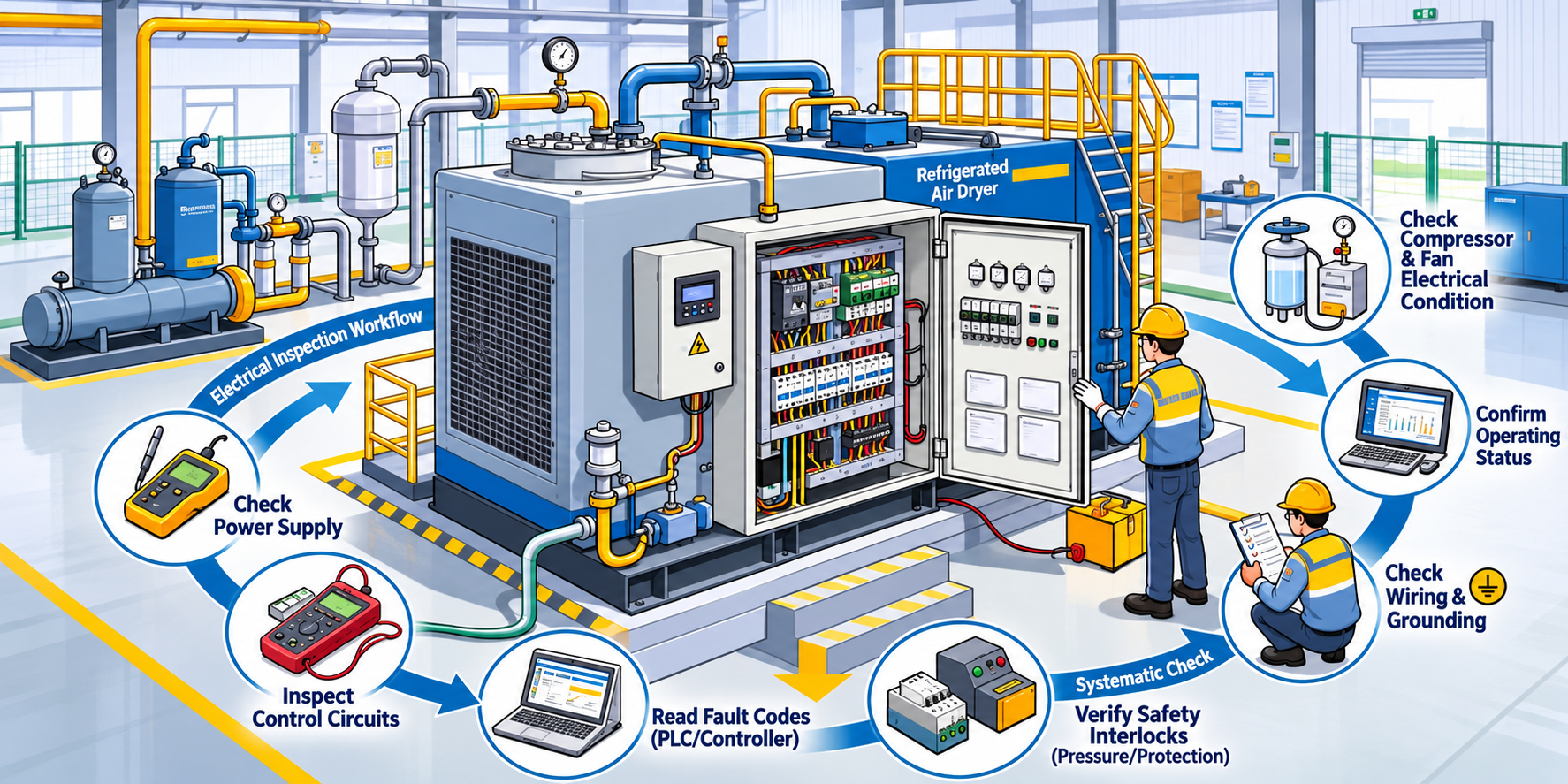
For related guidance, consult Lingyu’s refrigerated air dryer electrical inspection checklist.
5. Environmental Resonance and Noise Transmission
In some installations, the dryer itself may operate within its normal noise range, but its sound becomes more noticeable because of the surrounding environment.
For example, a rigid floor, nearby metal structure or enclosed equipment room can transmit or reflect noise.
5.1. Reduce vibration transmission
If the dryer is installed on a rigid floor or shares supports with other equipment, vibration may be transmitted into the building structure.
Possible measures include:
Manufacturer-approved vibration isolators.
Appropriate base supports.
Properly secured pipework.
Flexible connections where specified by the system design.
Eliminating direct contact between vibrating components and surrounding structures.
Vibration isolation must not compromise equipment stability or the integrity of compressed air and refrigerant connections.
5.2. Improve room acoustics without restricting ventilation
Acoustic panels, suitable sound-absorbing materials and carefully designed equipment-room treatments can help reduce reflected noise.
However, sound-control measures must account for:
Cooling airflow requirements.
Access to maintenance panels.
Electrical safety.
Fire performance of materials.
Condensation and moisture exposure.
Local occupational noise requirements.
Avoid installing ordinary acoustic foam directly against hot equipment, electrical components or ventilation openings.
5.3. Optimize equipment placement
When designing or upgrading an equipment room, consider the distance between the dryer and noise-sensitive areas, such as offices, control rooms and occupied workstations.
A dedicated, properly ventilated mechanical room may reduce noise exposure in adjacent areas.
The installation must still provide sufficient space for service access, airflow and safe operation.
6. Preventive Maintenance to Keep Refrigerated Air Dryer Noise Under Control
The most reliable approach is to identify changes in noise before they develop into major equipment faults.
A preventive maintenance program should focus on equipment condition, cleanliness and operating stability.
Establish routine inspection records
Record:
New or changing operating noises.
Compressor and fan cycling patterns.
Visible cabinet and piping vibration.
Air inlet pressure and temperature.
Ambient temperature.
Dryer operating alarms.
Condensate drainage behavior.
Pressure dew point trends, if available.
Compare these observations against the equipment’s normal operating baseline.
Maintain a clean and suitable operating environment
Keep the equipment room dry, adequately ventilated and free from excessive dust.
Do not block condenser airflow or allow debris to accumulate around the fan.
Inspect external piping supports, ventilation openings and cabinet condition during routine maintenance.
Schedule qualified service when symptoms persist
Persistent abnormal compressor noise, repeated electrical buzzing, severe fan vibration or unexplained refrigeration sounds require a more detailed assessment.
A professional service evaluation may include mechanical inspection, electrical checks and refrigeration performance measurements.
For broader corrective maintenance considerations, refer to Lingyu’s industrial air dryer repair guide.
7. Quick Troubleshooting Checklist for a Noisy Refrigerated Air Dryer
Use the following checklist to organize the initial assessment.
| Inspection | What to check | Recommended response |
|---|---|---|
| Noise location | Compressor, fan, drain, cabinet or piping | Identify the likely source before repairs |
| Operating pattern | Startup, continuous running, fan operation or drain cycle | Compare the sound with equipment activity |
| Mounting and vibration | Loose panels, damaged isolators and pipe contact | Inspect and correct after safe isolation |
| Condenser airflow | Blocked vents, dust, fan condition and room temperature | Restore required ventilation and cleanliness |
| Refrigeration system | Abnormal knocking, changes in cooling performance and alarms | Request qualified refrigeration diagnosis |
| Electrical components | Unusual buzzing, repeated clicking or startup faults | Arrange qualified electrical inspection |
| Installation environment | Structural vibration and reflected noise | Evaluate appropriate acoustic and vibration control |
| Maintenance history | Recent changes, service work or equipment movement | Compare conditions before and after the change |
When should a noisy refrigerated air dryer be shut down?
An abnormal sound does not always require an immediate emergency shutdown.
However, potentially dangerous symptoms such as severe metallic knocking, rapid increases in vibration, smoke, burning odors, repeated protective trips or suspected electrical failure should trigger the site’s established emergency or controlled shutdown procedure.
Do not continue operating equipment with signs of a potentially serious fault merely to maintain production.
8. How to Confirm That Noise Reduction Measures Worked
After the cause has been corrected, assess whether the noise has decreased and whether the dryer is still operating normally.
Where practical, compare the following before and after maintenance:
Sound level at the same measurement location.
Compressor and condenser fan operating status.
Vibration condition.
Ambient temperature.
Dryer operating pressures and temperatures.
Pressure dew point.
Electrical input and cycling behavior.
Equipment alarms.
Sound measurements should be taken at consistent locations and under comparable operating conditions.
A reduction in sound level alone does not prove that the equipment is functioning correctly. Cooling performance, compressed air quality and operating safety must also remain within the applicable specifications.
Conclusion: Effective Refrigerated Air Dryer Noise Reduction Begins With Accurate Diagnosis
Excessive refrigerated air dryer noise should be approached systematically.
Mechanical vibration, loose components, condenser fan problems, abnormal refrigerant flow and unsuitable installation conditions can all contribute to increased noise.
The most effective approach is to:
Identify the noise type and when it occurs.
Check operating conditions and obvious external abnormalities.
Distinguish mechanical, airflow, refrigeration and environmental causes.
Perform appropriate maintenance using safe procedures.
Confirm both noise reduction and normal dryer performance.
The goal is not simply to make the dryer quieter. It is to correct the underlying problem while maintaining reliable refrigeration, stable compressed air quality and long-term equipment performance.
Need Technical Support for Your Refrigerated Air Dryer?
Lingyu provides industrial compressed air treatment equipment, including refrigerated air dryers designed for a range of industrial operating conditions.
If your dryer produces persistent abnormal noise, or if you are evaluating a replacement unit, the correct solution depends on the equipment model, operating conditions and identified fault.
Contact Lingyu’s technical team to discuss refrigerated air dryer specifications, compressed air treatment requirements and equipment selection.