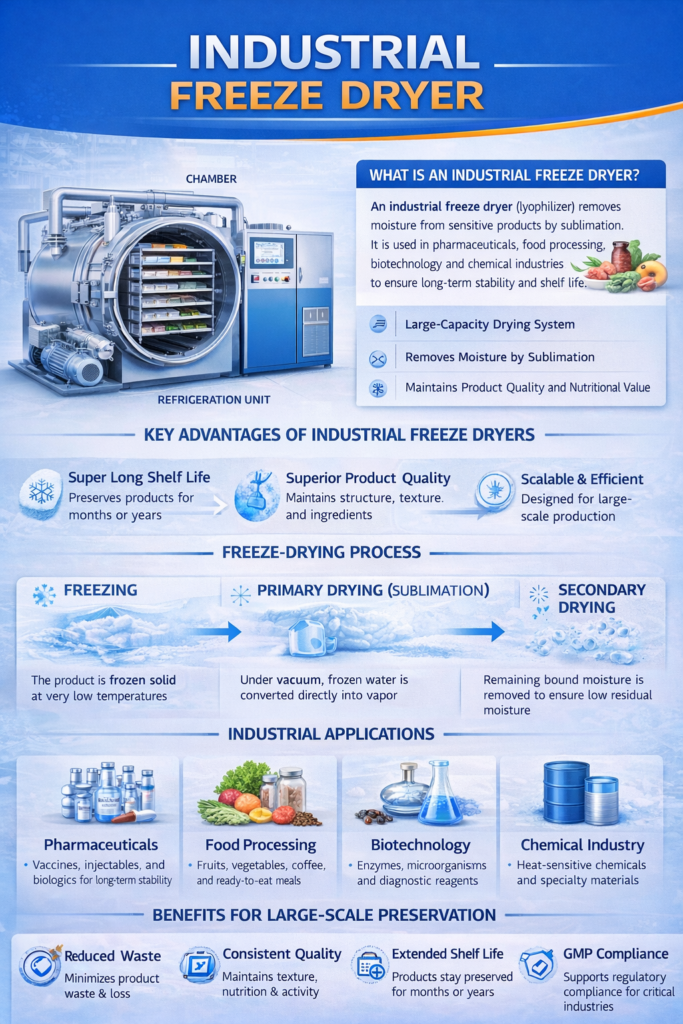
An industrial freeze dryer, also known as an industrial lyophilizer, is a large-scale preservation system used to remove moisture from temperature-sensitive materials through freezing, vacuum, and sublimation. Unlike conventional thermal drying methods, freeze drying removes frozen water without requiring it to pass through a liquid phase, helping preserve the structure and important characteristics of sensitive products.
Industrial freeze-drying technology is widely used in pharmaceutical manufacturing, biotechnology, food processing, laboratory applications, and specialty chemical production. For manufacturers processing high-value or heat-sensitive materials, industrial freeze drying provides a controlled method for achieving low residual moisture while supporting improved product stability and storage.
What Is an Industrial Freeze Dryer?
An industrial freeze dryer is a high-capacity drying system designed to process larger quantities of material under carefully controlled low-temperature and vacuum conditions.
A typical freeze-drying cycle consists of three main stages.
1. Freezing
The material is cooled until its water content becomes solid ice.
Proper control of the freezing stage is important because ice crystal formation can influence subsequent drying behavior and the final physical structure of the product.
2. Primary Drying — Sublimation
After freezing, the chamber pressure is reduced to create vacuum conditions.
Controlled heat is then introduced so that frozen water changes directly from ice into vapor rather than first melting into liquid water. This sublimation stage removes most of the frozen moisture from the product.
3. Secondary Drying — Desorption
After most of the ice has been removed, the process moves into secondary drying.
The temperature is gradually adjusted to remove additional bound moisture remaining in the material. This stage helps the process reach the required final residual moisture level.
Because moisture is removed under controlled low-temperature conditions, freeze drying is particularly valuable for materials that could experience thermal degradation, shrinkage, loss of biological activity, or deterioration in product quality during conventional high-temperature drying.
Key Advantages of Industrial Freeze Dryers
One of the main advantages of industrial freeze drying is its ability to remove moisture while protecting the characteristics of sensitive materials.
High Product Quality
Freeze drying can help maintain the structure, appearance, and important functional characteristics of temperature-sensitive products.
Because the material remains frozen during primary drying, the process can reduce some of the structural changes associated with conventional liquid-phase evaporation.
Extended Storage Stability
Reducing residual moisture can help limit moisture-related deterioration mechanisms.
When freeze drying is combined with appropriate packaging, storage, and handling, it can significantly improve the storage stability of suitable products.
Large-Scale Processing Capability
Industrial freeze dryers are designed for commercial and production-scale batches rather than the relatively small quantities handled by laboratory freeze dryers.
Capacity should still be evaluated according to actual product loading, usable shelf area, condenser performance, cycle time, and production requirements rather than chamber volume alone.
Controlled Process Conditions
Industrial systems can provide control over important process parameters such as:
- Shelf temperature
- Chamber pressure
- Freezing conditions
- Drying time
- Vacuum conditions
- Product loading
- Heating and cooling stages
Accurate process control is particularly important where batch consistency and repeatability are required.
Suitability for High-Value Materials
Freeze drying involves relatively long processing cycles and more complex equipment than many conventional drying methods.
It is therefore particularly suitable for products whose value, sensitivity, stability requirements, or performance requirements justify the additional equipment and operating cost.
Industrial Applications of Freeze-Drying Technology
Industrial freeze dryers are used across several sectors, although equipment configuration and process requirements can vary significantly between applications.
Pharmaceutical and Biopharmaceutical Production
The pharmaceutical sector is one of the most important users of industrial lyophilization.
Freeze drying can be applied to vaccines, injectable products, proteins, biological materials, diagnostic substances, and other formulations that may have limited stability in liquid form.
In addition to the freeze dryer itself, pharmaceutical manufacturing facilities may require carefully controlled utility systems. Depending on the process, clean compressed air and nitrogen can support production, packaging, instrumentation, and other plant operations.
For compressed-air and gas-treatment requirements in these environments, see Lingyu’s pharmaceutical and biopharmaceutical industry solutions.
It is important to distinguish the functions of these systems. A compressed-air dryer removes moisture from compressed air, whereas an industrial freeze dryer removes moisture from the product being preserved.
Food Processing
Industrial freeze dryers are used for products such as fruits, vegetables, coffee, meat products, ingredients, instant foods, and other premium food products.
Freeze drying can help preserve product appearance, flavor, structure, and nutritional characteristics while substantially reducing moisture content.
After processing, suitable packaging remains important because freeze-dried foods can absorb moisture from the surrounding environment.
Food production facilities may also require clean, dry compressed air for processing, pneumatic equipment, and packaging. Lingyu’s food and beverage compressed-air solutions provide information on this supporting plant utility.
Biotechnology, Laboratories, and Life Sciences
Freeze drying is also used in biotechnology and research environments for materials such as enzymes, microorganisms, cultures, reagents, reference materials, and other sensitive biological substances.
Laboratory freeze dryers are generally smaller than industrial production systems, but the fundamental preservation principle is similar.
Scaling a freeze-drying process from laboratory testing to industrial production requires careful consideration of freezing behavior, heat transfer, vacuum performance, product loading, chamber configuration, and cycle reproducibility.
Facilities operating laboratory or analytical equipment may also have specific compressed-air or gas-quality requirements. More information on these supporting utilities is available through Lingyu’s laboratory and analytical equipment applications.
Chemical and Specialty Materials
Freeze drying can also be considered for certain heat-sensitive chemicals, specialty materials, fine powders, and other high-value products that may be damaged by conventional high-temperature drying.
Whether lyophilization is appropriate depends heavily on:
- Material properties
- Solvent system
- Production requirements
- Required residual moisture
- Product sensitivity
- Batch size
- Economic value of the finished product
In a chemical plant, the freeze dryer is only one part of the broader production infrastructure. Clean compressed air, instrument air, nitrogen, and other treated gases may also be required for plant operations.
Lingyu’s petrochemical and chemical processing solutions cover these supporting compressed-air and gas-treatment requirements.
Technical Factors to Consider When Selecting an Industrial Freeze Dryer
Industrial freeze dryer selection should not be based on chamber size alone.
The equipment must be matched to the actual product characteristics, batch requirements, process conditions, and production targets.
Important selection factors include:
- Chamber capacity
- Usable shelf area
- Condenser capacity
- Minimum shelf temperature
- Heating and cooling performance
- Ultimate vacuum level
- Vacuum stability
- Product loading
- Batch cycle time
- Automation level
- Process-data recording
- Energy consumption
- Cleaning requirements
- Production environment
- Maintenance access
- Available utilities
- Future production capacity
For pharmaceutical and other tightly controlled manufacturing environments, sanitary design, cleanability, documentation, validation requirements, and applicable regulatory expectations should also be evaluated.
CIP and SIP Requirements
Clean-in-place (CIP) and sterilize-in-place (SIP) capabilities should not automatically be assumed to be standard on every industrial freeze dryer.
Their availability, design, automation, and validation requirements depend on the specific equipment configuration and intended application.
If CIP or SIP is required, it should be clearly defined during the equipment specification and purchasing stage.
Freeze Dryer vs. Compressed-Air Dryer: What Is the Difference?
The terms can cause confusion because both types of equipment are called dryers, but their functions are fundamentally different.
Industrial Freeze Dryer
An industrial freeze dryer dries the product itself.
The material is frozen, placed under vacuum, and dehydrated through sublimation followed by secondary drying.
Typical targets include pharmaceutical formulations, biological products, food products, laboratory materials, and specialty materials.
Compressed-Air Dryer
A compressed-air dryer removes moisture from compressed air before the air reaches production equipment, pneumatic components, instruments, or manufacturing processes.
Refrigerated air dryers and desiccant air dryers are examples of compressed-air treatment equipment. They are not lyophilizers and do not perform freeze drying on the manufactured product.
This distinction is particularly important in pharmaceutical, food, biotechnology, laboratory, and chemical facilities. A plant may require both an industrial freeze dryer and a compressed-air drying system, but they perform completely different functions.
Supporting Utilities for an Industrial Freeze-Drying Facility
A large industrial freeze-drying installation is rarely an isolated machine.
Depending on the production process, the facility may also require:
- Compressed air
- Cooling water
- Vacuum infrastructure
- Electrical power
- Process gases
- Nitrogen
- Packaging equipment
- Instrumentation
- Control systems
- Downstream product-handling equipment
Each supporting utility should be designed according to its own process requirements.
Compressed-Air Treatment
Compressed-air quality deserves particular attention where air is used for pneumatic equipment, instrumentation, packaging, or other production operations.
Moisture, oil, and solid particles are separate compressed-air contaminants and may require cooling, filtration, drying, separation, and condensate-management equipment.
Where compressed-air drying is required, refrigerated dryers and adsorption dryers should be selected according to actual air flow, pressure, inlet temperature, pressure dew point, contamination limits, and point-of-use requirements.
For a broader overview, see the industrial air dryer systems selection guide.
The compressed-air dryer should be selected according to the required compressed-air quality rather than according to the freeze-drying requirements of the product.
Nitrogen Supply
Nitrogen may also be required for certain manufacturing, inerting, handling, or packaging operations, depending on the process.
When on-site nitrogen generation is appropriate, a PSA nitrogen generator can form part of the plant’s utility infrastructure.
The nitrogen-generation system remains separate from the freeze-drying mechanism. Its capacity, purity, pressure, dew point, and other specifications should be determined from the requirements of the actual nitrogen-consuming process.
How to Choose the Right Industrial Freeze Dryer
Before purchasing an industrial lyophilizer, manufacturers should first define what the equipment must achieve for the actual product.
Important questions include:
- What product or formulation will be processed?
- What is the initial moisture content?
- What final residual moisture is required?
- What is the required batch size?
- What container format will be used?
- How frequently will batches be processed?
- What freezing temperature is required?
- What condenser capacity is needed?
- What vacuum performance is required?
- What is the acceptable cycle duration?
- Which utilities are available?
- What cleaning procedures are required?
- What automation and data-recording functions are needed?
- What maintenance access is necessary?
- Is future capacity expansion expected?
Answering these questions provides a more reliable basis for equipment selection than choosing a system solely from nominal chamber volume.
Why Pilot Testing Matters
Pilot testing can be particularly valuable for products that have not previously been freeze dried at production scale.
A successful laboratory-scale cycle does not automatically guarantee identical industrial-scale performance.
As production volume increases, factors such as product loading, shelf arrangement, chamber geometry, heat transfer, mass transfer, freezing behavior, condenser load, and vacuum performance can change.
Pilot testing and process development can therefore help establish suitable cycle conditions before full-scale production.
Energy Consumption and Total Operating Cost
Industrial freeze drying requires refrigeration, vacuum generation, heating, and process control over relatively long operating cycles.
Energy consumption should therefore be evaluated as part of the total operating cost rather than treated as a secondary equipment specification.
Cycle optimization, equipment capacity, refrigeration performance, vacuum efficiency, product loading, and production scheduling can all influence long-term operating economics.
A system with a lower initial purchase price is not necessarily the lowest-cost solution over its full operating life.
Benefits of Investing in Industrial Freeze-Drying Equipment
For suitable products, industrial freeze drying can provide several long-term manufacturing benefits.
These can include:
- Improved preservation of sensitive materials
- Longer storage stability
- Controlled batch processing
- Reduced dependence on high-temperature drying
- Production of high-value, shelf-stable products
- Better retention of important product characteristics
However, the economic case should be evaluated across the complete production process.
Production capacity, batch cycle time, energy consumption, maintenance, utilities, cleaning, labor, packaging, equipment utilization, and expected product value all contribute to total cost of ownership.
Conclusion
An industrial freeze dryer is a specialized preservation system designed for large-scale processing of temperature-sensitive and high-value materials.
Through controlled freezing, vacuum sublimation, and secondary drying, lyophilization removes moisture while minimizing the thermal stress associated with many conventional drying technologies.
The technology is particularly valuable in pharmaceutical, biotechnology, food, laboratory, and specialty-material applications where product quality, stability, and moisture control are important.
At the same time, an industrial freeze dryer should not be confused with a refrigerated or desiccant compressed-air dryer. Freeze dryers remove moisture from products, while compressed-air dryers condition the air used by industrial equipment and processes.
For facilities building a complete production system, selecting the freeze dryer is therefore only one part of the engineering process. Vacuum equipment, cooling systems, compressed-air treatment, process gases, electrical supply, automation, packaging, and other supporting utilities should be evaluated together to achieve reliable and efficient production.